
AI Bias Statistics 2026
Published November 18, 2026
Our analysts gathered results from eight studies and surveys published from 2018 to 2025, covering more than three million AI resume comparisons, 189 face recognition algorithms, the records of 49,618 hospital patients, 6,000 test mortgage applications, and the views of 5,410 US adults and 1,013 AI experts, to show how often AI systems treat groups of people differently as of Q4 2026.
Key Findings
- In a 2024 University of Washington test of three AI models ranking resumes, the models preferred white-associated names 85% of the time and Black-associated names 9% of the time.2
- Commercial gender classifiers tested in the 2018 Gender Shades study misclassified darker-skinned women up to 34.7% of the time, compared with at most 0.8% for lighter-skinned men.4
- In a 2024 Lehigh University test, GPT-4 Turbo would have required Black mortgage applicants to have credit scores about 120 points higher than white applicants to get the same approval rate.7
- 47% of organizations in a 2025 Accenture and Stanford survey reported a model bias incident in the past two years, and in a 2024 McKinsey survey only 26% said they were actively working to mitigate equity and fairness risks.8
- 55% of US adults and 55% of AI experts said in 2024 that they are highly concerned about bias in decisions made by AI.9
AI bias happens when an AI system gives worse or different results to people because of their race, gender, age, or another trait, usually because the data it learned from reflected unequal treatment in the past. A resume screener trained on past hiring decisions can learn to favor the kinds of names that were hired before, and a face recognition system trained mostly on lighter-skinned faces can make more mistakes on darker-skinned ones. As employers, hospitals, lenders, and police departments rely on these systems for decisions about real people, researchers have started to measure how large the differences are.2,4,6 The results vary by system and by group, but several of them are large.
Our analysts read the published results of academic audits of AI resume screening, face analysis, health care risk scoring, and mortgage underwriting. We added the National Institute of Standards and Technology (NIST) test of face recognition algorithms, a Cornell University study of how employers comply with New York City's bias audit law, the responsible AI chapter of Stanford's 2025 AI Index, and Pew Research Center surveys of US adults and AI experts. All sources were opened on November 18, 2026.
In the following sections, we compare bias in AI hiring tools, error rates in face analysis and face recognition, bias in health care and lending algorithms, how organizations handle bias risk, how Americans and AI experts view AI bias, and how research on AI fairness has grown since 2019.
AI Resume Screeners Preferred White-Associated Names 85% of the Time
Many employers now use AI to sort applicants before a recruiter reads a single resume. To test whether these tools treat candidates differently, researchers keep the resume the same and change only the name at the top, which signals a likely race and gender. We collected the results of the largest such test of AI language models and of a study of New York City's law requiring bias audits of hiring software.
| Measure | Value | Source |
|---|---|---|
| Share of comparisons in which AI models preferred white-associated names | 85% (Black-associated names: 9%) | University of Washington, 2024 |
| Share of comparisons in which AI models preferred male-associated names | 52% (female-associated names: 11%) | University of Washington, 2024 |
| Share of comparisons in which AI models preferred Black female names over Black male names | 67% (Black male names: 15%) | University of Washington, 2024 |
| Comparisons in which Black male names were preferred over white male names | None | University of Washington, 2024 |
| Scale of the University of Washington test | More than 550 resumes, 120 first names, more than 500 job listings in nine occupations, and more than three million comparisons | University of Washington, 2024 |
| Employers checked for compliance with New York City Local Law 144 | 391 | Cornell University and partners, 2024 |
| Employers that posted a bias audit report | 18 of 391 (4.6%) | Cornell University and partners, 2024 |
| Employers that posted a transparency notice to job seekers | 13 of 391 (3.3%) | Cornell University and partners, 2024 |
| Employers with open New York City jobs that posted an audit report | 14 of 267 (5.2%) | Cornell University and partners, 2024 |
Source: AI Services Companies analysis of University of Washington and Null Compliance: NYC Local Law 144 and the Challenges of Algorithm Accountability data, conducted November 2026. Data: ai-resume-screening-name-preference-2024.csv
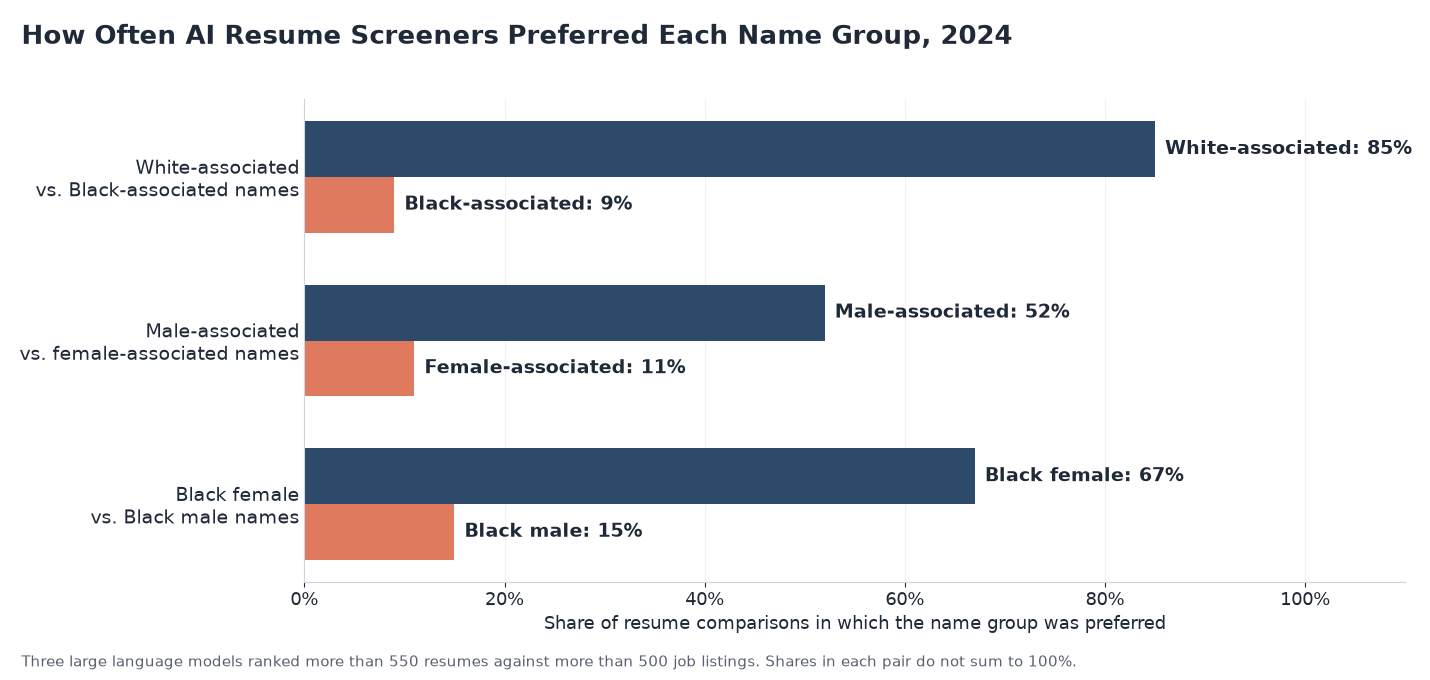
Source: AI Services Companies analysis of University of Washington data, conducted November 2026.
Key Findings
- The three models tested came from Mistral AI, Salesforce, and Contextual AI. The researchers presented the study in October 2024 at the AAAI/ACM Conference on Artificial Intelligence, Ethics, and Society.2
- The bias was not the sum of race and gender effects. The smallest gap was between white female and white male names, while Black male names were never preferred over white male names.2
- New York City has required yearly independent bias audits of automated hiring tools since July 2023. Because employers decide for themselves whether their tools are covered, the Cornell researchers could not tell how many of the 373 employers without a posted audit were breaking the law, and nearly all posted audits reported impact ratios above 0.8, the usual rule of thumb in employment discrimination cases.3
Face Analysis Error Rates Reached 34.7% for Darker-Skinned Women
Face analysis software is used to unlock phones, check passports, and search for suspects in police photo databases. Two studies set the benchmark figures still cited for how its accuracy differs across groups: the 2018 Gender Shades study, which tested commercial tools that guess a person's gender from a photo, and NIST's 2019 test of face recognition algorithms, which match one face to another.
| Measure | Value | Source |
|---|---|---|
| Highest gender classification error rate, darker-skinned women | 34.7% (IBM) | Gender Shades, 2018 |
| Lowest error rate for darker-skinned women among the three classifiers | 20.8% (Microsoft) | Gender Shades, 2018 |
| Highest gender classification error rate, lighter-skinned men | 0.8% (Face++) | Gender Shades, 2018 |
| Overall error rates of the three classifiers | 6.3% (Microsoft), 10.0% (Face++), and 12.1% (IBM) | Gender Shades, 2018 |
| Faces in the Gender Shades benchmark | 1,270 parliamentarians from three African and three European countries | Gender Shades, 2018 |
| Face recognition algorithms tested by NIST | 189 algorithms from 99 developers | NIST, 2019 |
| Photos used in the NIST test | 18.27 million images of 8.49 million people | NIST, 2019 |
| Typical difference in false positive rates between demographic groups | 10 to 100 times, depending on the algorithm | NIST, 2019 |
| Group with the highest false positive rates in one-to-one matching | American Indian | NIST, 2019 |
| Group with higher false positive rates in one-to-many searches of 1.6 million FBI mugshots | African American women | NIST, 2019 |
Source: AI Services Companies analysis of Gender Shades and NIST data, conducted November 2026. Data: gender-classification-error-rates-2018.csv
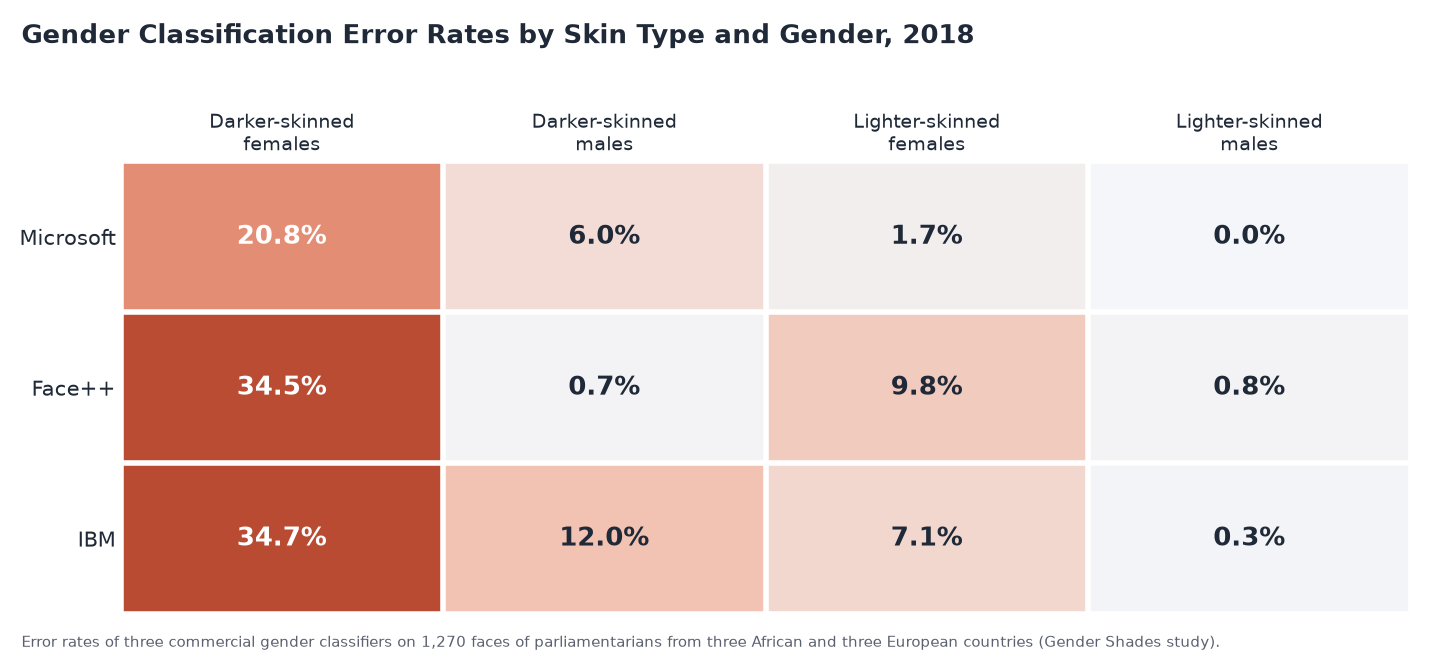
Source: AI Services Companies analysis of Gender Shades data, conducted November 2026.
Key Findings
- All three classifiers in the Gender Shades study made the most errors on darker-skinned women. IBM's error rate for that group, 34.7%, was more than 100 times its 0.3% rate for lighter-skinned men.4
- In NIST's one-to-one tests, US-developed algorithms had similarly high false positive rates for Asian, African American, and Native faces, while some algorithms developed in Asian countries showed no such large gap between Asian and white faces.5
- A false positive in a one-to-many search puts the wrong person on a list of possible matches, which NIST says could lead to false accusations.5
Correcting a Hospital Algorithm Raised Black Patients' Share of Extra Care From 18% to 47%
Hospitals use algorithms to decide which patients get extra care, and lenders are testing AI models to help underwrite loans. In both cases the model can learn bias from the numbers it is given. A hospital algorithm that predicts health care spending, for example, will rank Black patients as healthier than they are if, as the researchers found, less money has been spent on their care in the past. We collected the results of a study of one widely used hospital algorithm and a test of AI models on mortgage applications.
| Measure | Value | Source |
|---|---|---|
| Black patients as a share of those automatically enrolled in extra care, original algorithm | 18% | UC Berkeley and Chicago Booth, 2019 |
| Black patients as a share of those automatically enrolled, after correcting for health differences | 47% | UC Berkeley and Chicago Booth, 2019 |
| Patients in the hospital study | 43,539 white patients and 6,079 Black patients | UC Berkeley and Chicago Booth, 2019 |
| People whose care is influenced by this category of algorithm | Over a hundred million Americans | UC Berkeley and Chicago Booth, 2019 |
| Extra credit score points Black applicants needed for the same approval rate (GPT-4 Turbo) | About 120 points | Lehigh University, 2024 |
| Extra credit score points Black applicants needed for the same interest rate (GPT-4 Turbo) | About 30 points | Lehigh University, 2024 |
| Mortgage applications used in the Lehigh test | 6,000 test applications built from 1,000 real 2022 applications | Lehigh University, 2024 |
| Model with the most discrimination in the Lehigh test | GPT-3.5 Turbo (GPT-4 from 2023 showed virtually none) | Lehigh University, 2024 |
Source: AI Services Companies analysis of UC Berkeley and Lehigh University data, conducted November 2026. Data: health-risk-algorithm-black-patients-enrolled-2019.csv
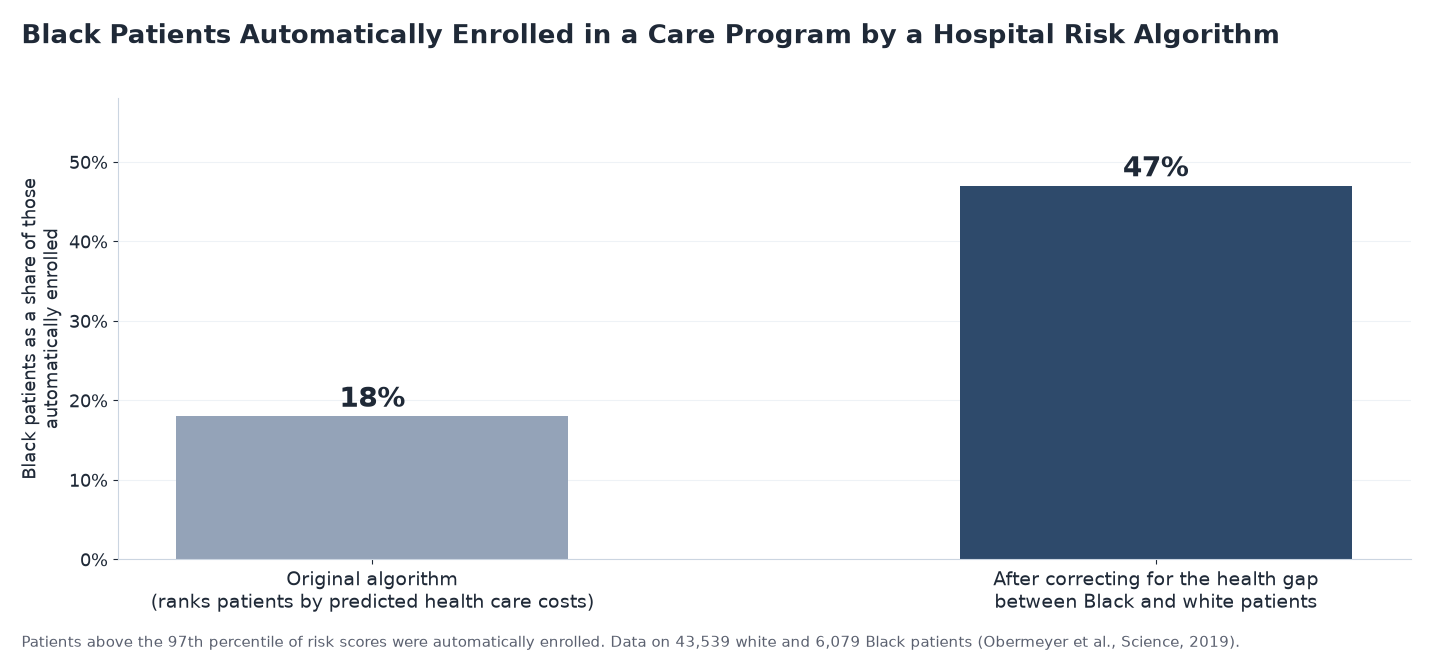
Source: AI Services Companies analysis of UC Berkeley data, conducted November 2026.
Key Findings
- The hospital algorithm was biased because it used health care costs to stand in for health. Black patients at the same level of health generated lower costs, so at the same risk score they were much sicker than white patients.6
- Retraining the algorithm to predict avoidable costs or the number of chronic conditions needing treatment in a year significantly reduced the racial bias, the researchers reported.6
- The Lehigh researchers built their test applications from the 2022 Home Mortgage Disclosure Act data set and changed only race and credit score. They also tested GPT-4, Claude 3 Sonnet and Opus, and Llama 3 models.7
47% of Large Organizations Reported a Model Bias Incident
Companies that build or use AI are the ones expected to catch bias before it reaches customers or job applicants. Two surveys summarized in Stanford's 2025 AI Index show how often organizations run into bias problems and how many are working to prevent them.
| Measure | Value | Source |
|---|---|---|
| Organizations reporting a model bias incident in the past two years | 47% | Accenture and Stanford survey, 2025 |
| Organizations reporting an adversarial attack incident | 56% | Accenture and Stanford survey, 2025 |
| Organizations reporting a privacy violation incident | 55% | Accenture and Stanford survey, 2025 |
| Organizations reporting unintended decision making by AI | 51% | Accenture and Stanford survey, 2025 |
| Organizations in the Accenture and Stanford survey | 1,500 with revenues of at least $500 million, in 20 countries and 19 industries | Accenture and Stanford survey, 2025 |
| Organizations that consider equity and fairness a relevant AI risk | 34% | McKinsey survey, 2024 |
| Organizations actively working to mitigate equity and fairness risks | 26% | McKinsey survey, 2024 |
| Organizations that consider cybersecurity a relevant AI risk | 66% (53% actively mitigating) | McKinsey survey, 2024 |
Source: AI Services Companies analysis of Stanford AI Index 2025, Chapter 3: Responsible AI data, conducted November 2026. Data: ai-risks-relevant-vs-mitigated-2024.csv
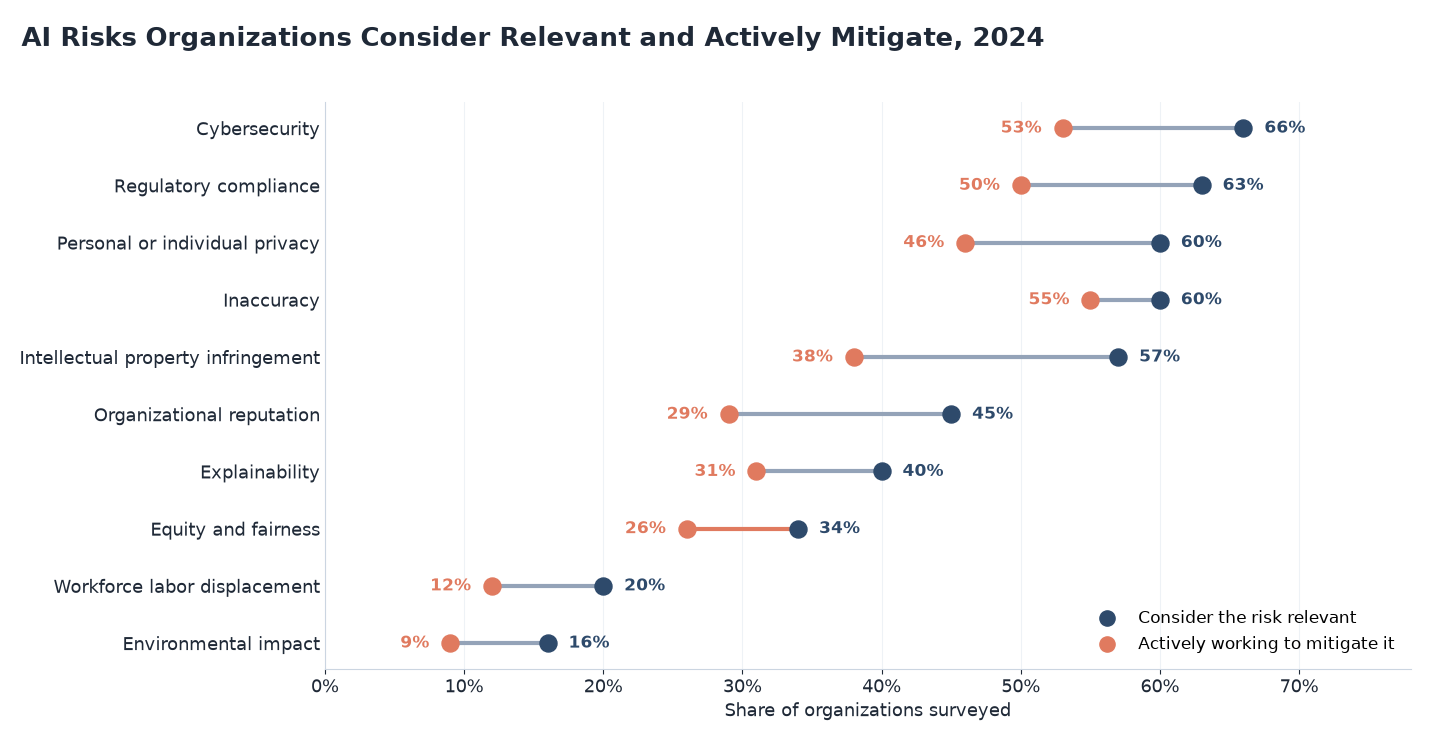
Source: AI Services Companies analysis of McKinsey data published in the Stanford AI Index 2025, conducted November 2026.
Key Findings
- Equity and fairness ranked eighth of the 13 AI risks in the McKinsey survey, below cybersecurity, regulatory compliance, privacy, inaccuracy, intellectual property, reputation, and explainability.8
- In every risk category, fewer organizations were working to mitigate the risk than said it was relevant to them.8
- Model bias was the fourth most common incident type in the Accenture and Stanford survey, after adversarial attacks, privacy violations, and unintended decision making, and ahead of performance failures at 46%.8
55% of Americans and AI Experts Are Highly Concerned About AI Bias
Pew Research Center asked the same questions of a national sample of US adults and of AI experts who wrote for or presented at AI conferences. On most questions the two groups disagree, with experts far more optimistic. Bias in decisions made by AI is one of the few concerns the two groups share in equal measure.
| Measure | US adults | AI experts |
|---|---|---|
| Highly concerned about bias in decisions made by AI | 55% | 55% |
| Highly concerned about people getting inaccurate information from AI | 66% | 70% |
| Want more control over how AI is used in their lives | 55% | 57% |
| Little or no confidence in US companies to develop and use AI responsibly | 59% | 55% |
| Say people who design AI take men's perspectives into account at least somewhat well | Not reported | 75% |
| Say people who design AI take women's perspectives into account at least somewhat well | Not reported | 44% |
| Say the perspectives of White adults are well represented in AI design | Four in ten | About three-quarters |
| Survey sample and dates | 5,410 adults, August 12 to 18, 2024 | 1,013 experts, August 14 to October 31, 2024 |
Source: AI Services Companies analysis of Pew Research Center data, conducted November 2026. Data: ai-bias-concern-public-vs-experts-2024.csv
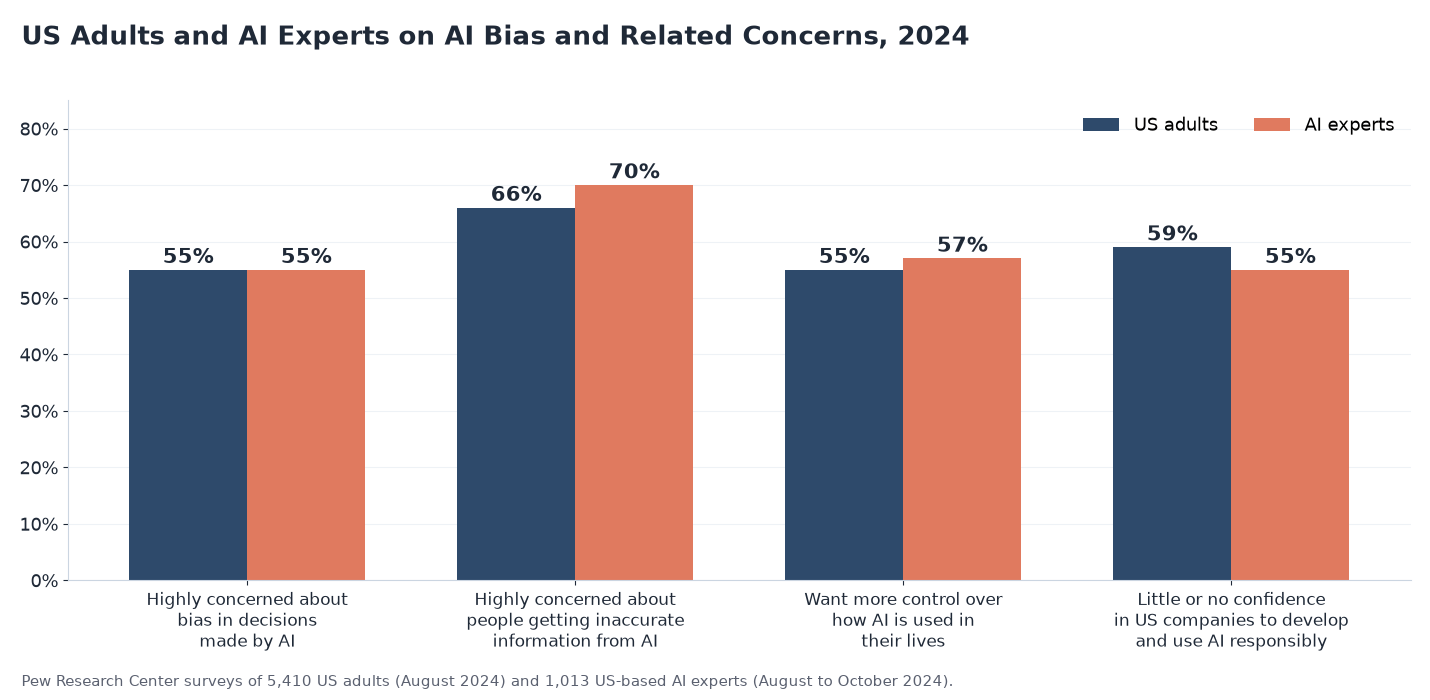
Source: AI Services Companies analysis of Pew Research Center data, conducted November 2026.
Key Findings
- Experts were far more likely than the public to expect AI to have a positive effect on the United States over the next 20 years, 56% compared with 17%, yet both groups were equally concerned about bias.9
- Among the public, a quarter or fewer said the perspectives of Asian, Black, or Hispanic adults are well represented in AI design, and about four in ten or more were unsure.9
- Pew did not receive enough responses from Hispanic or Black AI experts to report expert views by race and ethnicity.9
AI Fairness and Bias Research Doubled in 2024
Researchers are publishing far more work on measuring and reducing AI bias, and newer studies test the large language and image models behind today's chatbots. We tracked the number of fairness and bias papers accepted at six leading AI conferences, as counted by Stanford's AI Index, along with the main findings it highlighted on bias in recent models.
| Measure | Value | Source |
|---|---|---|
| Fairness and bias papers accepted at six leading AI conferences, 2019 | 57 | Stanford AI Index, 2025 |
| Fairness and bias papers accepted, 2023 | 212 | Stanford AI Index, 2025 |
| Fairness and bias papers accepted, 2024 | 408 | Stanford AI Index, 2025 |
| All responsible AI papers accepted at the same conferences | 992 in 2023 and 1,278 in 2024 (up 28.8%) | Stanford AI Index, 2025 |
| Language models tested for implicit bias across 21 stereotype categories | 8, including GPT-4 and Claude 3 Sonnet | Stanford AI Index, 2025, citing Bai et al., 2024 |
| Increase in the likelihood of Black and Latino men being classified as criminals as training data grew from 400 million to 2 billion images | Up to 69% | Stanford AI Index, 2025, citing Birhane et al., 2024 |
| Vision-language models evaluated in that study | 14 | Stanford AI Index, 2025, citing Birhane et al., 2024 |
Source: AI Services Companies analysis of Stanford AI Index 2025, Chapter 3: Responsible AI data, conducted November 2026. Data: ai-fairness-bias-papers-2019-2024.csv
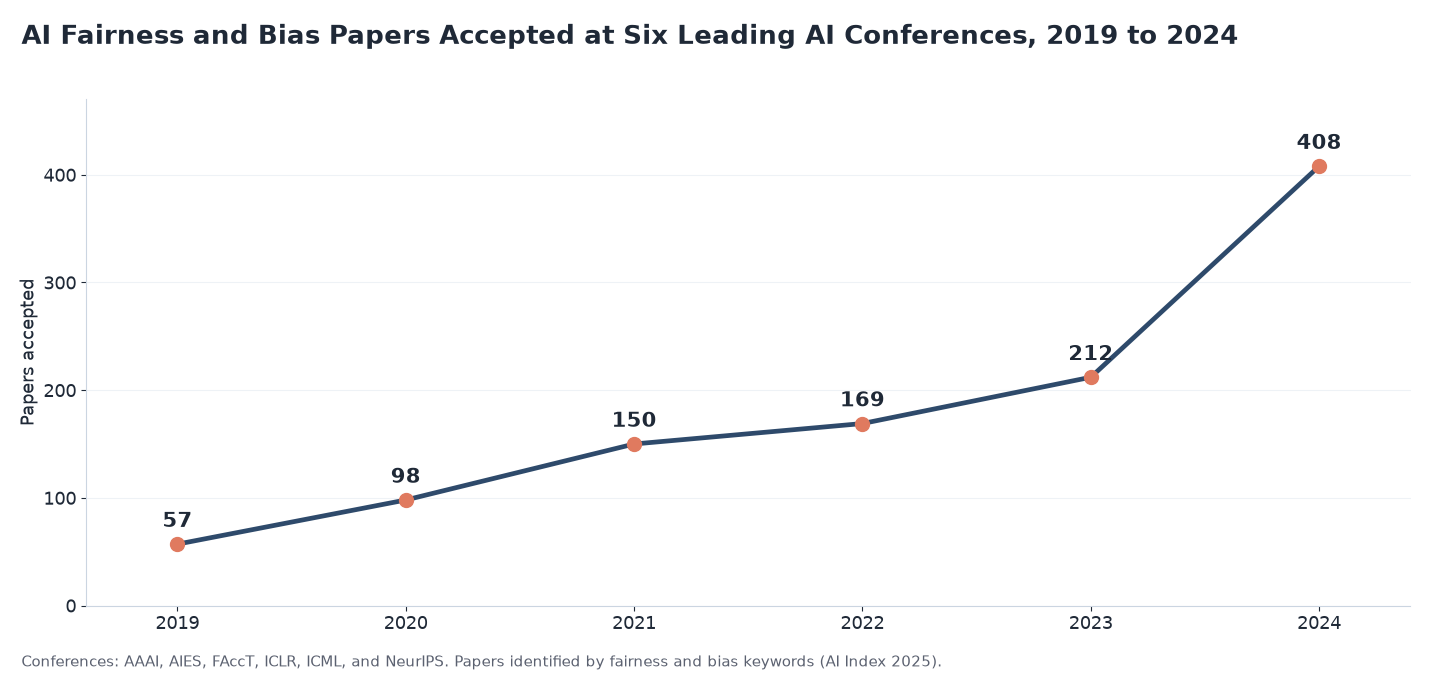
Source: AI Services Companies analysis of Stanford AI Index data, conducted November 2026.
Key Findings
- Fairness and bias papers grew more than sevenfold from 2019 to 2024, from 57 to 408, and the 2024 count was nearly twice the 2023 count.8
- Models trained to avoid explicit bias, including GPT-4 and Claude 3 Sonnet, still associated negative terms with Black people more often, linked women with the humanities more than with science fields, and favored men for leadership roles, the AI Index reported.8
- The same research found that implicit bias increased as language models grew larger, even as bias scores on standard benchmarks improved.8
What AI Bias Statistics Show Going Into 2027
The measured gaps are often large. AI resume screeners preferred white-associated names nine times as often as Black-associated names, and a face analysis tool erred on darker-skinned women more than 100 times as often as on lighter-skinned men.1,2,4 Several studies also show that the gaps can shrink: the corrected hospital algorithm more than doubled Black patients' share of extra care, and in the Lehigh test GPT-4 from 2023 showed virtually no lending discrimination.
Most of these figures come from researchers testing systems from the outside, because few companies publish their own bias results. Even New York City's audit law, the first of its kind, produced posted audits from fewer than 5% of the employers checked.
So if you cite an AI bias statistic, name the system or model tested, the groups compared, the year, and the measure used, because a 2018 error rate for a gender classifier and a 2024 preference rate for a resume screener describe different systems and different kinds of harm.
Data Collection and Methodology
We collected figures from published studies, official test reports, and surveys, opened on November 18, 2026. Hiring figures come from the University of Washington's October 2024 summary of its resume screening study and from the study by Cornell University, the Data and Society Research Institute, and Consumer Reports of New York City Local Law 144, in which 155 student investigators checked 391 employers from October 24 to November 9, 2023. Face analysis figures come from the main results table of the Gender Shades paper by Joy Buolamwini and Timnit Gebru (2018) and from NIST's December 2019 summary of its Face Recognition Vendor Test, Part 3: Demographic Effects (NISTIR 8280). Health care figures come from UC Berkeley's summary of the study by Obermeyer and colleagues published in Science in October 2019, and lending figures from Lehigh University's August 2024 summary of its mortgage underwriting experiment.
Organizational survey figures, the count of fairness and bias papers, and the findings on implicit bias and image model bias come from Chapter 3 of Stanford's 2025 AI Index, which reports the McKinsey and Accenture and Stanford surveys and summarizes the Bai et al. and Birhane et al. studies. Paper counts for 2019 to 2024 were read from the labeled totals in the AI Index chart of fairness and bias papers at AAAI, AIES, FAccT, ICLR, ICML, and NeurIPS. Public and expert opinion figures come from Pew Research Center's April 2025 report on surveys conducted in 2024. Shares such as 18 of 391 employers (4.6%) and the 373 employers without a posted audit are our own arithmetic from the published counts. No figures in this article are estimates.
Sources (9)
- AI Services Companies analysis of AI bias studies, test reports, and surveys from the University of Washington, Cornell University, Gender Shades, NIST, UC Berkeley, Lehigh University, Stanford AI Index, and Pew Research Center, 2018 to 2025, conducted November 2026.
- University of Washington, AI tools show biases in ranking job applicants' names according to perceived race and gender (October 31, 2024)
- Lucas Wright and colleagues, Null Compliance: NYC Local Law 144 and the Challenges of Algorithm Accountability (FAccT 2024)
- Joy Buolamwini and Timnit Gebru, Gender Shades: Intersectional Accuracy Disparities in Commercial Gender Classification (2018)
- National Institute of Standards and Technology, NIST Study Evaluates Effects of Race, Age, Sex on Face Recognition Software (December 19, 2019)
- UC Berkeley, Widely used health care prediction algorithm biased against Black people (October 24, 2019)
- Lehigh University, AI Exhibits Racial Bias in Mortgage Underwriting Decisions (August 20, 2024)
- Stanford Institute for Human-Centered AI, AI Index Report 2025, Chapter 3: Responsible AI
- Pew Research Center, How the U.S. Public and AI Experts View Artificial Intelligence (April 3, 2025)