
AI Customer Service Statistics 2026
Published November 16, 2026
Our analysts compiled figures on AI in customer service from Gartner's surveys of customers and service leaders, Salesforce's State of Service report, Zendesk's CX Trends report, Intercom's published resolution rates for its Fin AI agent, Klarna's disclosures about its AI assistant, and the National Bureau of Economic Research study of 5,179 support agents, to show how far AI has gone in customer support as of Q4 2026.
Key Findings
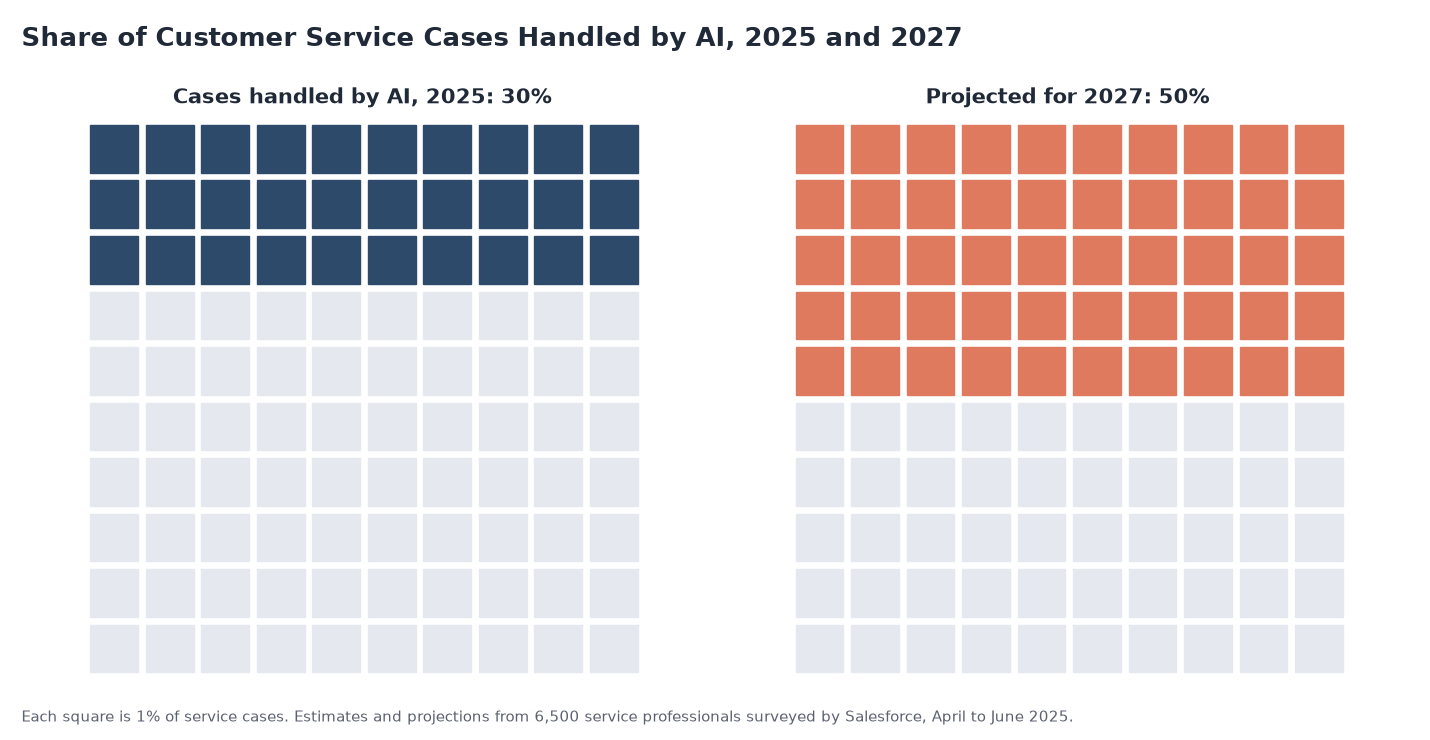
- Service teams estimate that AI handles 30% of customer service cases today and project 50% by 2027, according to a Salesforce survey of 6,500 service professionals.6
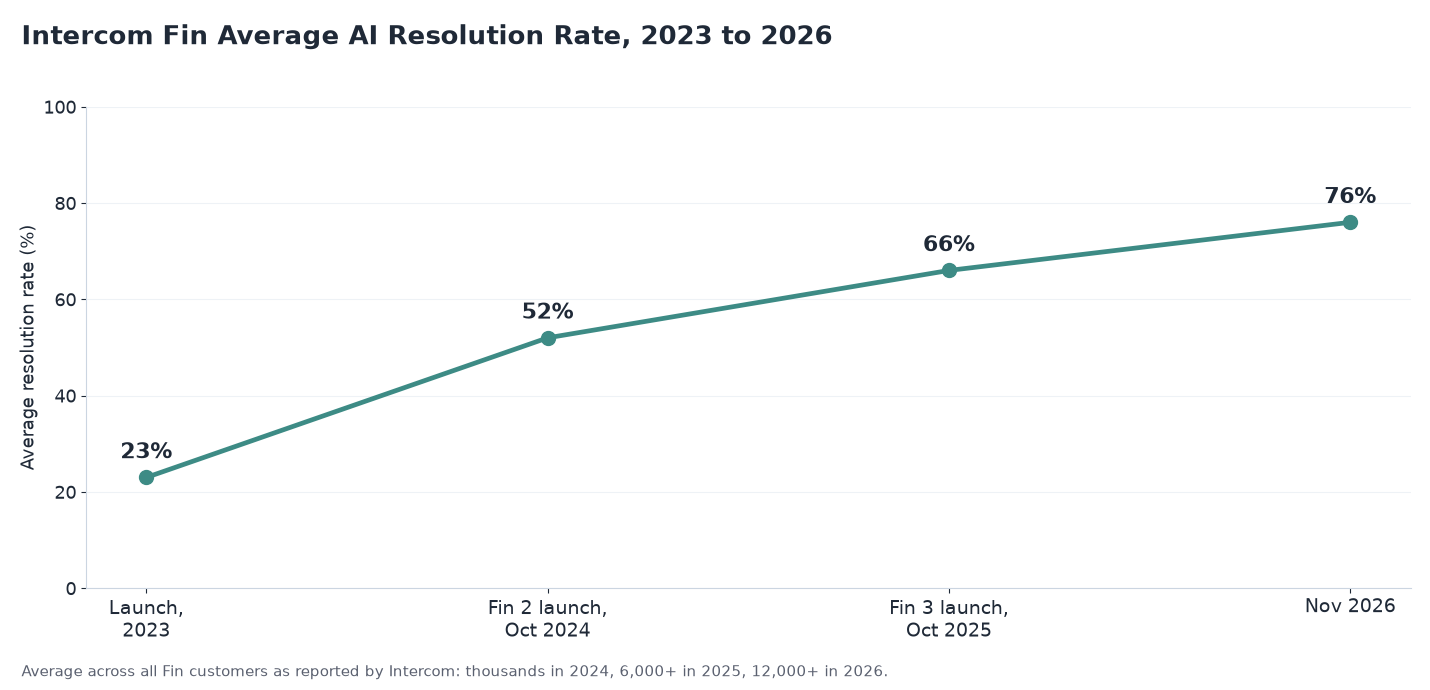
- Intercom says its Fin AI agent resolves an average of 76% of conversations across more than 12,000 customers, up from 23% at launch in 2023.8,9
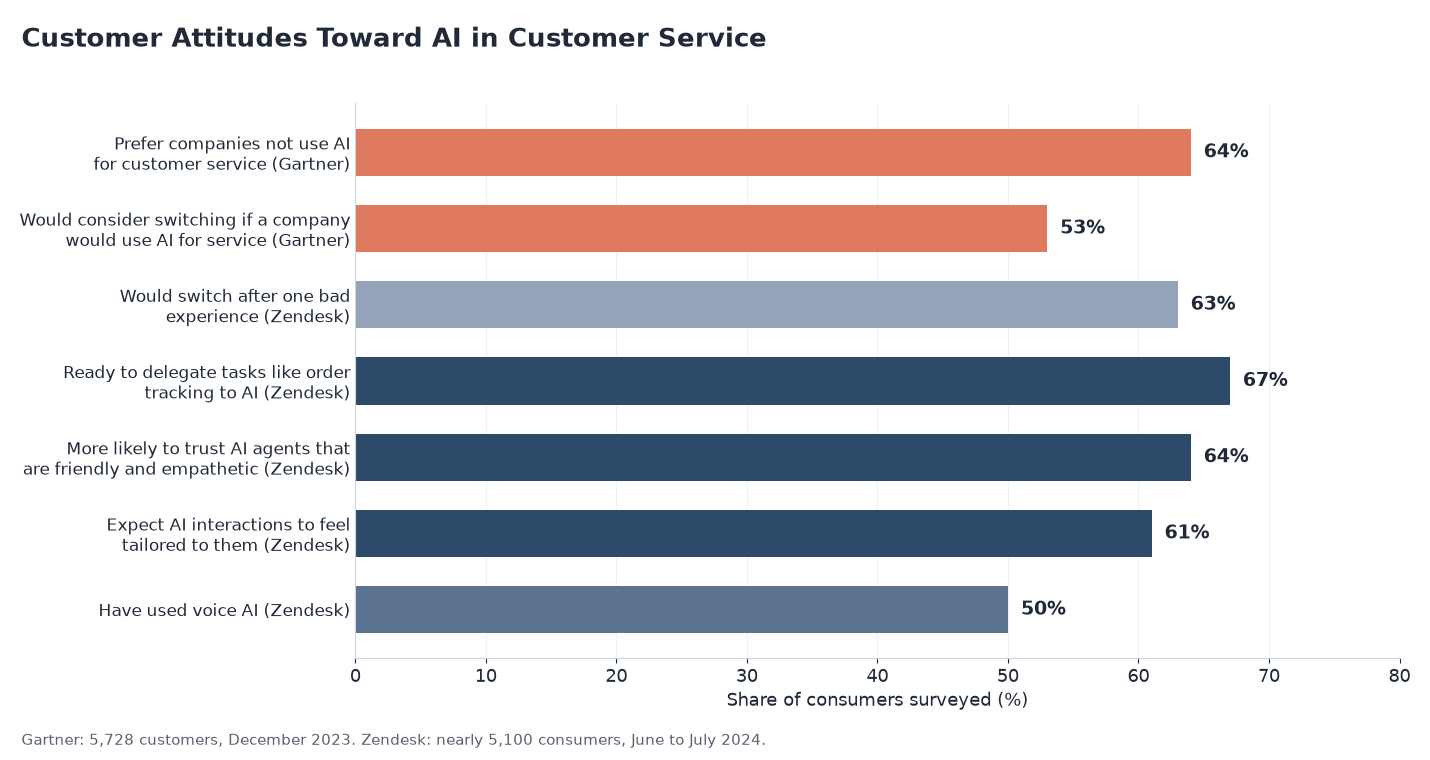
- 64% of customers would prefer that companies did not use AI for customer service, and 53% would consider switching to a competitor if they found out a company was going to, according to Gartner.3
- Support agents with access to a generative AI assistant resolved 14% more issues per hour on average, and novice and low-skilled agents resolved 34% more.11
- Only 21% of service and support leaders say their organizations have reduced human agent headcount because of AI, and 7% have already rehired workers after earlier cuts, according to Gartner's 2026 survey.4
Customer service was one of the first business functions where companies put generative AI in front of customers, and it is where results are easiest to count: cases resolved, minutes per contact, and cost per transaction. In 2026, 91% of service leaders said they faced executive pressure to adopt AI, according to Gartner, while only 4% said they had achieved the return they expected.5 Vendor claims, company earnings reports, and independent studies often point in different directions.
Our analysts read Gartner's press releases on customer attitudes (July 2024), its agentic AI prediction (March 2025), and its 2026 workforce survey, plus CMSWire's report from Gartner's November 2026 Customer Service and Support Conference. We used Salesforce's 7th State of Service report (November 2025), Zendesk's 2025 CX Trends report, Intercom's published Fin figures, Klarna's announcements and earnings figures as reported by CX Dive, and the Brynjolfsson, Li, and Raymond study published by NBER and the Quarterly Journal of Economics. All sources were opened on November 16, 2026.
In the following sections, we compare AI adoption in customer service, AI resolution rates, customer attitudes, cost per contact, the productivity of agents working with AI, and the effect of AI on customer service jobs.
Service Teams Estimate AI Handles 30% of Cases and Expect 50% by 2027
Surveys of service teams are the main source for how much customer service work AI already does. We collected the adoption figures and forecasts from Salesforce, Gartner, and Zendesk.
| Measure | Period | Value | Publisher |
|---|---|---|---|
| Share of service cases handled by AI, as estimated by service teams | 2025 | 30% | Salesforce |
| Projected share of service cases handled by AI | 2027 | 50% | Salesforce |
| Rank of AI among service leaders' priorities | 2024 to 2025 | Rose from 10th to 2nd | Salesforce |
| Service leaders saying security concerns delayed or limited AI initiatives | 2025 | 51% | Salesforce |
| Service leaders under pressure to adopt AI | 2023 survey | 60% | Gartner, 2024 |
| Service leaders facing executive pressure to implement AI | 2026 | 91% | Gartner, via CMSWire |
| Common customer service issues resolved by agentic AI without human help, prediction | 2029 | 80%, with a 30% cut in operational costs | Gartner, 2025 |
| CX leaders expecting 80% of interactions to be resolved without a human in the next few years | 2024 | 75% | Zendesk |
Source: AI Services Companies analysis of Salesforce, State of Service, Gartner, Gartner, CMSWire, and Zendesk, CX Trends 2025 data, conducted November 2026. Data: customer-service-cases-handled-by-ai-2025-2027.csv
Source: AI Services Companies analysis of Salesforce data, conducted November 2026.
Key Findings
- The Salesforce figures are estimates by service professionals, not counts of cases. They came from a survey of 6,500 service professionals and decision makers in 40 countries conducted from April 25 to June 6, 2025.6
- AI rose from the 10th to the 2nd priority for service leaders in a year. Improving the customer experience stayed first.6
- Gartner predicts that by 2029 agentic AI will resolve 80% of common customer service issues without human help, cutting operational costs by 30%. The prediction covers common issues, so it does not mean 80% of all contacts.2
AI Agents Now Resolve Most Simple Conversations at the Companies That Publish Rates
We collected published AI resolution rates from Intercom, Klarna, and a Zendesk customer to see how often AI agents close conversations on their own. Resolution rate, the share of conversations an AI agent closes without handing off to a person, is the most quoted performance figure for AI in customer service, and only a few vendors and companies publish it.
| Company or product | Measure | Value | Date reported |
|---|---|---|---|
| Intercom Fin | Average resolution rate at launch | 23% | 2023 |
| Intercom Fin | Average resolution rate at the Fin 2 launch | 52% | October 2024 |
| Intercom Fin | Average resolution rate across 6,000+ customers | 66% | October 2025 |
| Intercom Fin | Average resolution rate across 12,000+ customers | 76% | November 2026 |
| Intercom Fin | Share of customers with resolution rates above 80% | More than 20% | October 2025 |
| Klarna AI assistant | Share of customer service chats handled in the first month | Two-thirds (2.3 million conversations) | February 2024 |
| Klarna AI assistant | Drop in repeat inquiries | 25% | February 2024 |
| Vagaro, using Zendesk AI | Share of incoming requests resolved by AI | 44% | November 2024 |
Source: AI Services Companies analysis of Intercom Fin, Intercom, Fin Ideas, Intercom blog, Klarna, and Zendesk data, conducted November 2026. Data: intercom-fin-resolution-rate-2023-2026.csv
Source: AI Services Companies analysis of Intercom data, conducted November 2026.
Key Findings
- Intercom's average resolution rate rose 53 percentage points from launch to November 2026, by our analysis of its published averages. Intercom said the rate climbed by about one percentage point a month after the Fin 2 launch.1,8,9
- Intercom itself notes that a 66% resolution rate does not mean Fin does 66% of the work, because the conversations it resolves are often the simplest ones.10
- Vendor resolution rates are self-reported and defined by each vendor. Quote them with the company name and the date, since Intercom's customer base grew from thousands to more than 12,000 over the period.8,9
Most Customers Would Prefer Companies Not Use AI for Service, but Many Will Delegate Simple Tasks
Customer surveys show both resistance to AI in customer service and willingness to use it for routine tasks. We collected the consumer findings from Gartner and Zendesk.
| Finding | Share of consumers | Publisher and survey |
|---|---|---|
| Would prefer that companies did not use AI for customer service | 64% | Gartner, 5,728 customers, December 2023 |
| Would consider switching to a competitor if a company was going to use AI for customer service | 53% | Gartner, December 2023 |
| Top concern about AI in customer service | It will get harder to reach a person | Gartner, December 2023 |
| More likely to trust AI agents that are friendly and empathetic | 64% | Zendesk, nearly 5,100 consumers, June to July 2024 |
| Ready to delegate tasks such as order tracking to AI | 67% | Zendesk, 2024 |
| Expect AI interactions to feel tailored to them | 61% | Zendesk, 2024 |
| Have used voice AI | Half | Zendesk, 2024 |
| Would switch to a competitor after one bad experience | 63% | Zendesk, 2024 |
| Customers who use the phone in a service interaction | One third | Gartner, 2026, via CMSWire |
Source: AI Services Companies analysis of Gartner, Zendesk, CX Trends 2025, and CMSWire data, conducted November 2026. Data: customer-attitudes-ai-customer-service.csv
Source: AI Services Companies analysis of Gartner and Zendesk data, conducted November 2026.
Key Findings
- Customers' top concern about AI in customer service is that it will become harder to reach a person, followed by AI displacing jobs and AI giving wrong answers, according to Gartner.3
- The Gartner and Zendesk figures are not in conflict. Gartner asked about AI in customer service in general, and Zendesk asked about specific tasks and traits. Customers accept AI for order tracking and similar errands while resisting it as a barrier to a person.3,7
- One third of customers use the phone in a customer service interaction, and only the website is used more, according to Gartner analyst Emily Potosky.5
Klarna Cut Its Customer Service Cost per Transaction by 40% in Two Years
Few companies publish their cost per customer contact, so Klarna's disclosures are the most cited real-world figures on AI and service costs. We collected them alongside Gartner's data on AI spending and returns.13,14
| Measure | Period | Value | Publisher |
|---|---|---|---|
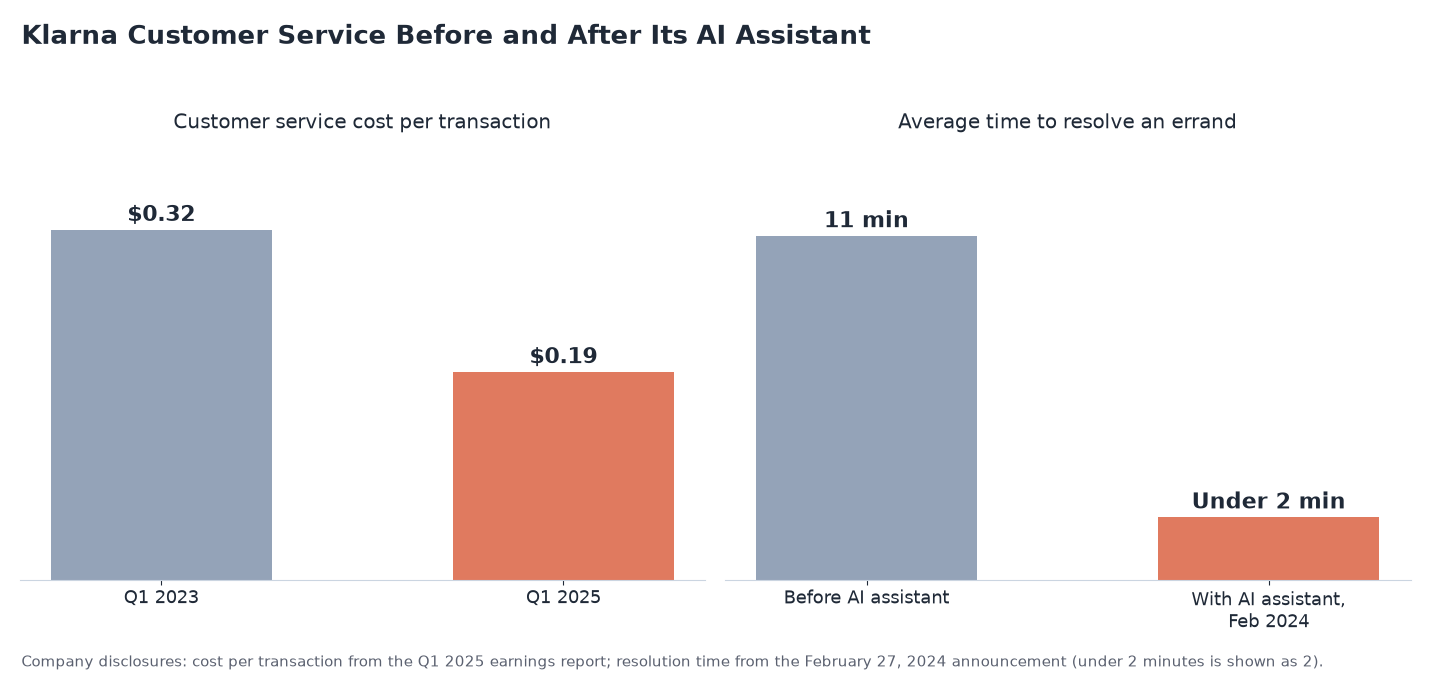
| Klarna customer service cost per transaction | Q1 2023 | $0.32 | Klarna, via CX Dive |
| Klarna customer service cost per transaction | Q1 2025 | $0.19 (down 40%) | Klarna, via CX Dive |
| Klarna estimated profit improvement from its AI assistant | 2024 | $40 million | Klarna, February 2024 |
| Klarna savings attributed to its AI assistant | As of Q3 2025 | $60 million | Klarna CEO, via CX Dive |
| Klarna customer service and operations cost | Q1 2024 to Q1 2025 | $57 million to $51 million | Klarna, via CX Dive |
| Klarna customer service and operations cost | Q3 2024 to Q3 2025 | $42 million to $50 million | Klarna, via CX Dive |
| Growth in AI spending by customer service leaders | 2026 | 38% (overall service budgets grew 2%) | Gartner, via CMSWire |
| Service organizations that achieved the ROI they expected from AI | 2026 | 4% | Gartner, via CMSWire |
| Service organizations reporting any positive ROI from AI | 2026 | 24% | Gartner, via CMSWire |
Source: AI Services Companies analysis of CX Dive, May 2025, CX Dive, November 2025, Klarna, and CMSWire data, conducted November 2026. Data: klarna-customer-service-cost-and-resolution-time.csv
Source: AI Services Companies analysis of Klarna data, conducted November 2026.
Key Findings
- Klarna said in February 2024 that customers resolved errands in under 2 minutes with its AI assistant, compared with 11 minutes before, and that the assistant was doing the work of 700 full-time agents. By November 2025 it put that figure at 853 agents.12,14
- Klarna's customer service and operations cost rose to $50 million in Q3 2025 from $42 million a year earlier, even as it reported $60 million in AI savings. The company grew to 114 million active users over the same period, so cost per transaction and total cost moved in different directions.14
- Only 4% of service organizations have achieved the return they expected from AI, and 24% report any positive return, according to Gartner. Gartner analyst Christopher Sladdin pointed to rising AI costs and the difficulty of turning time savings into financial savings.5
AI Assistance Raised Support Agent Productivity by 14%, and by 34% for Newer Agents
The strongest evidence on AI and agent productivity comes from a study of a real deployment at a large software company's support operation. We collected its findings with survey data from Salesforce and Zendesk on agents who use AI.
| Measure | Value | Source |
|---|---|---|
| Change in issues resolved per hour, all agents with AI assistant | Up 14% on average | Brynjolfsson, Li, and Raymond, NBER |
| Change in issues resolved per hour, novice and low-skilled agents | Up 34% | Brynjolfsson, Li, and Raymond, NBER |
| Change for experienced and highly skilled agents | Minimal | Brynjolfsson, Li, and Raymond, NBER |
| Agents in the study | 5,179 customer support agents | Brynjolfsson, Li, and Raymond, NBER |
| Less time spent on routine cases by reps using AI | 20% (about four hours a week) | Salesforce, 2025 |
| Reps with AI who say it creates growth opportunities | 71% | Salesforce, 2025 |
| Reps with AI who have developed new skills | 86% | Salesforce, 2025 |
| Agents who believe an AI copilot would help them do their job better | 73% | Zendesk, 2024 |
Source: AI Services Companies analysis of Brynjolfsson, Li, and Raymond, Generative AI at Work (NBER Working Paper 31161), Salesforce, State of Service, and Zendesk, CX Trends 2025 data, conducted November 2026. Data: ai-agent-assist-productivity.csv
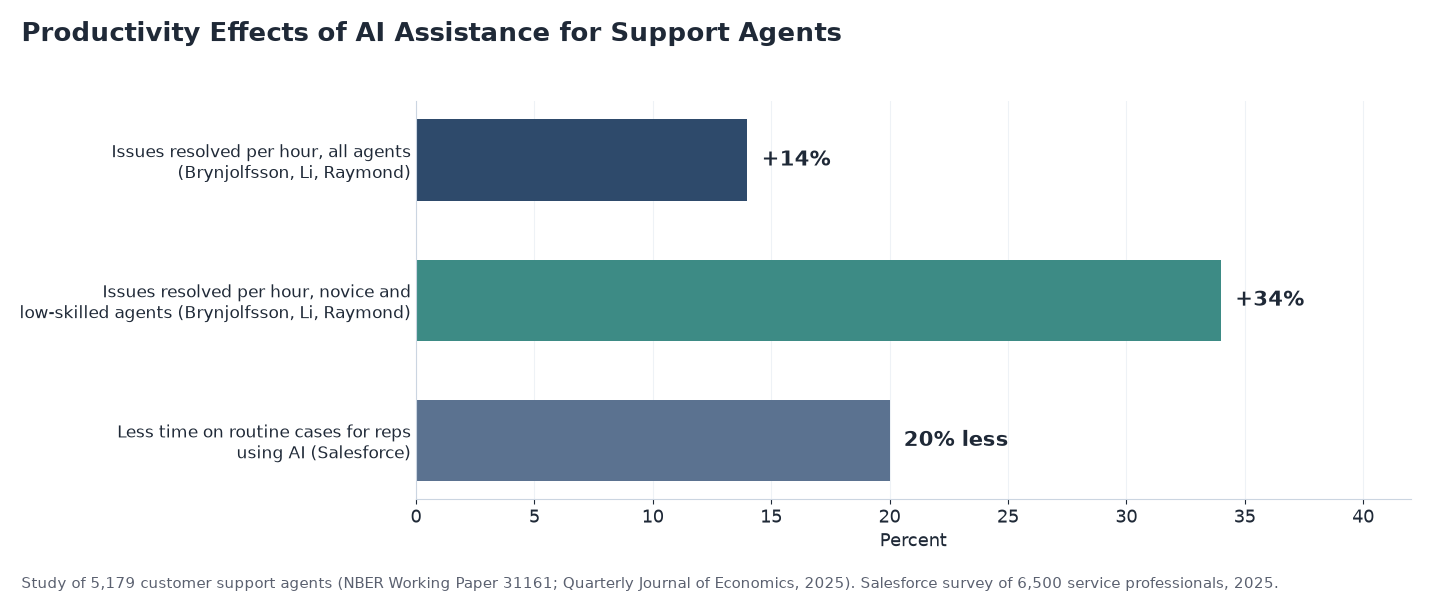
Source: AI Services Companies analysis of NBER and Salesforce data, conducted November 2026.
Key Findings
- The study found that the AI assistant spread the practices of the most able agents to newer ones and helped them move down the experience curve faster. It also found improved customer sentiment and higher employee retention.11
- The study was first released as an NBER working paper in April 2023 and published in the Quarterly Journal of Economics in 2025, volume 140, issue 2.11
- Salesforce's productivity figures are self-reported by survey respondents. Salesforce noted that the optimism of agentic AI users may reflect selection bias among early adopters.6
Only 21% of Service Leaders Have Cut Agent Headcount Because of AI
We collected Gartner's 2026 findings on how service organizations are changing their workforce, to see whether forecasts that AI would quickly shrink contact centers show up in what leaders report.
| Measure | Share of service and support leaders |
|---|---|
| Shifting human agents into different roles within service and support | 71% |
| Hiring freeze | 45% |
| Shifting human agents into other business units | 39% |
| Reduced human agent headcount because of AI | 21% |
| Using forced reductions as a workforce strategy | 20% |
| Plan to rehire human workers within the next 18 months | 11% |
| Have rehired human workers after previous reductions | 7% |
| Average headcount reduction among organizations that cut, previous 18 months | 16.7% of the workforce |
| Hired specialized staff to support AI initiatives | More than half |
Source: Gartner, Gartner Survey Finds 21% of Service and Support Leaders Have Reduced Human Agent Headcount Because of AI, November 5, 2026. Data: customer-service-workforce-changes-ai-2026.csv
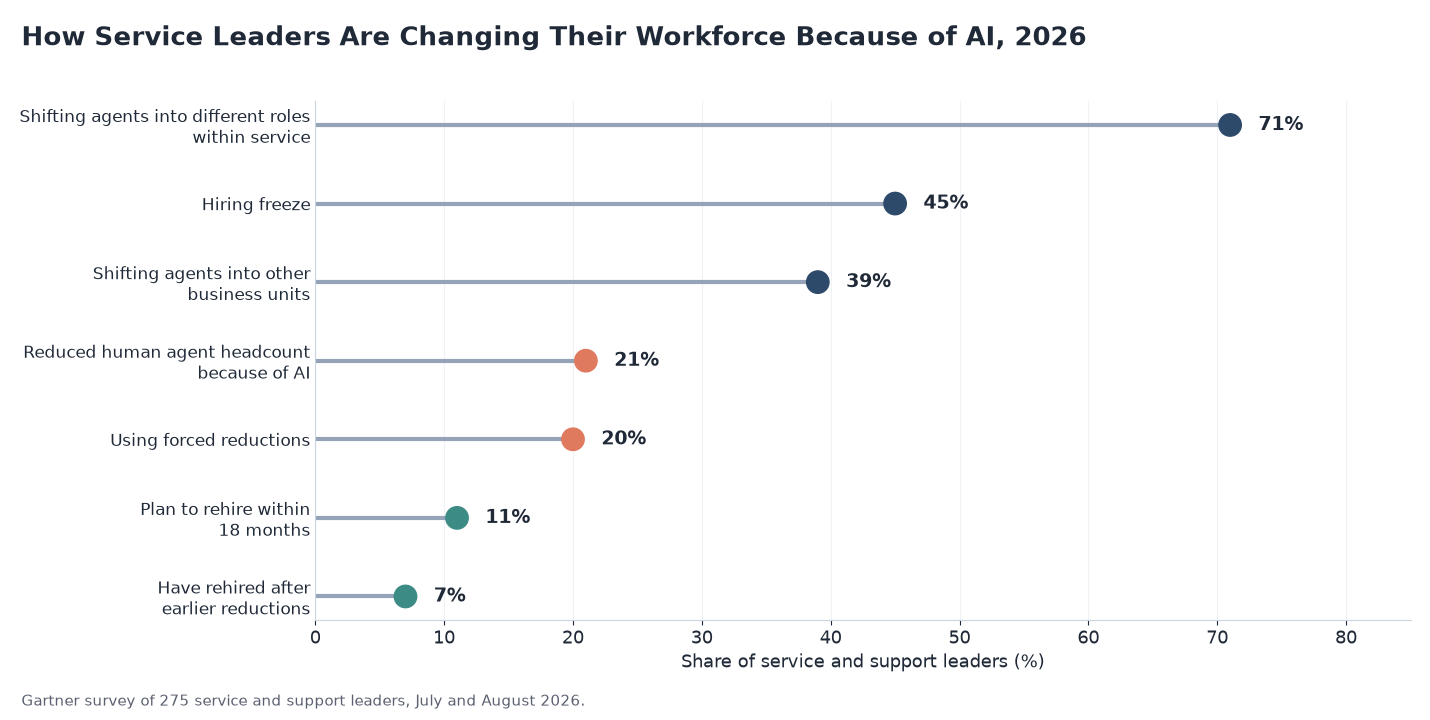
Source: AI Services Companies analysis of Gartner data, conducted November 2026.
Key Findings
- Gartner surveyed 275 service and support leaders in July and August 2026. Among the 21% whose organizations cut agents because of AI, the average reduction was 16.7% of the workforce over 18 months.4
- Gartner predicts that half of companies that cut customer service staff because of AI will rehire by 2027. The 7% that have already rehired and the 11% that plan to are the first signs of that.4,5
- In April 2026, 31% of service leaders had implemented or were planning AI-driven frontline layoffs, according to Gartner, so plans ran ahead of the cuts that took place.5
What AI in Customer Service Means Going Into 2027
The numbers show AI doing a growing share of simple customer service work. Service teams estimate it handles 30% of cases, the vendors that publish rates report averages of two-thirds or more, and companies such as Klarna report lower cost per transaction and faster resolutions. The independent evidence on agents is also positive, with the largest gains for newer staff.
The figures on returns and jobs are more modest. Few service organizations have reached the returns they expected, most have not cut agents, and some that did are hiring again. Customers still call, and most say they would prefer companies not use AI for service at all.
So if you cite a figure for AI in customer service, say whether it is a vendor's self-reported rate, a company disclosure, a survey estimate, or an independent study, and give the date, because figures from these four kinds of sources can differ widely for the same measure.
Data Collection and Methodology
All sources were opened on November 16, 2026. Survey figures come from Gartner press releases (a survey of 5,728 customers in December 2023, published July 2024; a prediction published March 2025; and a survey of 275 service and support leaders in July and August 2026, published November 5, 2026), CMSWire's report from Gartner's Customer Service and Support Conference on November 4 and 5, 2026, Salesforce's 7th State of Service report (6,500 service professionals, April to June 2025), and Zendesk's 2025 CX Trends report (nearly 5,100 consumers and 5,400 service leaders, agents, and buyers, June to July 2024). Figures attributed to Gartner via CMSWire were reported by CMSWire from conference sessions. Gartner also announced the 4% ROI figure in a November 4, 2026 press release, which we did not open.
Resolution rates for Intercom Fin are Intercom's own averages across its customers, taken from its October 2025 posts and its product site; the launch year is 2023 and the customer counts differ by date. Klarna figures come from its February 27, 2024 press release and from its earnings figures as reported by CX Dive in May and November 2025. Productivity figures come from Brynjolfsson, Li, and Raymond, Generative AI at Work (NBER Working Paper 31161; Quarterly Journal of Economics, 2025), which measured productivity as issues resolved per hour. In the Klarna chart, under 2 minutes is drawn at 2 minutes. We calculated differences and ratios from the published values (for example, 76% minus 23% for the change in Fin's resolution rate and $0.19 against $0.32 for Klarna's cost per transaction).
Sources (14)
- AI Services Companies analysis of AI customer service data from Gartner, Salesforce, Zendesk, Intercom, Klarna, and NBER, 2023 to 2026, conducted November 2026.
- Gartner, Gartner Predicts Agentic AI Will Autonomously Resolve 80% of Common Customer Service Issues Without Human Intervention by 2029 (March 5, 2025)
- Gartner, Gartner Survey Finds 64% of Customers Would Prefer That Companies Didn't Use AI For Customer Service (July 9, 2024)
- Gartner, Gartner Survey Finds 21% of Service and Support Leaders Have Reduced Human Agent Headcount Because of AI (November 5, 2026)
- CMSWire, Just 4% of Customer Service Leaders Hit Their Expected Automation Returns (November 10, 2026)
- Salesforce, AI Expected to Resolve Half of Service Cases by 2027, Data Shows (State of Service, 7th edition, November 13, 2025)
- Zendesk, 2025 CX Trends Report: Human-Centric AI Drives Loyalty (November 20, 2024)
- Intercom, Fin product site (opened November 16, 2026)
- Intercom, Fin Ideas: The next leap forward for Fin (October 17, 2025)
- Intercom, What's new with Fin 3 (October 15, 2025)
- Erik Brynjolfsson, Danielle Li, and Lindsey R. Raymond, Generative AI at Work, NBER Working Paper 31161 (Quarterly Journal of Economics, 2025)
- Klarna, Klarna AI assistant handles two-thirds of customer service chats in its first month (February 27, 2024)
- CX Dive, Klarna credits AI for slashing customer service costs (May 21, 2025)
- CX Dive, Klarna says its AI agent is doing the work of 853 employees (November 20, 2025)