
AI Data Privacy Statistics 2026
Published November 18, 2026
Our analysts brought together figures on AI and data privacy from IBM's study of 600 breached organizations, Cisco's surveys of 2,600 privacy and security professionals, Pew Research Center surveys of US adults, a KPMG and University of Melbourne study of more than 48,000 people in 47 countries, Stanford HAI's AI Index, and fines issued by European data protection authorities, to show where AI puts personal data at risk as of Q4 2026.
Key Findings
- 13% of organizations reported a breach of their AI models or applications in IBM's 2025 study, and 97% of those organizations had no AI access controls in place.2
- Breaches involving shadow AI, meaning AI tools employees use without approval, exposed personally identifiable information in 65% of cases, compared with 53% across all breaches.2
- 48% of privacy and security professionals admitted entering non-public company information into generative AI tools, according to Cisco's 2024 survey.3
- 81% of Americans who have heard of AI expect companies' use of it to lead to personal information being used in ways people are not comfortable with.5
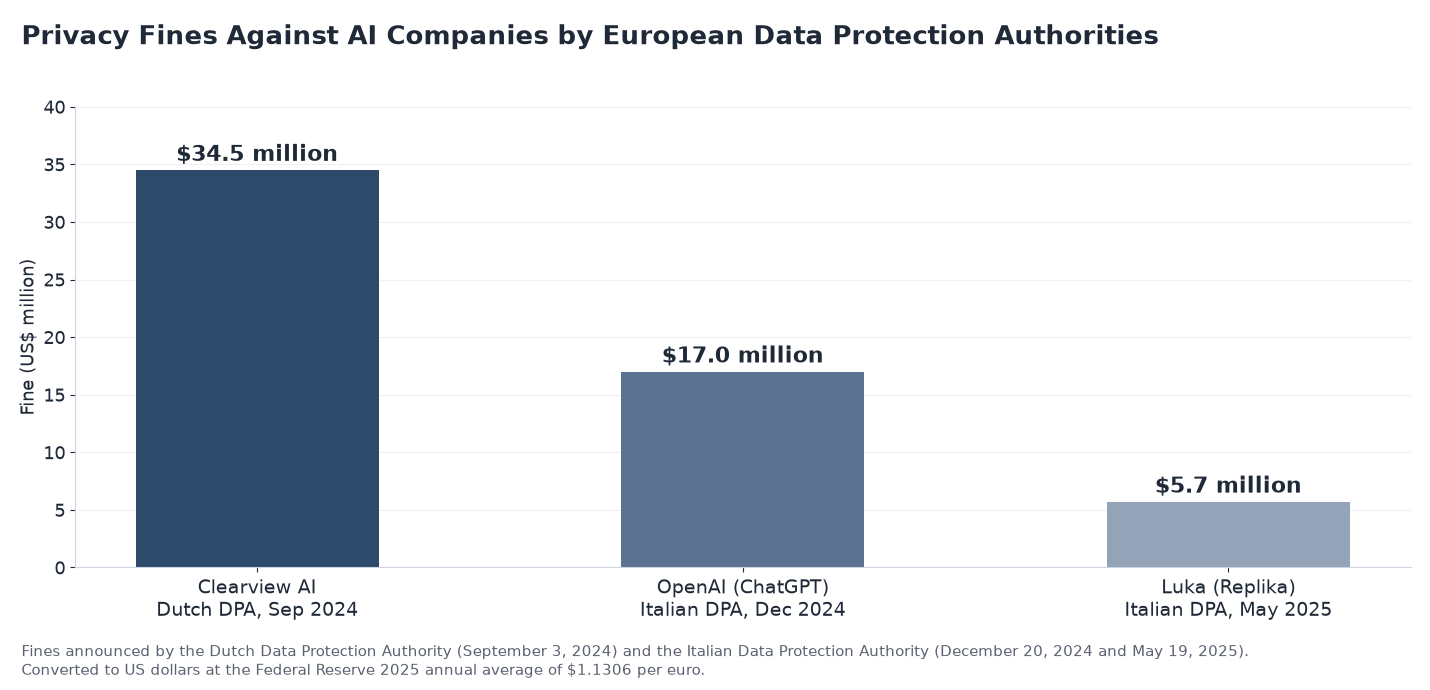
- European data protection authorities fined Clearview AI about $34.5 million in 2024, OpenAI about $17.0 million in 2024, and the maker of the Replika chatbot about $5.7 million in 2025, converted from euros.10,11,12
AI systems run on data, and much of that data is about people: customer records fed into a chatbot, employee files pasted into a writing assistant, or photos and posts collected from the web to train a model. Each of those steps can move personal information somewhere its owner did not expect. In 2024, the number of reported AI-related incidents in the AI Incident Database reached 233, a record.9 Companies, regulators, and the public now track the risks with their own numbers, and those numbers often measure different things.
Our analysts read IBM's 2025 Cost of a Data Breach findings, which were the first in that report to cover AI security. We used Cisco's 2024 and 2025 Data Privacy Benchmark studies, Pew Research Center reports from 2023, 2025, and 2026, and the 2025 KPMG and University of Melbourne trust study. We added the responsible AI chapter of Stanford HAI's 2025 AI Index and the official announcements of three privacy fines against AI companies in the Netherlands and Italy. All sources were opened on November 18, 2026.
In the following sections, we compare AI-related data breaches, the kinds of data exposed, how employees put company data into generative AI, what the public thinks about AI and personal data, how that concern has changed since 2021, and how regulators have responded.
AI-Related Data Breaches and Missing Access Controls
IBM's annual Cost of a Data Breach study, run by the Ponemon Institute, is one of the most cited sources on what breaches cost. Its 2025 edition asked breached organizations about AI security and governance for the first time, so we collected those figures here.2
| Measure | Value | Base |
|---|---|---|
| Organizations reporting a breach of AI models or applications | 13% | All studied organizations |
| Organizations that did not know whether their AI models or applications had been compromised | 8% | All studied organizations |
| Organizations with no AI access controls in place | 97% | Organizations with an AI model or application breach |
| AI-related security incidents that led to compromised data | 60% | AI-related incidents |
| AI-related security incidents that led to operational disruption | 31% | AI-related incidents |
| Organizations without an AI governance policy, or still developing one | 63% | Breached organizations |
| Organizations with AI governance policies that perform regular audits for unsanctioned AI | 34% | Organizations with AI governance policies |
| Organizations with policies to manage AI or detect shadow AI | 37% | Breached organizations |
| Breaches in which attackers used AI tools, most often for phishing or deepfake impersonation | 16% | Breaches studied |
Source: IBM, Cost of a Data Breach Report 2025 press release, July 30, 2025. Data: ai-security-governance-gaps-2025.csv
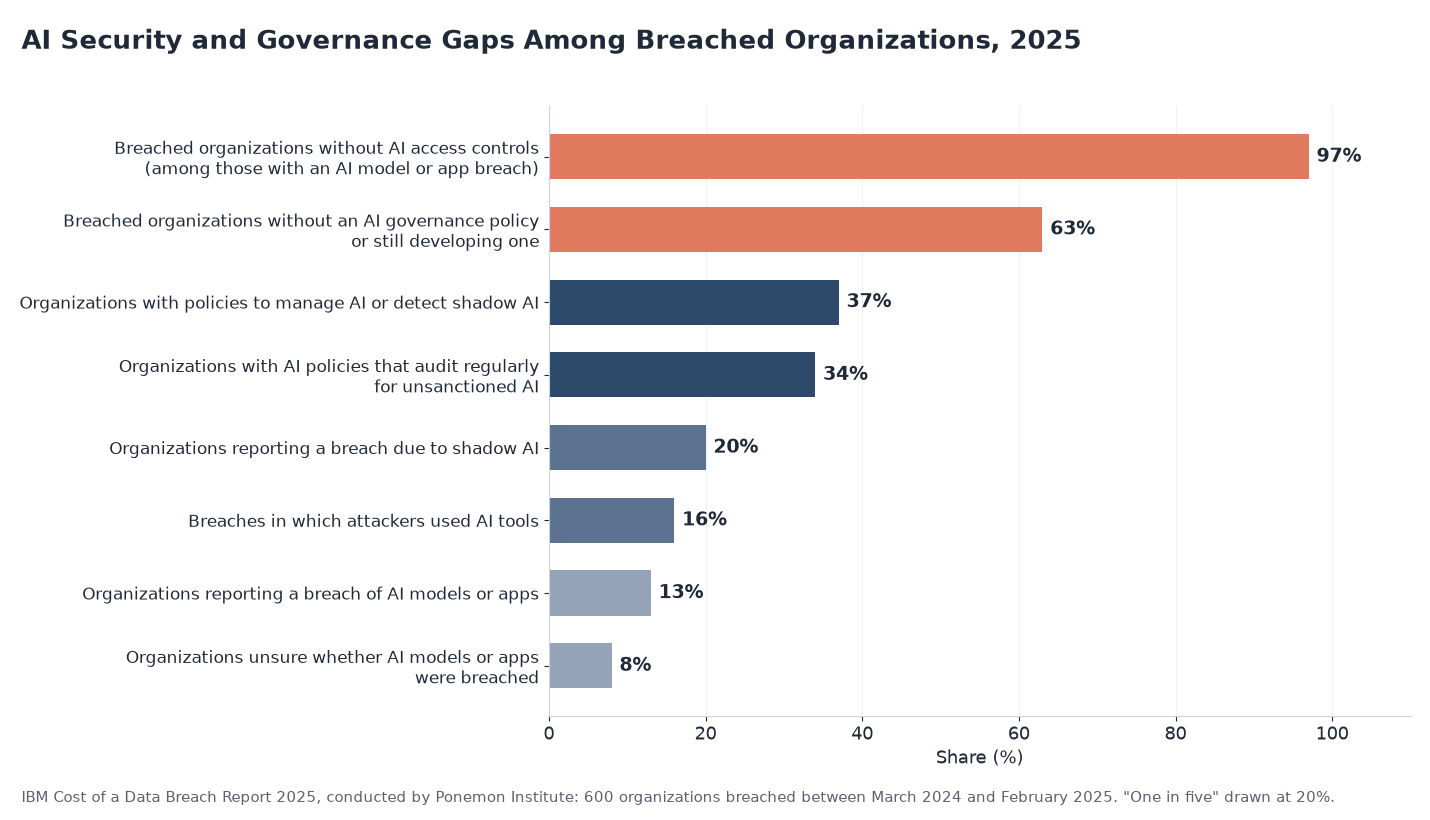
Source: AI Services Companies analysis of IBM data, conducted November 2026.
Key Findings
- IBM's 2025 study covers 600 organizations that were breached between March 2024 and February 2025, so all of its shares describe organizations that had a breach, not all companies.2
- The AI breach share is small, 13%, but nearly all of those organizations (97%) lacked basic access controls for their AI systems.2
- Among organizations that do have an AI governance policy, only about a third (34%) regularly audit for AI tools used without approval.2
Personal Data Exposed in Breaches Involving Shadow AI
Pasting customer records into a free chatbot without the employer's approval is one example of shadow AI. IBM compared breaches that involved shadow AI with its global averages, which shows what kinds of data are at stake and what those breaches cost.2
| Measure | Breaches involving shadow AI | All breaches |
|---|---|---|
| Personally identifiable information compromised | 65% | 53% |
| Intellectual property compromised | 40% | 33% |
| Share of organizations reporting a breach due to shadow AI | One in five | Not applicable |
| Added breach cost for organizations with high levels of shadow AI | $670,000 higher on average | Not applicable |
| Global average cost of a data breach, 2025 | Not reported | $4.44 million, the first decline in five years |
| Average cost of a data breach in the United States, 2025 | Not reported | $10.22 million, a record |
| Average cost of a healthcare breach, 2025 | Not reported | $7.42 million |
Source: IBM, Cost of a Data Breach Report 2025 press release, July 30, 2025. Data: data-compromised-shadow-ai-breaches.csv
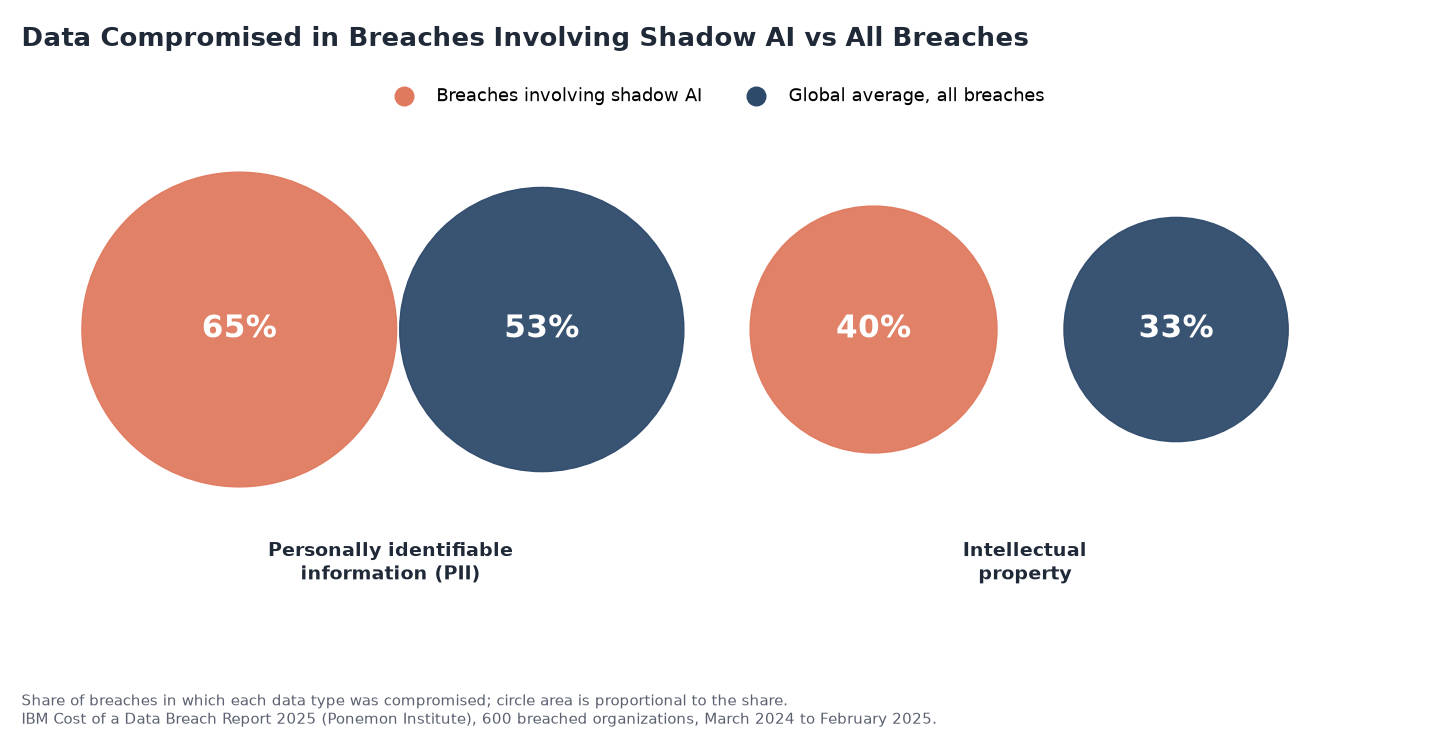
Source: AI Services Companies analysis of IBM data, conducted November 2026.
Key Findings
- Personally identifiable information was compromised in 65% of breaches involving shadow AI, 12 percentage points above the 53% average for all breaches, by our analysis of IBM's figures.1,2
- Organizations with high levels of shadow AI paid an average of $670,000 more per breach than those with low levels or none.2
- Only 37% of breached organizations had policies to manage AI or detect shadow AI.2
Employees, Generative AI Tools, and Company Data
Most AI data leaks start with an ordinary work task, such as asking a chatbot to summarize a contract or a spreadsheet. We collected what privacy professionals and employees report about the data they enter into generative AI tools and the rules their employers set, from Cisco's benchmark studies and the KPMG and University of Melbourne study.3,4,13
| Measure | Value | Survey and year |
|---|---|---|
| Respondents who admit entering non-public company information into generative AI tools | 48% | Cisco, 2024 |
| Organizations that limit what data can be entered into generative AI | 63% | Cisco, 2024 |
| Organizations that limit which generative AI tools employees can use | 61% | Cisco, 2024 |
| Organizations that have banned generative AI applications for the time being | 27% | Cisco, 2024 |
| Organizations that say they need to do more to reassure customers about how their data is used in AI | 91% | Cisco, 2024 |
| Respondents who worry about sharing sensitive information publicly or with competitors by accident | 64% | Cisco, 2025 |
| Respondents who admit entering personal employee or non-public data into generative AI tools | Nearly half | Cisco, 2025 |
| Employees who say they hide their use of AI and present AI-generated work as their own | 57% | KPMG and University of Melbourne, 2025 |
| Employees whose workplace has a policy or guidance on generative AI use | 40% | KPMG and University of Melbourne, 2025 |
Source: AI Services Companies analysis of Cisco 2024 Data Privacy Benchmark Study, Cisco 2025 Data Privacy Benchmark Study, and KPMG and University of Melbourne, Trust, attitudes and use of AI data, conducted November 2026. Data: generative-ai-data-controls-2024.csv
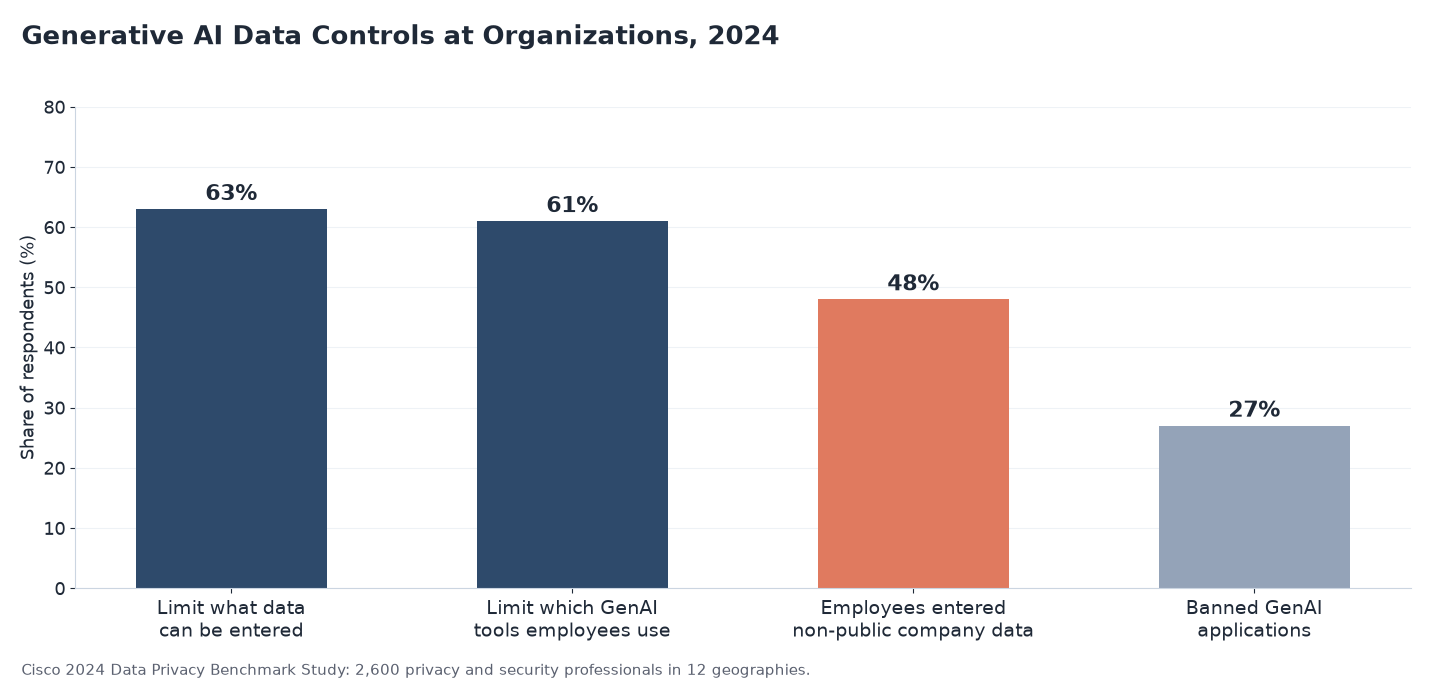
Source: AI Services Companies analysis of Cisco data, conducted November 2026.
Key Findings
- Cisco's surveys each drew on 2,600 privacy and security professionals in 12 countries or geographies, the people responsible for protecting company data.3,4
- Nearly half of these professionals said they had entered non-public data into generative AI tools in both 2024 and 2025, even as 64% worried about sharing sensitive information by accident.3,4
- In the KPMG and University of Melbourne study, only 40% of employees said their workplace had a policy or guidance on generative AI use.13
What Americans Think About AI and Their Personal Data
Pew Research Center asked 5,101 US adults in May 2023 about data privacy, including how they expect companies to use AI with their personal information. These are among the most quoted figures on public attitudes toward AI and privacy in the United States, and we added one privacy question from Pew's August 2023 survey.5,6,7
| Measure | Share of US adults | Base |
|---|---|---|
| Expect companies' AI use to lead to personal information being used in ways people are not comfortable with | 81% | Adults who have heard of AI |
| Expect companies' AI use to lead to personal information being used in ways that were not originally intended | 80% | Adults who have heard of AI |
| Have little or no trust in companies to make responsible decisions about how they use AI in their products | 70% | Adults who have heard of AI |
| Think companies using AI to analyze personal details could make life easier | 62% | Adults who have heard of AI |
| Understand little or nothing about what companies are doing with their personal data | 67% | All adults |
| Think privacy policies are ineffective at explaining how companies use people's data | 61% | All adults |
| Always, almost always, or often click "agree" without reading privacy policies | 56% | All adults |
| Say AI is doing more to hurt than help people keep their personal information private (August 2023 survey) | 53% | All adults |
| Want more government regulation of what companies can do with personal information | 78% of Democrats and 68% of Republicans | All adults |
Source: AI Services Companies analysis of Pew Research Center, Key findings about Americans and data privacy and Pew Research Center, How Americans View Data Privacy (October 18, 2023) and Pew Research Center, Growing public concern about the role of artificial intelligence in daily life (August 28, 2023) data, conducted November 2026. Data: americans-views-ai-personal-data-2023.csv
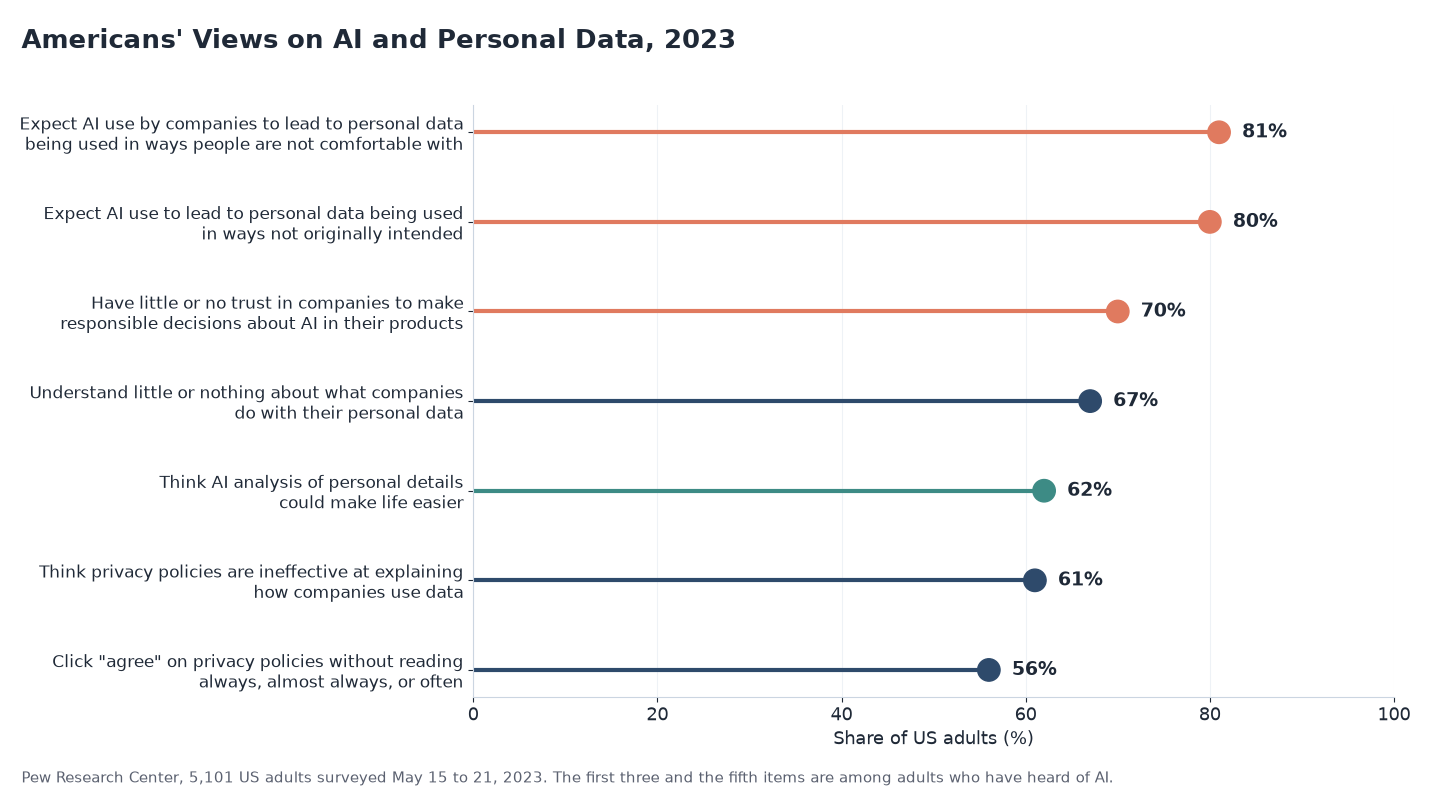
Source: AI Services Companies analysis of Pew Research Center data, conducted November 2026.
Key Findings
- The AI questions were asked only of adults who had heard of AI. Among them, about eight in ten expected companies' AI use to lead to uncomfortable or unintended uses of their data.5,6
- Attitudes are mixed: 62% of the same group said companies using AI to analyze personal details could make life easier.5
- Support for more regulation of how companies use personal information crosses party lines, at 78% of Democrats and 68% of Republicans.5,6
How Public Concern About AI and Data Has Changed Since 2019
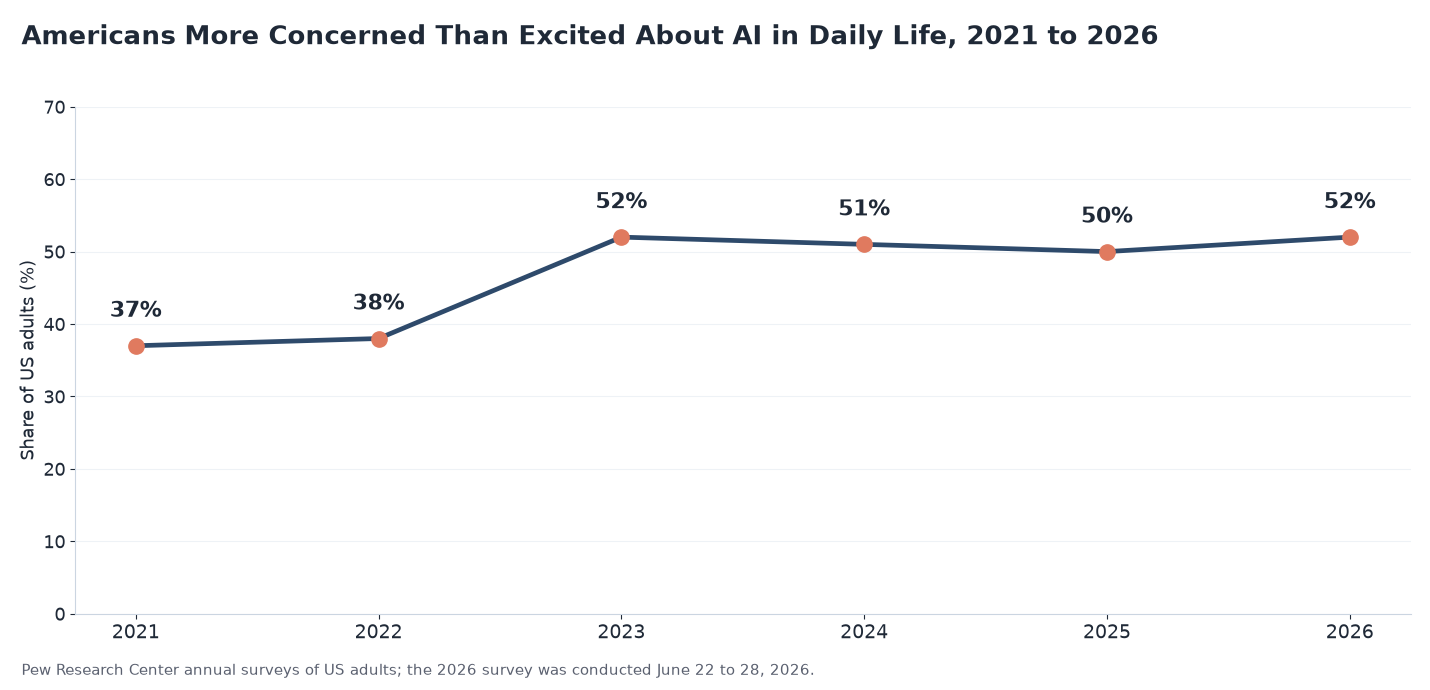
Pew has asked some of the same questions in several survey waves, which makes it possible to track public concern over time. We collected the share of Americans more concerned than excited about AI in daily life from 2021 to 2026, along with Pew's data privacy measures from 2019 and 2023 and the 2025 global trust study.6,7,8,13,15
| Measure | Earlier value | Later value | Publisher |
|---|---|---|---|
| US adults more concerned than excited about the increased use of AI in daily life | 37% (2021) | 52% (June 2026) | Pew Research Center |
| US adults more concerned than excited about AI in daily life, intermediate surveys | 38% (December 2022) | 52% (August 2023), 51% (2024), and 50% (June 2025) | Pew Research Center |
| US adults who understand little or nothing about what companies do with their personal data | 59% (2019) | 67% (2023) | Pew Research Center |
| US adults worried about how the government uses people's data | 64% (2019) | 71% (2023) | Pew Research Center |
| People globally willing to trust AI systems | Not comparable | 46% (November 2024 to January 2025) | KPMG and University of Melbourne |
| People globally who use AI regularly | Not comparable | 66% (November 2024 to January 2025) | KPMG and University of Melbourne |
Source: AI Services Companies analysis of Pew Research Center (August 18, 2026), Pew Research Center (September 17, 2025), Pew Research Center (August 28, 2023), Pew Research Center (October 18, 2023), and KPMG and University of Melbourne (April 2025) data, conducted November 2026. Data: americans-concerned-about-ai-2021-2026.csv
Source: AI Services Companies analysis of Pew Research Center data, conducted November 2026.
Key Findings
- The share of Americans more concerned than excited about AI rose 15 percentage points from 2021 to June 2026, by our analysis of Pew's figures, with most of the jump coming between December 2022 and August 2023.1,7,15
- The 2023 and 2025 Pew figures come from surveys of 11,201 and 5,023 US adults.7,8
- The KPMG and University of Melbourne study found people less trusting and more worried about AI than in its previous study, which covered 17 countries before ChatGPT's release in 2022.13
Privacy Fines, Regulation, and Limits on Training Data
Privacy law already applies to AI in Europe, where the General Data Protection Regulation (GDPR) lets each country's data protection authority fine companies that process personal data without a legal basis. We collected three fines against AI companies, organizations' views of privacy laws, and the Stanford AI Index's figures on websites restricting the use of their content for AI training.4,9,10,11,12
| Measure | Value | Date | Source |
|---|---|---|---|
| Fine on Clearview AI for building a facial recognition database of more than 30 billion photos without a legal basis | $34.5 million, plus up to $5.8 million more in penalties for non-compliance | September 3, 2024 | Dutch Data Protection Authority |
| Fine on OpenAI over ChatGPT's processing of personal data, plus a six-month public information campaign | $17.0 million | December 20, 2024 | Italian Data Protection Authority |
| Fine on Luka Inc., maker of the Replika chatbot, plus a new investigation into how its AI model was trained | $5.7 million | May 19, 2025 | Italian Data Protection Authority |
| Respondents reporting that privacy laws have a positive impact on their organizations | 86%, up from 80% a year earlier | 2025 | Cisco |
| Respondents expecting to move resources from privacy budgets to AI initiatives | 99% | 2025 | Cisco |
| People who believe AI regulation is needed | 70% | 2025 | KPMG and University of Melbourne |
| People who believe existing laws and regulation are adequate | 43% | 2025 | KPMG and University of Melbourne |
| Restricted tokens in actively maintained web domains in the C4 training dataset | Rose from 5% to 7% to between 20% and 33% | 2023 to 2024 | Stanford HAI, AI Index 2025 |
Source: AI Services Companies analysis of Dutch Data Protection Authority, Italian Data Protection Authority (OpenAI), Italian Data Protection Authority (Replika), Cisco, KPMG and University of Melbourne, and Stanford HAI data, conducted November 2026. Data: privacy-fines-ai-companies-europe.csv
Source: AI Services Companies analysis of Dutch and Italian Data Protection Authority announcements, conducted November 2026.
Key Findings
- The Dutch authority said Clearview AI's database holds more than 30 billion photos of people, including Dutch residents, collected without consent.12
- Italy's authority said it set OpenAI's fine, about $17.0 million, taking into account the company's cooperative attitude, and also ordered a six-month campaign on radio, television, newspapers, and the internet.10
- Stanford's AI Index reports that websites sharply increased restrictions on data scraping for AI training from 2023 to 2024.9
What AI Data Privacy Figures Show Going Into 2027
The figures show AI adding new ways for personal data to leak. Breaches of AI systems are still a minority, but the organizations that had them mostly lacked access controls, and breaches involving unapproved AI tools exposed personal data more often than the average breach. Employees, including privacy professionals, put company data into generative AI tools at high rates, while fewer than half of workers in the KPMG study had any workplace guidance.
Public concern rose sharply in 2023 and has stayed near half of US adults since. Regulators in Europe have started to fine AI companies under existing privacy law, and website owners have started to block AI training crawlers on their own.
So if you cite an AI data privacy statistic, give the publisher, the year, and who was surveyed, because a share of breached organizations, a share of privacy professionals, and a share of US adults are not interchangeable.
Data Collection and Methodology
All sources were opened on November 18, 2026. Breach figures come from IBM's July 30, 2025 announcement of its Cost of a Data Breach Report, conducted by the Ponemon Institute and based on breaches at 600 organizations from March 2024 to February 2025. Workplace figures come from Cisco's 2024 (January 2024) and 2025 (April 2, 2025) Data Privacy Benchmark Study announcements, each based on 2,600 privacy and security professionals in 12 countries or geographies, and from the KPMG and University of Melbourne study of more than 48,000 people in 47 countries, surveyed November 2024 to January 2025. Public opinion figures come from Pew Research Center surveys of 5,101 US adults (May 15 to 21, 2023), 11,201 US adults (July 31 to August 6, 2023), and 5,023 US adults (June 9 to 15, 2025); the annual series from 2021 to 2026 comes from Pew's August 18, 2026 chart, whose 2026 value is from a survey conducted June 22 to 28, 2026.
Fines are taken from the official announcements of the Dutch Data Protection Authority (September 3, 2024) and the Italian Data Protection Authority (December 20, 2024 and May 19, 2025); the Replika fine was under appeal at the time of the announcement. Fines announced in euros were converted to US dollars at $1.1306 per euro, the Federal Reserve's 2025 annual average rate, and rounded once to one decimal place.14 Incident and training data figures come from the responsible AI chapter of Stanford HAI's 2025 AI Index. In the IBM chart, "one in five" is drawn at 20%. We calculated percentage point differences from the published values (65% minus 53% for personal data exposure and 52% minus 37% for public concern about AI).
Sources (15)
- AI Services Companies analysis of AI data privacy figures from IBM, Cisco, Pew Research Center, KPMG and the University of Melbourne, Stanford HAI, and European data protection authorities, 2019 to 2026, conducted November 2026.
- IBM, IBM Report: 13% Of Organizations Reported Breaches Of AI Models Or Applications, 97% Of Which Reported Lacking Proper AI Access Controls (July 30, 2025)
- Cisco, Cisco 2024 Data Privacy Benchmark Study (January 2024)
- Cisco, Cisco 2025 Data Privacy Benchmark Study: Privacy Landscape Grows Increasingly Complex in the Age of AI (April 2, 2025)
- Pew Research Center, Key findings about Americans and data privacy (October 18, 2023)
- Pew Research Center, How Americans View Data Privacy (October 18, 2023)
- Pew Research Center, Growing public concern about the role of artificial intelligence in daily life (August 28, 2023)
- Pew Research Center, How Americans View AI and Its Impact on People and Society (September 17, 2025)
- Stanford HAI, The 2025 AI Index Report: Responsible AI
- Italian Data Protection Authority, ChatGPT: the Italian Data Protection Authority closes the preliminary investigation (December 20, 2024)
- Italian Data Protection Authority, AI: The Italian Data Protection Authority fines company behind chatbot "Replika" (May 19, 2025)
- Dutch Data Protection Authority, Dutch DPA imposes a fine on Clearview because of illegal data collection for facial recognition (September 3, 2024)
- KPMG and University of Melbourne, Trust, attitudes and use of artificial intelligence: A global study 2025 (April 2025)
- Board of Governors of the Federal Reserve System, Foreign Exchange Rates, G.5A Annual (January 5, 2026)
- Pew Research Center, Americans have grown more concerned about AI over time (August 18, 2026)