
AI Job Displacement Statistics 2026
Published November 13, 2026
Our analysts compiled nine Challenger, Gray & Christmas monthly layoff reports covering every announced US job cut that employers attributed to artificial intelligence from January 2023 through October 2026, and set them beside exposure estimates and forecasts from the IMF, the International Labour Organization, the World Economic Forum, Goldman Sachs Research, and Stanford University, to show how much job loss AI is causing as of Q4 2026 and how much forecasters expect.
Key Findings
- US employers attributed 121,401 announced job cuts to AI from January through October 2026, 19.7% of all 617,189 announced cuts and more than twice the 54,836 attributed to AI in all of 2025.1,2,9
- AI-attributed cuts peaked at 38,579 in May 2026, 40% of that month's announced cuts, then fell to 1,265 in October, the lowest monthly total of the year.2,6
- The International Labour Organization estimates that 25% of global employment is in occupations exposed to generative AI and that 3.3% is in the highest exposure group.12,13
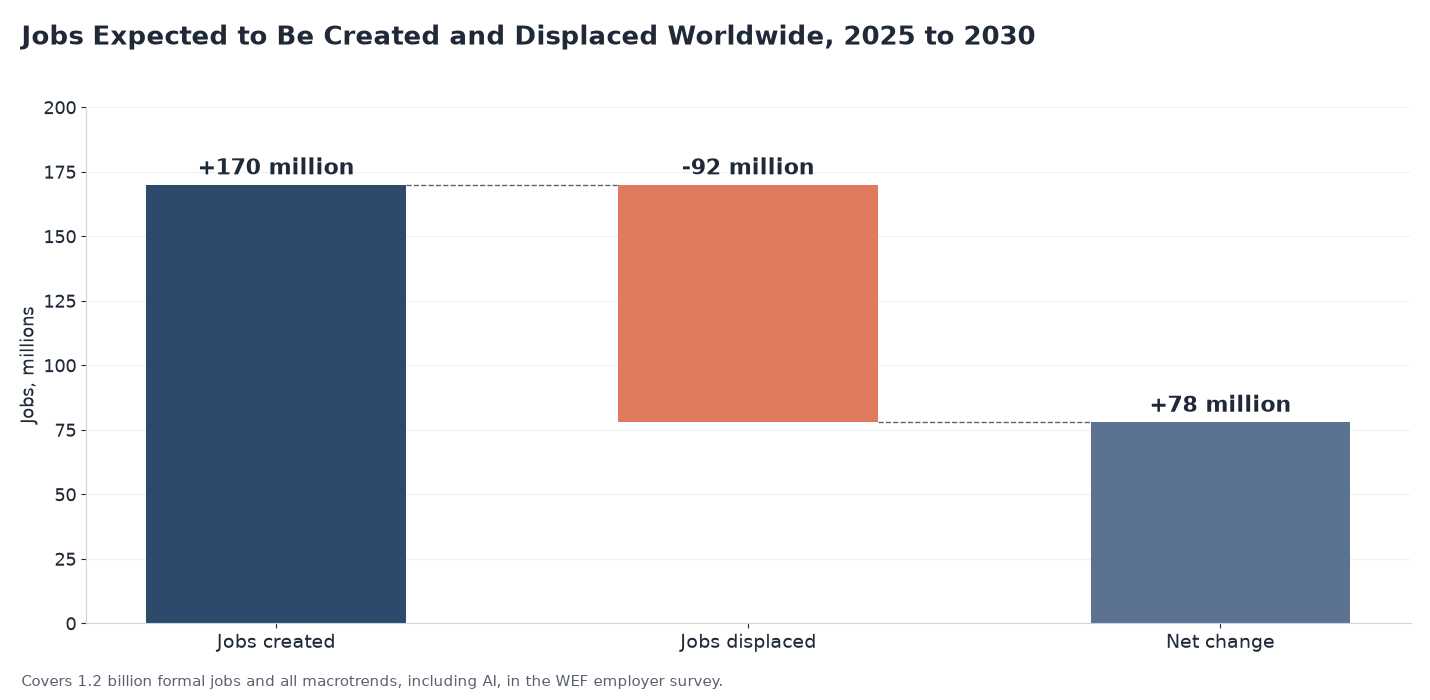
- The World Economic Forum expects 170 million jobs to be created and 92 million displaced worldwide from 2025 to 2030, a net gain of 78 million, and 40% of employers expect to reduce staff where AI can automate tasks.14
- Employment of US workers aged 22 to 25 in AI-exposed occupations is 19% below where it would be had it kept pace with less-exposed peers, according to Stanford payroll research through June 2026.16
Job displacement means work that disappears because a machine or software can now do it, and the worry that AI will cause it on a large scale has grown since ChatGPT's release in late 2022. Two kinds of numbers get quoted. One counts layoffs that companies themselves blame on AI, which Challenger, Gray & Christmas, an outplacement firm, has tracked as a separate reason since 2023. The other estimates how many jobs could be affected, based on how many of each job's tasks AI can perform. The two rarely appear side by side, and they measure different things.
Our analysts read each Challenger monthly report that states AI-attributed cuts and rebuilt the monthly and yearly series from the published monthly and year-to-date figures. We then collected exposure estimates from the IMF and the ILO, the job creation and displacement forecast in the World Economic Forum's Future of Jobs Report 2025, Goldman Sachs Research's displacement and unemployment estimates, and the Stanford Digital Economy Lab's study of payroll records, all opened on November 13, 2026. US data comes first, and job counts are announcements, not confirmed separations.
In the following sections, we compare AI-attributed layoffs by year and by month, AI against the other reasons employers give for cutting jobs, the share of jobs exposed to AI by country income group, forecasts of jobs created and displaced through 2030, and which workers are most exposed.
AI-Attributed US Job Cuts Rose From 4,247 in 2023 to 121,401 in the First 10 Months of 2026
Challenger began counting AI as a separate reason for layoffs in 2023, so its reports give a consistent yearly record of how many announced US job cuts employers blamed on AI. We set each year's AI count against all announced cuts that year to show how large a part AI plays.
| Year | Cuts attributed to AI | All announced cuts | AI share of all cuts |
|---|---|---|---|
| 2023 | 4,247 | 721,677 | 0.6% |
| 2024 | 12,742 | 761,358 | 1.7% |
| 2025 | 54,836 | 1,206,374 | 4.5% |
| 2026 (January to October) | 121,401 | 617,189 | 19.7% |
| Total since tracking began in 2023 | 193,226 | 3,306,598 | 5.8% |
Source: AI Services Companies analysis of Challenger, Gray & Christmas monthly job cut reports, December 2023 to October 2026, conducted November 2026. Data: ai-attributed-job-cuts-by-year-2023-2026.csv
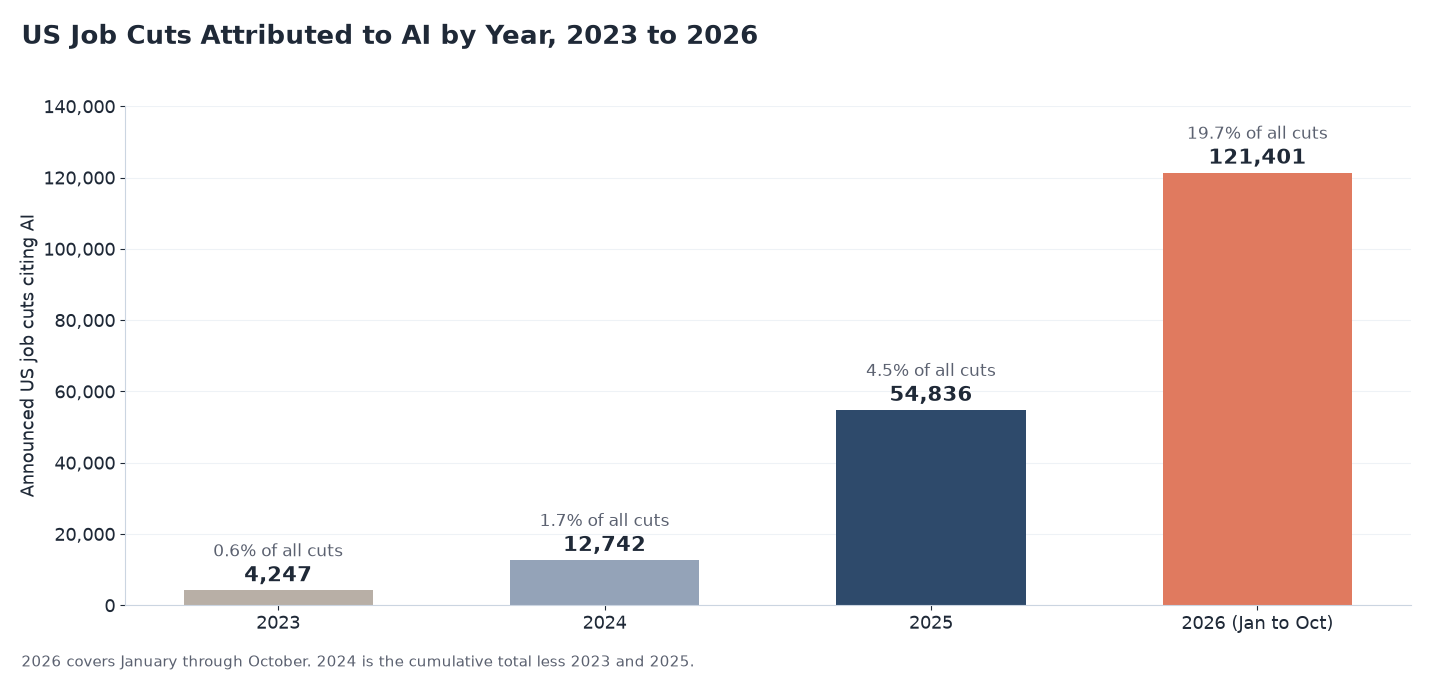
Source: AI Services Companies analysis of Challenger, Gray & Christmas monthly job cut reports, conducted November 2026.
Key Findings
- The 2026 count through October is 2.2 times the full-year 2025 total, and AI's share of all announced cuts rose from 4.5% to 19.7% in the same period.1,2,9
- AI-attributed cuts are still a small part of the US labor market. The 193,226 cuts tracked since 2023 add up to 5.8% of all announced cuts over those years. Challenger also counted 20,219 cuts in 2025 under a separate reason, "Technological Update (possibly AI)", for layoffs where a company pointed to new technology without tying the cuts to AI directly.1,5,9
- Challenger counts announcements and the reasons companies give, not people who lost jobs. Its July 2026 report noted that naming AI in a layoff announcement "can win over investors", so the yearly totals record what employers say about AI as well as what AI does.5
AI-Attributed Cuts Peaked in May 2026 and Fell to a Yearly Low in October
Yearly totals hide large swings inside 2026. We rebuilt the monthly count of AI-attributed cuts from Challenger's monthly and year-to-date figures and compared each month with all cuts announced that month.
| Month | Cuts attributed to AI | All announced cuts | AI share | AI cuts, year to date |
|---|---|---|---|---|
| January | 7,624 | 108,435 | 7.0% | 7,624 |
| February | 4,680 | 48,307 | 9.7% | 12,304 |
| March | 15,341 | 60,620 | 25.3% | 27,645 |
| April | 21,490 | 83,387 | 25.8% | 49,135 |
| May | 38,579 | 97,006 | 39.8% | 87,714 |
| June | 14,029 | 45,849 | 30.6% | 101,743 |
| July | 10,970 | 33,429 | 32.8% | 112,713 |
| August | 3,462 | 52,881 | 6.5% | 116,175 |
| September | 3,961 | 43,281 | 9.2% | 120,136 |
| October | 1,265 | 43,994 | 2.9% | 121,401 |
Source: AI Services Companies analysis of Challenger, Gray & Christmas monthly job cut reports, February to October 2026, conducted November 2026. Data: ai-attributed-job-cuts-by-month-2026.csv
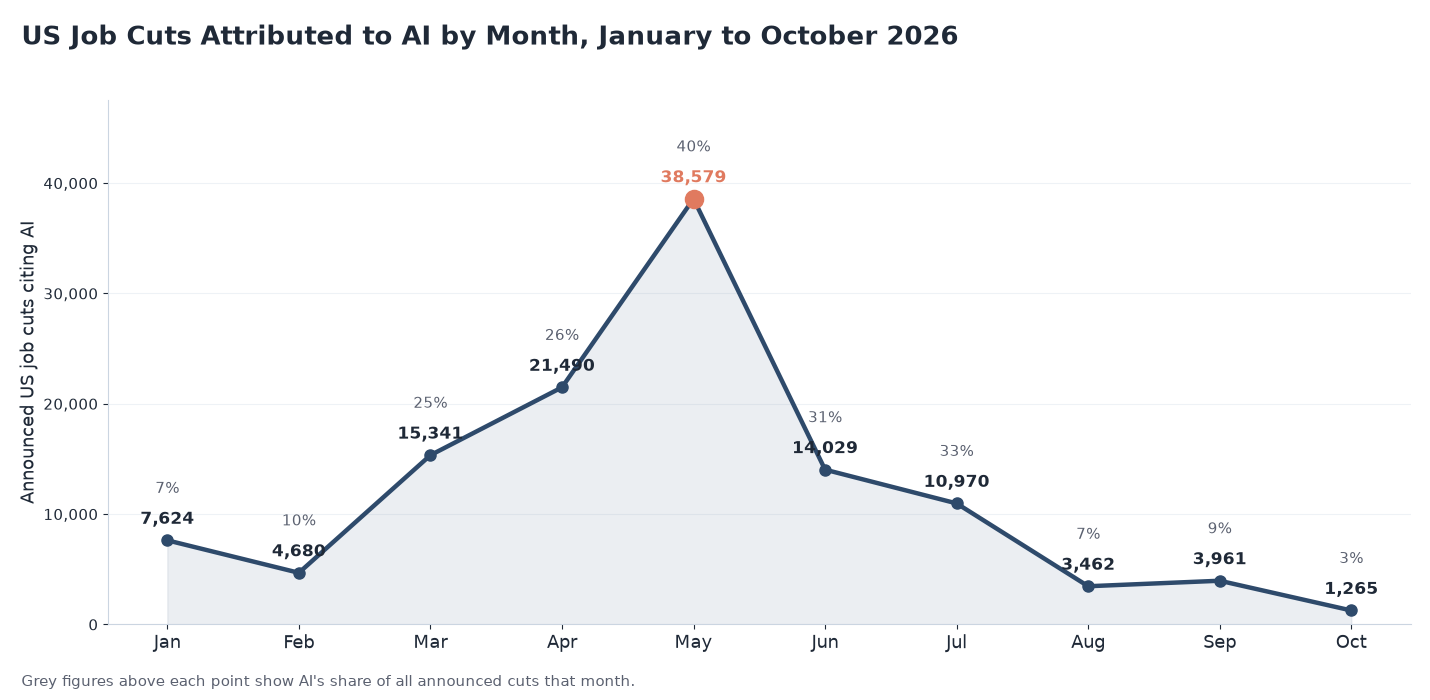
Source: AI Services Companies analysis of Challenger, Gray & Christmas monthly job cut reports, conducted November 2026.
Key Findings
- May 2026 alone accounted for 38,579 AI-attributed cuts, 31.8% of the 2026 total through October and more than the 4,247 and 12,742 recorded in 2023 and 2024 combined.1,6
- AI was the leading reason employers gave for cuts in five straight months, March through July. In August it fell to the fourth most cited reason with 3,462 cuts, and in October it accounted for 2.9% of all cuts.1,4,5
- Challenger said in its October 2026 report that "the reasons employers give have shifted from technology to the economy." A smaller AI count shows that fewer companies are naming AI in announcements, which may or may not mean AI is replacing fewer jobs.2
AI Was the Second Most Cited Reason for US Job Cuts in 2026
Employers give one main reason for each announced layoff, and Challenger sorts them into about 30 categories. We ranked the eight reasons cited most often from January through October 2026 to show where AI stands among the other causes of job cuts.
| Reason | Cuts, January to October 2026 | Share of all cuts | Cuts, October 2026 |
|---|---|---|---|
| Market/Economic Conditions | 130,531 | 21.1% | 16,407 |
| Artificial Intelligence | 121,401 | 19.7% | 1,265 |
| Closing | 109,342 | 17.7% | 10,250 |
| Restructuring | 85,391 | 13.8% | 5,499 |
| Contract Loss | 46,528 | 7.5% | 1,099 |
| Cost-Cutting | 38,106 | 6.2% | 60 |
| Demand Downturn | 21,347 | 3.5% | 6,118 |
| Acquisition/Merger | 17,168 | 2.8% | 701 |
| All reasons | 617,189 | 100% | 43,994 |
Source: Challenger, Gray & Christmas, Job Cut Announcement Report, October 2026, November 5, 2026. Data: us-job-cuts-by-reason-2026.csv
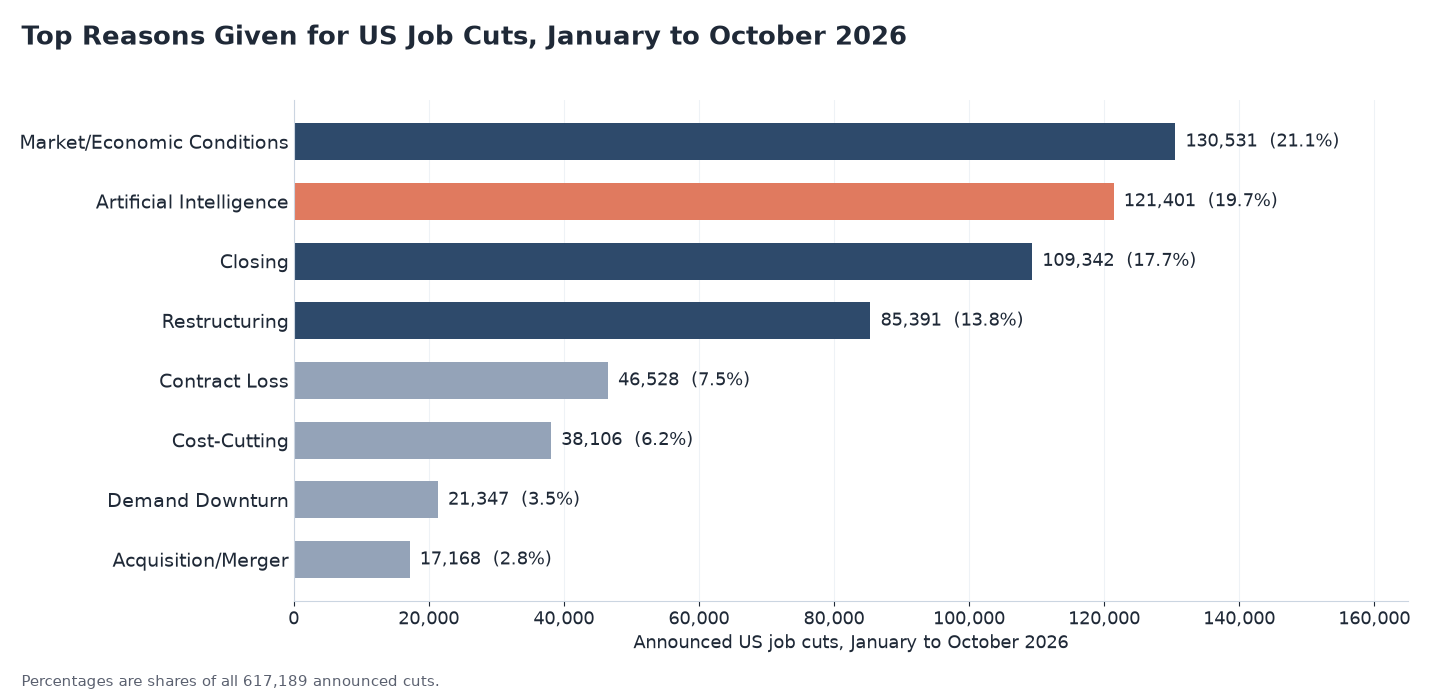
Source: AI Services Companies analysis of Challenger, Gray & Christmas data, conducted November 2026.
Key Findings
- Market and economic conditions passed AI as the leading reason for 2026 in October, with 130,531 cuts against AI's 121,401. Demand downturn cuts reached 21,347, up 145% from 8,701 through October 2025.2
- Technology companies announced 171,501 cuts through October 2026, more than any other industry and more than the 154,445 the sector announced in all of 2025.2
- Total announced cuts fell 44% from the first ten months of 2025, from 1,099,500 to 617,189, while AI-attributed cuts more than doubled. AI became a larger share of a smaller total.2,9
The IMF Puts AI Exposure at Almost 40% of Jobs Worldwide and the ILO at 25%
Exposure estimates measure how many jobs include tasks that AI could perform, which is a different question from how many jobs will be lost. The two most quoted international estimates come from the IMF and the ILO, and they use different methods, so we show them by country income group.
| Publisher and date | Measure | World | Advanced or high-income economies | Emerging markets | Low-income countries |
|---|---|---|---|---|---|
| IMF, January 2024 | Jobs exposed to AI | Almost 40% | 60% | 40% | 26% |
| ILO and NASK, May 2025 | Employment in occupations exposed to generative AI | 25% | 34% | Not reported | 11% |
| ILO and NASK, May 2025 | Employment in the highest exposure group (gradient 4) | 3.3% | Not reported | Not reported | Not reported |
| Goldman Sachs Research, August 2025 | US workforce displaced if AI is widely adopted (baseline) | 6% to 7% (US) | |||
| Goldman Sachs Research, August 2025 | Range of US displacement under other assumptions | 3% to 14% (US) | |||
| Goldman Sachs Research, August 2025 | US employment at risk if current AI uses spread economy-wide | 2.5% (US) |
Source: AI Services Companies analysis of IMF figures as reported by CNN, ILO, ILO Working Paper 140, and Goldman Sachs Research data, conducted November 2026. Data: ai-job-exposure-by-income-group-imf-ilo.csv
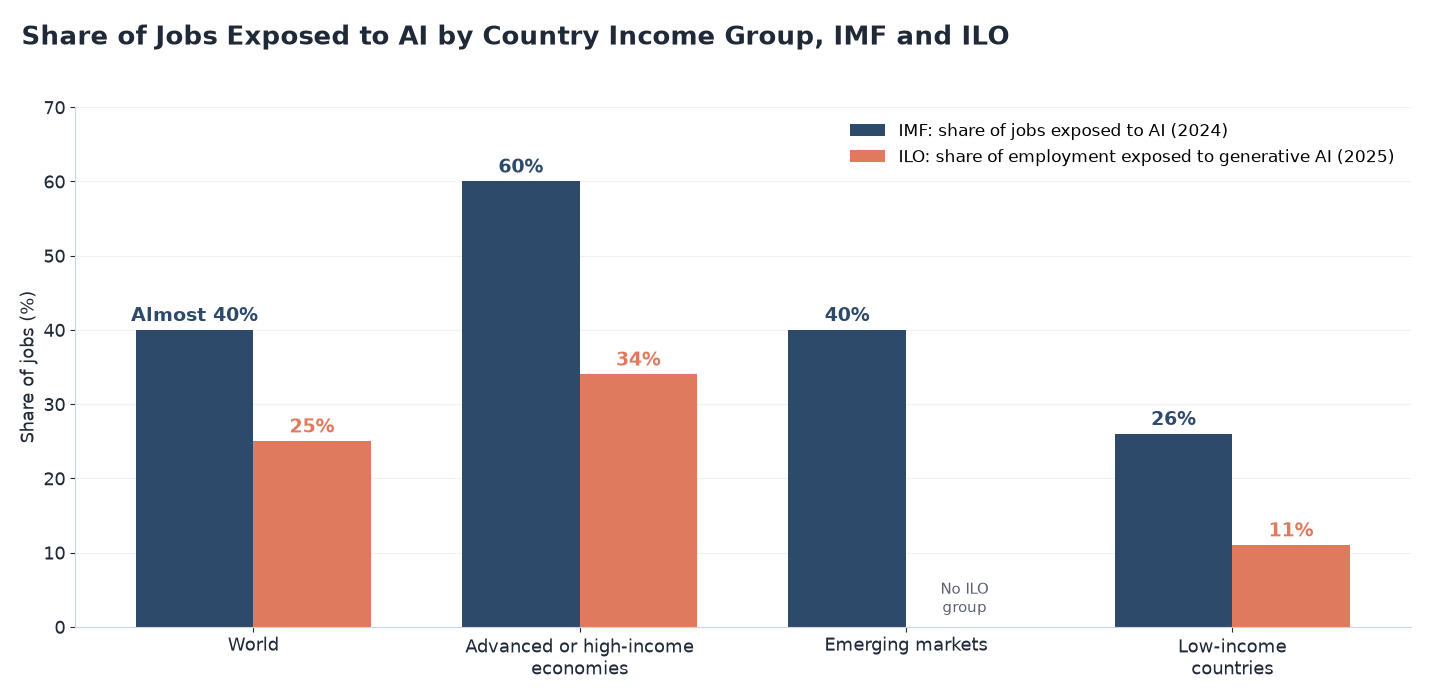
Source: AI Services Companies analysis of IMF and ILO estimates, conducted November 2026.
Key Findings
- Both estimates find exposure rises with country income. The IMF puts it at 60% of jobs in advanced economies and 26% in low-income countries, and the ILO at 34% and 11%.11,13
- Exposure is not the same as job loss. IMF Managing Director Kristalina Georgieva said about half of exposed jobs in advanced economies may benefit from AI's productivity gains, and the ILO says transformation, not replacement, is the most likely result for most exposed jobs.11,12
- The ILO revised its estimate of jobs in its highest exposure group from 2.3% of global employment in 2023 to 3.3% in 2025, as generative AI tools took on more specialized professional and technical tasks.13
The World Economic Forum Expects 92 Million Jobs Displaced and 170 Million Created by 2030
Forecasts try to turn exposure into expected job losses and gains over a set period. We collected the World Economic Forum's employer-based forecast for 2025 to 2030 and Goldman Sachs Research's estimates of how AI could change US unemployment.
| Publisher | Period | Measure | Value |
|---|---|---|---|
| World Economic Forum | 2025 to 2030 | Jobs created worldwide by all macrotrends, including AI | 170 million (14% of current employment) |
| World Economic Forum | 2025 to 2030 | Jobs displaced worldwide | 92 million (8%) |
| World Economic Forum | 2025 to 2030 | Net change in jobs | +78 million (7%) |
| World Economic Forum | 2025 to 2030 | Employers expecting to reduce their workforce where AI can automate tasks | 40% |
| World Economic Forum | 2025 to 2030 | Employers planning to hire talent with specific AI skills | Two-thirds |
| World Economic Forum | 2025 to 2030 | Share of workers' current skills expected to change or become outdated | 39% |
| Goldman Sachs Research | AI transition period | Rise in the US unemployment rate above trend | 0.5 percentage point |
| Goldman Sachs Research | When fully adopted | Rise in US and developed-market labor productivity from generative AI | About 15% |
Source: AI Services Companies analysis of World Economic Forum, Future of Jobs Report 2025 and Goldman Sachs Research data, conducted November 2026. Data: wef-jobs-created-displaced-2025-2030.csv
Source: World Economic Forum, Future of Jobs Report 2025, January 2025.
Key Findings
- The World Economic Forum forecast covers 1.2 billion formal jobs and every major trend, from AI to the cost of living, so its 92 million displaced jobs are not all caused by AI. It expects the fastest-declining roles to include postal service clerks, bank tellers, and data entry clerks.14
- Employers expect to both cut and hire because of AI. In the same survey, half of employers plan to reorient their business in response to AI, two-thirds plan to hire people with AI skills, and 40% expect to reduce staff where AI can automate tasks.14
- Goldman Sachs Research expects AI-driven job losses to raise US unemployment by about half a percentage point during the transition, and notes that job displacement from past technologies tended to fade after about two years. About 60% of US workers today are in occupations that did not exist in 1940.15
Women and Workers Aged 22 to 25 Show the Highest AI Exposure
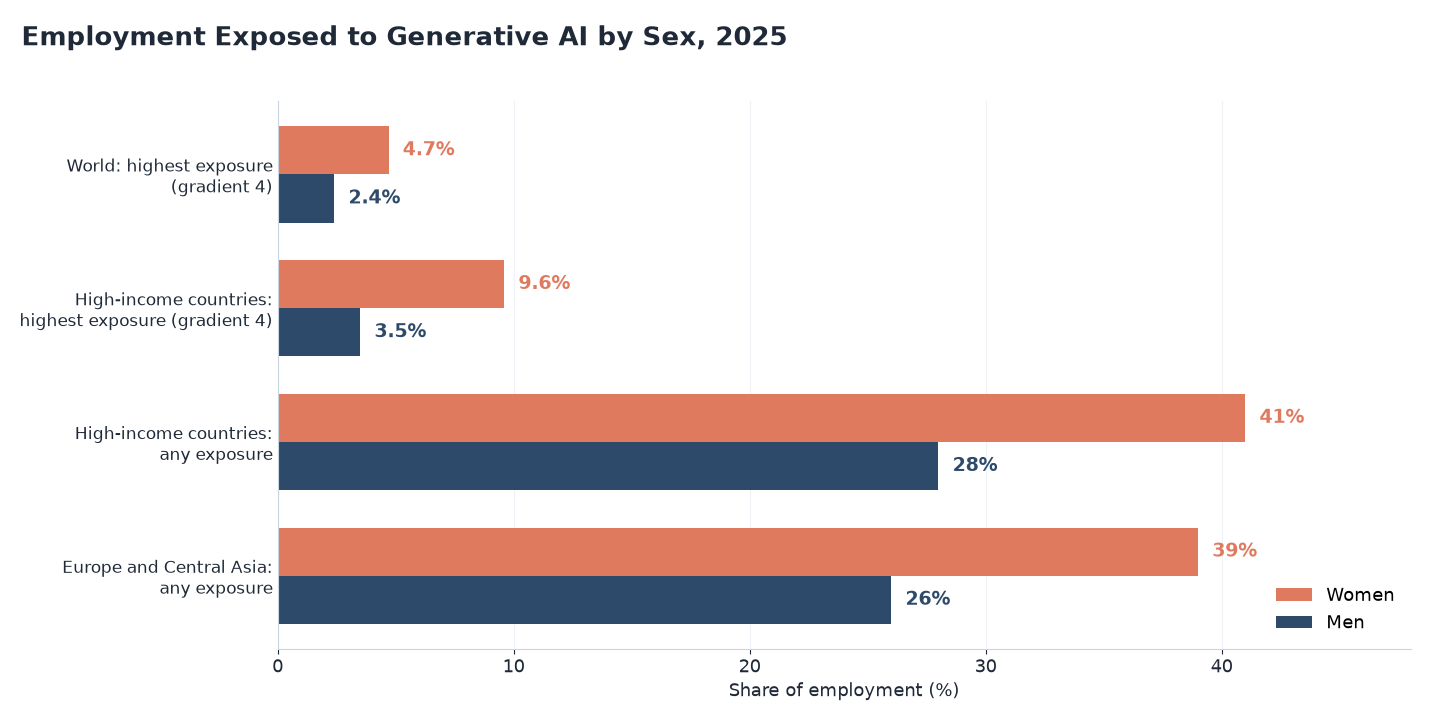
Averages hide which workers face the most risk. We looked at the ILO's breakdown of exposure by sex and region and at Stanford's payroll study of employment by age in AI-exposed occupations.
| Group | Measure | Value | Publisher |
|---|---|---|---|
| Women, worldwide | Employment in the highest exposure group (gradient 4) | 4.7% | ILO and NASK, 2025 |
| Men, worldwide | Employment in the highest exposure group (gradient 4) | 2.4% | ILO and NASK, 2025 |
| Women, high-income countries | Employment in the highest exposure group (gradient 4) | 9.6% (7.8% in the 2023 estimate) | ILO and NASK, 2025 |
| Men, high-income countries | Employment in the highest exposure group (gradient 4) | 3.5% (2.9% in the 2023 estimate) | ILO and NASK, 2025 |
| Women, high-income countries | Employment in any exposure group | 41% | ILO and NASK, 2025 |
| Men, high-income countries | Employment in any exposure group | 28% | ILO and NASK, 2025 |
| US workers aged 22 to 25 in AI-exposed occupations | Employment gap against less-exposed peers, through June 2026 | 19% below | Stanford Digital Economy Lab, August 2026 |
| Experienced US workers in AI-exposed occupations | Employment gap against less-exposed peers | No comparable gap | Stanford Digital Economy Lab, August 2026 |
Source: AI Services Companies analysis of ILO Working Paper 140 and Stanford Digital Economy Lab data, conducted November 2026. Data: genai-exposure-by-sex-2025.csv
Source: ILO, Generative AI and Jobs: A Refined Global Index of Occupational Exposure, Working Paper 140, May 2025.
Key Findings
- Women in high-income countries are 2.7 times as likely as men to work in the most exposed jobs, 9.6% against 3.5%, and the ILO links the pattern to occupational structure, with clerical, financial, and customer service jobs among the most exposed.13
- The Stanford researchers found the gap for young workers has widened since they first reported it in August 2025, and it comes mainly from fewer young people being hired, not from more being let go. They found no evidence of widespread, economy-wide job displacement.16
- Stanford found declines mainly in occupations where people use AI to replace tasks. Where AI mostly helps workers do their jobs, employment is flat or rising, especially for experienced workers, so early-career hiring is the first place to watch for displacement.16
What the AI Job Displacement Figures Mean Going Into 2027
For most US workers, AI has not yet taken jobs on a large scale. Companies blamed AI for about one in five announced layoffs in 2026, but total layoffs were lower than in 2025, and the clearest sign of change in the payroll data is that fewer young people are being hired into AI-exposed occupations.
The estimates of what could happen are much larger than what has happened so far. Between 25% and 40% of jobs worldwide are exposed to AI, depending on whose estimate is used, while forecasters at the World Economic Forum and Goldman Sachs expect new jobs to outnumber lost ones over time, with a period of higher unemployment while displaced workers find new roles.
So if you cite a number for AI job losses, say whether it counts layoffs that employers attributed to AI, jobs exposed to AI, or forecast displacement, because the 2026 figures for those three measures range from 121,401 announced US cuts to 92 million jobs worldwide.
Data Collection and Methodology
AI-attributed job cuts come from Challenger, Gray & Christmas monthly Job Cut Announcement Reports for December 2023, December 2025, and February, April, May, July, August, September, and October 2026, downloaded on November 13, 2026. Challenger records the main reason each US employer gives for an announced layoff and began tracking artificial intelligence as a separate reason in 2023. Monthly 2026 figures are the month's stated count where published (February, April, May, July, August, September, and October) and otherwise the difference between consecutive year-to-date totals (January, March, and June). The 2024 total is the cumulative count since 2023 at the end of 2025 (71,825) less the 2023 and 2025 totals. All announced cuts for 2024 are the sum of the monthly totals in the December 2025 report. Challenger revises earlier figures in later reports; we used the most recent report for each figure, and its February 2026 report states a cumulative figure since 2023 (91,753) that does not match the October 2026 report's 193,226, which we used.
Exposure estimates are as published. The IMF figures are from Kristalina Georgieva's January 14, 2024 blog post as reported by CNN on January 15, 2024. The ILO figures are from the ILO and NASK working paper and news release of May 20, 2025, which define four exposure gradients, with gradient 4 the highest. The World Economic Forum forecast is from the Future of Jobs Report 2025, based on its survey of employers, and covers job changes from all macrotrends, including AI. Goldman Sachs Research figures are from its August 13, 2025 article. Stanford figures are from the August 12, 2026 revision of "Canaries in the Coal Mine?", based on ADP payroll data through June 2026; the authors describe them as descriptive indicators, not causal estimates. We calculated products, differences, and ratios from the published values.
Sources (16)
- AI Services Companies analysis of AI-attributed US job cuts from Challenger, Gray & Christmas monthly reports, December 2023 to October 2026, with exposure and forecast data from the IMF, ILO, World Economic Forum, Goldman Sachs Research, and Stanford Digital Economy Lab, conducted November 2026.
- Challenger, Gray & Christmas, Job Cut Announcement Report, October 2026 (November 5, 2026)
- Challenger, Gray & Christmas, Job Cut Announcement Report, September 2026
- Challenger, Gray & Christmas, Job Cut Announcement Report, August 2026
- Challenger, Gray & Christmas, Job Cut Announcement Report, July 2026
- Challenger, Gray & Christmas, Job Cut Announcement Report, May 2026
- Challenger, Gray & Christmas, Job Cut Announcement Report, April 2026
- Challenger, Gray & Christmas, Job Cut Announcement Report, February 2026
- Challenger, Gray & Christmas, Job Cut Announcement Report, December 2025
- Challenger, Gray & Christmas, Job Cut Announcement Report, December 2023
- CNN, Nearly 40% of global employment could be disrupted by AI, IMF says (January 15, 2024)
- International Labour Organization, One in four jobs at risk of being transformed by GenAI, new ILO-NASK Global Index shows (May 20, 2025)
- International Labour Organization and NASK, Generative AI and Jobs: A Refined Global Index of Occupational Exposure, ILO Working Paper 140 (May 2025)
- World Economic Forum, Future of Jobs Report 2025 (January 2025)
- Goldman Sachs, How Will AI Affect the Global Workforce? (August 13, 2025)
- Stanford Digital Economy Lab, Canaries in the Coal Mine? Six Facts about the Recent Employment Effects of Artificial Intelligence (revised August 12, 2026)