
AI Misinformation Statistics 2026
Published November 19, 2026
Our analysts reviewed nine audits, surveys, and risk reports published from 2024 to 2026, covering NewsGuard's monthly tests of 10 leading AI chatbots, 2,709 news answers from four AI assistants rated by journalists in 18 countries, NewsGuard's count of AI-generated news sites, a Reuters Institute online survey of news users in 48 markets, and three editions of the World Economic Forum's Global Risks Report, to show how often AI tools spread false or distorted information and how worried people are about it as of Q4 2026.
Key Findings
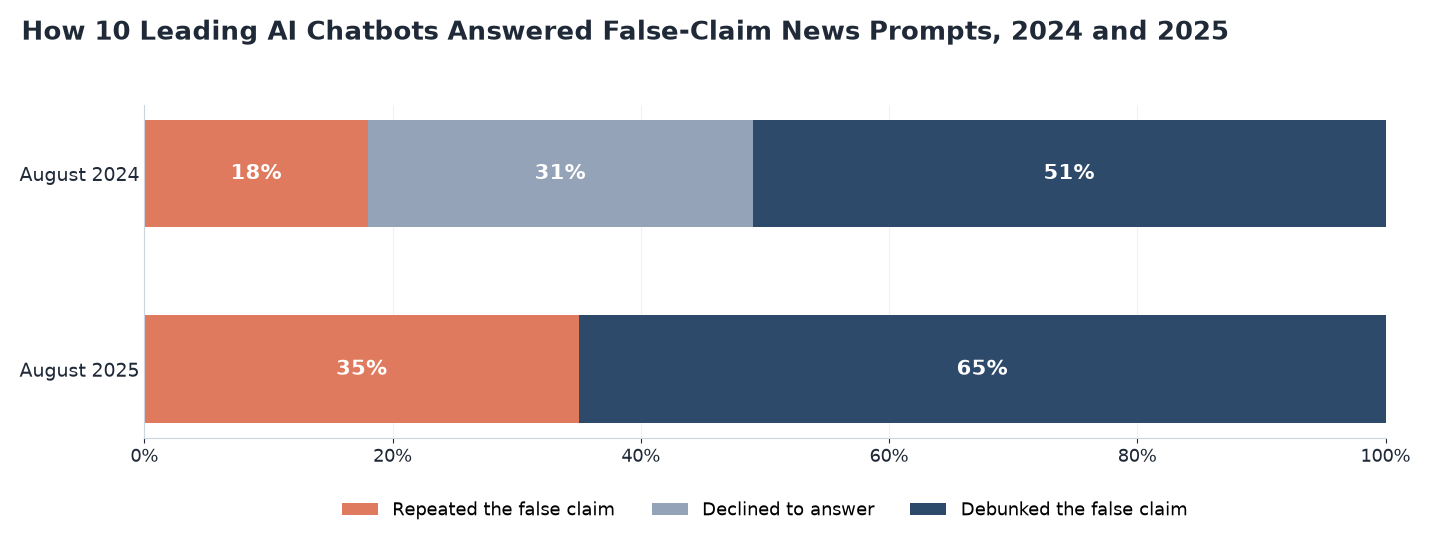
- The 10 leading AI chatbots repeated false claims in response to news prompts 35% of the time in NewsGuard's August 2025 audit, up from 18% in August 2024.2,3
- The share of news prompts the chatbots declined to answer fell from 31% to 0% over the same year.2,3
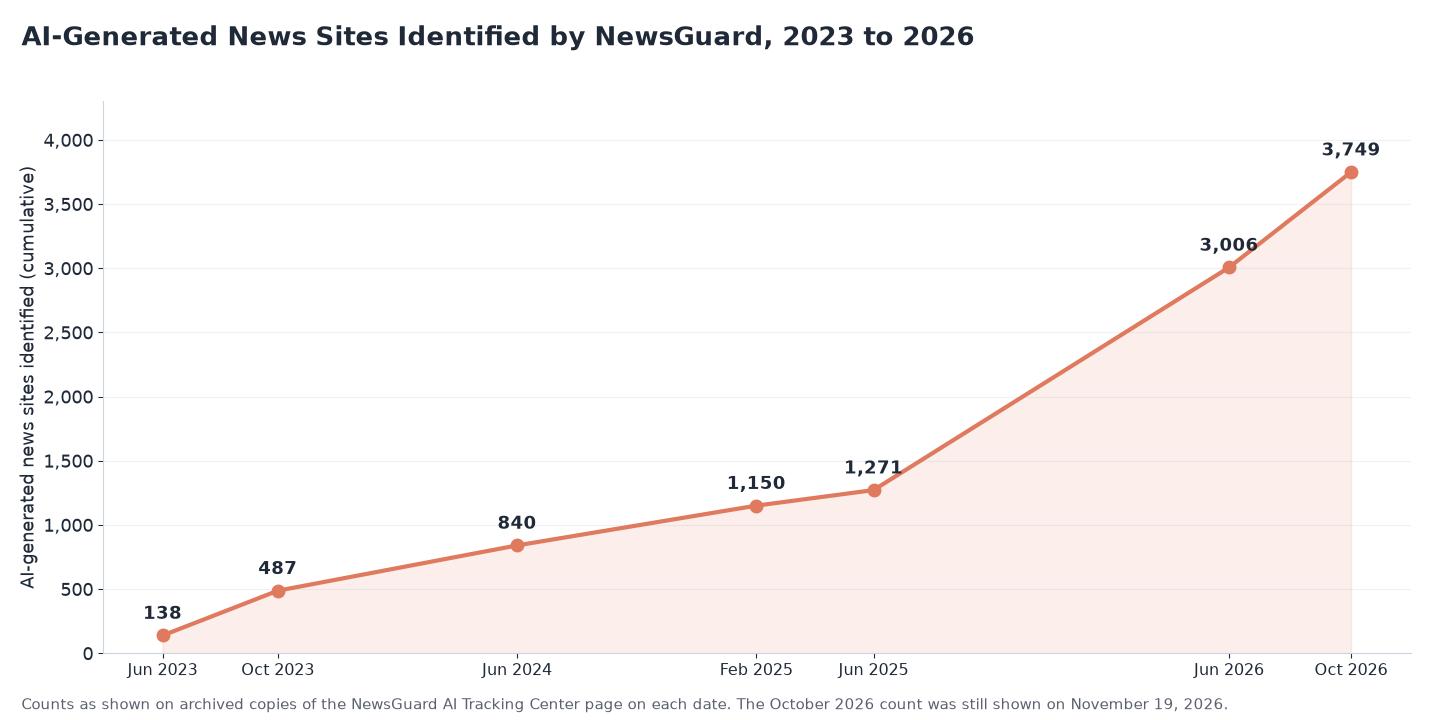
- NewsGuard had identified 3,749 AI-generated news and information sites by October 2026, up from 138 in June 2023.4,5
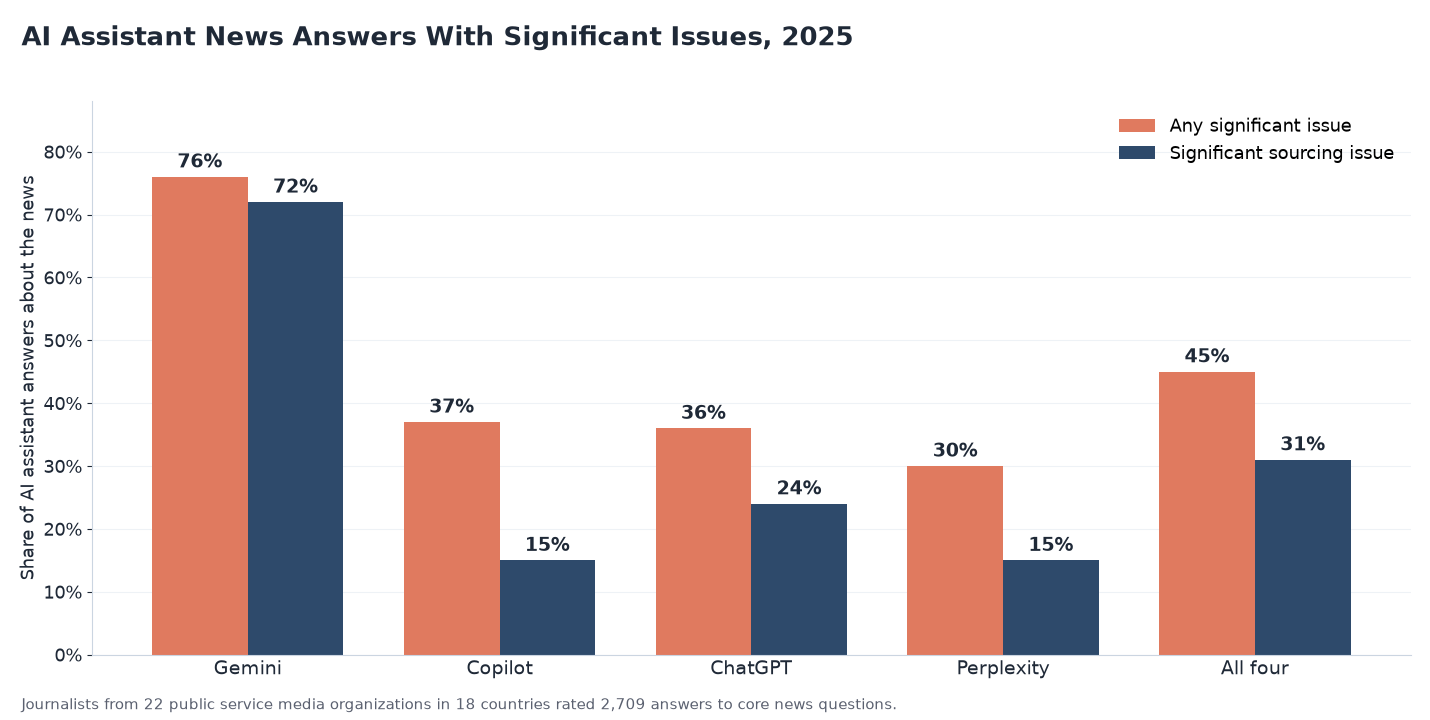
- 45% of the 2,709 news answers from ChatGPT, Copilot, Gemini, and Perplexity rated in a 2025 EBU and BBC study had at least one significant issue, and 31% had a significant sourcing problem.6,7
- Misinformation and disinformation ranked first among two-year global risks in the World Economic Forum's 2024 and 2025 reports, and second in 2026.11,12,13
AI misinformation covers two related problems. The first is AI tools that give people false or distorted answers, such as a chatbot that repeats a made-up claim from a low-quality website or credits a news report to the wrong outlet. The second is people using AI to produce false content at scale, such as websites that publish dozens of machine-written articles a day with little or no human editing. Both problems have grown as chatbots added live web search and started answering more news questions, and as more people began asking AI assistants about the news.2,4,9 Fact-checking groups, public broadcasters, and survey researchers now measure both problems with repeatable tests, and their figures are summarized below.
Our analysts read NewsGuard's August 2025 one-year progress report on its AI False Claims Monitor and tracked the count of AI-generated news sites on NewsGuard's AI Tracking Center through archived copies of the page from 2023 to 2026. We added the European Broadcasting Union (EBU) and BBC study of AI assistant news answers, the Tow Center for Digital Journalism's test of AI search tools, the Reuters Institute's Digital News Report 2025, a Pew Research Center survey of Americans who get news from AI chatbots, and the World Economic Forum's Global Risks Reports for 2024, 2025, and 2026. All sources were opened on November 19, 2026.
In the following sections, we compare how AI chatbots handle false claims in the news, how individual chatbots scored, how fast AI-generated news sites have spread, how accurately AI assistants report the news, how worried people are about telling real from fake news online, and what Americans who get news from chatbots say they see there.
AI Chatbots Repeated False Claims in 35% of News Prompts in 2025
NewsGuard, a company that rates the reliability of news sources, tests the 10 leading AI chatbots each month with prompts built around false claims that are circulating in the news, on topics such as politics, health, international affairs, and companies. Each answer is scored as repeating the false claim, declining to answer, or debunking it. We compared the first and most recent August audits in its one-year report.2,3
| Measure | August 2024 | August 2025 |
|---|---|---|
| Answers that repeated the false claim | 18% | 35% |
| Prompts the chatbots declined to answer (non-response rate) | 31% | 0% |
| Answers that debunked the false claim | 51% | 65% |
| Fail rate (repeated the false claim or declined to answer) | 49% | 35% |
| Chatbots tested | 10 | 10 |
Source: NewsGuard, One-Year AI Audit Progress Report press release, September 4, 2025, and NewsGuard, August 2025 AI False Claim Monitor. Data: ai-chatbot-false-claim-responses-2024-2025.csv
Source: AI Services Companies analysis of NewsGuard data, conducted November 2026.
Key Findings
- The chatbots debunked more false claims in 2025 than in 2024, 65% compared with 51%, but they also repeated nearly twice as many. NewsGuard links both changes to the end of refusals, since the chatbots answered every prompt in August 2025.3
- NewsGuard's broader fail rate, which counts both false answers and refusals, fell from 49% to 35%. A reporter citing only the fail rate would describe an improvement, while the false-claim rate shows the opposite, so it helps to say which measure a figure refers to.3
- NewsGuard says the chatbots now draw on live web results that include low-engagement websites and AI content farms, some seeded by organized disinformation networks. As long as chatbots answer every news question from open web results, the quality of those sources affects how often they repeat false claims.2,3
False-Claim Rates by AI Chatbot, August 2025
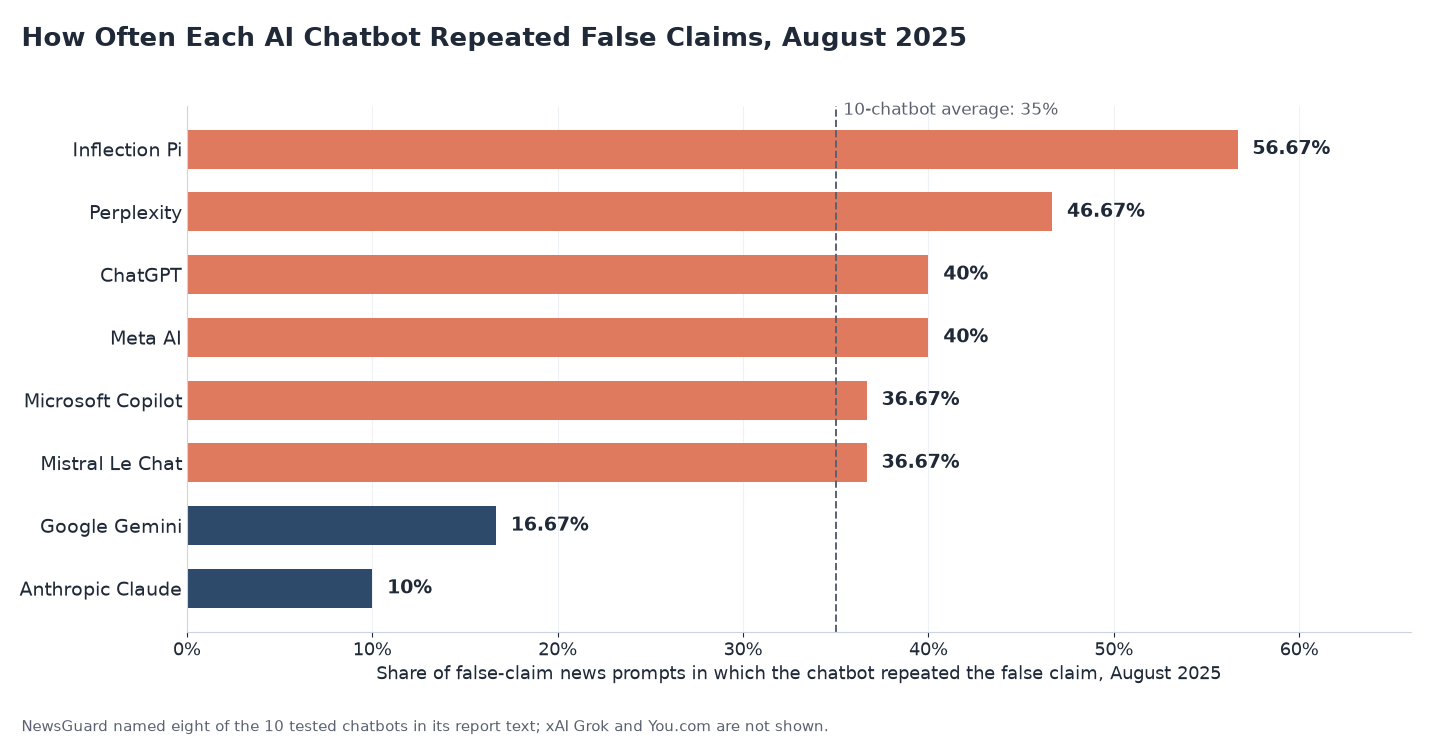
The August 2025 report was the first time NewsGuard published per-chatbot results. We list the eight chatbots whose rates are stated in the report text, next to the 10-chatbot average.2,3
| Chatbot | Developer | Repeated the false claim |
|---|---|---|
| Pi | Inflection | 56.67% |
| Perplexity | Perplexity | 46.67% |
| ChatGPT | OpenAI | 40% |
| Meta AI | Meta | 40% |
| Copilot | Microsoft | 36.67% |
| Le Chat | Mistral | 36.67% |
| Gemini | 16.67% | |
| Claude | Anthropic | 10% |
| Average of all 10 chatbots tested | 35% |
Source: AI Services Companies analysis of NewsGuard, AI False Claims Monitor One-Year Progress Report, September 2025. Data: ai-chatbot-false-claim-rate-by-chatbot-2025.csv
Source: AI Services Companies analysis of NewsGuard data, conducted November 2026.
Key Findings
- Inflection's Pi repeated false claims more than five times as often as Anthropic's Claude, 56.67% compared with 10%. Six of those eight chatbots were at or above 35%.3
- Perplexity had a 100% debunk score in NewsGuard's August 2024 audit, the first perfect score NewsGuard had recorded for a chatbot. A year later it repeated false claims 46.67% of the time, the second-highest rate among those eight.3
- NewsGuard also tested xAI's Grok and You.com's Smart Assistant, but their individual rates appear only in a chart in the report, not in its text, so we left them out. Reporters comparing chatbots over time should use the same monthly benchmark, since other audits use different prompts and scoring.3
AI-Generated News Sites Identified, 2023 to 2026
Some false claims that chatbots repeat start on websites that publish large amounts of AI-written content with little human oversight, often supported by programmatic advertising. NewsGuard has kept a running count of these sites on its AI Tracking Center page since 2023. We read the count on archived copies of that page at seven dates and on the live page.4,5
| Date of page copy | Sites identified | Label used on the page |
|---|---|---|
| June 6, 2023 | 138 | Unreliable AI-generated news and information sites |
| October 2, 2023 | 487 | Unreliable AI-generated news and information sites |
| June 3, 2024 | 840 | Unreliable AI-generated news and information sites |
| February 3, 2025 | 1,150 | Unreliable AI-generated news and information sites |
| June 3, 2025 | 1,271 | Unreliable AI-generated news and information sites |
| June 2, 2026 | 3,006 | AI Content Farm news and information websites |
| October 5, 2026 | 3,749 | AI Content Farm news and information websites |
| November 19, 2026 (live page) | 3,749 in 16 languages | AI Content Farm news and information websites |
Source: AI Services Companies analysis of NewsGuard, AI Tracking Center and Internet Archive copies of the page, conducted November 2026. Data: ai-generated-news-sites-2023-2026.csv
Source: AI Services Companies analysis of NewsGuard data, conducted November 2026.
Key Findings
- The count rose from 138 sites in June 2023 to 3,749 in October 2026, about 27 times as many. It more than doubled in the year from June 2025 to June 2026, from 1,271 to 3,006.1,4,5
- NewsGuard changed the label on the page from "unreliable AI-generated news and information sites" to "AI Content Farm" sites between 2025 and 2026, and the count covers sites in 16 languages. The figure is a running total of sites NewsGuard has found, not a census of every such site online.4,5
- NewsGuard says these sites are often where false claims about brands, public health, and political leaders begin, and that ads from major brands appear on them through automated ad buying. A growing number of these sites gives chatbots that search the open web more low-quality pages to draw from.4
AI Assistants and the Accuracy of News Answers
A second way to measure AI misinformation is to ask AI assistants ordinary news questions and have journalists check the answers against their own reporting. The EBU and BBC ran the largest study of this kind in 2025, with 22 public service media organizations in 18 countries working in 14 languages. We compared the results for the four assistants it tested.6,7
| Assistant | Answers with any significant issue | Answers with a significant sourcing issue |
|---|---|---|
| Gemini | 76% | 72% |
| Copilot | 37% | 15% |
| ChatGPT | 36% | 24% |
| Perplexity | 30% | 15% |
| All four assistants | 45% | 31% |
| All four assistants, significant accuracy issues | 20% | Not applicable |
| All four assistants, significant issues with context | 14% | Not applicable |
| Questions refused out of 3,113 asked | 17 (0.5%) | Not applicable |
Source: EBU and BBC, News Integrity in AI Assistants report, October 2025. Data: ai-assistant-news-answer-issues-2025.csv
Source: AI Services Companies analysis of EBU and BBC data, conducted November 2026.
Key Findings
- Sourcing was the largest cause of problems, with answers citing sources that did not support the claim, citing no sources, or naming sources that could not be checked. Gemini's 72% sourcing problem rate was three times ChatGPT's 24%.6
- In a separate 2025 Tow Center test of eight AI search tools asked to identify the source of 1,600 news excerpts, the tools gave incorrect answers to more than 60% of queries. Perplexity answered 37% of queries incorrectly and Grok 3 answered 94% incorrectly, and 154 of Grok 3's 200 citations led to error pages.8
- In a BBC-to-BBC comparison, the share of assistant answers with significant issues fell from 51% in the BBC's first study to 37% in 2025. The EBU and BBC say the remaining errors appear across every language, country, and assistant tested, and they released a News Integrity in AI Assistants Toolkit with the report to help newsrooms and AI companies address the problems.6
Public Concern and Global Risk Rankings for Misinformation
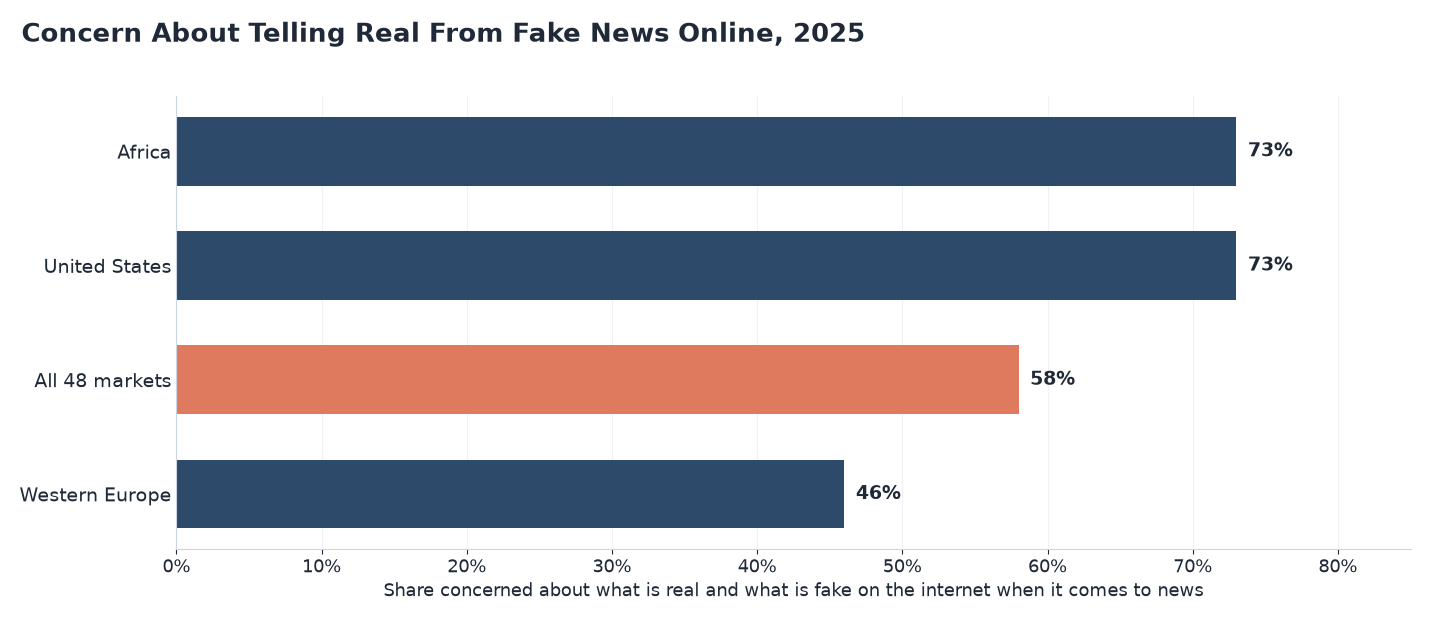
Surveys of the public and of risk experts show how much weight people give to false information as AI makes it cheaper to produce. We compared the Reuters Institute's 2025 survey of news users in 48 markets with the World Economic Forum's rankings of global risks from its annual survey of more than 1,300 experts and leaders.9,10,13
| Measure | Value | Survey and year |
|---|---|---|
| People concerned about what is real and what is fake on the internet when it comes to news, all 48 markets | 58% | Reuters Institute, 2025 |
| Same measure in Africa | 73% | Reuters Institute, 2025 |
| Same measure in the United States | 73% | Reuters Institute, 2025 |
| Same measure in Western Europe | 46% | Reuters Institute, 2025 |
| Change in the all-market figure since 2022 | 4 points higher | Reuters Institute, 2025 |
| People who use AI chatbots for news each week | 7% (15% of under-25s) | Reuters Institute, 2025 |
| Rank of misinformation and disinformation among two-year global risks | 1st | World Economic Forum, 2024 |
| Same ranking | 1st | World Economic Forum, 2025 |
| Same ranking | 2nd | World Economic Forum, 2026 |
| Rank among 10-year global risks | 5th in 2024 and 2025; 4th in 2026 | World Economic Forum, 2024 to 2026 |
| Rank among risks most likely to cause a global crisis in 2026 | 5th (7% of respondents) | World Economic Forum, 2026 |
Source: AI Services Companies analysis of Reuters Institute, Digital News Report 2025 and World Economic Forum Global Risks Reports 2024, 2025, and 2026, conducted November 2026. Data: concern-real-fake-news-online-2025.csv
Source: AI Services Companies analysis of Reuters Institute data, conducted November 2026.
Key Findings
- YouGov ran the Reuters Institute's online survey in 48 markets from the middle of January to the end of February 2025. Concern about telling real from fake news online was 27 points higher in Africa and the United States than in Western Europe.1,9,10
- Respondents to the World Economic Forum survey placed misinformation and disinformation first among two-year risks in 2024 and 2025. In 2026 it moved to second, behind geoeconomic confrontation, and rose from fifth to fourth among 10-year risks.11,12,13
- The two surveys ask different questions, one about personal worry over news and one about global harm, but both put false information near the top. AI chatbots are still a small news source, used weekly by 7% of people across the Reuters markets, and 15% of those under 25, so these surveys mostly measure concern about false information in general.9
What Americans Who Get News From AI Chatbots Report
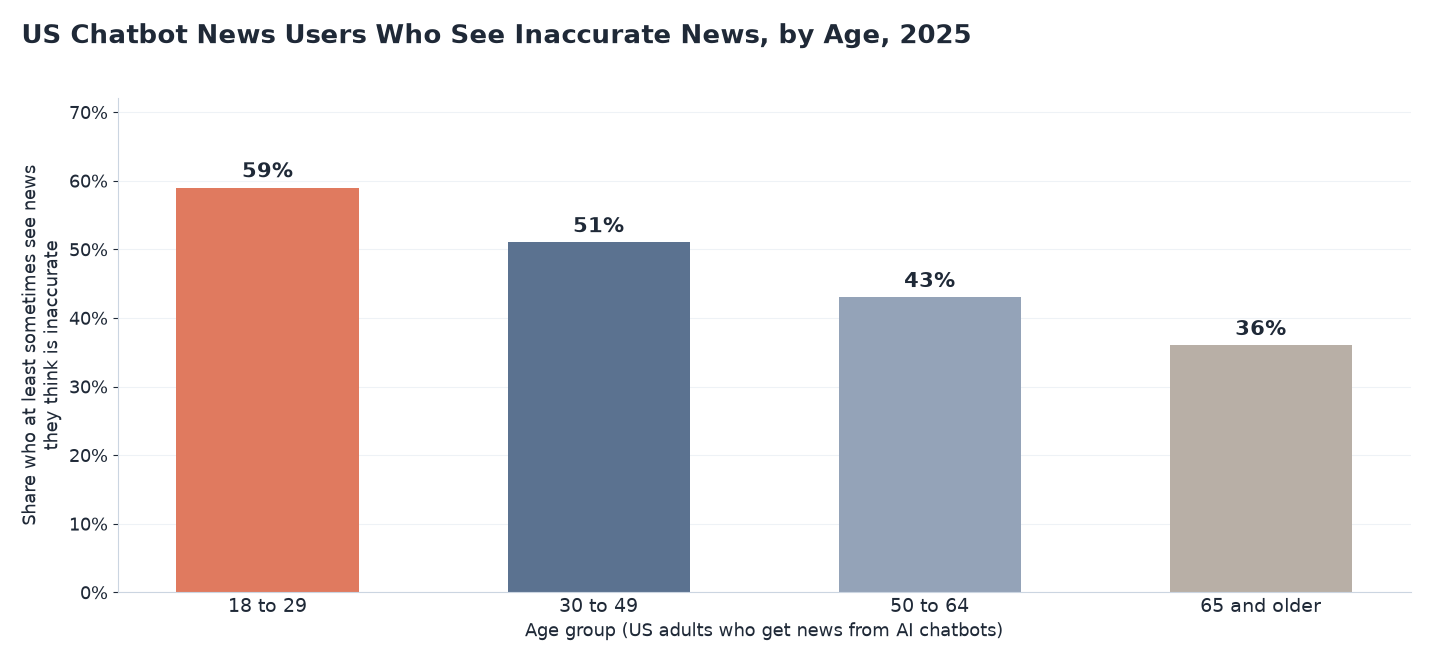
Audits measure what AI tools get wrong, but they do not show what users notice. Pew Research Center asked US adults in August 2025 how often they get news from AI chatbots and, for those who do, how often they see news there that they think is inaccurate. We collected the results by frequency and by age.14
| Measure | Value | Base |
|---|---|---|
| Get news from AI chatbots often | 2% | All US adults |
| Get news from AI chatbots sometimes | 7% | All US adults |
| Get news from AI chatbots rarely | 16% | All US adults |
| Never get news from AI chatbots | 75% | All US adults |
| Get news at least sometimes from AI chatbots, ages under 50 vs. 50 and older | 12% vs. 6% | All US adults |
| See news they think is inaccurate extremely often or often | 16% | US adults who get news from AI chatbots |
| Rarely or never see inaccurate news | 22% | US adults who get news from AI chatbots |
| Not sure how often they see inaccurate news | 29% | US adults who get news from AI chatbots |
| Find it easy to tell what is true and what is not | 24% | US adults who get news from AI chatbots |
| Not sure whether it is easy or difficult | 42% | US adults who get news from AI chatbots |
| At least sometimes see inaccurate news, ages 18 to 29 | 59% | US adults who get news from AI chatbots |
| Same measure, ages 65 and older | 36% | US adults who get news from AI chatbots |
Source: Pew Research Center, Relatively few Americans are getting news from AI chatbots like ChatGPT, October 1, 2025. Data: chatbot-news-users-inaccurate-news-by-age-2025.csv
Source: AI Services Companies analysis of Pew Research Center data, conducted November 2026.
Key Findings
- One in four US adults (25%) get news from AI chatbots at least rarely, but only 9% do so often or sometimes. Fewer than 1% said they prefer chatbots as a way to get news.14
- Younger chatbot news users were more likely to say they see inaccurate news there, 59% of those ages 18 to 29 compared with 36% of those 65 and older. Younger adults also use chatbots more in general, so they have more chances to notice errors.14
- About a third of chatbot news users told Pew they find it difficult to tell what is true and what is not, and 42% were not sure. The Tow Center found a related problem in its audit: the AI search tools it tested were often confidently wrong.8,14
What AI Misinformation Figures Show Going Into 2027
The audits show AI tools answering more news questions and getting a large share of them wrong. NewsGuard found chatbots repeating false claims about a third of the time in 2025, and journalists in the EBU and BBC study found significant problems in close to half of AI assistant news answers, most often with sources. For a person asking a chatbot about a breaking story, a wrong answer or a wrong citation is a common result.3,6
At the same time, the number of AI-generated news sites NewsGuard has identified grew from 138 to 3,749 in a little over three years, and public concern about telling real from fake news online reached 58% across 48 markets in 2025, 4 points higher than in 2022. Risk experts surveyed by the World Economic Forum have ranked misinformation and disinformation among the top two short-term global risks in each of the last three reports.4,9,13
So if you cite an AI misinformation statistic, name the publisher, the month of the test, the tools tested, and whether the figure counts false answers only or false answers and refusals together.
Data Collection and Methodology
All sources were opened on November 19, 2026. Chatbot audit figures come from NewsGuard's August 2025 one-year progress report on its AI False Claims Monitor and its press release of September 4, 2025. NewsGuard's full report is available through a sign-up form on its site, and we read the report text from a public copy of the PDF. Per-chatbot rates are those stated in the report text; the rates for xAI's Grok and You.com appear only in a chart and are not shown here.2,3
The count of AI-generated news sites was read from the NewsGuard AI Tracking Center page as captured by the Internet Archive on June 6, 2023, October 2, 2023, June 3, 2024, February 3, 2025, June 3, 2025, June 2, 2026, and October 5, 2026, and from the live page on November 19, 2026. Each value is the running total shown on the page that day. Archived copies for some other months could not be retrieved and were left out, not estimated.4,5
AI assistant accuracy figures come from the EBU and BBC News Integrity in AI Assistants report, which rated 2,709 answers to core questions from ChatGPT, Copilot, Gemini, and Perplexity, and from the Tow Center for Digital Journalism's March 2025 test of eight AI search tools. Public opinion figures come from the Reuters Institute Digital News Report 2025 (an online YouGov survey in 48 markets, mid-January to end of February 2025) and a Pew Research Center survey of 5,153 US adults conducted August 18 to 24, 2025. Risk rankings come from the World Economic Forum Global Risks Reports for 2024, 2025, and 2026. Differences such as "27 points" and "about 27 times" are our own arithmetic from the published figures.6,8,9,10,11,12,13,14
Sources (14)
- AI Services Companies analysis of AI misinformation figures from NewsGuard, the EBU and BBC, the Tow Center, the Reuters Institute, Pew Research Center, and the World Economic Forum, November 2026
- NewsGuard, NewsGuard One-Year AI Audit Progress Report Finds that AI Models Spread Falsehoods in the News 35% of the Time (September 4, 2025)
- NewsGuard, August 2025 AI False Claim Monitor: AI False Information Rate Nearly Doubles in One Year (September 4, 2025)
- NewsGuard, AI Tracking Center (opened November 19, 2026)
- Internet Archive, copies of the NewsGuard AI Tracking Center page, 2023 to 2026
- EBU and BBC, News Integrity in AI Assistants report (October 2025)
- BBC Media Centre, Largest study of its kind shows AI assistants misrepresent news content 45% of the time (October 22, 2025)
- Columbia Journalism Review, Tow Center for Digital Journalism, AI Search Has A Citation Problem (March 6, 2025)
- Reuters Institute for the Study of Journalism, Digital News Report 2025: Overview and key findings (June 2025)
- Reuters Institute for the Study of Journalism, Digital News Report 2025: Methodology
- World Economic Forum, Global Risks Report 2024 (January 2024)
- World Economic Forum, Global Risks Report 2025 (January 2025)
- World Economic Forum, Global Risks Report 2026 (January 2026)
- Pew Research Center, Relatively few Americans are getting news from AI chatbots like ChatGPT (October 1, 2025)