
AI Project Failure Rate Statistics 2026
Published October 10, 2026. Updated November 16, 2026.
Our analysts compared 14 studies and forecasts on AI project failure published between August 2022 and November 2026 by MIT NANDA, IDC, RAND, BCG, S&P Global, Gartner, IBM, Metrigy, and Air IT Group, recording what each one counts as a failure, who was asked, and when, to show how often AI projects stall or are abandoned as of Q4 2026.
Key Findings
- 60% of organizations evaluated custom or vendor-sold enterprise generative AI tools in 2025, 20% reached the pilot stage, and 5% reached production, according to MIT NANDA.2
- For every 33 AI proofs of concept a company launched, only 4 reached production, an 88% drop-off, according to IDC research with Lenovo published in March 2025.4
- 42% of companies abandoned most of their AI initiatives before production in S&P Global's late 2024 survey, up from 17% a year earlier.7,8
- Gartner found that at least 50% of generative AI projects were abandoned after proof of concept by the end of 2025, above its own 2024 forecast of at least 30%.9,10
- 62% of UK organizations that formally track AI pilots abandoned at least one in the 12 months before Air IT Group's November 2026 survey.17
"Most AI projects fail" is one of the most repeated lines in enterprise technology, and the numbers quoted behind it range from 95% to under 20%. A company starts an AI project, usually as a small trial called a pilot or proof of concept, to test whether a model can do a useful job with its own data. If the trial works, the project moves into production, where staff or customers use it every day. Many projects never make that move: the trial disappoints, the data is not ready, costs climb, or the people paying for it lose interest. Each research group measures a different one of those outcomes, so two failure rates for the same year can differ by more than 50 points. Reporters and buyers quoting a figure need to know which one it is.
Our analysts collected the most cited published figures on AI project failure, pilot abandonment, and production rates. For each figure, we recorded the outcome it measures, the sample, the survey period, and the publication date. We opened each source again in November 2026 and took every number from the source text. We then grouped the figures by stage, from first evaluation to production, and lined up the surveys that asked the same question in more than one year.
In the following sections, we compare the headline failure figures and what each one counts, where generative AI tools drop out between evaluation and production, how production and abandonment rates have changed since 2019, what share of pilots reach production, how Gartner's abandonment forecasts have held up, and the reasons companies give for stalled projects.
Published AI Failure Figures Range From 16.6% to 95% Because They Count Different Outcomes
A single "AI failure rate" does not exist, because each study counts something different: companies without a return, pilots that never launch, or projects cancelled after launch. We listed the most cited figures with their definitions and samples so each one can be quoted with its own scope.
| Source | Figure | What it measures | Sample or basis | Published |
|---|---|---|---|---|
| MIT NANDA, The GenAI Divide | 95% | Organizations getting zero return from generative AI | 52 organization interviews, 153 leader surveys, and 300+ public initiatives, January to June 2025 | July 2025 |
| IDC with Lenovo | 88% | AI proofs of concept that did not reach wide-scale deployment (29 of every 33) | IDC research, reported by CIO.com | March 2025 |
| RAND, The Root Causes of Failure for Artificial Intelligence Projects | More than 80% | AI projects that fail "by some estimates," about twice the rate for IT projects without AI | Cited from earlier estimates; 65 interviews with data scientists and engineers, August to December 2023 | August 2024 |
| BCG, Where's the Value in AI? | 74% | Companies that have yet to show tangible value from AI | 1,000 executives in 59 countries | October 2024 |
| Gartner | At least 50% | Generative AI projects abandoned after proof of concept by the end of 2025 | Gartner analysis of hundreds of generative AI implementations | January 2026 |
| S&P Global Market Intelligence | 46% | Average share of AI proofs of concept scrapped before production | 1,006 IT and business professionals in North America and Europe, October to November 2024 | March 2025 |
| S&P Global Market Intelligence | 42% | Companies abandoning most of their AI initiatives before production (17% a year earlier) | Same survey | March 2025 |
| Metrigy, AI Organizational Best Practices 2026-27 | 16.6% | AI projects discontinued once in production | 756 companies worldwide | July 2026 |
Source: AI Services Companies analysis of MIT NANDA, CIO.com on IDC, RAND, BCG, Gartner, CFO Dive on S&P Global, and Metrigy, conducted November 2026. Data: ai-project-failure-headline-figures.csv
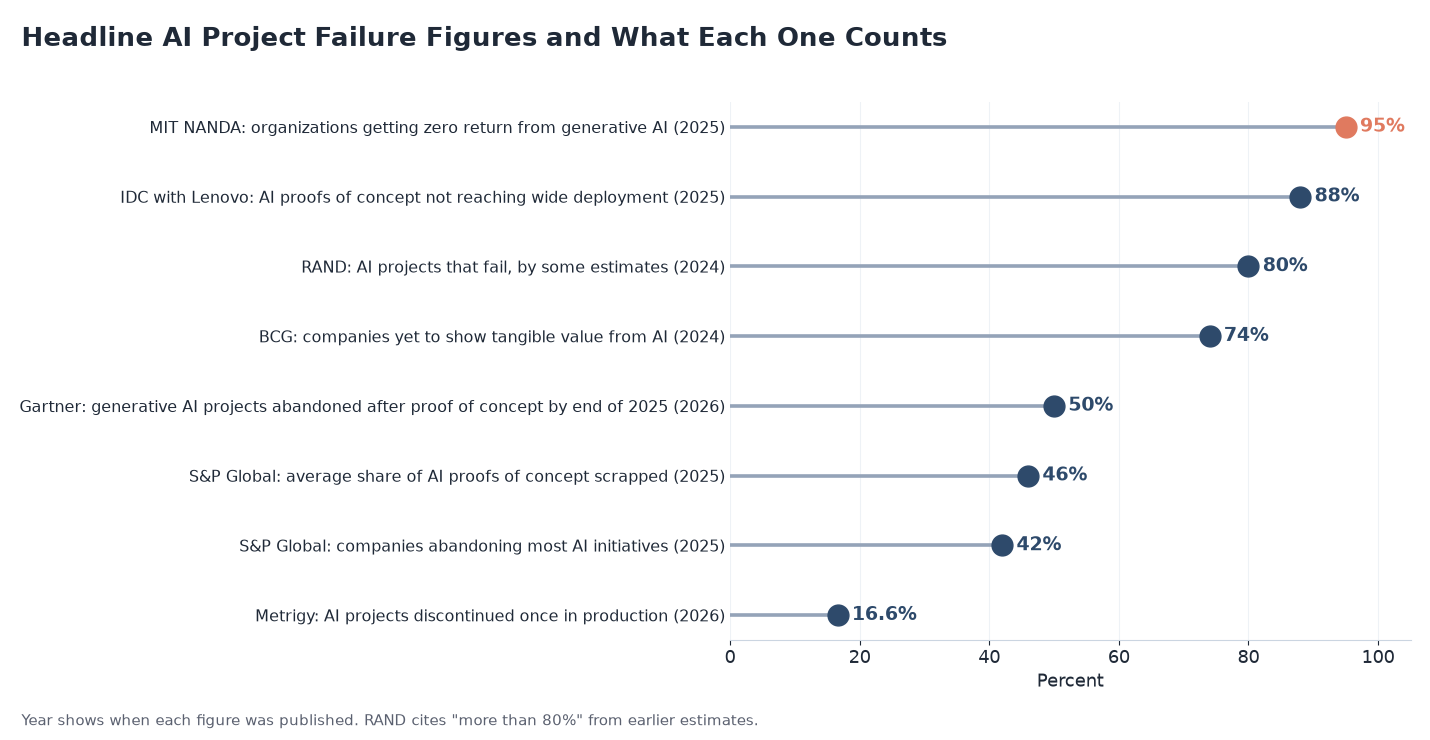
Source: AI Services Companies analysis of eight published studies and forecasts, conducted November 2026.
Key Findings
- The highest figures measure value. MIT NANDA's 95% and BCG's 74% count organizations that have not seen a return, which includes projects still running, so neither is a count of cancelled projects.2,6
- RAND's "more than 80%" is often quoted as a RAND finding. The report attributes it to earlier estimates and puts it beside a second claim, that AI projects fail at about twice the rate of IT projects without AI.5
- The lowest figure in the set comes from the latest survey. Metrigy's 756-company study, published in July 2026, found companies discontinue 16.6% of AI projects once they are in production, which shows that most losses happen before launch.16
Only 5% of Organizations Took Custom Enterprise Generative AI Tools Into Production in 2025
MIT NANDA's study is the source of the most quoted number in this debate, and its full report tracks organizations through each stage from first look to production. We pulled the stage-by-stage shares for the two kinds of tools it compared.
| Tool type | Stage | Share of organizations |
|---|---|---|
| Custom or vendor-sold enterprise AI tools | Evaluated | 60% |
| Custom or vendor-sold enterprise AI tools | Reached pilot | 20% |
| Custom or vendor-sold enterprise AI tools | Reached production | 5% |
| General-purpose tools such as ChatGPT and Copilot | Explored or piloted | Over 80% |
| General-purpose tools such as ChatGPT and Copilot | Deployed | Nearly 40% |
| Generic LLM chatbots | Pilot-to-implementation rate | About 83% |
Source: MIT NANDA, The GenAI Divide: State of AI in Business 2025, July 2025. Data: mit-nanda-genai-adoption-funnel-2025.csv
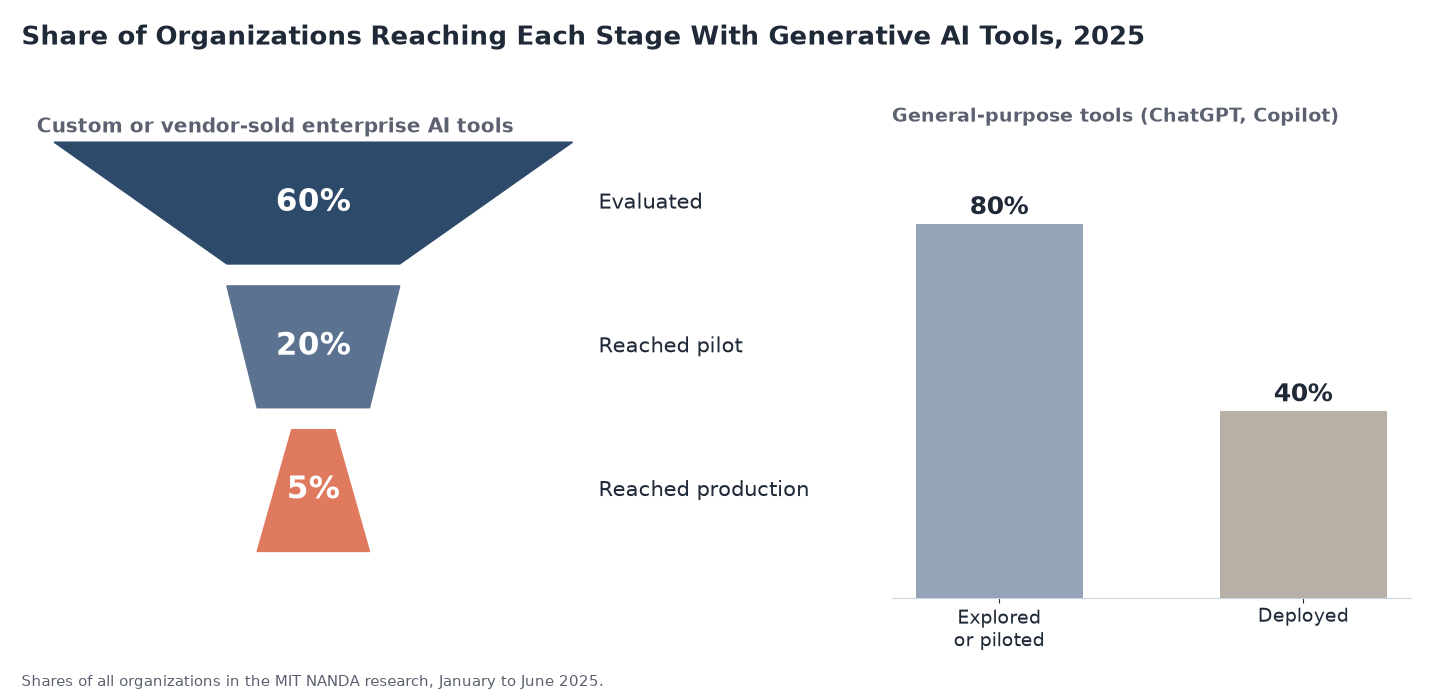
Source: AI Services Companies analysis of MIT NANDA data, conducted November 2026. Data: mit-nanda-genai-adoption-funnel-2025.csv
Key Findings
- Of the organizations that evaluated a custom or vendor-sold enterprise AI tool, about 1 in 12 had one in production. Of those that reached the pilot stage, one in four got to production.2
- General-purpose chat tools move far more easily. Generic LLM chatbots convert pilots to use at about 83%, and workers at over 90% of surveyed companies reported regular use of personal AI tools, against 40% of companies that bought an official subscription.2
- The 5% figure describes custom enterprise tools reaching production, so it is often misquoted as "95% of AI pilots fail." MIT NANDA found that tools bought from specialized vendors and built with partners succeeded about 67% of the time, while internal builds succeeded one-third as often.2,3
The Share of Companies Abandoning Most AI Initiatives Rose From 17% to 42% in One Year
Most failure figures come from one-time studies, so they cannot show whether things are getting better or worse. We collected the surveys that asked the same question in more than one year: Gartner's average production rate for AI projects and S&P Global's share of companies abandoning most of their AI work.
| Source | Measure | Survey year | Result | Published |
|---|---|---|---|---|
| Gartner, AI in Organizations Survey | Average share of AI projects reaching production | 2019 | 53% | 2019 survey, cited August 2022 |
| Gartner | Average share of AI projects moving from pilot to production | 2021 (October to December, 699 respondents) | 54% | August 22, 2022 |
| Gartner | Average share of AI projects reaching production | 2023 (fourth quarter, 644 respondents) | 48% | May 7, 2024 |
| S&P Global Market Intelligence | Companies abandoning the majority of AI initiatives before production | 2023 (1,001 respondents) | 17% | Prior-year result, reported March 2025 |
| S&P Global Market Intelligence | Companies abandoning the majority of AI initiatives before production | 2024 (October 21 to November 25, 1,006 respondents) | 42% | March 2025 |
Source: Gartner, August 22, 2022; Gartner, May 7, 2024; CFO Dive on S&P Global, March 14, 2025; The Langford Institute on S&P Global survey dates. Data: ai-production-and-abandonment-rates-2019-2024.csv
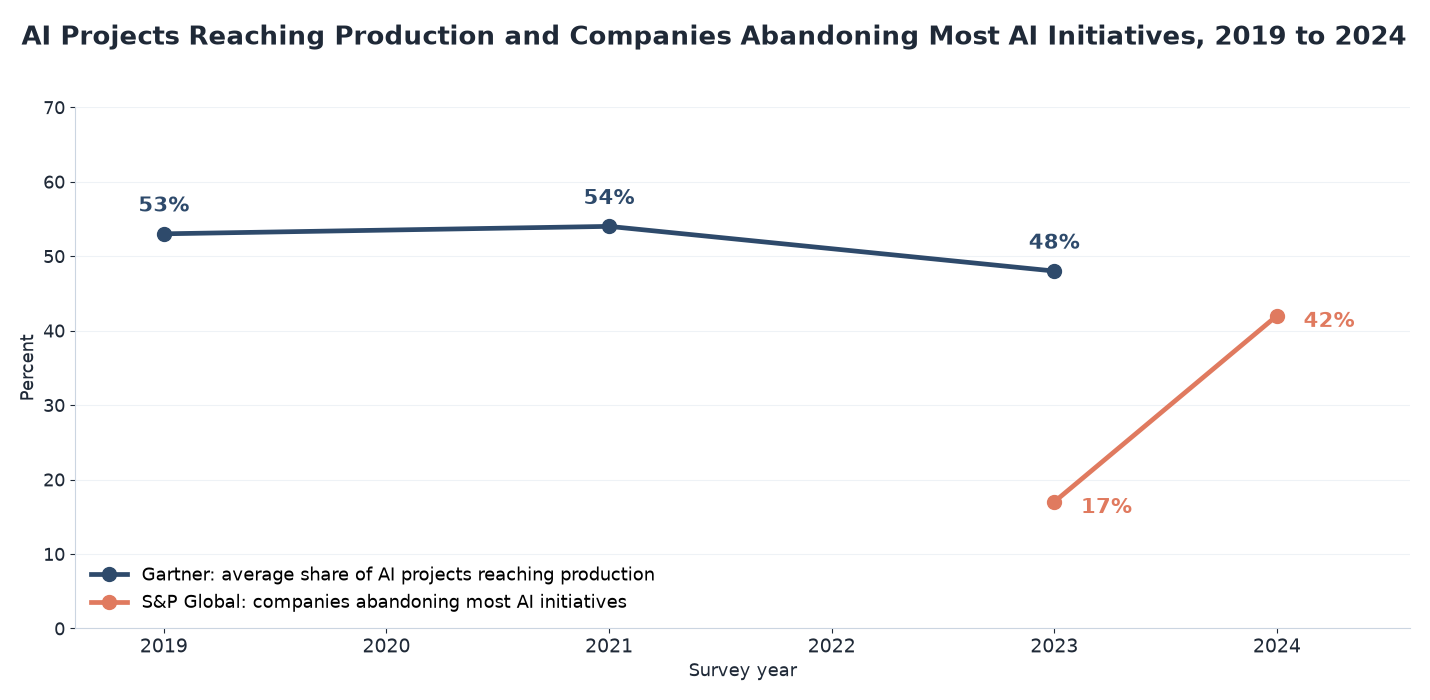
Source: AI Services Companies analysis of Gartner and S&P Global survey data, conducted November 2026. Data: ai-production-and-abandonment-rates-2019-2024.csv
Key Findings
- S&P Global's abandonment share rose 2.5 times in one year, from 17% to 42%. Respondents cited cost, data privacy, and security risks as the top obstacles.7
- Gartner's production rate held near half for four years, at 53% in 2019 and 54% in 2021, then fell to 48% in its fourth quarter 2023 survey. The same survey also found it took 8 months on average to move from AI prototype to production.14,13
- Both measures come from surveys fielded in 2024 or earlier, and we found no newer published reading of either question. The 2024 jump in abandonment is one reading so far, not a confirmed multi-year trend.8
Studies Put the Share of AI Projects Reaching Production Between 12% and 48%
For a team deciding how many pilots to fund, the most useful number is the share that make it into daily use. We gathered every figure in our set that measures the step from proof of concept to production or to enterprise-wide scale.
| Source | Measure | Value | Sample or basis | Published |
|---|---|---|---|---|
| IDC with Lenovo | AI proofs of concept reaching production | 4 of 33 (12%) | IDC research | March 2025 |
| S&P Global Market Intelligence | Average share of AI proofs of concept scrapped before production | 46% | 1,006 IT and business professionals, North America and Europe | March 2025 |
| Gartner | Average share of AI projects reaching production | 48% | 644 respondents in the US, Germany, and UK | May 2024 |
| Gartner | Average time from AI prototype to production | 8 months | Same survey | May 2024 |
| MIT NANDA | Organizations with custom or vendor-sold enterprise AI tools in production | 5% | 52 interviews, 153 leader surveys, 300+ public initiatives | July 2025 |
| IBM Institute for Business Value, CEO Study | AI initiatives that delivered expected ROI over the last few years | 25% | 2,000 CEOs worldwide | May 2025 |
| IBM Institute for Business Value, CEO Study | AI initiatives scaled enterprise-wide | 16% | 2,000 CEOs worldwide | May 2025 |
| Metrigy | AI projects discontinued once in production | 16.6% | 756 companies worldwide | July 2026 |
Source: CIO.com on IDC with Lenovo, March 25, 2025; CFO Dive on S&P Global; Gartner, May 7, 2024; MIT NANDA; IBM, May 6, 2025; Metrigy, July 7, 2026. Data: ai-pilot-to-production-figures.csv
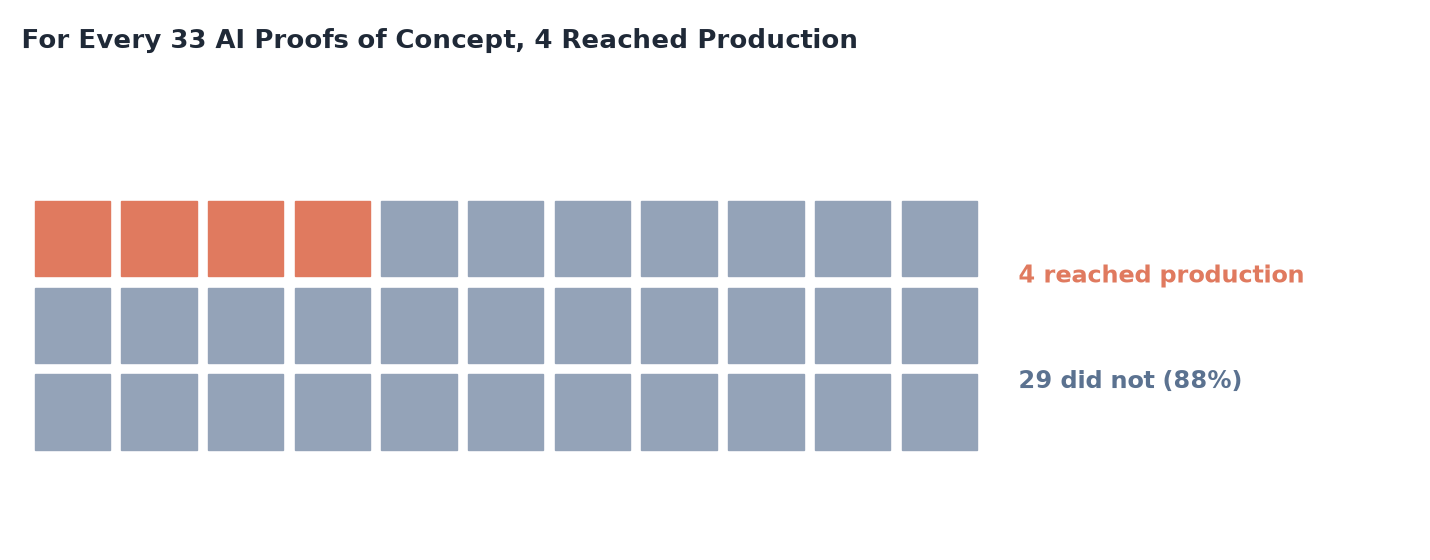
Source: AI Services Companies analysis of IDC research with Lenovo as reported by CIO.com, conducted November 2026.
Key Findings
- IDC's 4 in 33 is the lowest conversion rate among studies that count individual projects, and IDC linked it to low organizational readiness in data, processes, and IT infrastructure.4
- Reaching production does not mean paying off. IBM's CEO respondents said 25% of their AI initiatives delivered the expected return over the last few years, and 16% had been scaled across the whole enterprise.15
- The 2026 data is less bleak than the 2025 headlines. In Metrigy's survey, 85% of companies said fewer than 40% of their AI pilots fail to continue into production, and the largest group, 30.3%, put their pilot failure rate at 11% to 20%.16
Gartner Forecast 30% Generative AI Abandonment for 2025 and Found at Least 50%
Forecasts from Gartner are among the most quoted AI failure statistics, and some have deadlines that have now passed. We listed Gartner's published abandonment and cancellation forecasts, the reasons it gave, and the one result it has reported against its own prediction.
| Prediction | Forecast | Deadline | Reasons Gartner gave | Published | Reported result |
|---|---|---|---|---|---|
| Generative AI projects abandoned after proof of concept | At least 30% | End of 2025 | Poor data quality, inadequate risk controls, escalating costs, or unclear business value | July 29, 2024 | At least 50% (January 26, 2026) |
| AI projects unsupported by AI-ready data abandoned | 60% | Through 2026 | 63% of organizations lack or are unsure they have the right data management practices for AI | February 26, 2025 | Not yet reported |
| Agentic AI projects canceled | Over 40% | End of 2027 | Escalating costs, unclear business value, or inadequate risk controls | June 25, 2025 | Not yet reported |
Source: Gartner, July 29, 2024; Gartner, January 26, 2026; Gartner, February 26, 2025; Gartner, June 25, 2025. Data: gartner-ai-abandonment-forecasts.csv
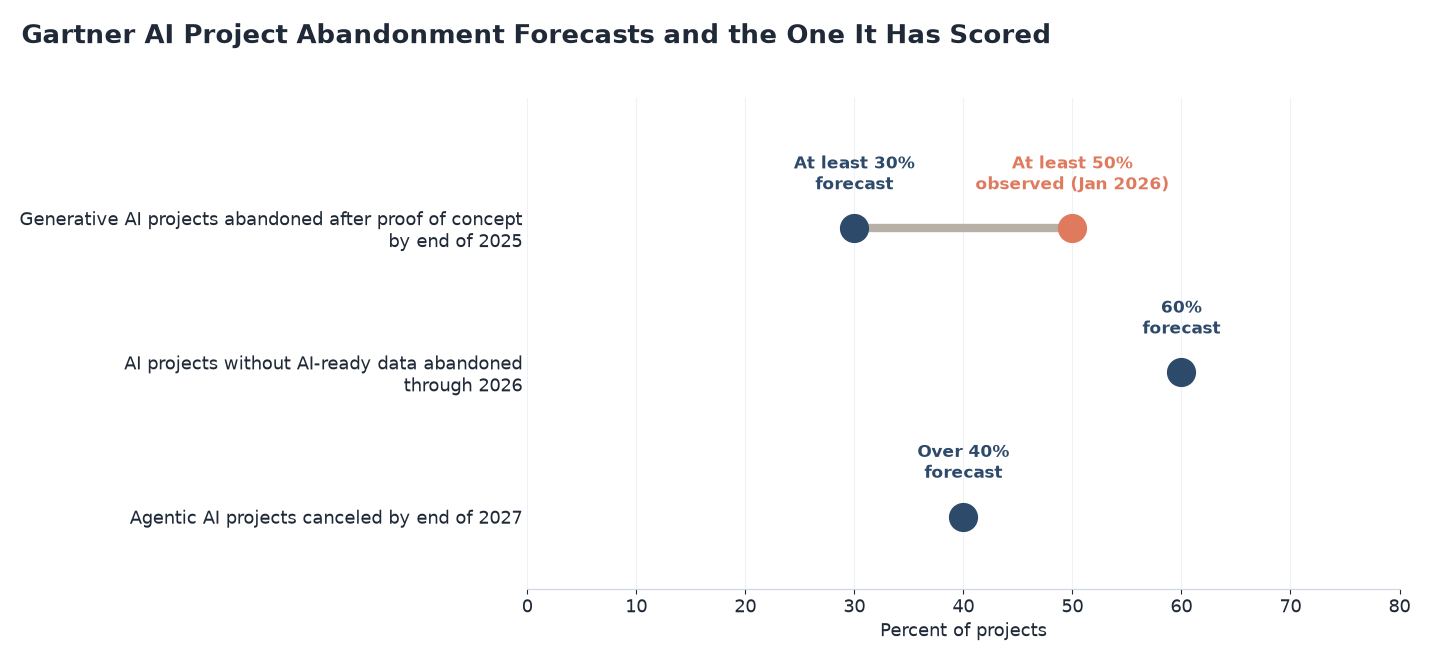
Source: AI Services Companies analysis of Gartner press releases and research, conducted November 2026. Data: gartner-ai-abandonment-forecasts.csv
Key Findings
- Gartner's generative AI forecast undershot by at least 20 points. It predicted at least 30% abandonment after proof of concept by the end of 2025 and later reported at least 50%, citing the same four causes.9,10
- The data forecast rests on a survey of 1,203 data management leaders in July 2024, in which 63% said their organizations did not have, or were unsure they had, the right data management practices for AI.12
- The agentic AI forecast comes with a vendor warning. Gartner estimates only about 130 of the thousands of agentic AI vendors are real and calls the relabeling of chatbots and automation tools as agents "agent washing," a warning for buyers comparing agent products.11
People and Process Problems Cause About 70% of AI Implementation Challenges
Knowing why projects stall is more useful to a project team than the failure rate itself. We collected the reasons that executives and practitioners give in the same studies, from technical problems to unclear goals.
| Source | Finding | Value |
|---|---|---|
| BCG (2024, 1,000 executives) | Share of AI implementation challenges from people and processes | About 70% |
| BCG (2024) | Share from technology problems | 20% |
| BCG (2024) | Share from AI algorithms | 10% |
| Gartner (2024, 644 respondents) | Respondents reporting difficulty estimating and demonstrating AI value as a top barrier, the most cited | 49% |
| Air IT Group (2026, 504 UK decision-makers) | Spent on AI without measurable returns, or not measuring returns | 83% |
| Air IT Group (2026) | Bought or introduced an AI tool before agreeing what problem it should solve | 41% |
| Air IT Group (2026) | Said AI made a task or process take longer once checking, correction, setup, and management were counted | 47% |
| Air IT Group (2026) | Most common reason for abandoning a pilot: integration difficulties | 34% |
| Air IT Group (2026) | Most common reason for abandoning a pilot: employee non-adoption | 29% |
| S&P Global (2025) | Respondents citing staff resistance to AI as a challenge | 28% |
| RAND (2024, 65 interviews) | Leading root cause from industry interviews | Stakeholders misunderstand or miscommunicate the problem AI should solve |
Source: BCG, October 24, 2024; Gartner, May 7, 2024; IT Brief on Air IT Group, November 11, 2026; The Langford Institute on S&P Global; RAND, 2024. Data: why-ai-projects-stall-survey-findings.csv
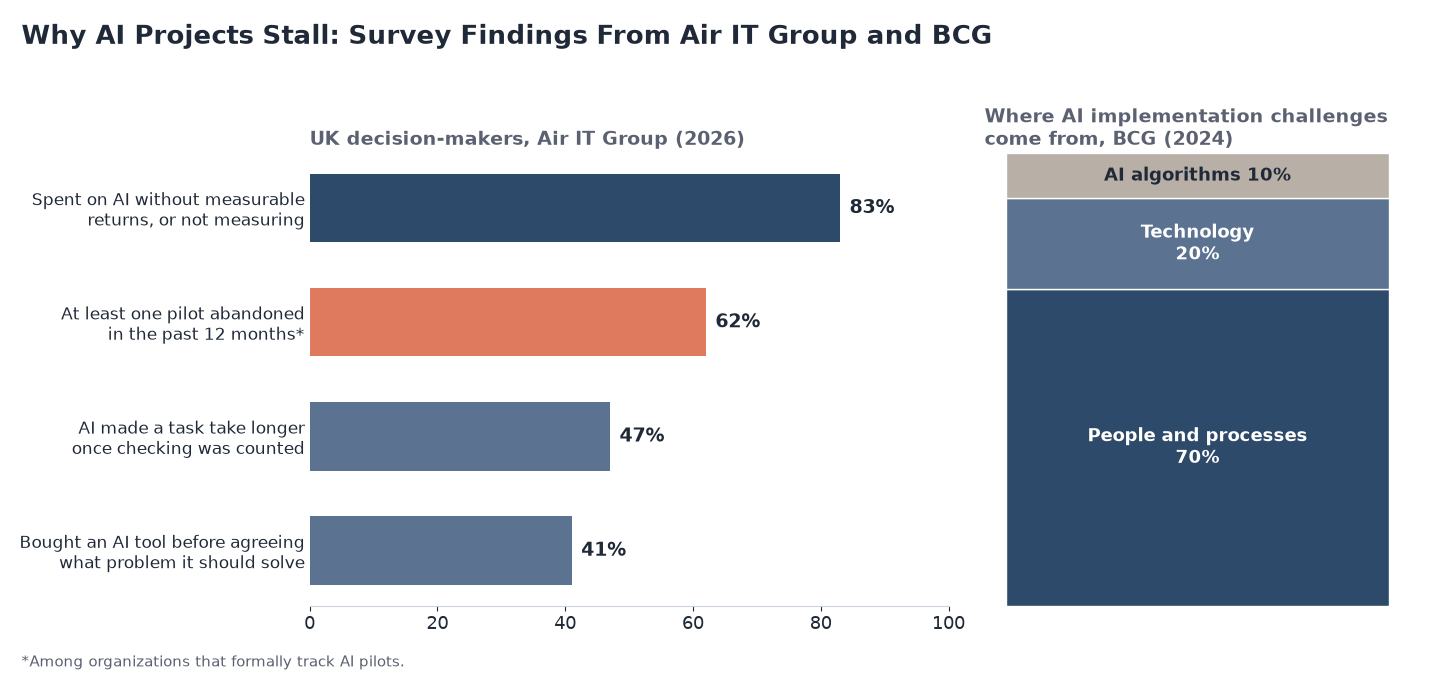
Source: AI Services Companies analysis of Air IT Group and BCG survey data, conducted November 2026. Data: why-ai-projects-stall-survey-findings.csv
Key Findings
- BCG found that algorithms cause about 10% of AI implementation challenges but often take a disproportionate share of time and resources. The leaders in its survey put 70% of their resources into people and processes.6
- Unclear goals show up before a pilot starts. 41% of UK organizations in Air IT Group's survey introduced an AI tool before agreeing on the problem, and 74% of those with an active AI initiative said not every initiative had both an agreed objective and a measure of success.17
- RAND's interviewees put a misunderstood or miscommunicated business problem first among five root causes. For a project sponsor, writing down the problem and the measure of success before a pilot begins addresses the cause that RAND, Air IT Group, and Gartner all report.5,17,13
What AI Project Failure Rates Mean Going Into 2027
For the people running AI projects, the main risk is rarely that a model stops working. A trial that works well enough often never gets the budget, data access, or staff to run every day, and whoever is paying ends it. Most of the losses in these studies happen between the pilot and production, and the reasons companies give are mostly about unclear goals, unready data, cost, and staff who do not use the tool.
The figures also differ more by definition than by year. A 95% rate for organizations with no return and a 16.6% rate for projects cancelled after launch can both be accurate, and only S&P Global and Gartner have measured the same thing twice. Gartner's AI-ready data and agentic AI forecasts reach their deadlines at the end of 2026 and 2027.
So if you cite an AI failure rate, say whether it counts companies without a return, pilots that never reached production, or projects cancelled after launch, and give the source's sample and survey year.
Data Collection and Methodology
We collected published figures on AI project failure, abandonment, and production rates from 14 studies, surveys, and forecasts released between August 2022 and November 2026 by nine research groups: MIT NANDA, IDC (with Lenovo), RAND, BCG, S&P Global Market Intelligence (451 Research), Gartner (six releases), the IBM Institute for Business Value, Metrigy, and Air IT Group. We opened every source page in November 2026 and recorded each figure with its definition, sample, survey period, and publication date. Where a study was available only through press coverage (IDC through CIO.com, S&P Global through CFO Dive and The Langford Institute, Air IT Group through IT Brief), we cite the article we opened.
Figures from different groups measure different things and use different samples, so we do not average or combine them. The trend table includes only measures that one group repeated with the same wording. Gartner's 2019 production rate comes from its 2022 release, which cites its 2019 AI in Organizations Survey. Survey year is the year fieldwork took place, which is often the year before publication. The MIT NANDA findings are labeled preliminary by their authors and are based on 52 interviews, 153 leader surveys, and more than 300 public AI initiatives from January to June 2025. RAND's "more than 80%" is an estimate RAND cites from earlier sources, not a result of its interviews. Gartner forecasts are shown as forecasts, and the only reported result against a Gartner forecast is its January 2026 figure for generative AI projects. We calculated products, differences, and ratios from the published values.
Sources (17)
- AI Services Companies analysis of 14 published studies, surveys, and forecasts on AI project failure, abandonment, and production rates from nine research groups, 2022 to 2026, conducted November 2026.
- MIT NANDA, The GenAI Divide: State of AI in Business 2025 (July 2025)
- Fortune, MIT report: 95% of generative AI pilots at companies are failing (August 18, 2025)
- CIO.com, 88% of AI pilots fail to reach production, but that's not all on IT (March 25, 2025)
- RAND, The Root Causes of Failure for Artificial Intelligence Projects and How They Can Succeed, RR-A2680-1 (2024)
- BCG, AI Adoption in 2024: 74% of Companies Struggle to Achieve and Scale Value (October 24, 2024)
- CFO Dive, AI project failure rates are on the rise: report (March 14, 2025)
- The Langford Institute, Companies abandoning most AI projects rose from 17 to 42 percent in a year
- Gartner, Gartner Predicts 30% of Generative AI Projects Will Be Abandoned After Proof of Concept By End of 2025 (July 29, 2024)
- Gartner, Why 50% of GenAI Projects Fail (January 26, 2026)
- Gartner, Gartner Predicts Over 40% of Agentic AI Projects Will Be Canceled by End of 2027 (June 25, 2025)
- Gartner, Lack of AI-Ready Data Puts AI Projects at Risk (February 26, 2025)
- Gartner, Gartner Survey Finds Generative AI Is Now the Most Frequently Deployed AI Solution in Organizations (May 7, 2024)
- Gartner, Gartner Survey Reveals 80% of Executives Think Automation Can Be Applied to Any Business Decision (August 22, 2022)
- IBM, IBM Study: CEOs Double Down on AI While Navigating Enterprise Hurdles (May 6, 2025)
- Metrigy, Most AI Pilots Continue to Production, Metrigy Finds (July 7, 2026)
- IT Brief, UK firms spend on AI without clear returns, study finds (November 11, 2026)