
AI Trust Statistics 2026
Published November 19, 2026
Our analysts gathered results from six public opinion survey programs fielded from late 2022 to May 2026, covering 48,340 adults in 47 countries, 23,216 adults in 30 countries, more than 5,000 adults in five countries, and repeated national samples of US adults, to show how much people trust AI and the companies and governments that build and manage it as of Q4 2026.
Key Findings
- 46% of adults in 47 countries said they are willing to trust AI systems in a survey fielded from November 2024 to January 2025, ranging from 79% in Nigeria to 25% in Finland.2
- Across the 17 countries surveyed in both 2022 and 2024, the share willing to rely on AI systems fell from 52% to 43%, while the share worried about AI rose from 49% to 62%.2
- 27% of US adults said in May 2026 that they trust businesses a lot or some to use AI responsibly, down from 31% in 2025, and 39% said AI does more harm than good, up from 31%.5
- In an October 2025 Edelman poll, 87% of adults in China said they trust AI, compared with 32% in the US and 36% in the UK.4
- 59% of US adults had little or no confidence in US companies to develop and use AI responsibly in February 2026, and 67% had little or no confidence in the US government to regulate AI effectively.7
Trust in AI is a person's willingness to rely on what an AI system says or does, and to accept the risks that come with it, such as a wrong answer, a misused piece of personal data, or a decision made without a human. Pollsters measure it in different ways: some ask whether people are willing to trust AI systems, some ask whether they trust AI as a technology, and others ask whether they trust businesses or governments to handle AI responsibly.2,4,5 Because the questions differ, the percentages below should be compared within a survey, not across surveys.
Our analysts read the global study on trust in AI by KPMG and the University of Melbourne, the Edelman Trust Barometer Flash Poll on AI, four years of the Bentley University-Gallup Business in Society survey, two 2026 Pew Research Center reports and one from 2025, and the Ipsos AI Monitor 2025. All sources were opened on November 19, 2026.
In the following sections, we compare trust in AI by country, trust by type of AI application, how trust has changed since 2022, trust by age in five countries, US trust in businesses and government to manage AI, and how trust in AI compares with trust in companies, governments, and other people.
46% of Adults in 47 Countries Are Willing to Trust AI Systems
The largest survey of trust in AI asked 48,340 adults in 47 countries how willing they are to trust AI systems, meaning to rely on their output and share information with them. We collected the global result, the split between advanced and emerging economies, and the results for the highest, lowest, and largest economies.
| Country or group | Willing to trust AI systems | Source |
|---|---|---|
| All 47 countries | 46% | KPMG and University of Melbourne, 2025 |
| Emerging economies | 57% | KPMG and University of Melbourne, 2025 |
| Advanced economies | 39% | KPMG and University of Melbourne, 2025 |
| Nigeria | 79% | KPMG and University of Melbourne, 2025 |
| India | 76% | KPMG and University of Melbourne, 2025 |
| Egypt | 71% | KPMG and University of Melbourne, 2025 |
| China | 68% | KPMG and University of Melbourne, 2025 |
| United Arab Emirates | 65% | KPMG and University of Melbourne, 2025 |
| Saudi Arabia | 62% | KPMG and University of Melbourne, 2025 |
| South Africa | 62% | KPMG and University of Melbourne, 2025 |
| Norway | 54% | KPMG and University of Melbourne, 2025 |
| Spain | 51% | KPMG and University of Melbourne, 2025 |
| Israel | 51% | KPMG and University of Melbourne, 2025 |
| Singapore | 50% | KPMG and University of Melbourne, 2025 |
| United Kingdom | 42% | KPMG and University of Melbourne, 2025 |
| United States | 41% | KPMG and University of Melbourne, 2025 |
| Australia | 36% | KPMG and University of Melbourne, 2025 |
| Canada | 34% | KPMG and University of Melbourne, 2025 |
| France | 33% | KPMG and University of Melbourne, 2025 |
| Germany | 32% | KPMG and University of Melbourne, 2025 |
| Japan | 28% | KPMG and University of Melbourne, 2025 |
| Finland | 25% | KPMG and University of Melbourne, 2025 |
Source: AI Services Companies analysis of KPMG and University of Melbourne, Trust, attitudes and use of AI: A global study 2025 data, conducted November 2026. Data: willingness-to-trust-ai-by-country-2025.csv
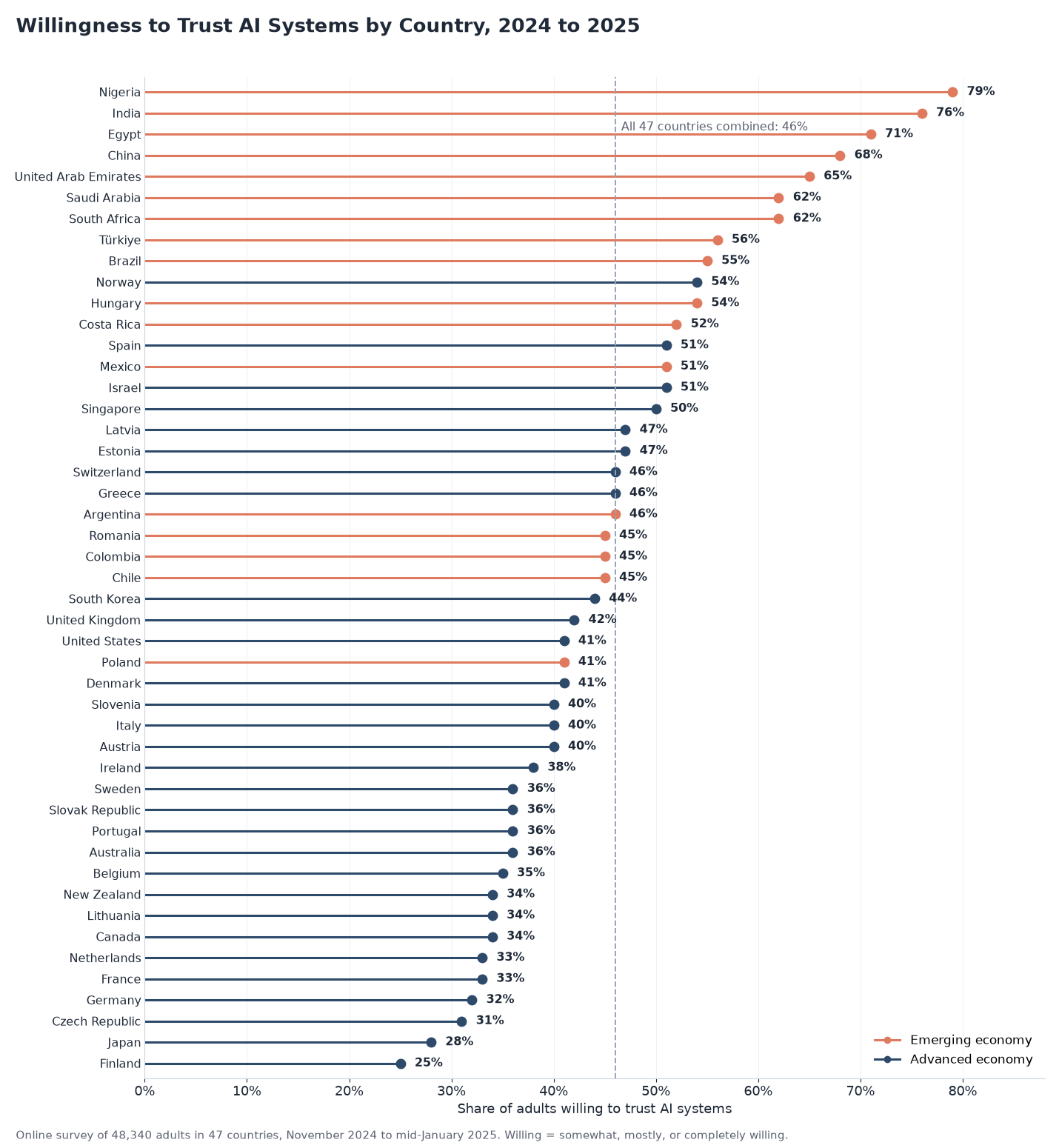
Source: AI Services Companies analysis of KPMG and University of Melbourne data, conducted November 2026.
Key Findings
- Over half of adults are willing to trust AI systems in 12 of the 17 emerging economies surveyed, while only 4 of the 29 advanced economies reach half or more: Norway at 54%, Spain and Israel at 51%, and Singapore at 50%.2
- Even in emerging economies, 43% of people remain ambivalent or unwilling to trust AI systems.2
- The United States (41%) and the United Kingdom (42%) sit below the 47-country figure of 46%, and Japan (28%) and Finland (25%) are lowest.2
People Trust AI in Health Care More Than Generative AI or AI in Hiring
Trust in AI depends on what the AI is used for. The same global survey asked about AI in general, generative AI tools, AI used in human resources, and AI used in health care, and also asked how far people accept AI's use. We gathered the full split of unwilling, ambivalent, and willing responses for each application.
| Measure | Value | Source |
|---|---|---|
| Willing to trust AI overall | 46% (unwilling 35%, ambivalent 19%) | KPMG and University of Melbourne, 2025 |
| Willing to trust AI systems in general | 45% (unwilling 36%, ambivalent 19%) | KPMG and University of Melbourne, 2025 |
| Willing to trust generative AI | 44% (unwilling 37%, ambivalent 19%) | KPMG and University of Melbourne, 2025 |
| Willing to trust AI in human resources | 42% (unwilling 39%, ambivalent 19%) | KPMG and University of Melbourne, 2025 |
| Willing to trust AI in health care | 52% (unwilling 30%, ambivalent 18%) | KPMG and University of Melbourne, 2025 |
| Adults with at least some acceptance of AI use | 72% | KPMG and University of Melbourne, 2025 |
| Adults with high acceptance of AI use | 33% | KPMG and University of Melbourne, 2025 |
| Adults who believe AI regulation is needed | 70% | KPMG and University of Melbourne, 2025 |
| Adults who believe current laws on AI are adequate | 43% | KPMG and University of Melbourne, 2025 |
| Countries where health care is the most trusted AI application | 42 of 47 | KPMG and University of Melbourne, 2025 |
| Employees who rely on AI output without evaluating its accuracy | 66% | KPMG, 2025 |
| Employees who have made mistakes in their work due to AI | 56% | KPMG, 2025 |
Source: AI Services Companies analysis of KPMG and University of Melbourne and KPMG data, conducted November 2026. Data: trust-in-ai-by-application-2025.csv
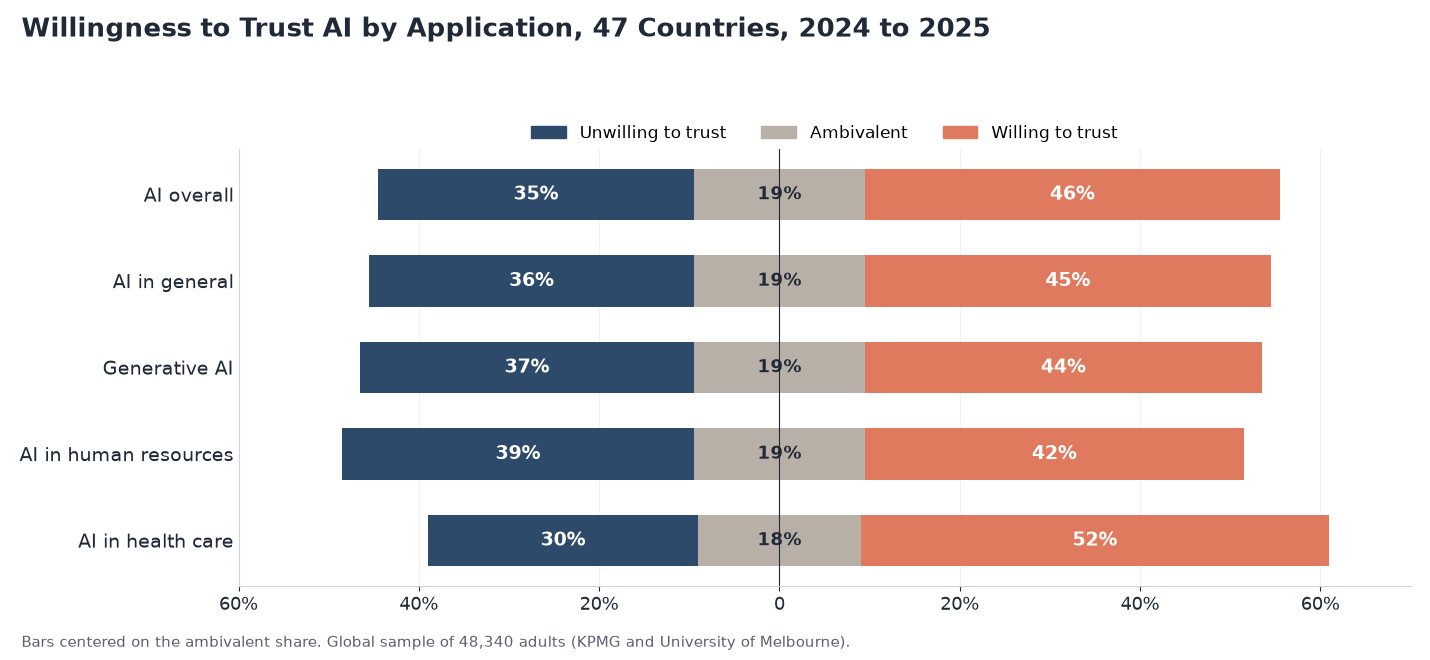
Source: AI Services Companies analysis of KPMG and University of Melbourne data, conducted November 2026.
Key Findings
- 52% of adults are willing to trust AI in health care, the highest of the four applications, while AI in human resources is lowest at 42%.2
- 72% accept the use of AI at least to some degree even though only 46% are willing to trust it, so many people accept AI they do not trust.2
- Two in three employees rely on AI output without checking its accuracy, and 56% say they have made mistakes in their work because of AI.3
Willingness to Rely on AI Fell From 52% to 43% Between 2022 and 2024
The KPMG and University of Melbourne team surveyed 17 countries in late 2022, just before ChatGPT was released, and again in late 2024 and early 2025. We compared the two waves to see how trust and worry changed as AI use spread.
| Measure | 2022 | 2024 | Change |
|---|---|---|---|
| Perceive AI systems as trustworthy | 63% | 56% | Down 7 points |
| Willing to rely on AI systems | 52% | 43% | Down 9 points |
| Worried about AI systems | 49% | 62% | Up 13 points |
| Willing to rely on AI systems, Japan | 43% | 21% | Down 22 points |
| Willing to rely on AI systems, Brazil | 67% | 53% | Down 14 points |
| Worried about AI, Brazil | 49% | 75% | Up 26 points |
| View AI as trustworthy, Israel | 68% | 52% | Down 16 points |
| View AI as trustworthy, South Africa | 76% | 62% | Down 14 points |
Source: AI Services Companies analysis of KPMG and University of Melbourne, Trust, attitudes and use of AI: A global study 2025 data, conducted November 2026. Data: ai-trust-and-worry-2022-vs-2024.csv
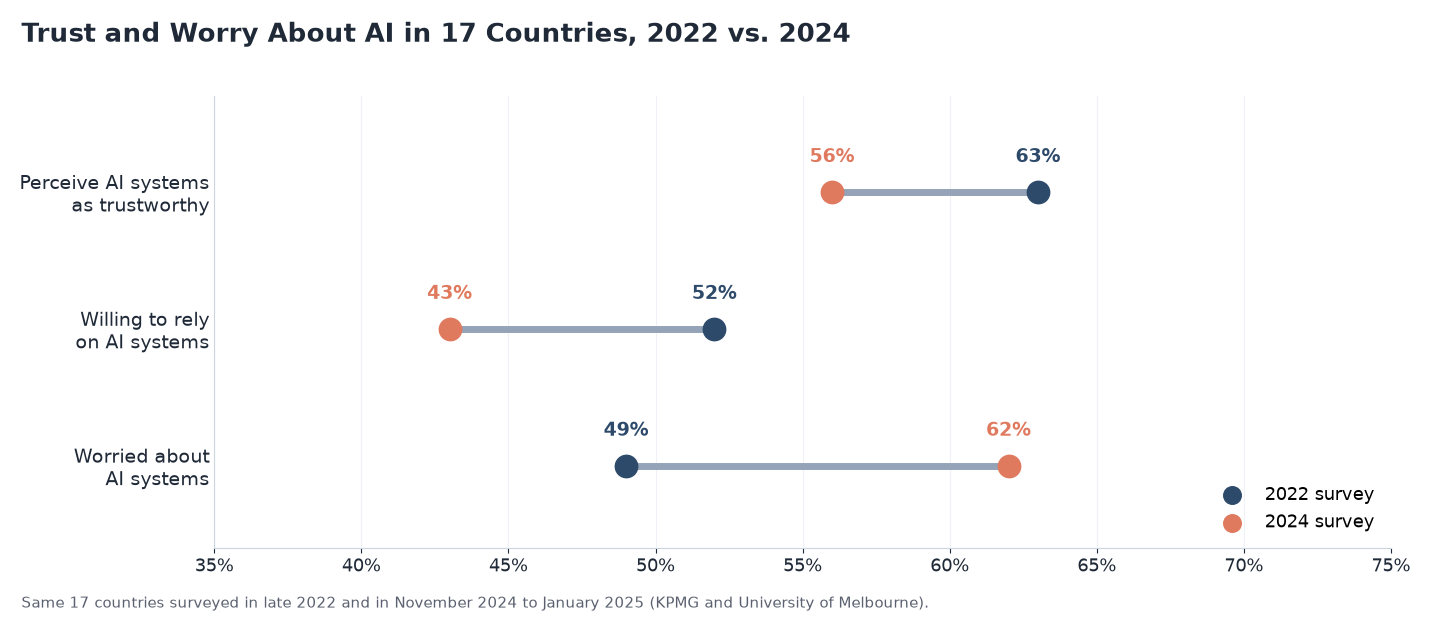
Source: AI Services Companies analysis of KPMG and University of Melbourne data, conducted November 2026.
Key Findings
- Perceived trustworthiness of AI fell in 13 of the 17 countries, and willingness to rely on AI fell in 12.2
- Worry about AI rose in 15 of the 17 countries, with the largest increase in Brazil, from 49% to 75%.2
- The researchers link the decline to wider use of generative AI tools, which made people more aware of both what AI can do and its limits, such as hallucinations.2
87% of Adults in China Trust AI, Compared With 32% in the US
Edelman asked more than 5,000 adults in Brazil, China, Germany, the UK, and the US in October 2025 how much they trust AI as a technology. We collected the country results, the change since Edelman last asked in November 2023, and the results by age group.
| Country | All adults | Change since Nov 2023 | Age 18 to 34 | Age 35 to 54 | Age 55+ |
|---|---|---|---|---|---|
| China | 87% | Up 9 points | 88% | 86% | 86% |
| Brazil | 67% | Up 14 points | 68% | 71% | 60% |
| Germany | 39% | Up 6 points | 53% | 45% | 29% |
| UK | 36% | Up 10 points | 59% | 39% | 18% |
| US | 32% | Up 2 points | 40% | 35% | 23% |
Source: AI Services Companies analysis of Edelman Trust Barometer Flash Poll: Trust and Artificial Intelligence at a Crossroads data, conducted November 2026. Data: trust-in-ai-by-country-and-age-2025.csv
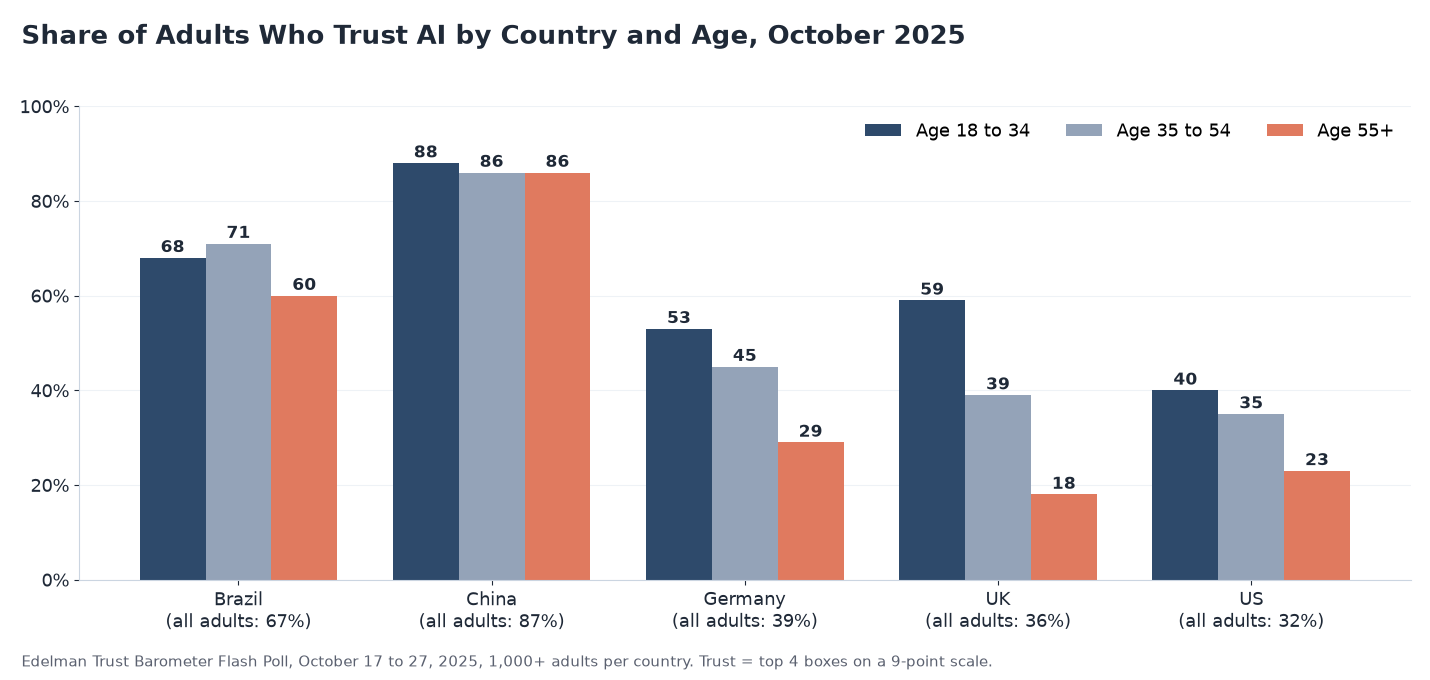
Source: AI Services Companies analysis of Edelman Trust Institute data, conducted November 2026.
Key Findings
- Edelman found a 26-point gap between trust in the technology sector and trust in AI, so trust in tech companies does not carry over to AI.4
- In the UK, 59% of adults aged 18 to 34 trust AI, compared with 18% of those 55 and older, the widest age gap of the five countries.4
- In the US, Germany, and the UK, about seven in ten or more of those who distrust AI said they reject its growing use: 74%, 71%, and 77%.4
27% of US Adults Trust Businesses to Use AI Responsibly
The Bentley University-Gallup Business in Society survey has asked US adults the same questions about AI each spring since 2023. We tracked trust in businesses' use of AI and views on whether AI does more harm than good, and added Pew Research Center's 2026 results on confidence in companies and the government.
| Measure | 2023 | 2024 | 2025 | 2026 | Source |
|---|---|---|---|---|---|
| Trust businesses a lot or some to use AI responsibly | 21% | 23% | 31% | 27% | Bentley-Gallup |
| Do not trust businesses at all to use AI responsibly | 38% | 33% | 28% | 31% | Bentley-Gallup |
| AI does more harm than good | 40% | 31% | 31% | 39% | Bentley-Gallup |
| AI does more good than harm | 10% | 13% | 12% | 9% | Bentley-Gallup |
| Adults aged 18 to 29 who say AI does more harm than good | 30% | 27% | 36% | 47% | Bentley-Gallup |
| Little or no confidence in US companies to develop and use AI responsibly | 59% | 59% | Pew Research Center | ||
| Little or no confidence in the US government to regulate AI effectively | 62% | 67% | Pew Research Center |
Source: AI Services Companies analysis of Gallup and Pew Research Center data, conducted November 2026. Data: us-trust-in-business-ai-use-2023-2026.csv
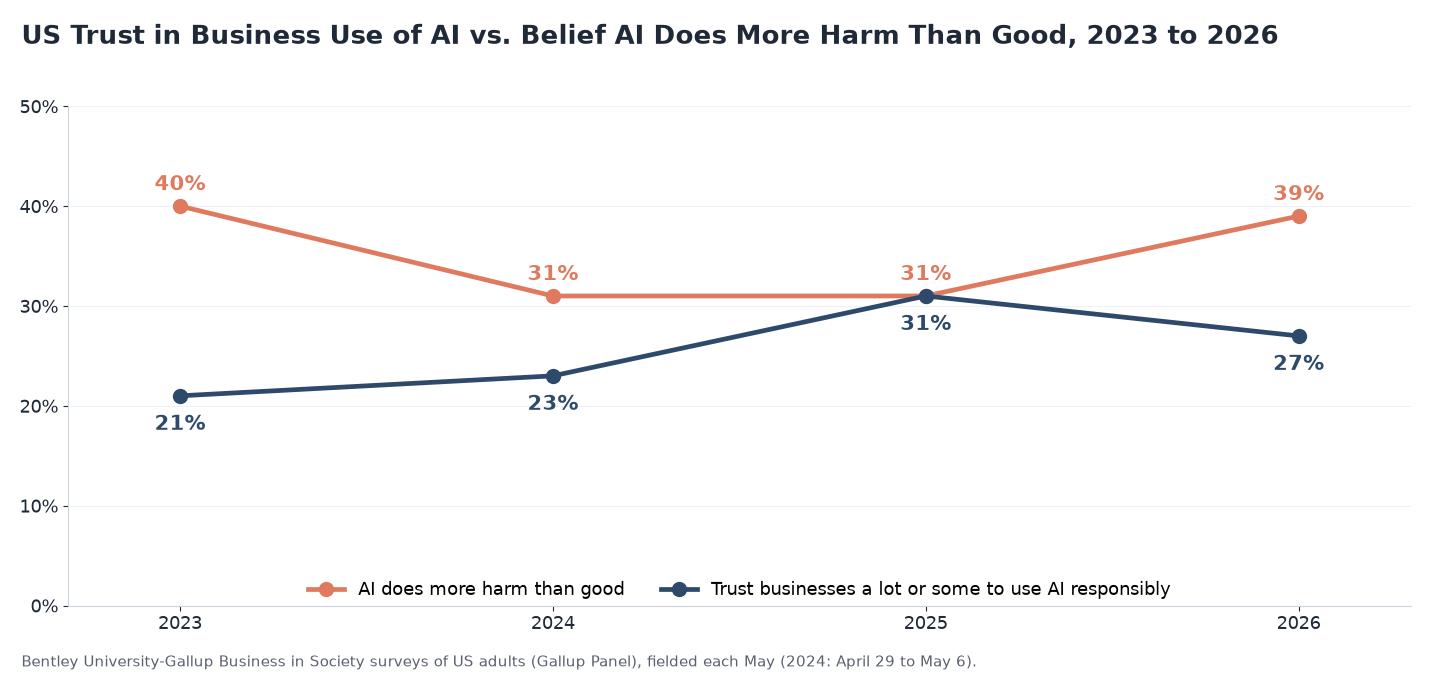
Source: AI Services Companies analysis of Bentley University-Gallup data, conducted November 2026.
Key Findings
- Trust in businesses' use of AI fell in 2026 for the first time since Gallup began asking in 2023, ending two years of gains.5,6
- Among adults aged 18 to 29, trust in businesses to use AI responsibly fell from 30% to 20% between 2025 and 2026, and the share saying AI does more harm than good rose from 36% to 47%.5
- Among US adults who do not use AI chatbots, 76% said not trusting them to give accurate information is a reason, including 45% who called it a major reason.8
54% Trust AI Not to Discriminate, but Only 48% Trust Companies to Protect Their Data
Ipsos asked 23,216 adults in 30 countries in spring 2025 whether they trust AI, the companies that use it, their government, and other people on a set of specific statements. We collected the 30-country averages and added Pew Research Center's 2025 measure of how Americans weigh AI's risks and benefits.
| Statement | Share of adults | Source |
|---|---|---|
| Companies using AI should have to disclose that use | 79% | Ipsos, 2025 (30-country average) |
| I trust AI not to discriminate or show bias toward any group of people | 54% | Ipsos, 2025 (30-country average) |
| I trust my government to regulate AI responsibly | 54% | Ipsos, 2025 (30-country average) |
| Products and services using AI make me nervous | 53% | Ipsos, 2025 (30-country average) |
| Products and services using AI make me excited | 52% | Ipsos, 2025 (30-country average) |
| I trust that companies that use AI will protect my personal data | 48% | Ipsos, 2025 (30-country average) |
| I trust people not to discriminate or show bias toward any group of people | 45% | Ipsos, 2025 (30-country average) |
| US adults who rate the societal risks of AI as high (June 2025) | 57% (benefits high: 25%) | Pew Research Center, 2025 |
| US adults more concerned than excited about AI in daily life (June 2025) | 50% (37% in 2021) | Pew Research Center, 2025 |
Source: AI Services Companies analysis of Ipsos AI Monitor 2025 and Pew Research Center data, conducted November 2026. Data: ai-trust-statements-30-countries-2025.csv
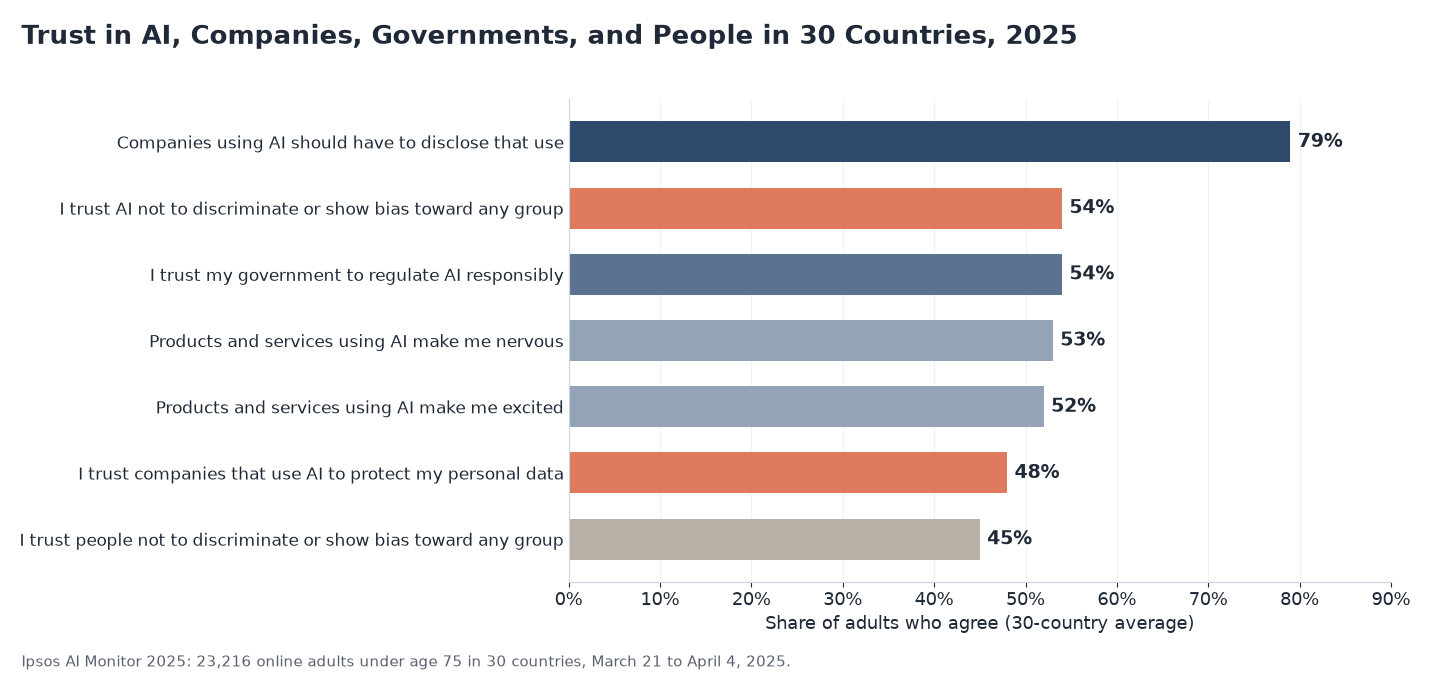
Source: AI Services Companies analysis of Ipsos data, conducted November 2026.
Key Findings
- Across 30 countries, more people trust AI not to discriminate (54%) than trust other people not to (45%).9
- Fewer than half (48%) trust companies that use AI to protect their personal data, while 79% want companies to disclose when they use AI.9
- Nervousness (53%) and excitement (52%) about AI products are almost evenly matched across the 30 countries.9
- In the US, 57% of adults rated the societal risks of AI as high in June 2025, compared with 25% who rated its benefits as high.10
What AI Trust Statistics Show Going Into 2027
Use of AI keeps rising while trust lags behind it. Fewer than half of adults across 47 countries are willing to trust AI systems, willingness to rely on AI fell between 2022 and 2024 in most countries tracked, and US trust in businesses' use of AI slipped in 2026 after two years of gains.1,2,5 Trust is highest in emerging economies such as Nigeria, India, and China, and among younger adults in most countries, though young Americans turned more skeptical in 2026.
The surveys also point to what people expect in return. 70% of adults in 47 countries say AI regulation is needed, 79% of adults in 30 countries want companies to disclose when they use AI, and trust is highest for uses with a clear personal benefit, such as health care.2,9
So if you cite an AI trust statistic, name the survey, the countries, the fieldwork dates, and the exact question, because "willing to trust AI systems," "trust AI," and "trust businesses to use AI responsibly" measure different things and produce very different numbers.
Data Collection and Methodology
We collected figures from published survey reports, opened on November 19, 2026. Global trust, acceptance, regulation, and 2022 to 2024 trend figures come from the full report of Trust, attitudes and use of artificial intelligence: A global study 2025 by the University of Melbourne and KPMG (Gillespie and colleagues), an online survey of 48,340 adults in 47 countries fielded from November 2024 to mid-January 2025, with 1,001 to 1,098 respondents per country. Country percentages were read from the labeled values in the report's Figure 13, and the 2022 and 2024 comparison uses the 17 countries surveyed in both waves (Figure 16). The employee figures on relying on AI output without checking accuracy and making mistakes come from KPMG's summary page for the same study. Trust in AI by country and age comes from the Edelman Trust Barometer Flash Poll, an online survey of more than 5,000 adults in Brazil, China, Germany, the UK, and the US fielded October 17 to 27, 2025, in which trust means the top four boxes on a 9-point scale; changes are measured against the 2024 Edelman Trust Barometer fielded in November 2023.
US trend figures come from the Bentley University-Gallup Business in Society surveys of US adults on the probability-based Gallup Panel: 3,270 adults on May 4 to 11, 2026, 3,007 adults on May 5 to 12, 2025, and earlier waves fielded April 29 to May 6, 2024, and May 8 to 15, 2023. The share trusting businesses a lot or some is the sum of Gallup's published "a lot" and "some" shares. Pew Research Center figures come from its survey of 5,119 US adults fielded February 17 to 23, 2026, and its survey of 5,023 US adults fielded June 9 to 15, 2025. Thirty-country figures come from the Ipsos AI Monitor 2025, an online survey of 23,216 adults under age 75 fielded March 21 to April 4, 2025. Survey questions differ, so results from different surveys should not be compared directly. Point changes are our own arithmetic from the published percentages. No figures in this article are estimates.
Sources (10)
- AI Services Companies analysis of AI trust surveys from KPMG and the University of Melbourne, Edelman, Bentley University and Gallup, Pew Research Center, and Ipsos, 2022 to 2026, conducted November 2026.
- Nicole Gillespie and colleagues, University of Melbourne and KPMG, Trust, attitudes and use of artificial intelligence: A global study 2025 (full report)
- KPMG International, Trust, attitudes and use of artificial intelligence: A global study 2025 (summary page)
- Edelman Trust Institute, 2025 Edelman Trust Barometer Flash Poll: Trust and Artificial Intelligence at a Crossroads (November 2025)
- Gallup, Americans Cool Toward AI (July 28, 2026)
- Gallup, Trust in Businesses' Use of AI Improves Slightly (September 9, 2025)
- Pew Research Center, Americans' Views on AI Chatbots, Smart Devices and AI's Impact (June 17, 2026)
- Pew Research Center, Why Don't Americans Use Chatbots? (June 17, 2026)
- Ipsos, Ipsos AI Monitor 2025 (June 2025)
- Pew Research Center, How Americans View AI and Its Impact on People and Society (September 17, 2025)