
Deepfake Fraud Statistics 2026
Published November 13, 2026
Our analysts reviewed 2,430 deepfake incidents reported in the news between January 2020 and September 2026, including 768 fraud cases with $3.91 billion in reported losses, and compared them with the FBI's 2025 Internet Crime Report and studies from Deloitte, Pindrop, Entrust, Sumsub, and Regula to show how much money deepfake fraud is taking, from whom, and through which channels as of Q4 2026.
Key Findings
- Reported deepfake fraud losses reached $2.52 billion in 2025, 7.5 times the $335.5 million reported in 2024, and $972.5 million in the first nine months of 2026.1,2
- Investment scams that use deepfaked celebrities and politicians account for $1.75 billion, or 44.7%, of the $3.91 billion in reported deepfake fraud losses since 2020.1,2
- The FBI received 22,364 complaints with an AI connection in 2025, with $893.3 million in losses; $632.0 million of that came from investment fraud.3,4
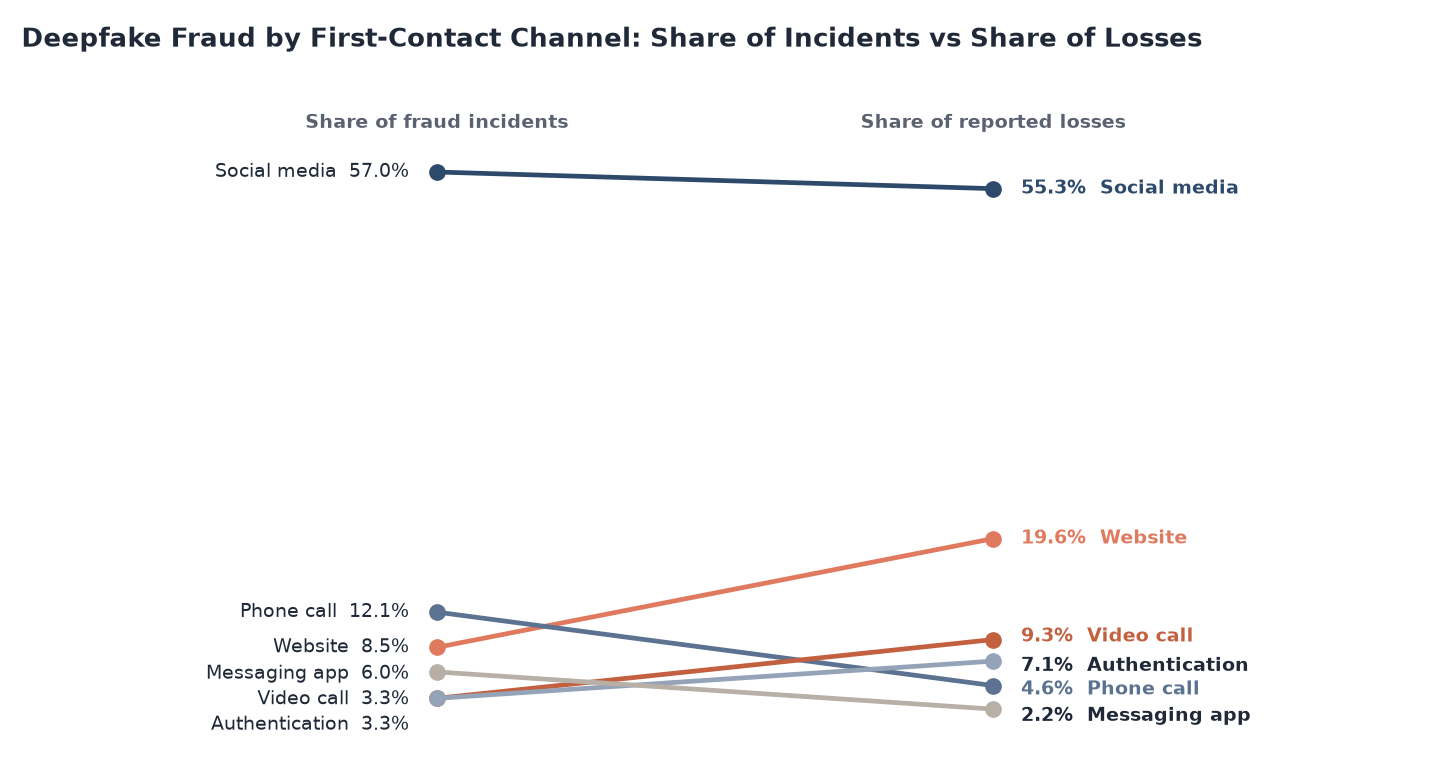
- Live deepfake video calls were the first point of contact in 3.3% of deepfake fraud incidents but 9.3% of reported losses, about $14.5 million per incident.1,2
- Pindrop measured a 1,300% rise in deepfake fraud attempts against call centers in 2024, from about one a month to seven a day.6
A deepfake is a video, image, or voice recording made with AI to show a real person saying or doing something they never did. Criminals now use them to put a famous investor's face on a crypto ad, to clone a grandchild's voice on the phone, or to place a fake chief financial officer in a video meeting. In early 2024, an employee in the Hong Kong office of the London-based engineering firm Arup joined a video call with what looked like senior colleagues and sent HK$200 million, about $25.6 million, to the scammers.11 Cases like that one get the headlines, and they leave reporters and fraud teams looking for numbers on how common these scams are and how much they cost. Those numbers come from several places, and they measure different things.
Our analysts worked from a public incident spreadsheet that Surfshark compiled from the AI Incident Database, Resemble AI, and the OECD, covering deepfake incidents covered by news media from 2020 to the third quarter of 2026. We recounted incidents, fraud cases, and reported losses by year, quarter, scam type, first-contact channel, and country, and checked our totals against Surfshark's published figures. We then set those counts beside the FBI Internet Crime Complaint Center's 2025 data on complaints with an AI connection, Deloitte's forecast of AI-enabled fraud losses, and studies from Pindrop, Entrust, Sumsub, and Regula. US figures come first wherever a source reports them separately, and all money is in US dollars.
In the following sections, we compare how fast reported deepfake incidents and losses have grown, which kinds of scams take the most money, which channels reach victims, the largest reported cases, what the FBI and fraud prevention companies measure, and which countries have reported the largest losses.
Reported Deepfake Fraud Losses Rose From $335 Million in 2024 to $2.52 Billion in 2025
News coverage is the broadest public record of deepfake incidents across countries and years, so we started by counting how many incidents were reported each year, how many involved fraud, and how much money the reports said victims lost.
| Year | Deepfake incidents | Fraud incidents | Incidents with a reported loss | Reported losses |
|---|---|---|---|---|
| 2020 | 22 | 4 | 2 | $35.2 million |
| 2021 | 19 | 2 | 0 | $0 |
| 2022 | 41 | 13 | 4 | $47.0 million |
| 2023 | 170 | 53 | 9 | $0.7 million |
| 2024 | 399 | 169 | 33 | $335.5 million |
| 2025 | 970 | 310 | 85 | $2,517.3 million |
| 2026 (Jan to Sep) | 809 | 217 | 60 | $972.5 million |
| Total | 2,430 | 768 | 193 | $3,908.2 million |
Source: AI Services Companies analysis of the Surfshark deepfake incident dataset (AI Incident Database, Resemble AI, and OECD records), conducted November 2026. Data: deepfake-incidents-and-losses-by-year-2020-2026.csv
Source: AI Services Companies analysis of the Surfshark deepfake incident dataset, conducted November 2026. Data: deepfake-incidents-per-quarter-2022-2026.csv
Key Findings
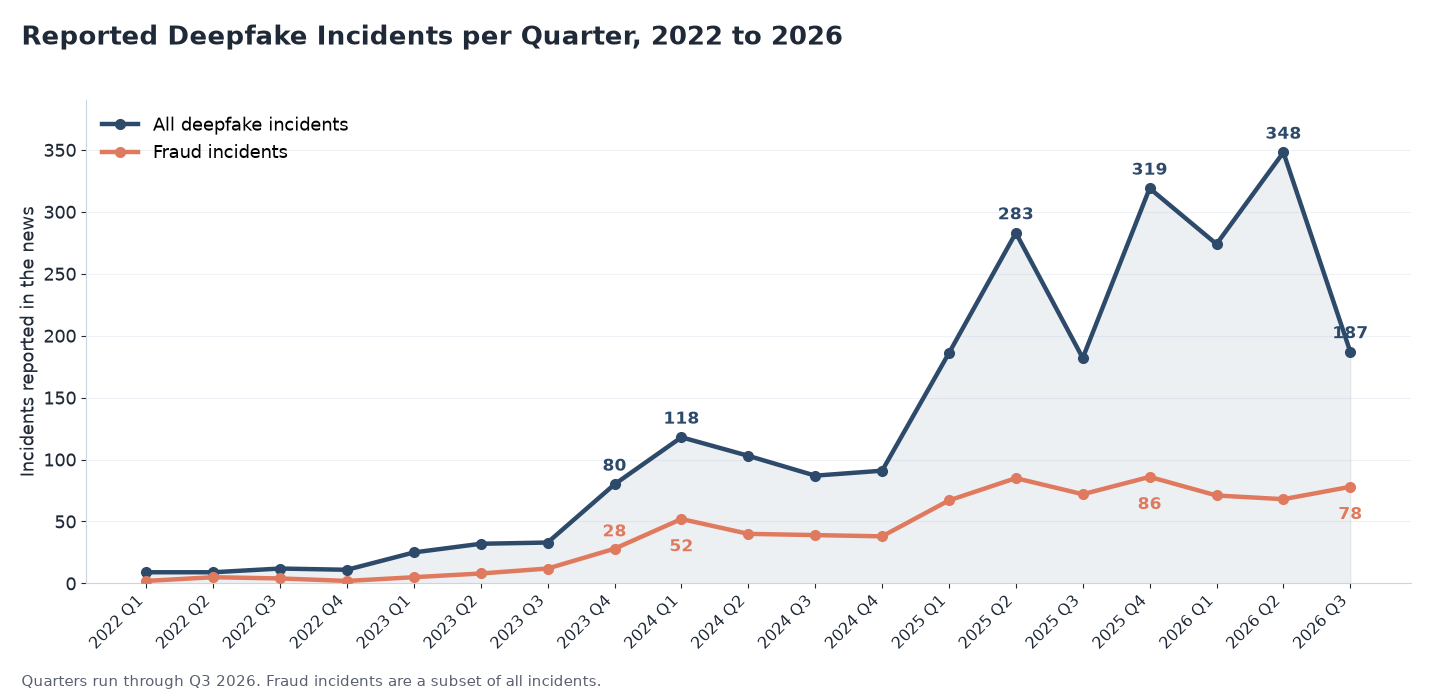
- Reported deepfake incidents of all kinds grew from 22 in 2020 to 970 in 2025. The first three quarters of 2026 produced 809, which is 24.3% more than the 651 reported in the same months of 2025.1,2
- Fraud cases have leveled off while other deepfake incidents keep climbing. 217 fraud incidents were reported from January to September 2026, against 224 in the same months of 2025, so fraud fell from 34.4% of incidents to 26.8%.1,2
- Most fraud reports carry no dollar figure. Only 193 of the 768 fraud incidents state a loss, and the median stated loss is $66,000, so the $3.91 billion total is a floor set by the cases journalists could put a number on.1,2
Investment Scams Account for 45% of Reported Deepfake Fraud Losses
Deepfakes turn up in many kinds of fraud, from fake celebrity investment ads to cloned voices of relatives asking for bail money. We grouped every fraud incident in the dataset by its scam type and added up the incidents, the cases with a stated loss, and the losses themselves.
| Scam type | Fraud incidents | Incidents with a reported loss | Reported losses | Share of losses | Median reported loss |
|---|---|---|---|---|---|
| Investment | 254 | 58 | $1,748.0 million | 44.7% | $163,500 |
| Finance | 103 | 27 | $1,144.9 million | 29.3% | $89,000 |
| Corporate | 56 | 24 | $544.6 million | 13.9% | $1,145,000 |
| Product promotion | 140 | 7 | $277.5 million | 7.1% | $39,000 |
| Romance | 30 | 21 | $178.7 million | 4.6% | $109,000 |
| Family | 48 | 24 | $3.8 million | 0.1% | $15,000 |
| Government | 39 | 7 | $4.9 million | 0.1% | $100,000 |
| Extortion | 46 | 14 | $0.3 million | 0.0% | $6,350 |
| Other | 49 | 9 | $5.5 million | 0.1% | $17,000 |
| Pets | 3 | 2 | $0 | 0.0% | $1,123 |
Source: AI Services Companies analysis of the Surfshark deepfake incident dataset, conducted November 2026. Shares under 0.05% show as 0.0%. Data: deepfake-fraud-losses-by-type-2020-2026.csv
Source: AI Services Companies analysis of the Surfshark deepfake incident dataset, conducted November 2026. Data: deepfake-fraud-losses-by-scam-type-2024-2026.csv
Key Findings
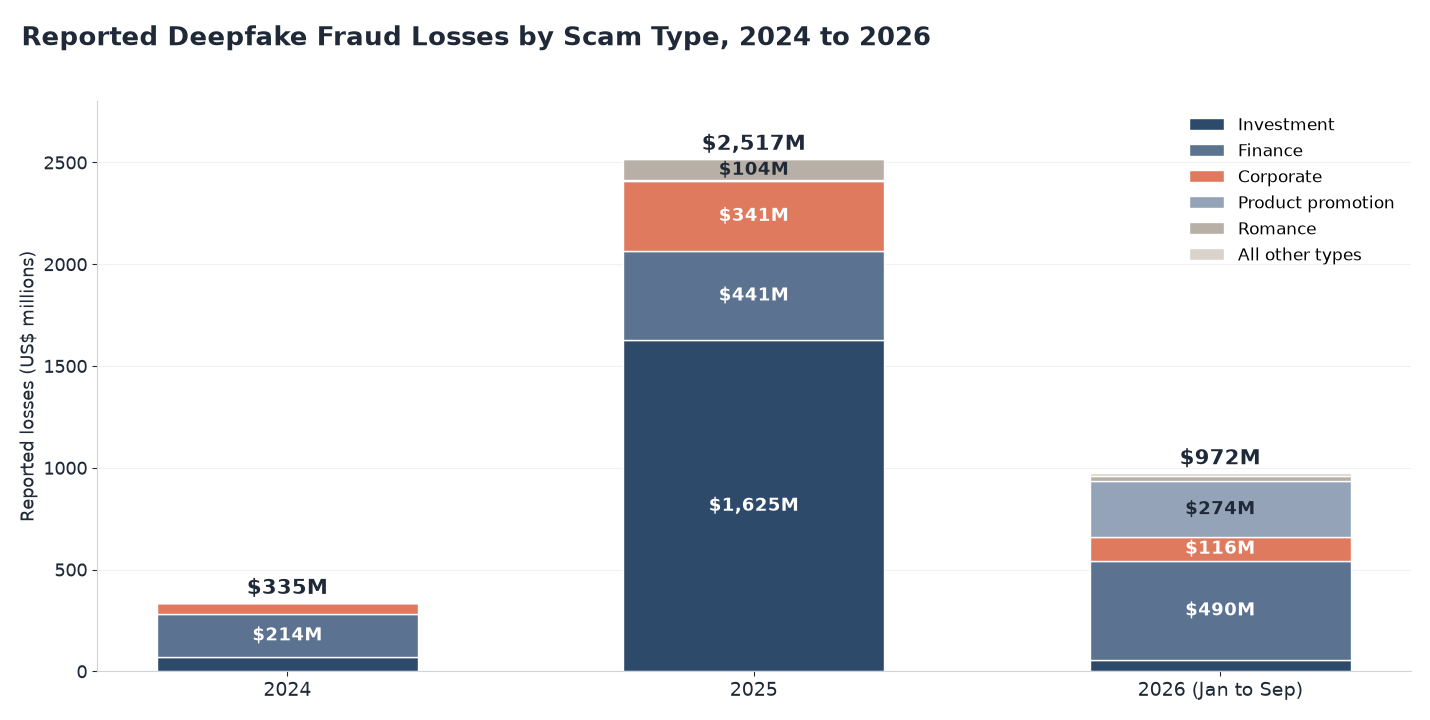
- Investment scams are the most common and the costliest type, with 254 incidents and $1.75 billion in reported losses. Most use deepfaked politicians, business leaders, or celebrities to promote fake trading platforms on social media.1,2
- Corporate impersonation has the highest median stated loss of any scam type, at $1,145,000 across 24 cases with a figure. That is 7.0 times the $163,500 median for investment scams, because one fake executive on a call can move a company's money in a single transfer.1,2
- The mix shifted in 2026. Finance and banking fraud, which includes cloned voices approving transfers and deepfakes used to pass identity checks, reached $490.4 million in the first nine months, more than the $440.8 million for all of 2025, while reported investment scam losses fell to $53.4 million.1,2
Social Media Is the First Contact in 57% of Deepfake Fraud Cases
Knowing where a scam first reaches its victim helps banks, platforms, and companies decide where to put warnings and checks. We sorted each fraud incident by its first-contact channel and compared each channel's share of incidents with its share of reported losses.
| First-contact channel | Fraud incidents | Share of incidents | Reported losses | Share of losses | Losses per incident |
|---|---|---|---|---|---|
| Social media | 438 | 57.0% | $2,160.6 million | 55.3% | $4.9 million |
| Website | 65 | 8.5% | $764.8 million | 19.6% | $11.8 million |
| Phone call | 93 | 12.1% | $180.9 million | 4.6% | $1.9 million |
| Messaging app | 46 | 6.0% | $84.1 million | 2.2% | $1.8 million |
| Video call | 25 | 3.3% | $363.1 million | 9.3% | $14.5 million |
| Identity check bypass | 25 | 3.3% | $276.0 million | 7.1% | $11.0 million |
| 8 | 1.0% | $12.2 million | 0.3% | $1.5 million | |
| Other | 35 | 4.6% | $10.1 million | 0.3% | $0.3 million |
| Not reported | 31 | 4.0% | $56.4 million | 1.4% | $1.8 million |
| TV/Radio | 2 | 0.3% | $0 | 0.0% | $0 |
Source: AI Services Companies analysis of the Surfshark deepfake incident dataset, conducted November 2026. Data: deepfake-fraud-first-contact-channels-2020-2026.csv
Source: AI Services Companies analysis of the Surfshark deepfake incident dataset, conducted November 2026. Data: deepfake-fraud-channels-incidents-vs-losses.csv
Key Findings
- Phone scams are frequent but smaller. Calls with cloned voices were the first contact in 93 fraud incidents, the second most of any channel, yet they account for only 4.6% of reported losses, about $1.9 million per incident.1,2
- Deepfakes used to fool face and identity checks at banks and apps appear in only 25 incidents but carry $276.0 million in losses. Entrust found that deepfakes were behind one in five biometric fraud attempts it saw in 2025.1,2,7
- Video is the most common medium in deepfake fraud. Faked video appears in 506 of the 768 fraud incidents, or 65.9%, against 325 with cloned voices and 139 with faked images, and some incidents use more than one.1,2
The Largest Reported Deepfake Fraud Losses Range From $25.6 Million to $756 Million
Single cases are what most readers remember, and they show how a deepfake scam can scale from one transfer to a whole country's fraud wave. We listed the ten largest losses recorded in the incident data and added the Arup case, the best-known corporate example, for comparison.
| Case | Reported | Scam type | First contact | Reported loss |
|---|---|---|---|---|
| European cryptocurrency investment network using deepfake videos of celebrities and politicians, dismantled across several countries; €700 million in damages | Dec 2025 | Investment | Website | $756.0 million |
| Deepfake videos of Malaysia's prime minister and other leaders promoting investment schemes; a national total of RM2.11 billion over 13,956 cases | Jul 2025 | Investment | Social media | $511.0 million |
| Voice-cloning and deepfake scams in Indonesia; an authorities' total of Rp 7.8 trillion across more than 343,000 scam cases | Nov 2025 | Finance | Social media | $433.0 million |
| Cryptocurrency ATM fraud in the US using deepfake impersonation, with elderly victims most affected; losses in 2025 | Mar 2026 | Finance | Social media | $333.0 million |
| Sofia-based network using deepfake ads of well-known people to sell fake dietary supplements across Europe since 2019; over €240 million | May 2026 | Product promotion | Social media | $273.6 million |
| Deepfake impersonation of CEOs, managers, and family members in the US; over 105,000 attacks in 2024 | Sep 2025 | Corporate | Video call | $200.0 million |
| More than 1,100 fraudulent loan applications in Indonesia using deepfake images to pass face checks | Dec 2024 | Finance | Identity check bypass | $138.5 million |
| Intesa Sanpaolo, Italy, reported loss to an AI voice scam | Sep 2026 | Corporate | Phone call | $108.0 million |
| Deepfake job candidates, including North Korea-linked IT workers, hired by US companies | Sep 2025 | Corporate | Video call | $100.0 million |
| Deepfakes used to defeat face biometrics in China, an estimated loss | Feb 2024 | Finance | Identity check bypass | $75.0 million |
| Arup, Hong Kong office: an employee sent HK$200 million after a video call with deepfaked colleagues | Reported Feb 2024, confirmed May 2024 | Corporate | Video call | $25.6 million |
Source: AI Services Companies analysis of the Surfshark deepfake incident dataset, conducted November 2026; Arup figures from CNN, May 16, 2024. Data: largest-reported-deepfake-fraud-losses.csv
Source: AI Services Companies analysis of the Surfshark deepfake incident dataset and CNN reporting, conducted November 2026.
Key Findings
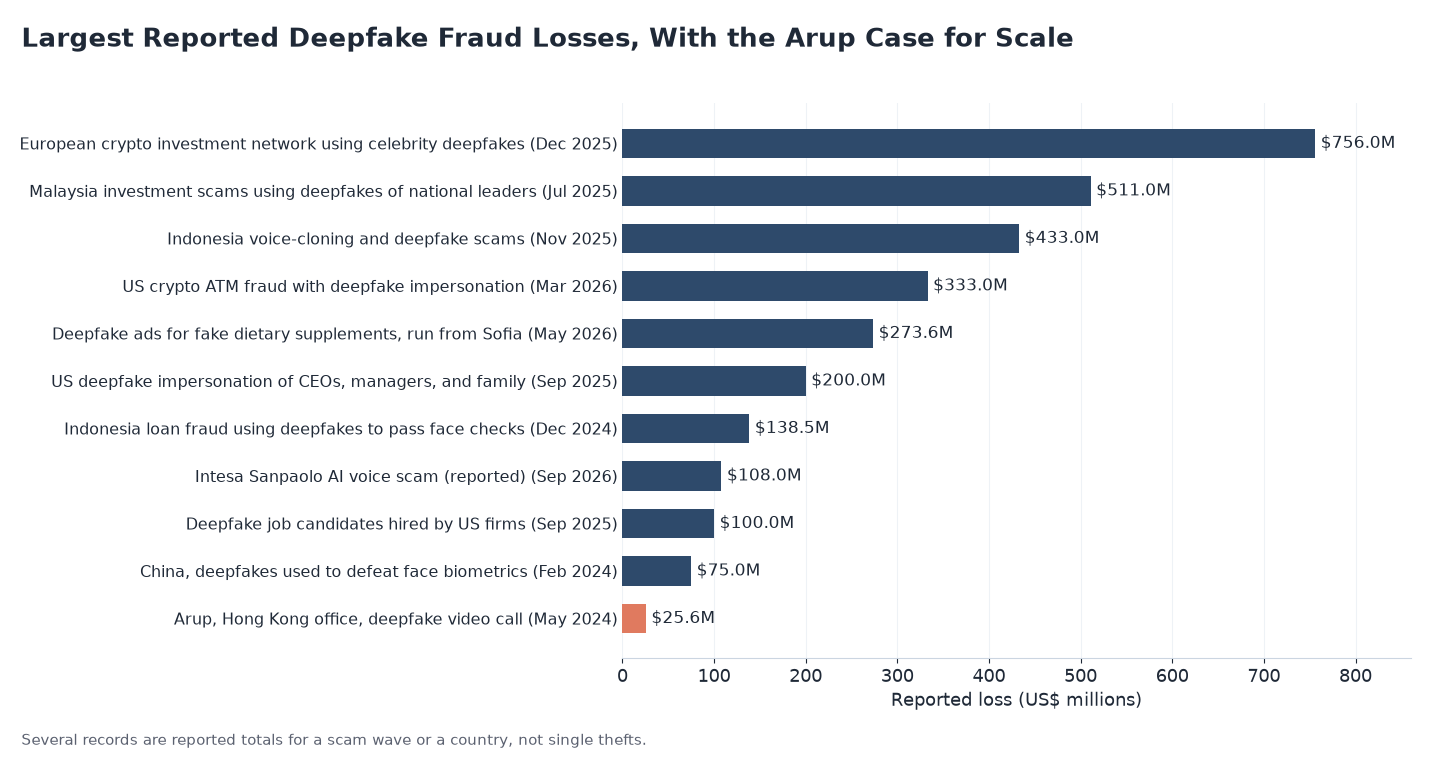
- Most of the ten largest records are totals for a scam wave or a country, such as Malaysia's RM2.11 billion over 13,956 cases, so a single headline figure often adds up thousands of victims.1,2
- The Arup loss of about $25.6 million came from one employee and one video call, and it ranks 23rd among the 193 fraud records with a stated loss in the incident data.1,2,11
- Three of the ten largest records are corporate impersonation cases, including the reported $108.0 million Intesa Sanpaolo voice scam in September 2026. For companies that approve payments on a call or in a video meeting, one successful deepfake can cost more than many consumer scams combined.1,2
The FBI Recorded $893 Million in AI-Related Fraud Losses in 2025
Government complaint data and fraud prevention companies measure deepfake fraud in different ways: complaints filed by victims, attacks caught by detection tools, and forecasts built from fraud trends. We collected the most recent published figures from each so they can be cited with their own scope.
| Source | Scope | Measure | Value |
|---|---|---|---|
| FBI IC3 2025 Internet Crime Report | Complaints filed in the US, 2025 | Complaints with an AI connection | 22,364 |
| FBI IC3 2025 Internet Crime Report | Complaints filed in the US, 2025 | Losses in complaints with an AI connection | $893.3 million |
| FBI IC3 2025 Internet Crime Report | Complaints filed in the US, 2025 | AI-related losses reported by people 60 and older | $352.5 million (3,143 complaints) |
| FBI IC3 2025 Internet Crime Report | Complaints filed in the US, 2025 | Losses to voice-cloned "distress" scams | Over $5 million |
| FBI IC3 2025 Internet Crime Report | Complaints filed in the US, 2025 | All reported cybercrime losses | $20.877 billion (1,008,597 complaints) |
| Deloitte Center for Financial Services | US fraud losses enabled by generative AI | 2023 estimate and 2027 forecast | $12.3 billion to $40 billion (32% a year) |
| Pindrop, 2025 Voice Intelligence and Security Report | More than 1.2 billion customer calls, 2024 | Change in deepfake fraud attempts | +1,300% (one a month to seven a day) |
| Pindrop, 2025 Voice Intelligence and Security Report | Customer calls, 2024 | Change in synthetic voice attacks by industry | Insurance +475%, banking +149%, retail +107% |
| Entrust, 2026 Identity Fraud Report | Identity verification checks, 2025 | Share of biometric fraud attempts linked to deepfakes | One in five |
| Entrust, 2026 Identity Fraud Report | Identity verification checks, 2025 | Change in deepfaked selfies | +58% |
| Sumsub, Identity Fraud Report 2025-2026 | Identity verification checks, 2025 | Share of first-party fraud cases that were deepfakes | 11% |
| Sumsub, Identity Fraud Report 2025-2026 | Identity verification checks, 2025 | Highest growth in deepfake attacks for one country | Maldives, +2,100% |
| Regula, Deepfake Trends 2024 | Business survey, 2024 | Average loss per business from deepfake fraud | Nearly $450,000 (financial services over $603,000) |
| Regula, Deepfake Trends 2024 | Business survey, 2024 | Organizations that lost more than $1 million | 10% |
Source: FBI Internet Crime Complaint Center, 2025 IC3 Annual Report; Deloitte Insights; Pindrop via PR Newswire, June 12, 2025; Biometric Update on Entrust, November 2025; Infosecurity Magazine on Sumsub, November 2025; Regula, October 31, 2024.
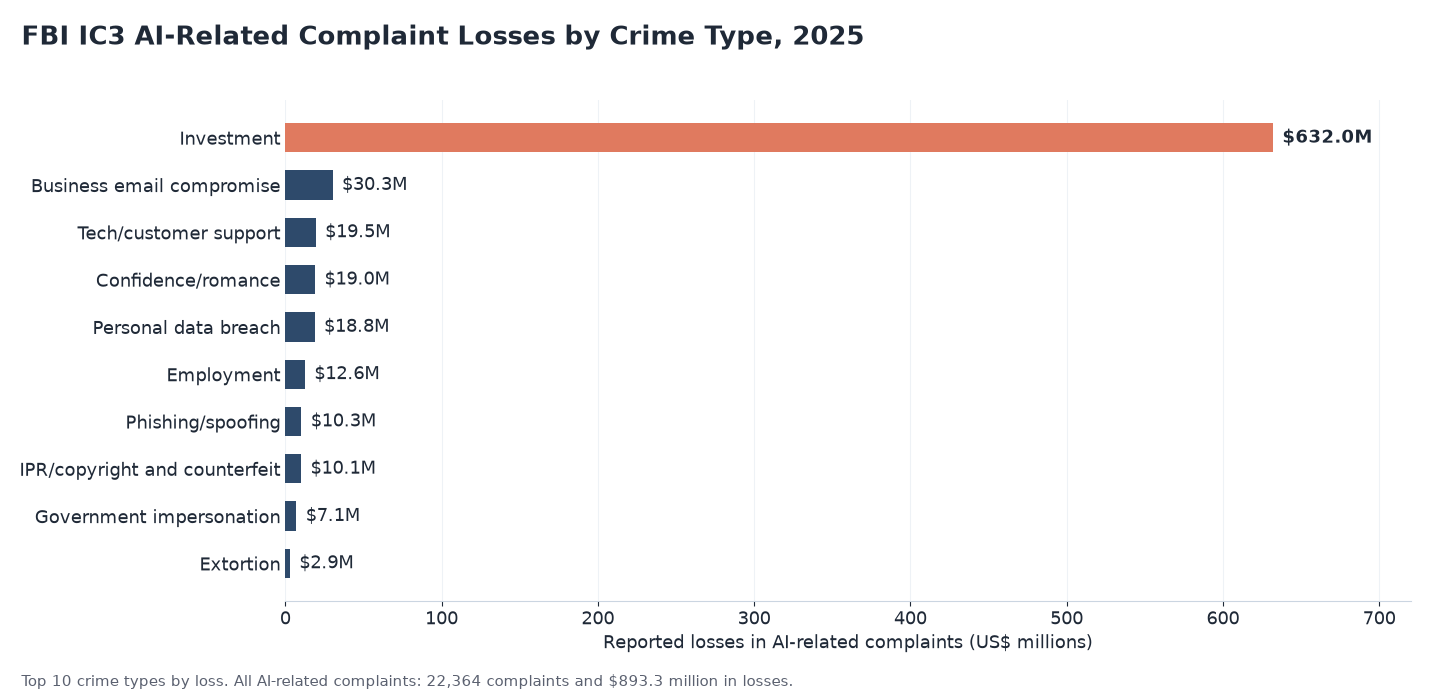
Source: AI Services Companies analysis of FBI IC3 2025 Annual Report data, conducted November 2026. Data: fbi-ic3-ai-related-complaints-by-crime-type-2025.csv
Key Findings
- The 2025 report is the first in the IC3's nearly 25-year history with a section on artificial intelligence. Complaints with an AI connection account for 4.3% of the $20.877 billion in losses reported to the FBI that year.3,4
- Investment fraud makes up 70.8% of AI-related losses reported to the FBI. The FBI notes that total investment fraud losses topped $8 billion in 2025, which it says shows that many victims do not realize the extent AI may be involved in scams.3
- Deloitte expects fraud losses enabled by generative AI in the US to grow 32% a year, from $12.3 billion in 2023 to $40 billion in 2027. Pindrop's forecast for 2025 called for another 162% rise in deepfake-related fraud.5,6
The United States Has the Largest Reported Deepfake Fraud Losses, at $705 Million
Deepfake fraud crosses borders, but where losses are reported shapes how regulators and banks in each country respond. We added up incidents and reported losses for every country in the dataset and ranked the ten with the largest losses.
| Country | Region | Deepfake incidents | Fraud incidents | Reported losses |
|---|---|---|---|---|
| United States | North America | 787 | 152 | $705.3 million |
| Indonesia | Asia | 30 | 10 | $614.5 million |
| Malaysia | Asia | 18 | 12 | $512.9 million |
| United Kingdom | Europe | 141 | 52 | $177.1 million |
| Italy | Europe | 31 | 12 | $148.0 million |
| Canada | North America | 47 | 19 | $141.4 million |
| Bulgaria | Europe | 25 | 19 | $138.8 million |
| Hong Kong | Asia | 19 | 16 | $107.3 million |
| Spain | Europe | 33 | 16 | $104.9 million |
| Taiwan | Asia | 62 | 23 | $94.4 million |
Source: AI Services Companies analysis of the Surfshark deepfake incident dataset, conducted November 2026. An incident that involves several countries counts toward each of them. Data: deepfake-fraud-losses-top-10-countries-2020-2026.csv
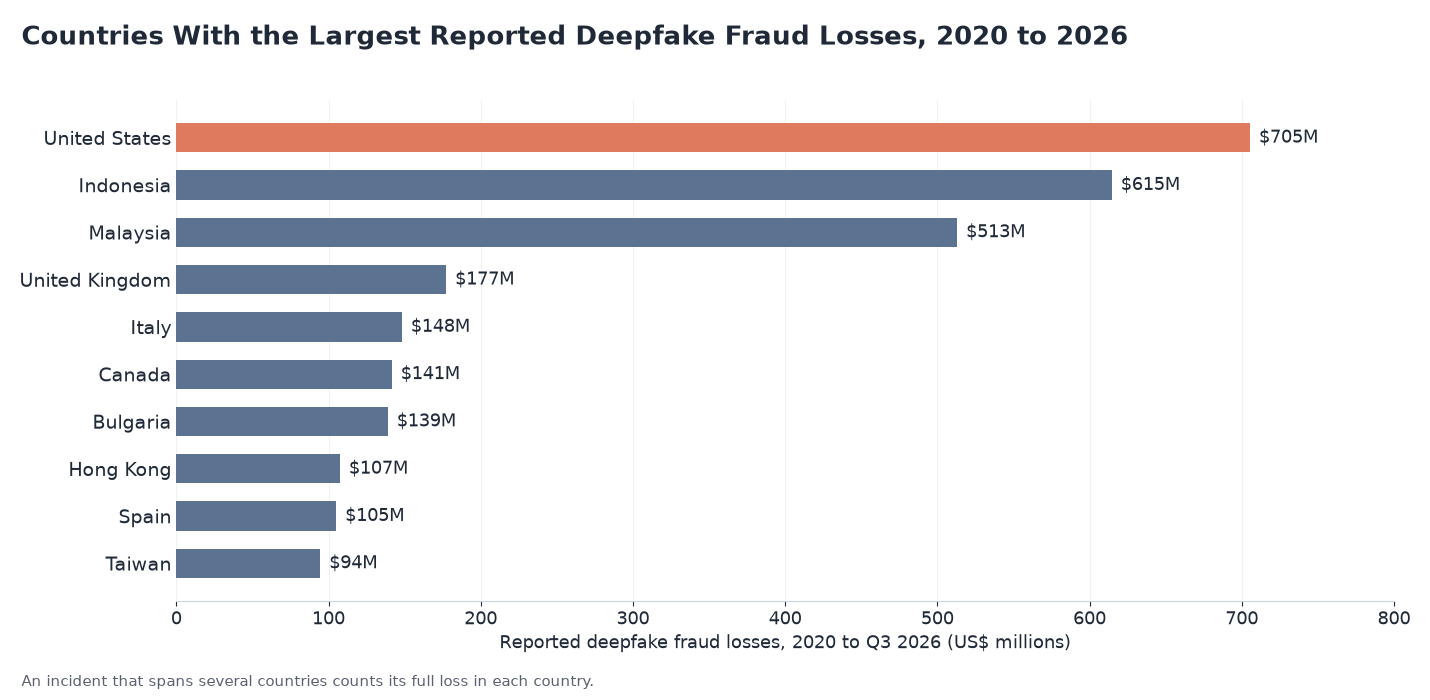
Source: AI Services Companies analysis of the Surfshark deepfake incident dataset, conducted November 2026.
Key Findings
- The US leads in both incidents and losses, with 787 deepfake incidents, 152 of them fraud, and $705.3 million in reported losses. That is 5.0 times Canada's $141.4 million.1,2
- Indonesia and Malaysia report $614.5 million and $512.9 million from only 30 and 18 incidents, because their figures come largely from national totals that authorities reported for deepfake-driven scam waves.1,2
- Europe has four of the ten largest country totals: the United Kingdom, Italy, Bulgaria, and Spain. Much of that comes from cross-border scams, including a cryptocurrency investment network with €700 million in damages and a dietary supplement ad scheme with over €240 million.1,2
What the Deepfake Fraud Figures Mean Going Into 2027
For consumers, deepfake fraud mostly arrives as an ad or a post on social media showing a familiar face recommending an investment, and those scams have taken the most money since 2020. For companies, the danger is concentrated in fewer cases with much larger losses, where a cloned voice or a faked video meeting persuades an employee to send money or let an impostor pass an identity check.
Every source points to growth, and every source also undercounts. News reports state a dollar figure for only 193 of 768 fraud cases, and the FBI says many investment fraud victims do not know AI was involved. The 2026 data shows the losses moving toward banks, payment approvals, and identity checks, which is where Entrust and Pindrop report steep rises in deepfake attempts.
So if you cite a deepfake fraud loss figure, say whether it comes from victim complaints, news-reported cases, or a forecast, because the 2025 totals range from the FBI's $893.3 million in AI-related complaints to $2.52 billion in news-reported cases worldwide.
Data Collection and Methodology
Incident counts and losses come from the deepfake incident spreadsheet Surfshark published with its November 10, 2026 study, downloaded on November 13, 2026 and used under its Creative Commons Attribution 4.0 license. Surfshark combined records from the AI Incident Database, Resemble AI, and the OECD and kept incidents that involved fake video, images, or audio covered in news articles; it tagged fraud cases by scam type and first-contact channel. We recounted the 2,430 records ourselves by the date on each record, which is usually the date of the news report, and our totals match Surfshark's published figures (2,430 incidents, 768 fraud incidents, and $3.91 billion in losses). We changed the presentation only: we grouped quarters, renamed the "Authentication" channel as identity check bypass, and computed medians and per-incident losses.
Reported losses are the dollar amounts stated in news coverage, converted to US dollars in the dataset. Some records are single thefts and others are national or network totals for a scam wave, and incidents without a stated loss count as zero, so totals are a lower bound. Medians use only incidents with a stated loss above zero. Country totals count the full loss of an incident in every country it lists. In the largest-losses table, one record (a call center investment scam operated from Tbilisi) is left out because its recorded loss of $275.0 million does not match the $35 million in its own description; it stays in all totals so they match the published dataset. The Arup amount is from CNN's May 16, 2024 report.
FBI figures are from the 2025 IC3 Annual Report, where "AI related" means the complaint contains a reference to artificial intelligence. Industry figures come from each company's own customers or survey and are shown with their own scope. We calculated products, differences, and ratios from the published values.
Sources (11)
- AI Services Companies analysis of 2,430 news-reported deepfake incidents from 2020 to Q3 2026, FBI IC3 complaint data, and five industry studies, conducted November 2026.
- Surfshark, Deepfake statistics (November 10, 2026) and research data spreadsheet, CC BY 4.0
- FBI Internet Crime Complaint Center, 2025 IC3 Annual Report (2026)
- FBI, Cryptocurrency and AI Scams Bilk Americans of Billions (April 6, 2026)
- Deloitte Insights, Deepfake banking and AI fraud risk (2024)
- Pindrop, Pindrop's 2025 Voice Intelligence and Security Report Reveals +1,300% Surge in Deepfake Fraud, PR Newswire (June 12, 2025)
- Biometric Update, Protect every layer of identity to thwart deepfake injection attacks: Entrust (November 2025)
- Infosecurity Magazine, AI and Deepfake-Powered Fraud Skyrockets Amid Global Stagnation (November 2025)
- Regula, Deepfake Fraud Costs the Financial Sector an Average of $600,000 for Each Company (October 31, 2024)
- Regula, The Deepfake Trends 2024
- CNN, British engineering giant Arup revealed as $25 million deepfake scam victim (May 16, 2024)