
Employee AI Training Statistics 2026
Published October 27, 2026
Our analysts reviewed 16 worker, employer and training-industry surveys from 11 publishers, released between May 2024 and September 2026, to show how many employees receive AI training, what employers provide and how training compares with AI use as of Q4 2026.
In the following sections, we compare the share of US workers trained across surveys, what employers offer, the gap between AI use and training, training hours and spending, training by role, job level and country, and the link between training and AI use.
Key Findings
- In Pew Research Center's October 2024 survey, 12% of US workers had taken AI-related job training in the prior 12 months (our calculation).
- In EY's 2025 survey of 15,000 employees in 29 countries, conducted in August 2025 and released in November 2025, 12% said they receive sufficient AI training, while 88% said they use AI at work.
- In BCG's 2025 AI at Work survey, 51% of frontline employees used generative AI at least several times a week, compared with 85% of leaders.
- In the Federal Reserve Bank of New York's August 2026 survey, 61% of service firms in New York and northern New Jersey used AI, up from 25% in 2024.
- In EY's 2025 survey, employees with more than 81 hours of AI training a year reported an average productivity gain of 14 hours a week.
How Many US Workers Get AI Training
Five national surveys asked US workers whether they had received AI training. In a national survey that Google ran with Ipsos at the end of 2025, 40% of employed Americans said they used AI at work, but only 14% said their employer had offered them any AI training in the previous year. Where a survey published only the share without training, we converted it to the share with training.
| Source | Published | Base | Published measure | Share with AI training |
|---|---|---|---|---|
| Pew Research Center | Feb 2025 | US workers, October 2024 | 51% took any job training in the prior 12 months; 24% of those said a training was related to AI use | 12% (our calculation) |
| Google and Ipsos | Feb 2026 | US employed adults, December 2025 (n=4,464) | Organization offered AI-related training in the past 12 months | 14% |
| KPMG and University of Melbourne | Apr 2025 | US respondents | Had formal or informal training in AI | 28% |
| Jobs for the Future | Dec 2024 | US workers, November 2024 (survey n=2,754) | Receive employer-provided AI training | 31% |
| Gallup | Oct 2024 | US employees who use AI, May 2024 | 47% say their organization has not offered any AI training | 53% (our calculation) |
Source: AI Services Companies, Employee AI Training Study, October 2026, using Pew Research Center, Google and Ipsos, KPMG and the University of Melbourne, Jobs for the Future and Gallup survey data. Data: us-ai-training-share.csv
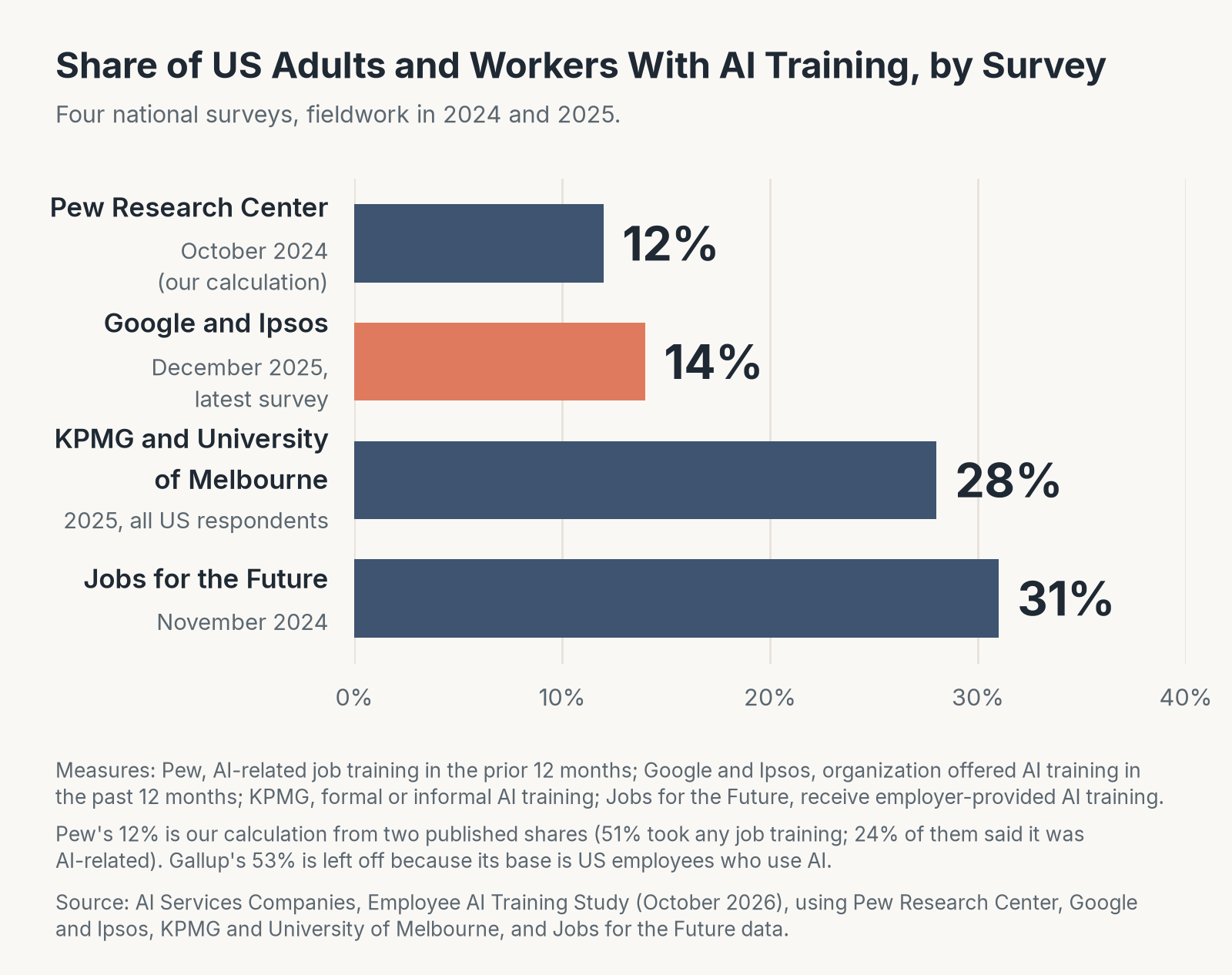
- The two measures limited to the past 12 months, from Pew and from Google and Ipsos, both come in below 15%, while the two without a time limit, from KPMG and JFF, come in at 28% and 31%.
- Gallup's figure counts only employees who already use AI, which places it above the all-worker measures.
- The share of US workers with recent AI training is much smaller than the share who have had any AI instruction at all. Repeat surveys that keep the same 12-month window will show most clearly how that share changes.
Pew asked the same October 2024 sample whether they had taken any job training in the prior year, then asked those who had whether it was related to AI use. Multiplying the two published shares gives the all-worker rate in the first row. KPMG's US page also reports that 72% of US workers did not receive any AI training or education.
What Employers Offer
Surveys of workers and employers measure how much AI training companies provide and plan, including two years of New York Fed regional business surveys.
| Source | Published | Base | Measure | Value |
|---|---|---|---|---|
| Microsoft and LinkedIn | May 2024 | People who use AI at work, 31 countries | Received AI training from their company | 39% |
| Microsoft and LinkedIn | May 2024 | Companies | Plan to offer generative AI training this year | 25% |
| Federal Reserve Bank of New York | Sep 2025 | AI-using service firms, New York region | Retrained workers in response to AI | Just over a third (published wording) |
| Federal Reserve Bank of New York | Sep 2025 | AI-using manufacturers, New York region | Retrained workers in response to AI | 14% |
| Federal Reserve Bank of New York | Sep 2026 | AI-using service firms, New York region | Retrained workers in response to AI | Just over a third (published wording) |
| Federal Reserve Bank of New York | Sep 2026 | AI-using manufacturers, New York region | Retrained workers in response to AI | More than 20% (published wording) |
| KPMG and University of Melbourne | Apr 2025 | Organizations using AI, 47 countries | Provide responsible AI training | 60% |
| EY | Nov 2025 | Employees, 29 countries | Receive sufficient AI training | 12% |
| World Economic Forum | Jan 2025 | Employers, 55 economies | Plan to prioritize upskilling their workforce | 85% |
Source: AI Services Companies, Employee AI Training Study, October 2026, using Microsoft and LinkedIn, Federal Reserve Bank of New York, KPMG and the University of Melbourne, EY and World Economic Forum data. Data: employer-ai-training-provision.csv, ny-fed-ai-adoption-retraining.csv
- In the New York Fed surveys, the share of AI-using service firms that retrained staff was just over a third in both 2025 and 2026, while the manufacturer share rose from 14% to more than 20%.
- The same 2026 survey found that 4% of service firms had laid off workers in response to AI, up from 1% a year earlier, and no manufacturers reported layoffs in either year.
- AI use among the region's firms climbed sharply over the same period. A steady retraining share among AI users therefore means more firms in total are training staff for AI each year.
The New York Fed lists the training firms offered as basic AI literacy and tool instruction, automating routine tasks, prompt engineering and AI applications for specific jobs, and many firms stressed training on responsible use. Among adopting firms, the median share of workers using AI was 17% for service firms and 7% for manufacturers.
The Gap Between AI Use and Training
In every survey that measured both, more workers used AI or wanted AI training than said they had received it.
| Source | Use or interest measure | Value | Training measure | Value | Gap |
|---|---|---|---|---|---|
| Google and Ipsos (US) | Some interest in formal AI training | 65% | Offered AI training in past 12 months | 14% | 51 points (our calculation) |
| BCG (11 markets) | Use AI several times a week or daily | 72% | Say they have been properly trained | 36% | 36 points (our calculation) |
| EY (29 countries) | Use AI at work | 88% | Receive sufficient AI training | 12% | 76 points (our calculation) |
| Microsoft and LinkedIn (31 countries) | Knowledge workers using AI | 75% | Use AI and received company training | 29% (our calculation) | 46 points (our calculation) |
| World Economic Forum (per 100 workers worldwide) | Will need training by 2030 | 59 | Expected to be upskilled in role or redeployed | 48 (our calculation) | 11 unlikely to receive it |
Source: AI Services Companies, Employee AI Training Study, October 2026, using Google and Ipsos, BCG, EY, Microsoft and LinkedIn and World Economic Forum data. Data: ai-training-demand-gap.csv
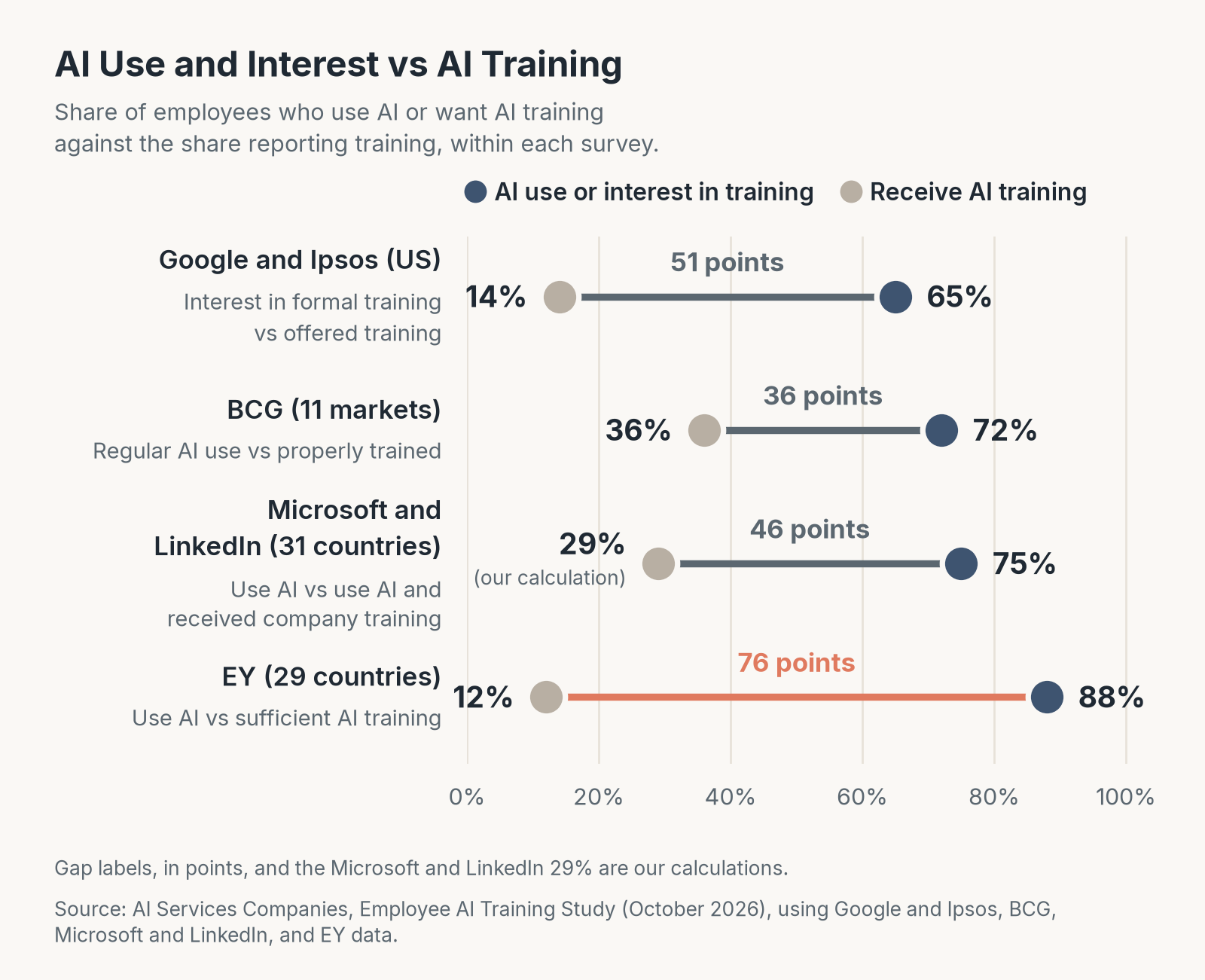
- The Google and Ipsos pair is the only one limited to US workers, and its 51-point gap measures unmet interest in training among all employed adults, users and non-users alike.
- In the same survey, the qualities employees most often rated as important in AI training were a trusted provider (77%), hands-on learning (75%), a structured learning path (72%) and experience with AI applications related to their current job (71%).
- In every pair, the share of workers who use or want AI is larger than the share with training. Many employees are therefore using AI tools with little or no formal instruction.
The Microsoft and LinkedIn row multiplies the 75% of knowledge workers who use AI by the 39% of those users who received company training. WEF's training figure adds the 29 of every 100 workers that employers expect to upskill in their current roles and the 19 expected to be upskilled and redeployed.
Training Hours and Spending
ATD reports per-employee learning hours and spending for all training, while EY and BCG report the AI-specific hour thresholds tied to higher gains and regular use.
| Source | Year of data | Measure | Value |
|---|---|---|---|
| ATD | 2024 | Direct learning expenditure per employee, all training | $1,254 |
| ATD | 2023 | Direct learning expenditure per employee, all training | $1,283 (our calculation) |
| ATD | 2024 | Learning hours used per employee, all training | 13.7 |
| ATD | 2023 | Learning hours used per employee, all training | 17.4 |
| ATD | 2024 | Cost per learning hour used | $165 |
| ATD | 2023 | Cost per learning hour used | $123 |
| EY | 2025 | Annual AI training hours for the highest-gain employee group | More than 81 |
| BCG | 2025 | AI training hours tied to sharply higher regular use | At least 5 |
Source: AI Services Companies, Employee AI Training Study, October 2026, using ATD 2025 State of the Industry (539 organizations), EY and BCG data. Data: training-hours-spending.csv
- ATD's cost per learning hour used rose by $42 from 2023 to 2024 (our calculation), which ATD describes as an increase of about 34%.
- None of the surveys we reviewed publishes AI-specific training spend per employee. ATD's figures cover all formal learning.
- EY's highest-gain group trained for more than 81 hours a year, at least 5.9 times the 13.7 hours ATD records for all training per employee (our calculation). Reaching that level for most staff would take a large expansion of training time.
ATD reports that 2024 direct expenditure per employee was $29 lower than in 2023, which gives the 2023 value in the second row.
Training by Role, Job Level and Country
White-collar workers, leaders and managers report more AI training or use than blue-collar workers and frontline employees, and emerging economies report more AI training than advanced economies.
| Source | Group | Measure | Value |
|---|---|---|---|
| Jobs for the Future (US) | White-collar workers | Receive employer AI training | 42% |
| Jobs for the Future (US) | Blue-collar workers | Receive employer AI training | 28% |
| Jobs for the Future (US) | White-collar workers | Use AI tools at work | 50% |
| Jobs for the Future (US) | Blue-collar workers | Use AI tools at work | 27% |
| BCG (11 markets) | Leaders | Use generative AI at least several times a week | 85% |
| BCG (11 markets) | Managers | Use generative AI at least several times a week | 78% |
| BCG (11 markets) | Frontline employees | Use generative AI at least several times a week | 51% |
| BCG (11 markets) | Frontline employees | Say they receive sufficient leadership support on AI | 25% |
Source: AI Services Companies, Employee AI Training Study, October 2026, using Jobs for the Future and BCG data. Data: ai-training-by-role-seniority.csv
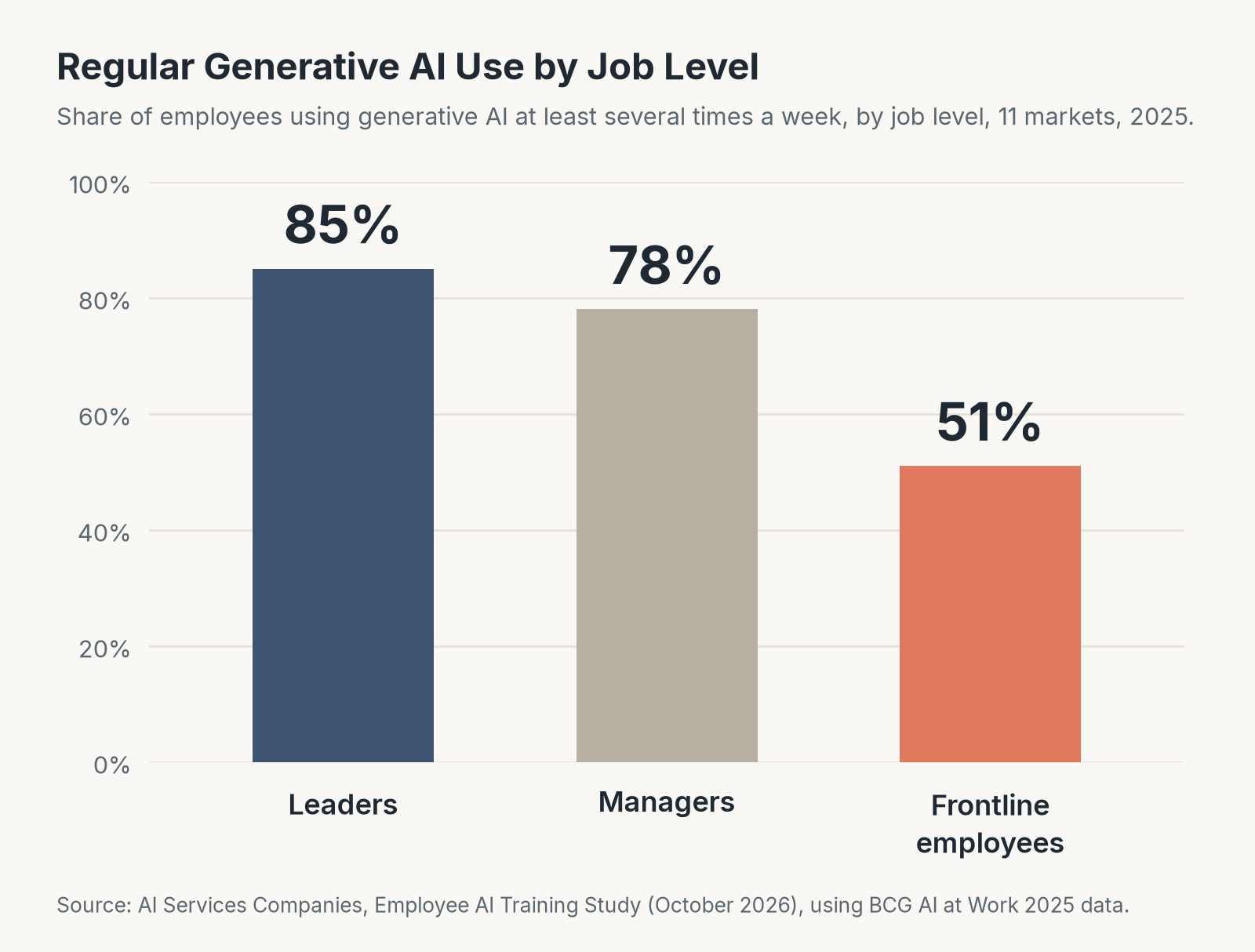
- JFF's 14-point gap between white-collar and blue-collar workers in employer AI training runs alongside a 23-point gap in AI use at work (our calculation).
- Only a quarter of BCG's frontline employees say their leaders give them enough support on how and when to use AI.
- In JFF's data, employer AI training and AI use at work are both lowest for blue-collar workers. The employees with the least AI instruction are also the ones using AI least often.
| Country group | AI training | AI knowledge | AI efficacy |
|---|---|---|---|
| Global, 47 countries | 39% | 52% | 60% |
| Advanced economies | 32% | 46% | 51% |
| Emerging economies | 50% | 64% | 74% |
| United States | 28% | Not published on this measure | No US figure published |
Source: AI Services Companies, Employee AI Training Study, October 2026, using KPMG and University of Melbourne, Trust, attitudes and use of artificial intelligence: A global study 2025 (48,000 respondents in 47 countries). Data: ai-training-by-country-group.csv
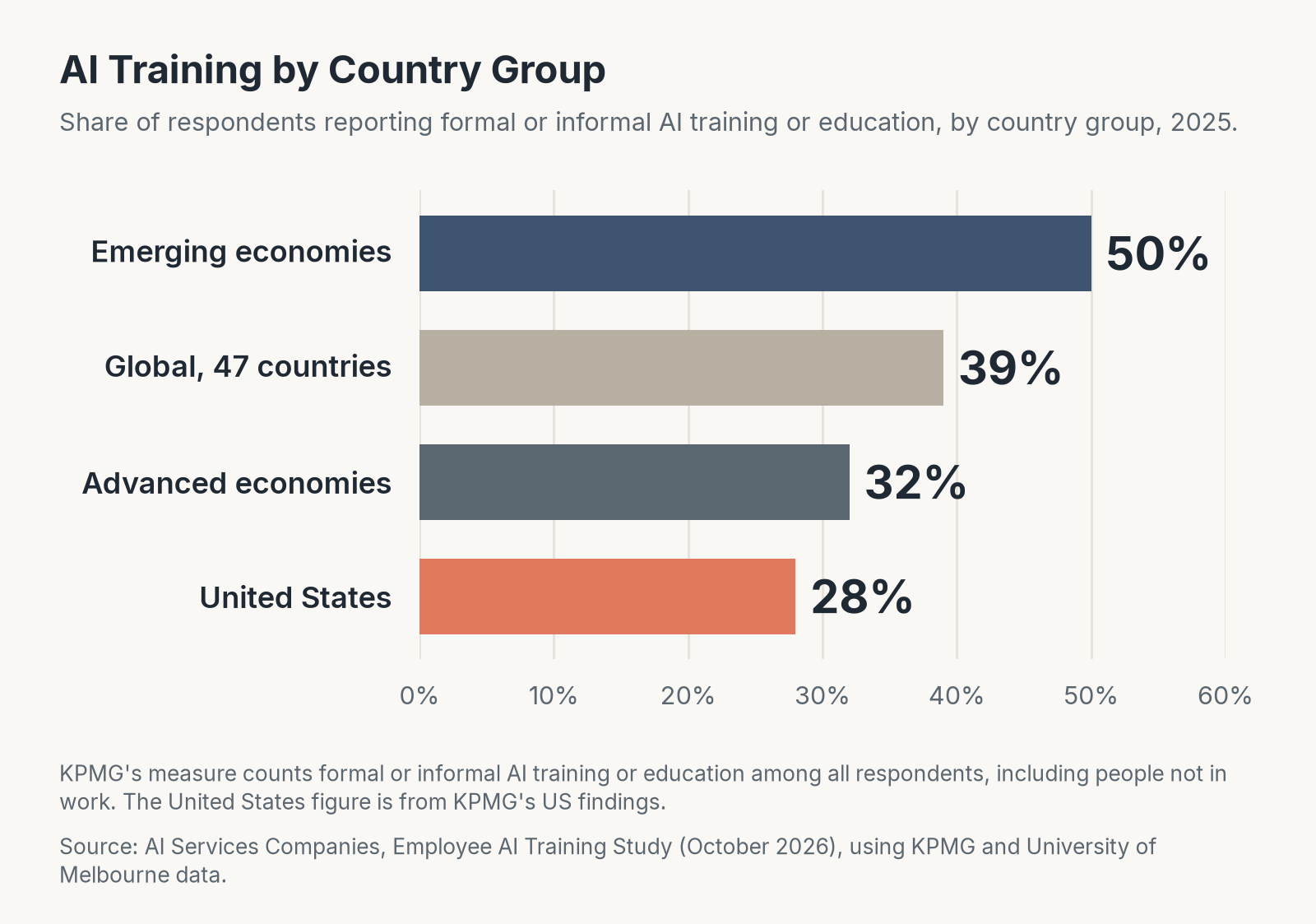
- The share reporting AI training was 18 points higher in emerging economies than in advanced economies (our calculation).
- The US rate of 28% is 4 points below the advanced-economy average and 22 points below emerging economies (our calculation).
- A smaller share of US adults report any AI training or education than the advanced-economy average, so US employers adding AI tools are more likely to be teaching adults with no prior AI instruction.
KPMG's training measure counts formal or informal training or education in AI among all respondents, including people outside work, so it differs from the employer-training measures in Table 1.
Training and AI Use
Employees who received more AI training use AI more and report larger time savings than less-trained employees in each survey that compared them.
| Source | Comparison | Measure | Value |
|---|---|---|---|
| BCG | More than 5 hours of training vs less than 5 hours | Regular AI users | 79% vs 67% |
| Google and Ipsos (US) | Employees who received training vs others | Likelihood of using AI for work | 2.5 times |
| Google and Ipsos (US) | Employees who received training vs others | Likelihood of being AI Fluent | Almost 3.5 times (published wording) |
| Google and Ipsos (US) | AI Fluent vs AI Explorer employees | Median hours saved per week | 8 vs 3 |
| EY | More than 81 hours of annual AI training vs all employees | Weekly productivity gain, hours | Average of 14 vs median of 8 |
Source: AI Services Companies, Employee AI Training Study, October 2026, using BCG, Google and Ipsos, and EY data. Data: ai-training-and-use.csv
- BCG's regular-use rate is 12 points higher for employees with more than 5 hours of training (our calculation).
- In the Google and Ipsos survey, AI Fluent employees save a median of 5 more hours a week than AI Explorers (our calculation).
- Each survey links more training with more use or larger reported savings, but none isolates training as the cause, since employees who seek training may already be heavier users.
Google and Ipsos group AI users into AI Fluent employees, who use AI often and across many tasks, and AI Explorers, who use it on an occasional basis. EY also found that its most-trained employees were 55% more likely to leave their organization.
What Employee AI Training Data Means Going Forward
For many employees, learning to use AI at work happens on their own time, through trial and error with whatever tools their employer has switched on.
The picture will grow clearer as repeat surveys arrive. The New York Fed asks firms in its region about AI each summer, Gallup runs quarterly workforce surveys, and BCG and Microsoft with LinkedIn publish yearly workforce studies.
Data Collection and Methodology
The AI Services Companies Employee AI Training Study gathered published figures from 16 documents by 11 publishers, released between May 2024 and September 2026, and we opened every source on October 26, 2026. We kept a figure only when the publisher stated the percentage or value along with its survey base and field period.
Surveys and samples: Pew Research Center, 5,273 US workers, October 7 to 13, 2024, with 2,860 who had taken job training answering the AI question; Google and Ipsos, 4,464 US employed adults, December 5 to 21, 2025, and 1,511 hiring managers, December 10 to 25, 2025; Gallup, 21,543 US working adults, May 11 to 25, 2024; Federal Reserve Bank of New York, firms in New York and northern New Jersey, August 2024, 2025 and 2026; Microsoft and LinkedIn, 31,000 people in 31 countries, February 15 to March 28, 2024; BCG, 10,635 employees in 11 markets, 2025; EY, 15,000 employees and 1,500 employers in 29 countries, August 2025; KPMG and the University of Melbourne, 48,000 respondents in 47 countries, published April 2025; Jobs for the Future, 2,754 US respondents, November 20 to 27, 2024; World Economic Forum, more than 1,000 employers in 55 economies, published January 2025; ATD, 539 organizations, 2024 data.
Where a survey published only the inverse of a measure, such as the share with no training, Table 1 converts it to the share with training and marks the result (our calculation). Products, differences and ratios are marked (our calculation) and were rounded once, from the published values. Where a publisher gave a share in words without an exact figure, we quote the wording.
Figures from different surveys use different questions, bases, time windows and geographies, and each table labels its base. KPMG's figures cover all respondents, including people not in work. ATD's spending and hours cover all formal learning.
Data files: us-ai-training-share.csv, employer-ai-training-provision.csv, ny-fed-ai-adoption-retraining.csv, ai-training-demand-gap.csv, training-hours-spending.csv, ai-training-by-role-seniority.csv, ai-training-by-country-group.csv, ai-training-and-use.csv
Sources (17)
- AI Services Companies, Employee AI Training Study: analysis of worker, employer and training-industry surveys from 11 publishers on AI training rates, employer provision, training hours and spending, and AI use, conducted October 2026.
- Google and Ipsos, The Path to AI Fluency: AI Works for America, February 2026. https://www.ipsos.com/sites/default/files/ct/news/documents/2026-02/The%20Path%20to%20AI%20Fluency.%20AI%20Works%20for%20America%20-%20Google-Ipsos.pdf (accessed October 26, 2026)
- Pew Research Center, Which workers use AI in their jobs, February 25, 2025. https://www.pewresearch.org/social-trends/2025/02/25/workers-exposure-to-ai/ (accessed October 26, 2026)
- Pew Research Center, AI and workers survey topline, October 2024 fieldwork. https://www.pewresearch.org/wp-content/uploads/sites/20/2025/02/ST_2024.2.24_AI-workers_topline.pdf (accessed October 26, 2026)
- Gallup, Your AI Strategy Will Fail Without a Culture That Supports It, October 31, 2024. https://www.gallup.com/workplace/652727/strategy-fail-without-culture-supports.aspx (accessed October 26, 2026)
- Federal Reserve Bank of New York, Liberty Street Economics, Businesses Are Using AI to Transform Work, Not Cut Jobs, September 1, 2026. https://libertystreeteconomics.newyorkfed.org/2026/09/businesses-are-using-ai-to-transform-work-not-cut-jobs/ (accessed October 26, 2026)
- Federal Reserve Bank of New York, Liberty Street Economics, Are Businesses Scaling Back Hiring Due to AI?, September 4, 2025. https://libertystreeteconomics.newyorkfed.org/2025/09/are-businesses-scaling-back-hiring-due-to-ai/ (accessed October 26, 2026)
- Microsoft and LinkedIn, 2024 Work Trend Index Annual Report, May 2024. https://assets-c4akfrf5b4d3f4b7.z01.azurefd.net/assets/2024/05/2024_Work_Trend_Index_Annual_Report_663d45200a4ad.pdf (accessed October 26, 2026)
- BCG, AI at Work 2025: Momentum Builds, but Gaps Remain, June 26, 2025. https://www.bcg.com/publications/2025/ai-at-work-momentum-builds-but-gaps-remain (accessed October 26, 2026)
- BCG, AI at Work 2025 slideshow, June 2025. https://web-assets.bcg.com/fd/0d/bcc5dfae4cbaa08c718b95b16cf5/ai-at-work-2025-slideshow-june-2025-edit-02.pdf (accessed October 26, 2026)
- BCG, Weekly Brief: How Leaders Can Boost AI Adoption in Their Organization, July 2, 2025. https://www.bcg.com/assets/2025/242-weekly-brief-how-leaders-can-boost-ai-adoption-in-their-organization.pdf (accessed October 26, 2026)
- EY, 2025 Work Reimagined Survey press release, November 10, 2025. https://www.ey.com/en_gl/newsroom/2025/11/ey-survey-reveals-companies-are-missing-out-on-up-to-40-percent-of-ai-productivity-gains-due-to-gaps-in-talent-strategy (accessed October 26, 2026)
- KPMG and the University of Melbourne, Trust, attitudes and use of artificial intelligence: A global study 2025, executive summary, April 2025. https://kpmg.com/kpmg-us/content/dam/kpmg/pdf/2025/trust-attitudes-artificial-intelligence-executive-summary.pdf (accessed October 26, 2026)
- KPMG US, Trust, attitudes and use of artificial intelligence: US findings, 2025. https://kpmg.com/us/en/articles/2025/trust-attitudes-and-use-of-artificial-intelligence.html (accessed October 26, 2026)
- Jobs for the Future, AI for Workers and Learners Survey, fielded November 2024. https://info.jff.org/hubfs/JFF%20AI%20for%20Workers%20&%20Learners%20Survey%202025.pdf (accessed October 26, 2026)
- World Economic Forum, The Future of Jobs Report 2025, January 7, 2025. https://www.weforum.org/publications/the-future-of-jobs-report-2025/digest/ (accessed October 26, 2026)
- Association for Talent Development, 5 Things TD Leaders Need to Know About the State of the Industry, 2025, August 2025. https://assets.td.org/m/3b1d61eaa0e22791/original/ATD-SOIR-2025-Talent-Development-Benchmarks-and-Trends.pdf (accessed October 26, 2026)