
Enterprise Generative AI Adoption Statistics 2026
Published November 10, 2026
Our analysts compared 11 published surveys, market estimates, and datasets, most of them released in 2026, including the Wharton-GBK survey of 1,007 US enterprise managers, McKinsey's State of AI survey of 1,719 respondents, 45 months of Ramp AI Index payment data from more than 85,000 US businesses, and the Census Bureau's Business Trends and Outlook Survey, to show how widely large companies use generative AI as of Q4 2026, how fast that use has grown since 2023, and how much they spend on it.
Key Findings
- 62% of managers at large US companies use AI daily in 2026, up from 46% in 2025, 29% in 2024, and 11% in 2023, and 91% use it more than weekly (Wharton-GBK, October 2026).5
- 55.9% of US businesses on Ramp paid for an AI product or service in September 2026, up from 43.8% in September 2025 and 7.5% in January 2023.6,7
- 40% of respondents at organizations with more than $1 billion in revenue report scaling AI agents in 2026, up from 27% in 2025, while the share at smaller organizations stayed at 22% (McKinsey, August 2026).2
- US enterprise AI spending reached an estimated $176.8 billion by September 2026, up from $33 billion in 2025, while the share of enterprises paying for AI rose from 55% to 65% (Menlo Ventures, November 2026).12
- 80% of US enterprise managers report a positive return on AI, but only 28% report a strongly positive one, and 37% of McKinsey respondents attribute any EBIT impact to AI.5,2
Generative AI tools such as ChatGPT, Claude, Gemini, and Microsoft Copilot reached most large companies within about two years of ChatGPT's launch in November 2022. Companies first bought chat assistants for office work, then added coding tools, AI features inside the software they already used, and, during 2025 and 2026, AI agents that carry out tasks on their own. Adoption figures for this technology appear in a great deal of news coverage, yet they come from very different sources: surveys of senior leaders at large companies, a government survey of all US businesses, and payment records. The same week can produce a headline that most enterprises use generative AI and another that only one business in five does. We wanted one place where the main numbers appear side by side with their samples and dates.
Our analysts took enterprise survey results from Wharton Human-AI Research and GBK Collective, McKinsey, Deloitte, and KPMG, and spending estimates from Menlo Ventures. We added Ramp's monthly count of businesses that pay for AI, taken from the FRED series the St. Louis Fed publishes, and the Census Bureau's survey of US firms. US results come first wherever a study reports them separately, and all money is in US dollars.
In the following sections, we compare headline adoption rates across surveys, how use grew from 2023 to 2026, the monthly record of businesses paying for AI, adoption by industry and company size, how far companies have moved from pilots to scaled use and agents, and what enterprises spend on generative AI and get back from it.
Between 20% and 91% of Organizations Use AI, Depending on the Survey
Adoption numbers depend heavily on who answers and what counts as use. Some surveys ask senior managers at large companies how often they personally use AI, some ask whether the organization uses it in any business function, and some count only businesses that paid for it, so we lined up the main 2025 and 2026 results with the sample behind each one.
| Source | Fieldwork or period | Sample | Measure | Share |
|---|---|---|---|---|
| Wharton-GBK | Jul 2026 | 1,007 US managers and above at companies with 1,000+ employees and over $50M revenue | Use AI more than weekly | 91% |
| Wharton-GBK | Jul 2026 | Same sample | Use AI daily | 62% |
| McKinsey | Jun to Jul 2025 | 1,993 respondents in 105 countries | Organization regularly uses gen AI in at least one business function | 79% |
| McKinsey | Jun to Jul 2025 | 1,993 respondents in 105 countries | Organization uses AI of any kind in at least one business function | 88% |
| Menlo Ventures | 2026 | Nearly 400 US enterprise decision-makers | Enterprises paying for AI | 65% |
| Deloitte | Aug to Sep 2025 | 3,235 business and IT leaders in 24 countries | Workers equipped with sanctioned AI tools | About 60% |
| Ramp AI Index | Sep 2026 | 85,000+ US businesses, card and bill-pay records | Large businesses with an AI payment | 65.7% |
| Ramp AI Index | Sep 2026 | 85,000+ US businesses, card and bill-pay records | All businesses with an AI payment | 55.9% |
| US Census Bureau BTOS | 2026 | Nationally representative US firms | Firms with 250+ employees using AI | 37% |
| US Census Bureau BTOS | Period ending May 3, 2026 | Nationally representative US firms | All firms using AI in the past two weeks | 19.8% |
Source: AI Services Companies analysis of Wharton-GBK, McKinsey, Menlo Ventures, Deloitte, Ramp, and US Census Bureau data, conducted November 2026. Data: genai-adoption-rates-by-survey.csv
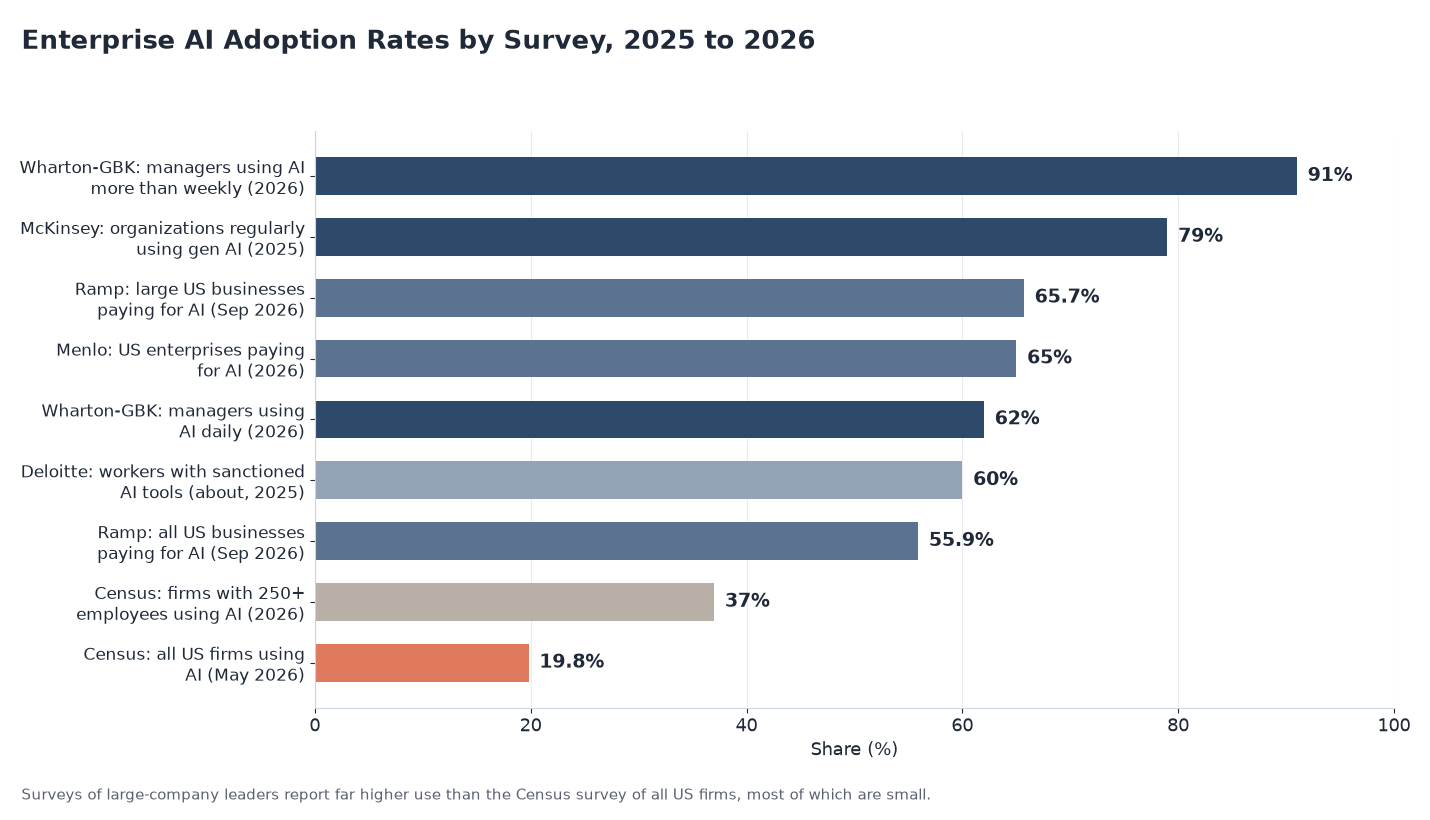
Source: AI Services Companies analysis of Wharton-GBK, McKinsey, Menlo Ventures, Deloitte, Ramp, and US Census Bureau data, conducted November 2026.
Key Findings
- The gap between surveys mostly reflects company size. The Census Bureau counts every US firm, most of them very small, and finds 19.8% using AI, while 37% of firms with 250 or more employees use it and surveys limited to large companies report 60% to 91%.8,5
- Payment records and surveys disagree even for the same businesses. Ramp, which counts card and invoice payments, found 55.9% of US businesses paying for AI in September 2026, more than double the Census Bureau's survey rate, and Ramp says its own count still misses free tools and personal accounts.6,8
- Use inside companies with AI is still spreading to more workers. Deloitte found that the share of workers equipped with sanctioned AI tools grew from fewer than 40% to around 60% in one year, so a company that "uses AI" may still leave a large part of its staff without approved tools.9
Generative AI Use Among Large Companies Has Climbed Every Year Since 2023
Two surveys have asked the same population about AI use every year since 2023, which makes them the best way to see the trend. Wharton and GBK Collective ask US managers at large companies how often they use AI for work, and McKinsey asks respondents worldwide whether their organization regularly uses generative AI in at least one business function.
| Year | Wharton-GBK: managers using AI daily | Wharton-GBK: managers using AI more than weekly | McKinsey: organizations regularly using gen AI |
|---|---|---|---|
| 2023 | 11% | 37% | 33% (April 2023) |
| 2024 | 29% | 72% | 65% (early 2024); 71% (July 2024) |
| 2025 | 46% | 82% | 79% |
| 2026 | 62% | 91% | Not reported in the 2026 summary |
Source: AI Services Companies analysis of Wharton-GBK and McKinsey 2025 and 2024 survey results, conducted November 2026. Data: genai-use-trend-2023-2026.csv
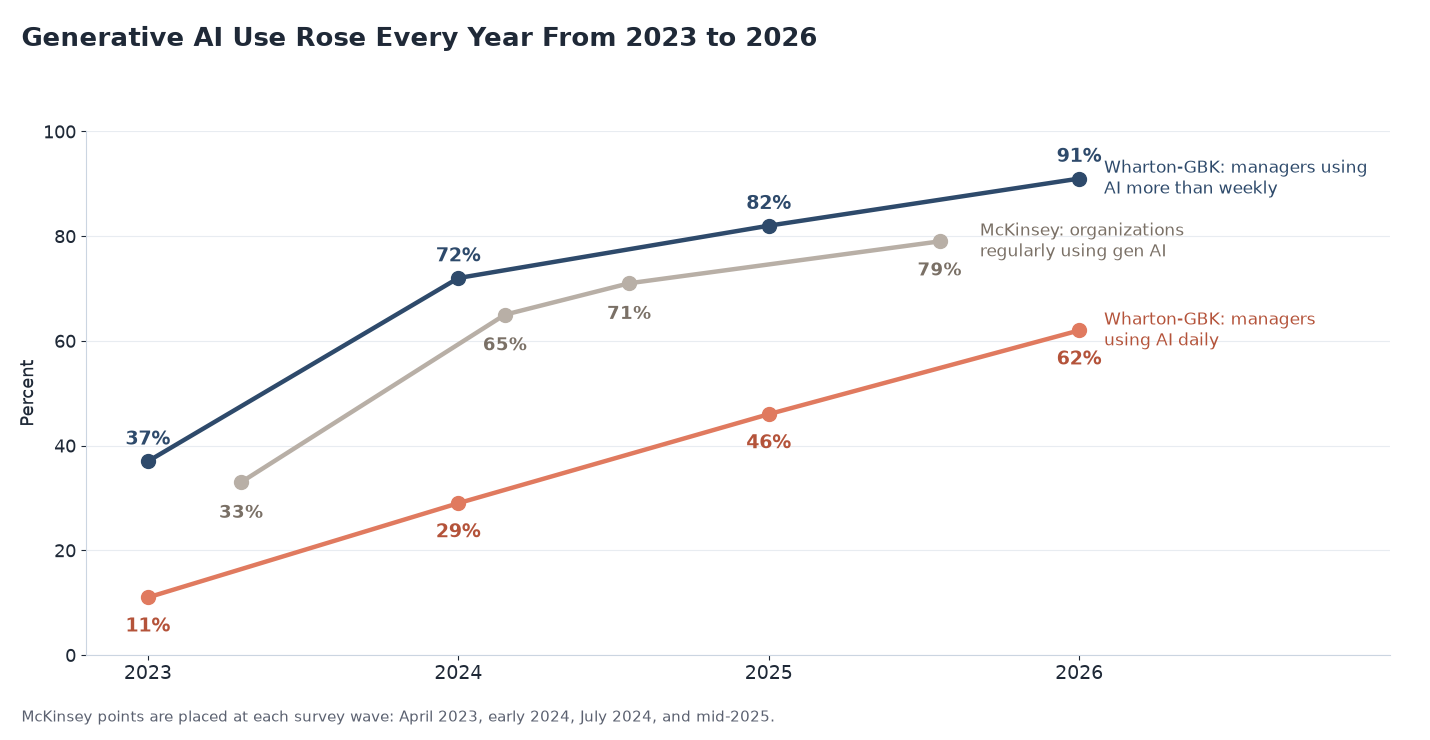
Source: AI Services Companies analysis of Wharton-GBK and McKinsey survey results, conducted November 2026.
Key Findings
- Daily use is growing faster than weekly use. Wharton-GBK's more-than-weekly rate rose 9 points in 2026 to 91%, close to its ceiling, while daily use rose 16 points to 62%, and the share using AI less than weekly or not at all fell from 16% to 9%.5
- The biggest jump in organizational adoption came in the first year. McKinsey's share of organizations regularly using generative AI almost doubled from 33% in April 2023 to 65% in early 2024, then rose more slowly to 71% in July 2024 and 79% in mid-2025.3,4
- Use is rising faster than enthusiasm. In Wharton-GBK's 2026 survey, the share of managers who describe themselves as excited about AI fell 8 points to 51%, while the share calling themselves skeptical rose 8 points to 25%, the first year in the study when use and sentiment moved in opposite directions.5
Paid AI Adoption Among US Businesses Rose From 7.5% to 55.9%
Ramp, a corporate card and bill-payment company, publishes a monthly count of the US businesses on its platform that made a payment to an AI model, subscription, token, or API provider. Because it comes from payments, it gives a month-by-month record that annual surveys cannot, and it covers businesses of every size.
| Month | Share of businesses on Ramp with an AI payment | Change from a year earlier |
|---|---|---|
| January 2023 | 7.5% | Not available |
| January 2024 | 30.4% | +22.9 points |
| January 2025 | 35.6% | +5.2 points |
| September 2025 | 43.8% | Not shown |
| January 2026 | 45.5% | +10.0 points |
| September 2026 | 55.9% | +12.1 points |
Source: AI Services Companies analysis of Ramp AI Index monthly data via FRED and the Ramp AI Index, conducted November 2026. Data: ramp-ai-adoption-monthly-2023-2026.csv
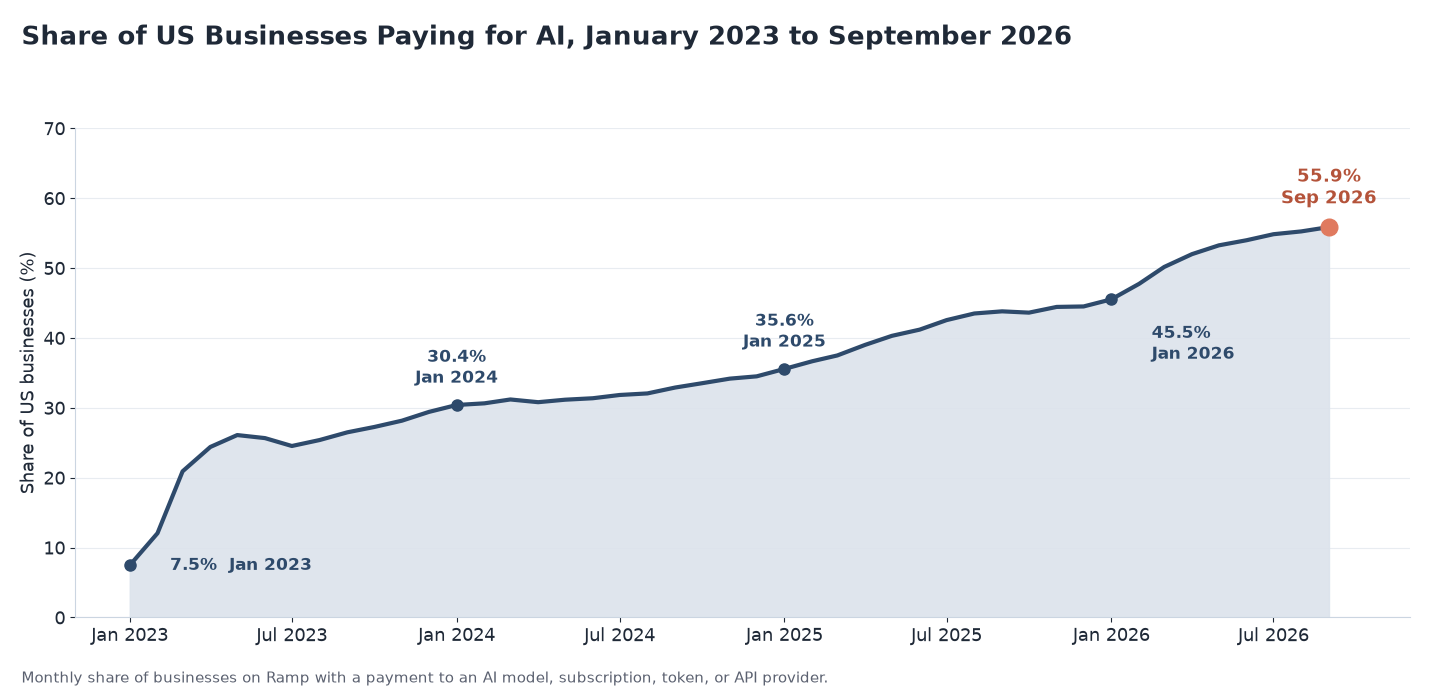
Source: AI Services Companies analysis of Ramp AI Index monthly data, conducted November 2026.
Key Findings
- Paid adoption grew in two bursts. The share more than tripled from 7.5% to 24.4% between January and April 2023, grew only from 30.4% to 34.5% during 2024, then rose 10.3 points between January and September 2026.7
- Spending among paying businesses is small at the median and large at the top. The median business paying for AI spent $15.70 per employee per month in September 2026, while the top 1% of paying businesses spent a median of $9,567.53 per employee.6
- Two model makers account for most paid business use. 43.8% of Ramp businesses paid Anthropic and 40.6% paid OpenAI in September 2026, and many pay both. Menlo Ventures found the same pattern in its 2026 survey, where spending growth came mainly from companies that already paid for AI.6,12
Information and Finance Companies Lead AI Adoption, and Larger Firms Lead Smaller Ones
Readers often want to know which kinds of companies have moved furthest. We compared Ramp's payment-based rates by sector and size with the Census Bureau's survey rates for the same sectors, and added Wharton-GBK's results by company revenue for large enterprises.
| Group | Ramp: paid for AI (Sep 2026) | Census BTOS: used AI (May 2026) | Wharton-GBK: managers using AI at least weekly (2026) |
|---|---|---|---|
| All businesses | 55.9% | 19.8% | Not applicable |
| Information | 79.9% | 39.7% | Not reported |
| Finance and insurance | 73.7% | 33.9% | Not reported |
| Manufacturing | 60.9% | Not reported | Not reported |
| Retail trade | 49.9% | About 14% | Not reported |
| Construction | 43.2% | Not reported | Not reported |
| Healthcare | 42.5% | Not reported | Not reported |
| Accommodation and food | 33.0% | Not reported | Not reported |
| Large businesses (Ramp) or 250+ employees (Census) | 65.7% | 37% | Not applicable |
| Medium-sized businesses (Ramp) or 100 to 249 employees (Census) | 62.5% | 32% | Not applicable |
| Small businesses (Ramp) | 50.0% | Under 20% for firms with four or fewer employees | Not applicable |
| Revenue under $250M | Not applicable | Not applicable | 94% |
| Revenue $250M to $2B | Not applicable | Not applicable | 94% |
| Revenue over $2B | Not applicable | Not applicable | 85% |
Source: AI Services Companies analysis of Ramp AI Index, US Census Bureau, and Wharton-GBK data, conducted November 2026. Data: ai-adoption-paid-vs-reported-by-sector.csv
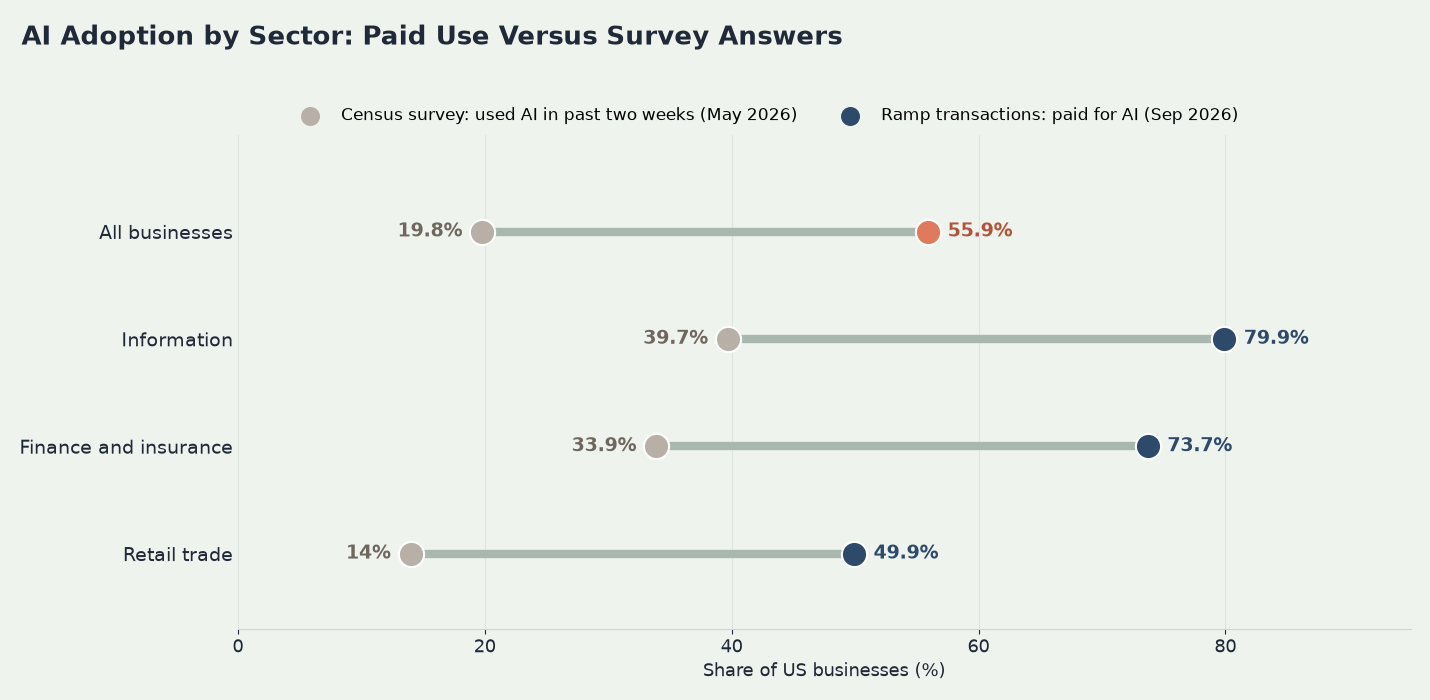
Source: AI Services Companies analysis of Ramp AI Index and US Census Bureau data, conducted November 2026.
Key Findings
- Information and finance lead in both datasets. The information sector has the highest rate in Ramp's payments at 79.9% and in the Census survey at 39.7%, followed by finance and insurance at 73.7% and 33.9%, while accommodation and food is lowest in Ramp's data at 33.0%.6,8
- The size gap has closed among large enterprises. Wharton-GBK found that 94% of companies under $250 million in revenue and 94% of those between $250 million and $2 billion use AI at least weekly in 2026, against 85% above $2 billion, up from 79%, 87%, and 70% a year earlier.5
- Size still matters across the whole economy. Between December 2025 and May 2026, AI use rose among Census respondents with at least 20 employees and did not change significantly among smaller firms, and Ramp's rate for small businesses, 50.0%, trails its 65.7% for large ones.8,6
Fewer Than Half of Organizations Have Scaled AI, and Most AI Agents Still Need Human Approval
Once most large companies use generative AI somewhere, the more useful question is how deeply they use it. We gathered measures of scaling, production deployment, and AI agents, which are systems that carry out tasks on their own, from McKinsey, Wharton-GBK, Deloitte, and KPMG.
| Source | Measure | Earlier result | Latest result |
|---|---|---|---|
| McKinsey (global) | AI scaling across the enterprise | 38% (2025) | 44% (2026) |
| McKinsey (global) | AI used in three or more business functions | 51% (2025) | 56% (2026) |
| McKinsey (global) | Scaling AI agents, organizations over $1B revenue | 27% (2025) | 40% (2026) |
| McKinsey (global) | Scaling AI agents, smaller organizations | 22% (2025) | 22% (2026) |
| McKinsey (global) | Scaling AI chatbots across the enterprise | Not reported | 47% (2026) |
| McKinsey (global) | Decided against buying software because it could be built with coding agents | Not reported | 32% (2026) |
| Wharton-GBK (US) | More than half of the department's AI pilots reached production | Not reported | 54% (2026) |
| Wharton-GBK (US) | AI fully embedded in core business processes | Not reported | 28% (2026) |
| Wharton-GBK (US) | Department uses AI agents in some form | Not reported | 67% (2026) |
| Wharton-GBK (US) | Department lets AI act without approving each step | Not reported | 17% (2026) |
| Deloitte (global) | Moved 40% or more of AI pilots into production | Not reported | 25% (2025) |
| Deloitte (global) | Companies planning agentic AI with a mature agent governance model | Not reported | 21% (2025) |
| KPMG (US, $1B+ revenue) | Developing or implementing multi-agent systems | 6% (Q2 2026) | 25% (Q3 2026) |
Source: AI Services Companies analysis of McKinsey, Wharton-GBK, Deloitte, and KPMG survey results, conducted November 2026. Data: ai-scaling-2025-vs-2026.csv
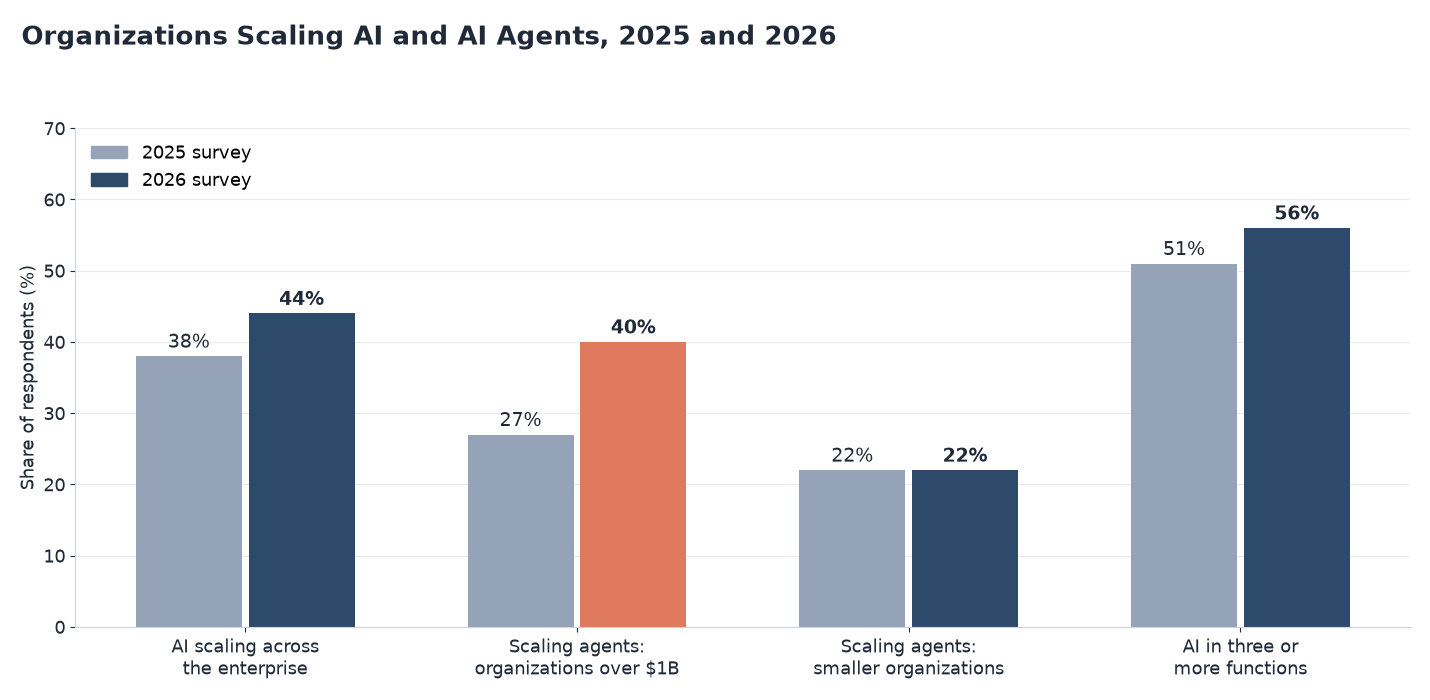
Source: AI Services Companies analysis of McKinsey State of AI survey results, conducted November 2026.
Key Findings
- Most companies still run AI in pilots or in parts of the business. 44% of McKinsey respondents say AI is scaling across their enterprise, and 28% of US managers in Wharton-GBK's survey describe AI as fully embedded in their department's core processes.2,5
- Agents are spreading quickly, but few act alone. Two-thirds of US enterprise departments use AI agents in some form, yet in 48% a person approves the work before anything happens and only 17% let AI act without approval of each step.5
- Large organizations are pulling ahead on agents. The share of McKinsey respondents at organizations over $1 billion in revenue that report scaling agents rose 13 points in a year, while smaller organizations stayed flat, and KPMG found multi-agent work among $1 billion-plus US companies rose from 6% to 25% in one quarter.2,10
Enterprise AI Spending Grew More Than Fivefold in 2026 While Reported Returns Held Steady
Spending shows how much companies are committing to generative AI beyond trying it. We collected Menlo Ventures' market estimates, which are built from enterprise surveys and public financial data, and budget and return figures from KPMG, Wharton-GBK, and McKinsey.
| Source | Measure | Value |
|---|---|---|
| Menlo Ventures | US enterprise generative AI spending, 2023 | $1.7 billion |
| Menlo Ventures | US enterprise generative AI spending, 2024 | $11.5 billion |
| Menlo Ventures | US enterprise AI spending, 2025 (restated in 2026 report; first reported as $37 billion) | $33 billion |
| Menlo Ventures | US enterprise AI spending, 2026 through September | $176.8 billion |
| Menlo Ventures | AI application spending, 2025 and 2026 | $19 billion to about $77 billion |
| Menlo Ventures | AI coding spending, 2025 and 2026 | $4 billion to $34 billion |
| Menlo Ventures | Anthropic share of enterprise LLM API spending, 2023 to 2026 | 12%, 24%, 40%, 55% |
| Menlo Ventures | OpenAI share of enterprise LLM API spending, 2023, 2025, and 2026 | 50%, 27%, 31% |
| KPMG | Projected AI investment over the next 12 months, US companies with $1B+ revenue | $130 million (Q3 2025) to $173 million (Q3 2026) |
| Wharton-GBK | Managers reporting an AI budget of $10 million or more | 39% (2025) to 45% (2026) |
| Wharton-GBK | Managers expecting AI spending to rise in the next 12 months | 88% (2025), 87% (2026) |
| McKinsey | Spending more than 10% of the ICT budget on AI | 28% (2026) |
| Wharton-GBK | Managers reporting positive return on AI; strongly positive | 80%; 28% (2026) |
| McKinsey | Respondents attributing any EBIT impact to AI | 37% (2026) |
| KPMG | Leaders reporting measurable business value from AI | 58% (Q3 2026) |
Source: AI Services Companies analysis of Menlo Ventures 2025 and 2026 reports, KPMG, Wharton-GBK, and McKinsey, conducted November 2026. Data: enterprise-ai-spending-2023-2026.csv
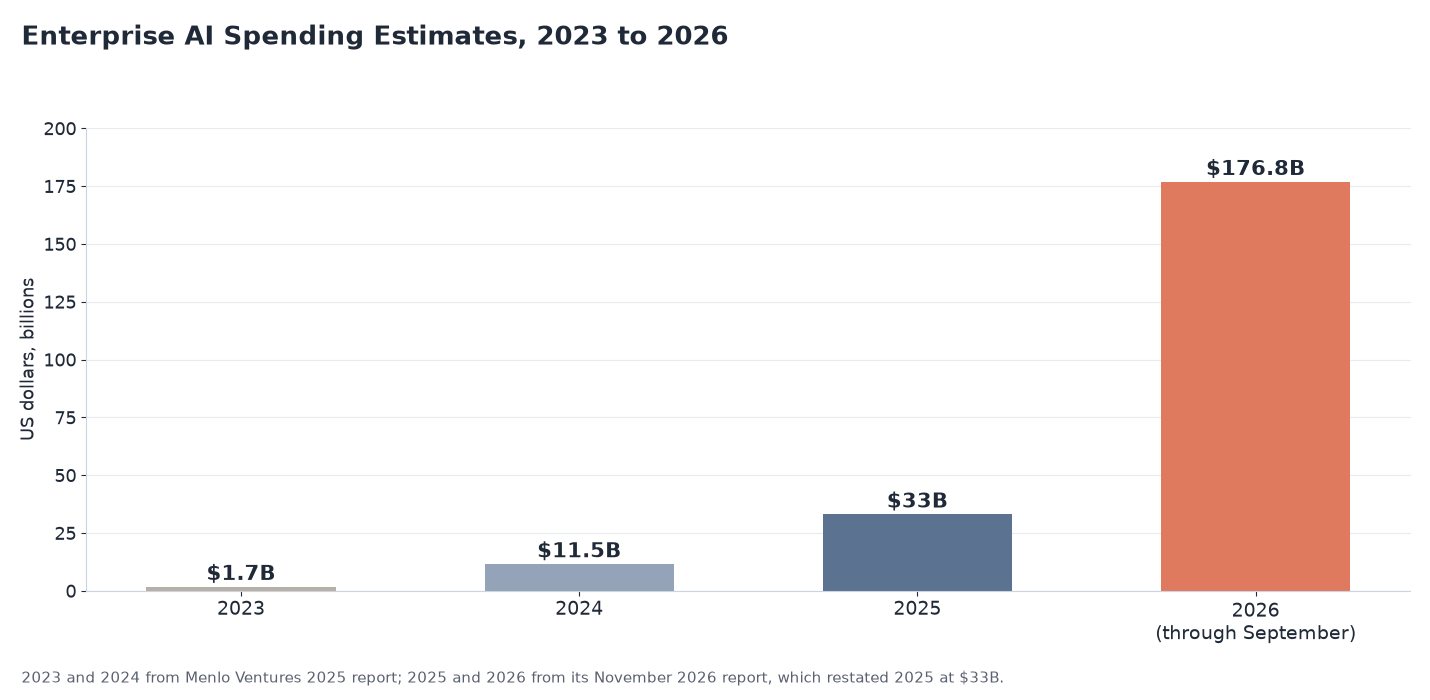
Source: AI Services Companies analysis of Menlo Ventures State of Enterprise AI reports, 2025 and 2026, conducted November 2026.
Key Findings
- Spending is growing much faster than the number of buyers. Menlo Ventures estimates enterprise AI spending grew 5.4 times from 2025 to 2026, while the share of enterprises paying for AI rose only from 55% to 65%, and its survey found companies spent 2.5 times what they had budgeted for 2026.12
- Coding and assistants take most application money. Coding tools ($34 billion) and AI assistants and productivity tools ($25 billion) made up 76% of the roughly $77 billion enterprises spent on AI applications in 2026, and Anthropic's share of enterprise model API spending rose to 55%.12
- Returns have not kept pace with use. The share of McKinsey respondents attributing any EBIT impact to AI was essentially unchanged at 37%, about one in five say operating costs limit their AI use, and the cost of tools, compute, and licenses is the most cited barrier to stronger returns among US managers, at 34%.2,5
What the Adoption Figures Mean Going Into 2027
For people who work at large US companies, generative AI is now an ordinary part of the job, and the growth that remains is in how often they use it and how much of their work they hand over to it. In the wider economy the picture is less complete: about one in five US firms told the Census Bureau they used AI in the past two weeks, and roughly half of small businesses on Ramp pay for it.
The figures also show that adoption is no longer the main measure of progress. Spending rose more than fivefold in 2026 while the share of companies reporting a clear financial gain barely moved, and only about a fifth of organizations scale agents across the business. The open question for 2027 is whether the large companies now scaling agents and rebuilding workflows begin to show returns that the many companies with lighter use do not.
So if you cite an enterprise generative AI adoption rate, give the source, the date, and whether it measures personal use, organizational use, or payments, because figures from the same year range from 19.8% to 91% on those differences alone.
Data Collection and Methodology
We collected published percentages, counts, and dollar figures from 11 reports and datasets. Surveys: Wharton Human-AI Research and GBK Collective (US managers and above at companies with 1,000 or more employees and more than $50 million in revenue, fielded July 9 to 29, 2026, n=1,007, plus 409 entry- and mid-level employees; earlier waves had about 670, 800, and 800 respondents, and the 2023 wave used different question wording, so its results are directional); McKinsey's State of AI surveys (May 4 to June 8, 2026, 1,719 participants in 97 countries; June 25 to July 29, 2025, 1,993 participants in 105 countries; July 16 to 31, 2024, 1,491 participants in 101 countries; all weighted by each country's share of global GDP); Deloitte's State of AI in the Enterprise (August to September 2025, 3,235 business and IT leaders in 24 countries); KPMG's AI Quarterly Pulse Survey (July 24 to August 25, 2026, 314 US C-suite and business leaders at companies with $1 billion or more in revenue); and the Census Bureau's Business Trends and Outlook Survey (biweekly, nationally representative, reviewed for December 14, 2025 to May 3, 2026).
Ramp AI Index figures are the monthly share of businesses on Ramp's card and bill-pay platform with a payment for an AI product or service, from the FRED series RAMPAIALL (January 2023 to September 2026) and Ramp's own page for sector, size, vendor, and spending figures. Ramp's sample is more than 85,000 US businesses and is not a random sample of all US firms. Menlo Ventures' spending figures are estimates from a bottom-up market model informed by surveys of about 500 US enterprise decision-makers in November 2025 and nearly 400 in 2026; its 2026 report restated 2025 spending at $33 billion against the $37 billion published in its 2025 report, and its 2023 and 2024 figures exclude inference.
McKinsey and Deloitte figures are global and are shares of respondents, not of companies. The Census Bureau revised its core AI question in November 2025 to ask about AI use in any business function. Survey measures differ in wording, sample, and time window, so we show each figure with its own source and do not average them. We calculated products, differences, and ratios from the published values.
Sources (12)
- AI Services Companies analysis of enterprise generative AI adoption survey, payment, and spending data from 11 published reports and datasets, conducted November 2026.
- McKinsey, The state of AI in 2026: On the road to ROI (August 25, 2026)
- McKinsey, AI at work but not at scale, chart on the State of AI 2025 survey (December 10, 2025)
- McKinsey, The state of AI: How organizations are rewiring to capture value (2024 survey)
- Wharton Human-AI Research and GBK Collective, The Adaptive Advantage: Who's Winning With AI and How (October 2026)
- Ramp, Ramp AI Index (data through September 2026)
- Federal Reserve Bank of St. Louis FRED, Artificial Intelligence Adoption by Ramp Businesses: Overall (RAMPAIALL, updated October 14, 2026)
- US Census Bureau, Large Firms With at Least 20 Employees Biggest AI Users (May 26, 2026)
- Deloitte, From Ambition to Activation, State of AI in the Enterprise 2026 news release (January 21, 2026)
- KPMG, AI Quarterly Pulse Survey Q3 2026 (September 2026)
- Menlo Ventures, 2025: The State of Generative AI in the Enterprise (December 9, 2025)
- Menlo Ventures, 2026 State of Enterprise AI Report news release (November 3, 2026)