
Synthetic Data Usage Statistics 2026
Published November 12, 2026
Our analysts counted 14,516 Hugging Face datasets tagged as synthetic and 12 years of arXiv papers that mention synthetic data, then compared them with three 2026 surveys of enterprise leaders, the published training recipes of Microsoft's Phi-4 and NVIDIA's Nemotron-4 340B, and four market size estimates, to show how widely synthetic data is used in AI work as of Q4 2026 and how fast its use is growing.
Key Findings
- 28% of 518 enterprise leaders surveyed in early 2026 say their organizations use synthetic data extensively as a core part of AI and machine learning work, another 20% use it on a limited basis, and 51% do not use it (Perforce Delphix).2
- 56% of the same leaders ranked synthetic data the most suitable way to protect sensitive data in AI and machine learning work, but only 13% chose it for software development and testing, where 45% preferred static data masking.3
- Synthetic data made up 40% of the pretraining tokens for Microsoft's 14-billion-parameter Phi-4 model, and more than 98% of the data NVIDIA used to align Nemotron-4 340B was synthetically generated.7,8
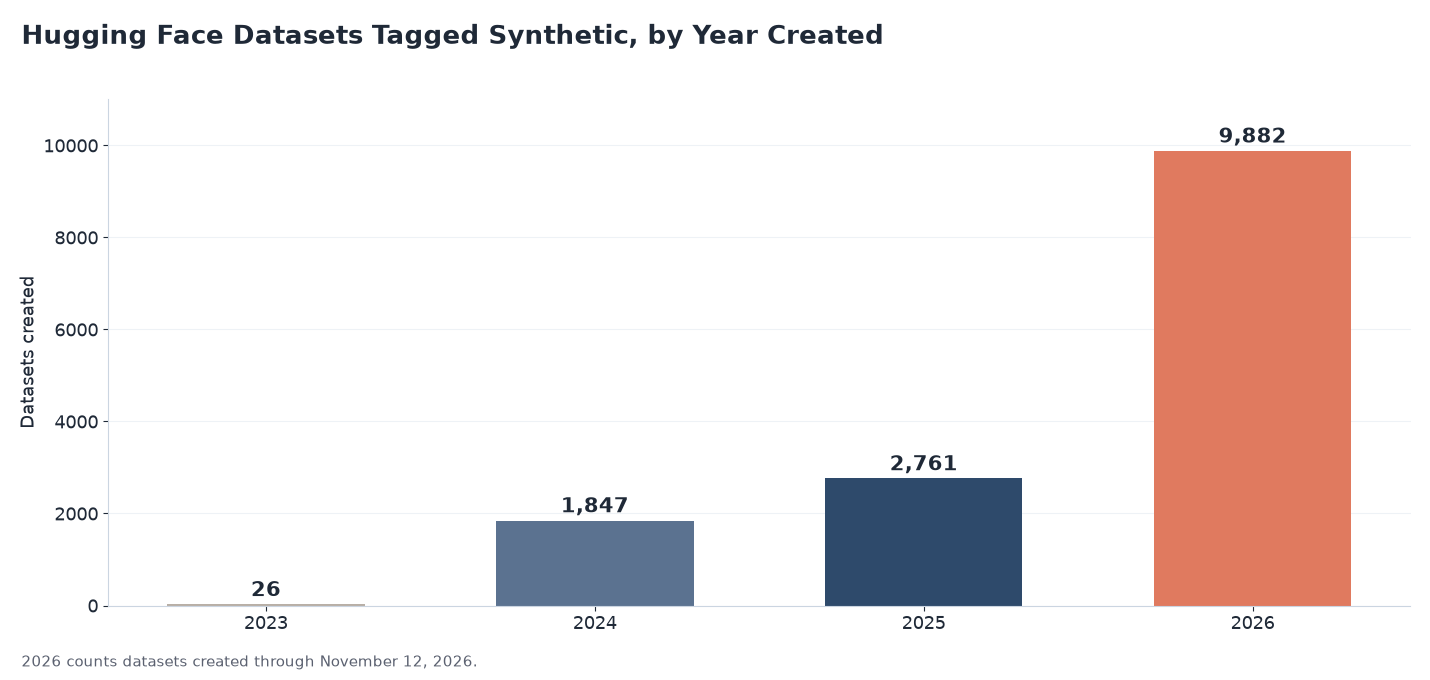
- Hugging Face lists 14,516 datasets tagged as synthetic as of November 12, 2026, and 9,882 of them, or 68.1%, were created in 2026.1,12
- arXiv papers that mention synthetic data in their abstracts rose from 134 in 2015 to 2,204 in 2025, 16.4 times as many, and reached 2,042 in the first ten months of 2026.1,11
Synthetic data is information produced by software to stand in for real records: customer tables, medical notes, driving scenes, or question-and-answer text written by one AI model to train another. Companies use it when real data is scarce, expensive to label, or too sensitive to hand to developers and model builders. In 2023, Gartner predicted that 60% of the data used for AI would be synthetic by 2024, up from 1% in 2021,6 and AI labs have since made synthetic text a large share of how they train language models. Epoch AI estimates the stock of usable human-written public text at about 300 trillion tokens and expects AI models to use all of it at some point between 2026 and 2032 if current trends continue.10 Surveys of companies outside the AI labs show a slower picture.
Our analysts pulled two sets of counts directly from public sources on November 12, 2026. From the arXiv API, we counted papers whose abstracts contain the phrase "synthetic data" in each calendar year from 2015 through October 31, 2026. From the Hugging Face Hub API, we downloaded the full list of datasets carrying the synthetic tag, with each dataset's creation date and downloads over the past 30 days. We then set those counts beside enterprise surveys from Perforce Delphix, Tonic.ai, and IDC, the training data tables in Microsoft's and NVIDIA's technical reports, and market estimates from Grand View Research, Global Market Insights, Precedence Research, and The Business Research Company. US results come first wherever a study reports them separately, and all money is in US dollars.
In the following sections, we compare how many organizations use synthetic data in AI work, where leaders say it fits best, how much of it goes into training language models, how fast synthetic data research has grown, how many public synthetic datasets are being released, and how large analysts estimate the market to be.
About Half of Enterprises Use Synthetic Data in AI Work, and 28% Use It Extensively
Three surveys published in 2026 asked companies whether they use synthetic data, and each asked a different group in different words. We set them side by side with the sample behind each figure, then looked at how the answers change by job role in the largest of them.
| Source | Fieldwork | Sample | Measure | Value |
|---|---|---|---|---|
| Perforce Delphix | Early 2026 | 518 enterprise leaders worldwide | Use synthetic data extensively as a core part of AI/ML workflows | 28% |
| Perforce Delphix | Early 2026 | 518 enterprise leaders worldwide | Use synthetic data on a limited basis for specific AI/ML use cases | 20% |
| Perforce Delphix | Early 2026 | 518 enterprise leaders worldwide | Not currently using synthetic data in AI/ML workflows | 51% |
| Perforce Delphix | Early 2026 | 518 enterprise leaders worldwide | Have used synthetic data in some capacity | 77% |
| Perforce Delphix | Early 2026 | 103 software engineering and testing leaders | Do not use synthetic data tools in development and testing | 66% |
| Tonic.ai | Q1 2026 | 232 business and technical leaders | Use synthetic data tools extensively | 31% |
| Tonic.ai | Q1 2026 | 232 business and technical leaders | Exploring synthetic data tools in limited or experimental ways | 54.3% |
| IDC, reported by No Jitter | July 2026 report | Organizations surveyed by IDC | Currently use synthetic data | Slightly more than half |
| IDC, reported by No Jitter | July 2026 report | Organizations surveyed by IDC | Plan to use synthetic data in the next 12 to 18 months | 44% |
| IDC, reported by No Jitter | July 2026 report | Organizations surveyed by IDC | No plans to use synthetic data | 5% |
Source: AI Services Companies analysis of Perforce Delphix, Perforce Delphix 2026 State of AI and Data Privacy Report, Tonic.ai, and IDC as reported by No Jitter data, conducted November 2026.
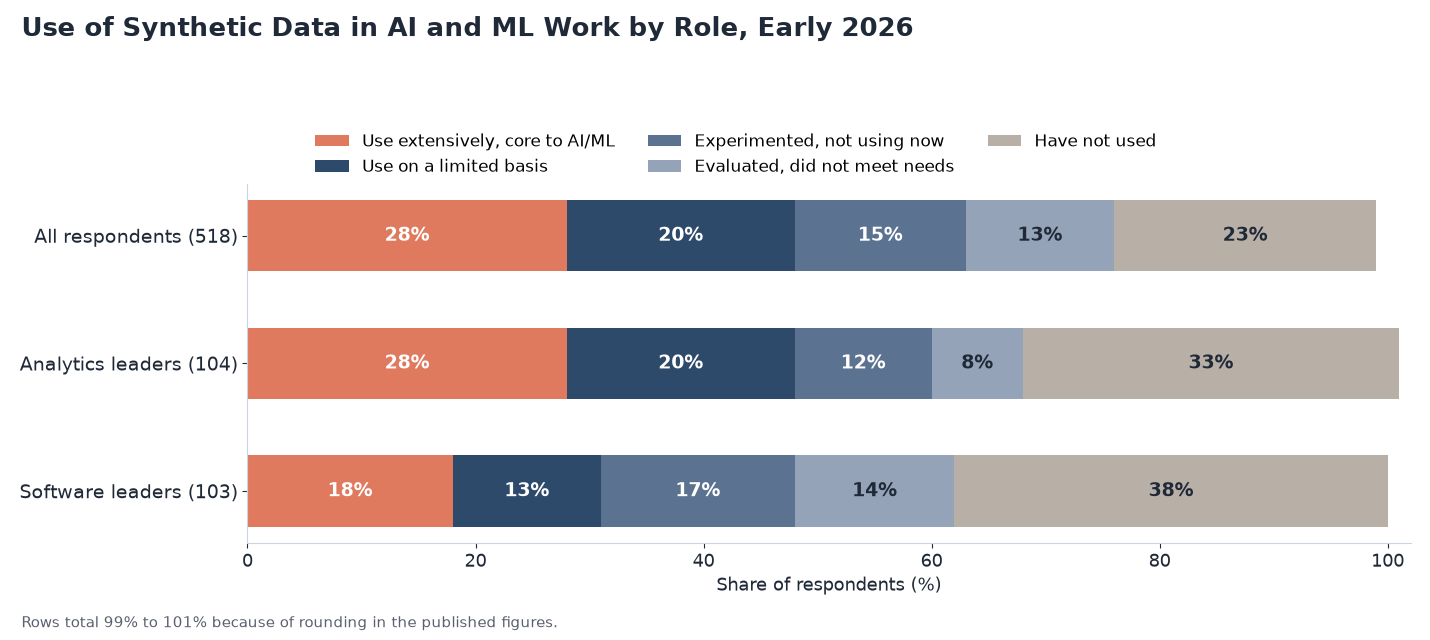
Source: AI Services Companies analysis of Perforce Delphix survey results, conducted November 2026. Data: synthetic-data-use-in-ai-ml-by-role-2026.csv
Key Findings
- Software teams use synthetic data less than data teams. 18% of software engineering and testing leaders say their organizations use it extensively in AI and machine learning work, against 28% of data engineering and analytics leaders, and 38% of software leaders say they have never used it.2
- Many companies have tried synthetic data and stopped. In the Delphix survey, 15% experimented with it and no longer use it and 13% evaluated it and found it did not meet their needs, so 28% of respondents have tested it without keeping it, the same share that uses it extensively.2
- The surveys agree on a core of heavy users near 30%, with 28% in the Delphix survey and 31% in Tonic.ai's. IDC's July 2026 report found slightly more than half of organizations already use synthetic data, 44% plan to within 12 to 18 months, and only 5% have no plans to. If those plans hold, nearly every organization in IDC's survey would be using synthetic data by early 2028.2,4,5
Leaders Prefer Synthetic Data for AI Workflows but Static Masking for Software Testing
Synthetic data competes with older ways of protecting sensitive records, such as masking real values or using a small slice of production data. The Delphix privacy survey asked the same 518 leaders which method fits each kind of work best and which methods meet specific requirements, so the answers show where companies trust synthetic data and where they do not.
| Use case | Synthetic data | Static data masking | Dynamic data masking | Data subsetting | Tokenization |
|---|---|---|---|---|---|
| AI/ML workflows | 56% | 27% | 8% | 6% | 1% |
| Data analytics workflows | 14% | 32% | 27% | 15% | 12% |
| Integration and unit testing | 12% | 30% | 28% | 14% | 15% |
| Software development and testing | 13% | 45% | 21% | 10% | 10% |
| Software development and testing when no production data exists | 22% | 38% | 24% | 8% | 8% |
| Requirement: provides data realism (share saying the method meets it) | 36% | 60% | |||
| Requirement: provides irreversible protection (share saying the method meets it) | 42% | 65% | |||
| Requirement: provides referential integrity (share saying the method meets it) | 34% |
Source: AI Services Companies analysis of Perforce Delphix 2026 State of AI and Data Privacy Report and Perforce Delphix synthetic data survey data, conducted November 2026. Data: synthetic-vs-masking-preference-by-use-case-2026.csv
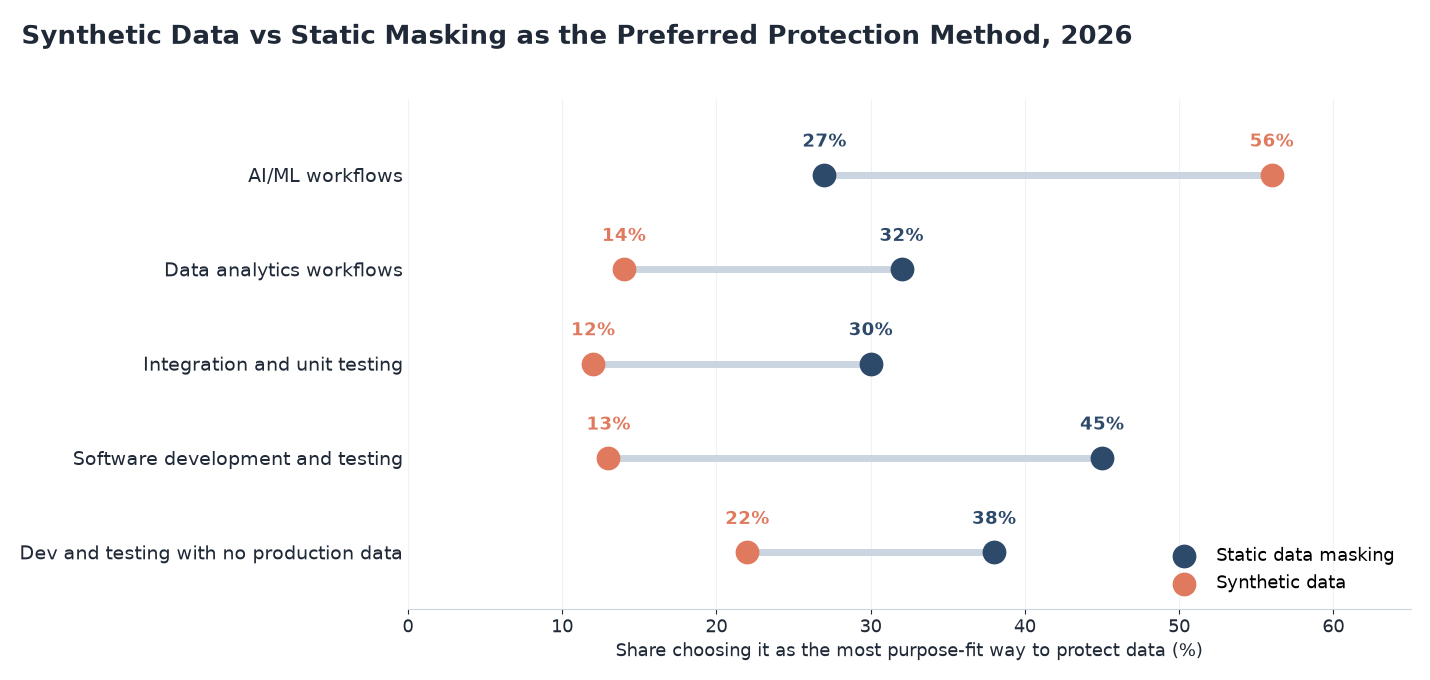
Source: AI Services Companies analysis of Perforce Delphix survey results, conducted November 2026.
Key Findings
- AI and machine learning work is the only use case where synthetic data leads. Among data engineering and analytics leaders, 59% chose it as the most suitable method for AI and machine learning, compared with 56% of all respondents.2,3
- Synthetic data gains ground when there is no real data to copy. Its share as the preferred method for software development and testing rises from 13% to 22% when no production data exists yet, while static masking falls from 45% to 38%.3
- Quality is the main doubt. Only 36% of leaders say synthetic data provides realistic data and 34% say it keeps relationships between tables intact, a property called referential integrity, against 60% who say static masking provides realism. Those two measures are where synthetic data tools have the most ground to make up against masking in testing work.2,3
Synthetic Data Made Up 40% of Phi-4's Training Tokens and 98% of Nemotron-4's Alignment Data
The heaviest users of synthetic data are the labs that train language models, and a few of them publish exactly how much they use. We collected the figures stated in technical reports and dataset releases from Microsoft, NVIDIA, and Hugging Face, along with Epoch AI's estimate of how much human-written text is left to train on.
| Model or dataset | Publisher and date | Measure | Value |
|---|---|---|---|
| Phi-4 (14 billion parameters) | Microsoft, December 2024 | Share of pretraining tokens from synthetic data | 40% |
| Phi-4 | Microsoft, December 2024 | Share of pretraining tokens from web rewrites, a kind of synthetic data | 15% |
| Phi-4 | Microsoft, December 2024 | Synthetic datasets created, and their total size | 50 types, about 400 billion unweighted tokens |
| Phi-4 | Microsoft, December 2024 | Times each synthetic token was repeated in pretraining | 13.8 epochs |
| Phi-4 | Microsoft, December 2024 | Total pretraining tokens | About 10 trillion |
| Nemotron-4 340B | NVIDIA, June 2024 | Share of alignment data that is synthetically generated | Over 98% |
| Cosmopedia | Hugging Face, March 2024 | Size of the open synthetic dataset at release | Over 30 million files and 25 billion tokens |
| Human-written public text | Epoch AI, June 2024 | Estimated effective stock for AI training | About 300 trillion tokens (90% range 100 to 1,000 trillion) |
| Human-written public text | Epoch AI, June 2024 | Years when models are expected to have used the full stock | 2026 to 2032 (80% range) |
Source: AI Services Companies analysis of Microsoft Phi-4 Technical Report, NVIDIA Nemotron-4 340B Technical Report, Hugging Face Cosmopedia, and Epoch AI data, conducted November 2026.
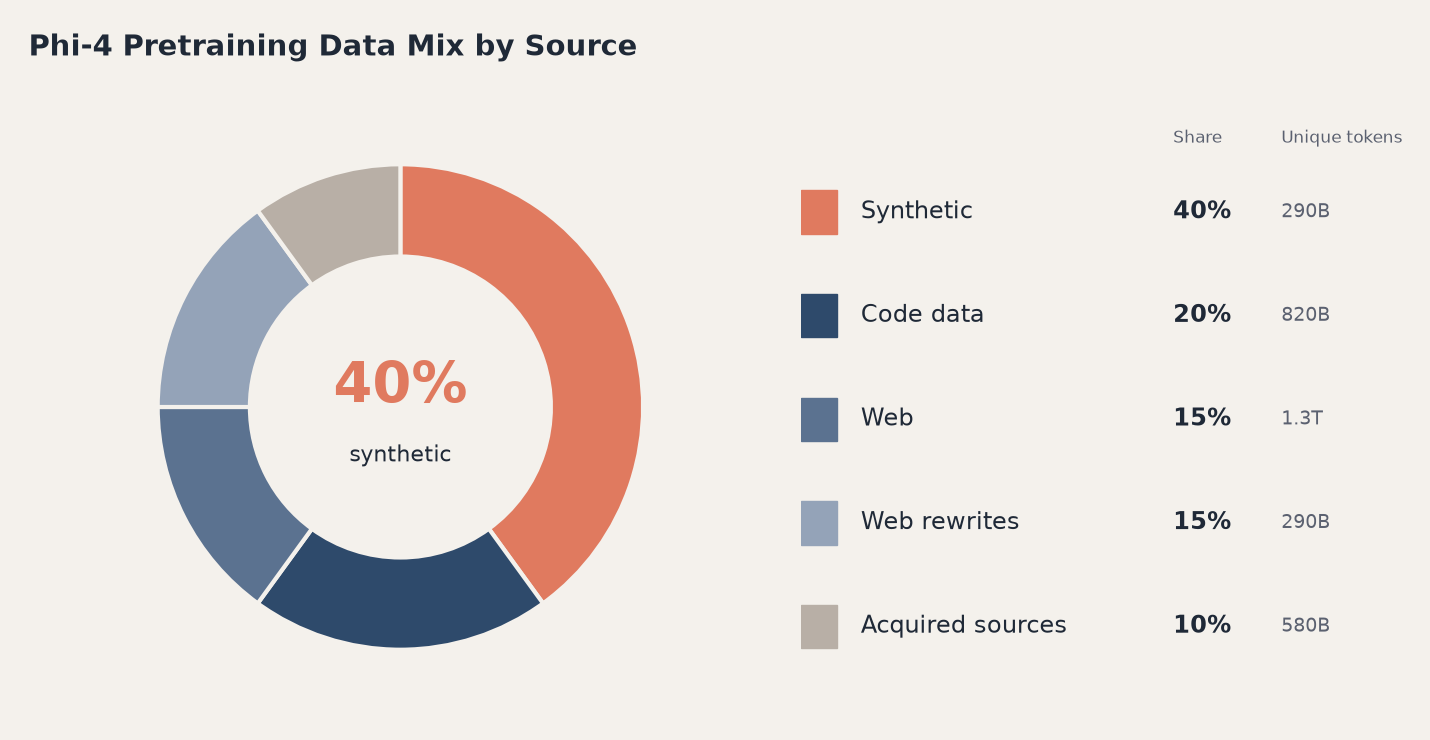
Source: Microsoft, Phi-4 Technical Report, Table 5, December 12, 2024. Data: phi-4-pretraining-data-mix.csv
Key Findings
- Synthetic data and web rewrites together supplied 55% of Phi-4's pretraining tokens, and its code data was also a mix of synthetic and raw code. Web text, the usual base of language model training, made up 15%.7
- Labs repeat synthetic data far more often than web text. Phi-4 saw each of its 290 billion unique synthetic tokens 13.8 times on average, against 1.2 times for its 1.3 trillion web tokens, and Microsoft found that extra passes over synthetic data beat adding fresh web data on the MMLU benchmark.7
- Synthetic data has limits on facts. Microsoft reported that a 13-billion-parameter test model trained only on synthetic data scored 14.8 points below the earlier phi-3-medium model on the TriviaQA knowledge test, which is why Phi-4 kept filtered web and licensed sources in its mix.7
arXiv Papers on Synthetic Data Grew 16-Fold From 2015 to 2025
Academic papers are an early signal of where AI methods are heading, since techniques usually appear in research before they appear in products. We counted papers posted to arXiv, the main open archive for AI research, whose abstracts include the phrase "synthetic data", for every year since 2015.
| Year | Papers | Change from prior year |
|---|---|---|
| 2015 | 134 | |
| 2016 | 202 | +50.7% |
| 2017 | 278 | +37.6% |
| 2018 | 390 | +40.3% |
| 2019 | 497 | +27.4% |
| 2020 | 702 | +41.2% |
| 2021 | 735 | +4.7% |
| 2022 | 888 | +20.8% |
| 2023 | 1,156 | +30.2% |
| 2024 | 1,722 | +49.0% |
| 2025 | 2,204 | +28.0% |
| 2026 (Jan 1 to Oct 31) | 2,042 | Not comparable (10 months) |
Source: AI Services Companies analysis of arXiv API search results for abstracts containing "synthetic data", conducted November 12, 2026. Data: arxiv-synthetic-data-papers-2015-2026.csv
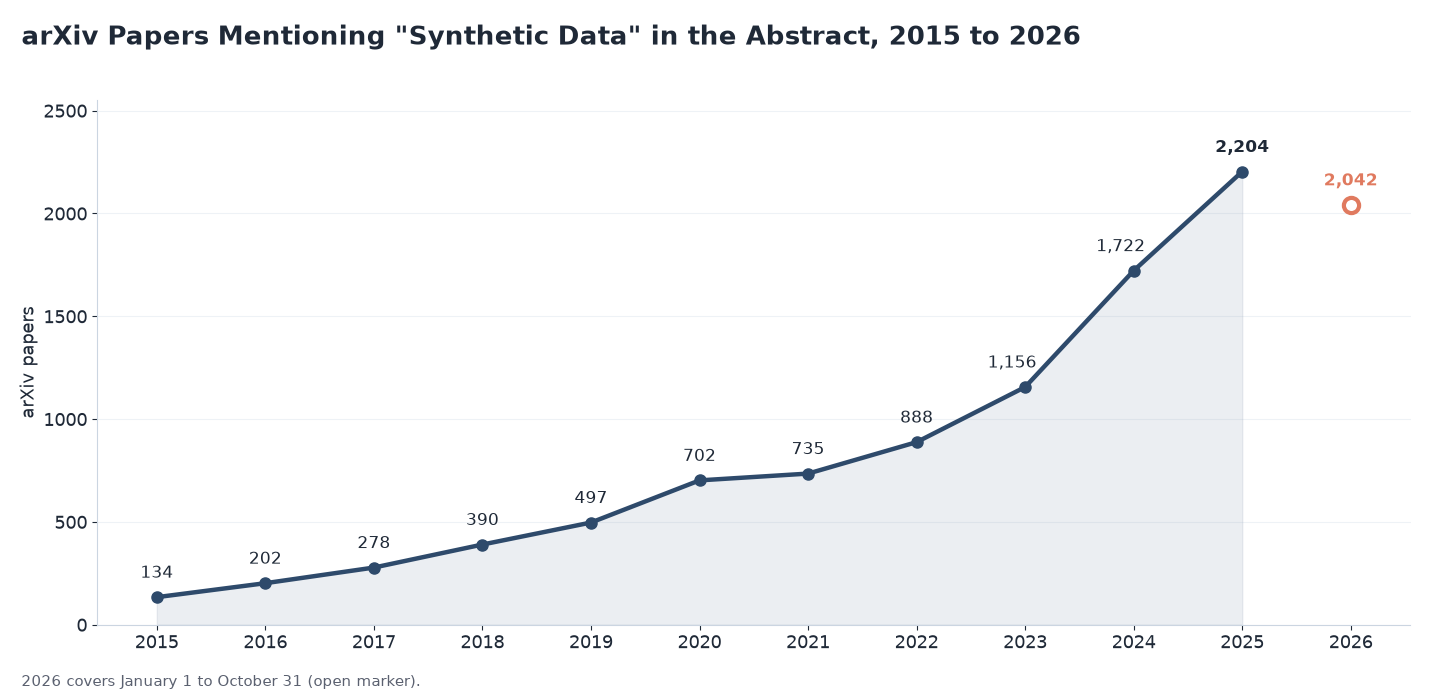
Source: AI Services Companies analysis of arXiv API data, conducted November 12, 2026.
Key Findings
- Growth sped up after ChatGPT's release in late 2022. Paper counts rose 30.2% in 2023 and 49.0% in 2024, the largest yearly increase since 2016, compared with 4.7% in 2021.1,11
- The 2,042 papers posted from January through October 2026 equal 92.6% of the full 2025 total with two months left, so 2026 is on course to set another record.1,11
- The yearly count passed 1,000 papers for the first time in 2023 and 2,000 in 2025, so the body of new research on synthetic data methods nearly doubled in two years.1,11
Hugging Face Synthetic Datasets More Than Tripled in 2026 to 9,882 New Releases
Hugging Face is the largest public host of AI training datasets, and publishers can tag a dataset as synthetic. Counting those tags by creation date shows how fast developers are sharing synthetic data, and download counts show how much of it gets used.
| Measure | Value |
|---|---|
| Datasets tagged synthetic, total | 14,516 |
| Created in 2023 | 26 |
| Created in 2024 | 1,847 |
| Created in 2025 | 2,761 |
| Created in 2026, through November 12 | 9,882 |
| Median downloads per dataset, past 30 days | 33 |
| Datasets with 100 or more downloads, past 30 days | 3,109 |
| Datasets with 1,000 or more downloads, past 30 days | 459 |
| Datasets with 10,000 or more downloads, past 30 days | 60 |
| Most downloaded synthetic-tagged dataset, past 30 days: Event6DBlender (created May 2026) | 379,303 |
| Rank 4: OpenThoughts-114k, a reasoning dataset (open-thoughts, January 2025) | 129,932 |
| Rank 9: OpenCodeInstruct, a coding dataset (NVIDIA, April 2025) | 54,522 |
| Rank 10: smoltalk, a chat training dataset (Hugging Face, November 2024) | 50,804 |
Source: AI Services Companies analysis of Hugging Face Hub dataset listings with the synthetic tag, conducted November 12, 2026. Data: hugging-face-synthetic-datasets-by-year-2026.csv, hugging-face-synthetic-datasets-top-50-downloads-2026-11-12.csv
Source: AI Services Companies analysis of Hugging Face Hub data, conducted November 12, 2026.
Key Findings
- 2026 has already produced 3.6 times as many synthetic-tagged datasets as all of 2025, and 68.1% of every synthetic-tagged dataset on Hugging Face was created this year.1,12
- Use is concentrated in a small share of releases. The median synthetic dataset was downloaded 33 times in the past 30 days, and only 459 of 14,516, or 3.2%, passed 1,000 downloads.1,12
- Large labs publish many of the most used sets. Hugging Face released Cosmopedia in March 2024 as the largest open synthetic dataset at the time, and NVIDIA and Hugging Face both have datasets in the 15 most downloaded synthetic sets in our snapshot.1,9,12
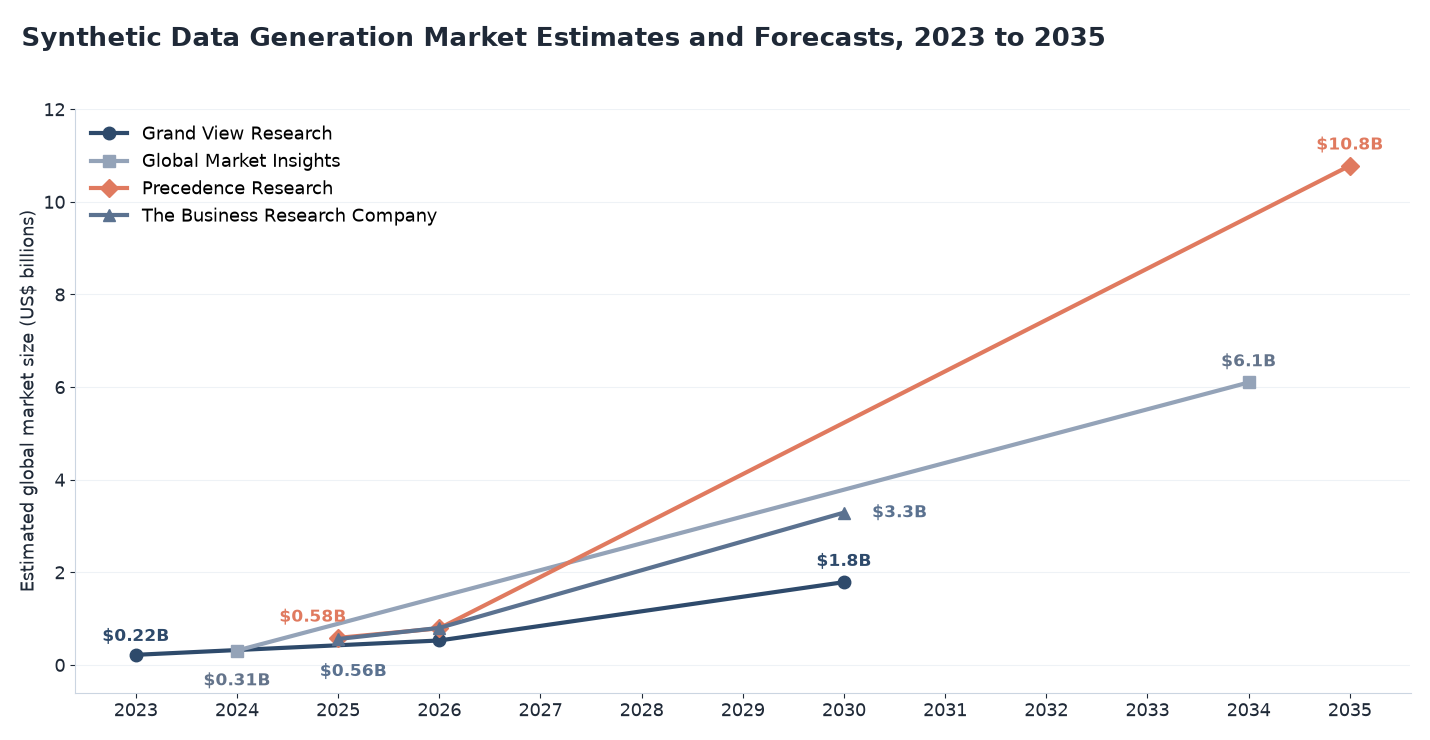
Analysts Put the 2026 Synthetic Data Market Between $528 Million and $800 Million
Market research firms size the business of selling synthetic data software and services, and their numbers are widely quoted in the press. We collected the current published estimates from four firms, because their figures differ enough that the source matters whenever one is cited.
| Publisher | Base-year value | 2026 value | Forecast | Growth rate |
|---|---|---|---|---|
| Grand View Research | $218.3 million (2023) | $528.3 million | $1,788.1 million (2030) | 35.3% a year, 2024 to 2030 |
| Global Market Insights | $310.5 million (2024) | Not published on page | $6.1 billion (2034) | 35.2% a year, 2025 to 2034 |
| Precedence Research | $584.52 million (2025) | $790.73 million | $10,780.44 million (2035) | 33.84% a year, 2026 to 2035 |
| The Business Research Company | $0.56 billion (2025) | $0.8 billion | $3.29 billion (2030) | 42.5% a year to 2030 |
Source: AI Services Companies analysis of Grand View Research, Global Market Insights, Precedence Research, and The Business Research Company report pages, conducted November 2026. Data: synthetic-data-market-estimates-2023-2035.csv
Source: AI Services Companies analysis of published market estimates, conducted November 2026.
Key Findings
- The four firms agree on fast growth, with yearly rates from 33.84% to 42.5%, but their 2030 forecasts differ widely: The Business Research Company's $3.29 billion is 1.8 times Grand View Research's $1,788.1 million.13,16
- North America is the largest region in every estimate that reports one: 34.5% of 2023 revenue for Grand View Research, over 34% of 2024 revenue for Global Market Insights, and more than 37% of 2025 revenue for Precedence Research.13,14,15
- One acquisition was worth more than half of a full year of the market. NVIDIA acquired the synthetic data startup Gretel in March 2025 for a reported nine-figure price above Gretel's last valuation of $320 million, according to Wired as reported by TechCrunch, while Precedence Research and The Business Research Company put the whole 2025 market at $584.52 million and $0.56 billion.17,15,16
What the Synthetic Data Figures Mean Going Into 2027
Synthetic data is now a standard part of how AI labs train models and a regular tool for about three in ten enterprises, while about half of companies still do not use it in AI work. The gap shows up most in software testing, where teams still prefer masked copies of real data because they trust them to look and behave like the real thing.
The public record points to faster growth. Research papers on synthetic data have risen every year since 2015, new synthetic datasets on Hugging Face more than tripled in 2026, and Epoch AI expects models to run through the stock of human-written public text within the next several years, which leaves generated data as one of the few ways to keep adding training material.
So if you cite a synthetic data adoption rate, say which survey it comes from and whether it counts extensive use, limited use, or any use at all, because 2026 figures range from 28% to 77% depending on that definition alone.
Data Collection and Methodology
arXiv counts come from the arXiv API query abs:"synthetic data" restricted by submission date to each calendar year from 2015 to 2025, and to January 1 through October 31, 2026, run on November 12, 2026. The search matches the exact phrase in paper abstracts, so papers that use related terms only, such as "simulated data" or "data augmentation", are not counted.
Hugging Face counts come from the Hub API list of all datasets with the synthetic tag, retrieved in full (14,516 records) on November 12, 2026, with each dataset's creation date and its downloads over the previous 30 days as reported by Hugging Face. Publishers apply the tag themselves, so the count includes only datasets whose owners tagged them.
Surveys: Perforce Delphix surveyed 518 enterprise leaders worldwide in early 2026 through a third-party research firm; its analytics leaders group (104 respondents) covers data engineering and data science or analytics roles, and its software leaders group (103) covers software engineering and testing roles. Tonic.ai surveyed 232 business and technical leaders in the first quarter of 2026. IDC figures are as reported by No Jitter on July 17, 2026, from IDC's July 2026 survey report. Each survey uses its own wording and sample, so we show each figure with its own source and do not average them.
Model training figures are taken from the technical reports' own tables and text. Market sizes are modeled estimates published on each firm's report page as of November 2026; the firms use different definitions and base years. We calculated products, differences, and ratios from the published values.
Sources (17)
- AI Services Companies analysis of synthetic data use from arXiv and Hugging Face Hub counts, three enterprise surveys, two model technical reports, and four market estimates, conducted November 2026.
- Perforce Delphix, The Synthetic Data Market Gap: Findings from Our 2026 Survey (2026)
- Perforce Delphix, The 2026 State of AI and Data Privacy Report (2026)
- Tonic.ai, Tonic.ai Research: Privacy Is Slowing AI Development (April 7, 2026)
- No Jitter, Synthetic data adoption rises, but risks remain (July 17, 2026)
- Gartner, Gartner Identifies Top Trends Shaping the Future of Data Science and Machine Learning (August 1, 2023)
- Microsoft, Phi-4 Technical Report, arXiv:2412.08905 (December 12, 2024)
- NVIDIA, Nemotron-4 340B Technical Report, arXiv:2406.11704 (June 17, 2024)
- Hugging Face, Cosmopedia: how to create large-scale synthetic data for pre-training (March 20, 2024)
- Epoch AI, Will We Run Out of Data? Limits of LLM Scaling Based on Human-Generated Data (June 6, 2024)
- arXiv API, search query results retrieved November 12, 2026
- Hugging Face Hub, datasets with the synthetic tag, retrieved November 12, 2026
- Grand View Research, Synthetic Data Generation Market Size report (accessed November 2026)
- Global Market Insights, Synthetic Data Generation Market Size report (accessed November 2026)
- Precedence Research, Synthetic Data Generation Market Size report (accessed November 2026)
- The Business Research Company, Synthetic Data Generation Market Report 2026 (accessed November 2026)
- TechCrunch, Nvidia reportedly acquires synthetic data startup Gretel (March 19, 2025)