
AI Governance and Compliance Statistics 2026
Published November 5, 2026
Our analysts compared survey results from Pacific AI’s 2025 AI Governance Survey of 351 professionals (91% at organizations with US operations), a Panterra and Optro survey of more than 400 GRC professionals, Continuum GRC’s 2026 benchmark of 275 compliance programs (187 of them AI-active), IBM’s September 2026 survey of 3,221 EMEA executives, and Stanford’s 2026 AI Index, to show how far AI governance and compliance have moved from policy into practice as of Q4 2026.
Key Findings
- Only 25% of GRC professionals in the Panterra and Optro survey say their organization has a fully implemented AI governance program, while 75% of Pacific AI respondents report an AI usage policy.
- Stanford’s 2026 AI Index finds ISO/IEC 42001 cited by 36% of surveyed organizations as an influence on responsible AI practice, and the NIST AI Risk Management Framework by 33%.
- Documented AI incidents in the AI Incident Database rose from 233 in 2024 to 362 in 2025, and 80% of surveyed EMEA executives say an AI-related incident reached their board or C-suite in the past year (IBM).
- Among Continuum GRC’s 187 AI-active programs, 41% sit in a foundational maturity band, and only 9% reach an advanced band with ISO 42001-level operating practice.
- Bias or fairness testing evidence is on file at 28% of those AI-active Continuum programs, and post-deployment monitoring records at 24%.
AI governance is the set of policies, roles, inventories, and controls that keep AI systems inside the risk limits a company can defend to customers, auditors, and regulators. Compliance adds the external rules those systems must meet, from the EU AI Act and US state laws to sector rules that already apply to privacy and safety. Companies now write AI usage policies faster than they build inventories, testing evidence, and incident playbooks. We wanted a clear picture of that gap, especially for US readers who buy AI services and must ask vendors how they govern the systems they ship.
Our analysts pulled published percentages from Pacific AI (fieldwork February 14 to May 29, 2025), Panterra and Optro’s GRC survey summarized in July 2025, Continuum GRC’s January 2025 to June 2026 program sample, IBM’s Censuswide fieldwork of September 14 to 24, 2026 across eight EMEA countries, and Stanford HAI’s 2026 AI Index chapters on responsible AI and policy. We compared framework adoption, maturity bands, control evidence, and incident response, and we kept US-facing figures first where a survey broke them out.
In the following sections, we compare how many organizations have moved past policy into a working program, which frameworks they cite, how mature compliance programs look when AI is already in scope, where control evidence is thinnest, and how often AI incidents now reach the board.
Most Organizations Have AI Policies, Few Have Full Programs
Surveys that ask about policies, roles, monitoring, and full programs show a clear staircase: written rules are common, dedicated owners are less common, and a finished governance program is still rare.
| Measure | Share of organizations | Survey |
|---|---|---|
| Fully implemented AI governance program | 25% | Panterra and Optro, 400+ GRC professionals |
| AI usage policy in place | 75% | Pacific AI, 351 respondents |
| Dedicated AI governance role or office | 59% | Pacific AI |
| AI incident response playbook | 54% | Pacific AI |
| Monitor production AI for accuracy, drift, or misuse | 48% | Pacific AI |
Source: AI Services Companies analysis of Panterra and Optro AI governance survey findings (July 30, 2025) and the Pacific AI 2025 AI Governance Survey, conducted November 2026. Data: ai-governance-program-adoption.csv
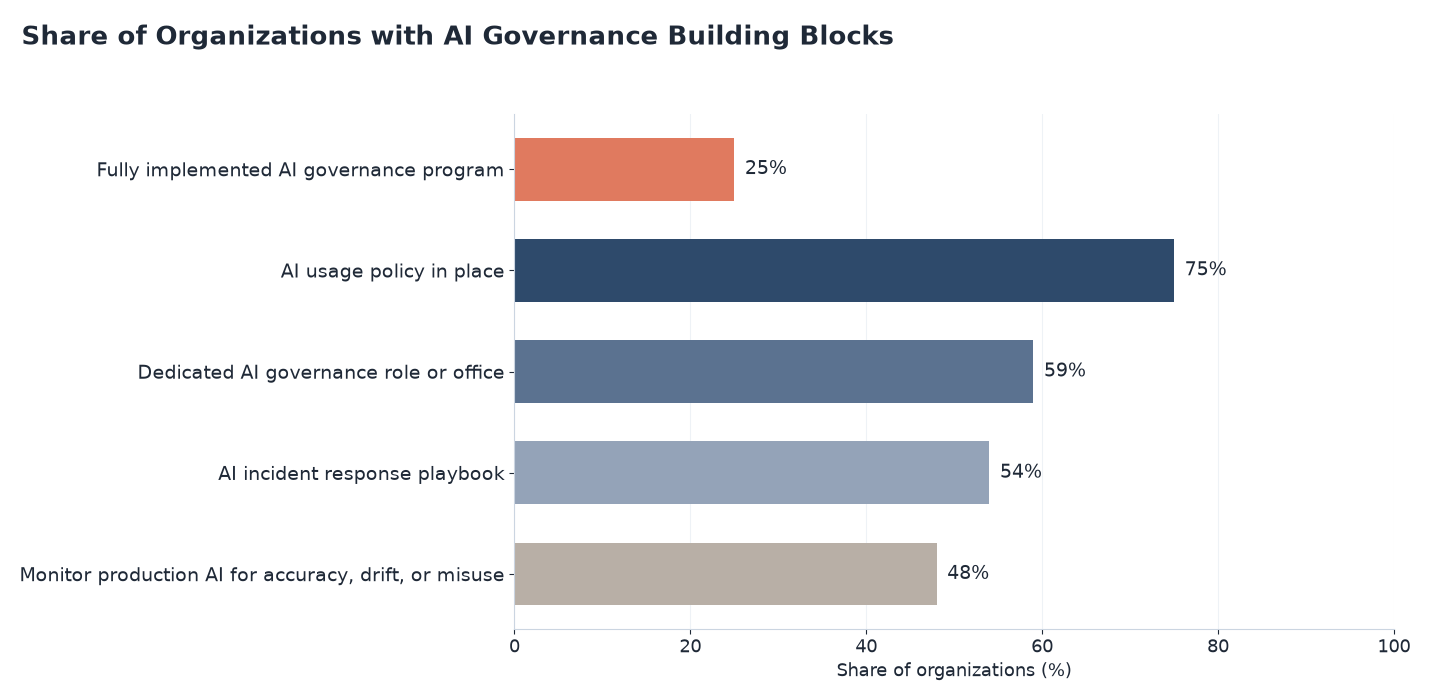
Source: AI Services Companies analysis of Panterra and Optro and Pacific AI survey findings, conducted November 2026.
Key Findings
- Speed to market is the top barrier for 45% of Pacific AI respondents, rising to 56% among technical leaders, which helps explain why policies land before monitoring and playbooks.
- Small companies lag: only 36% have governance officers, against 62% to 64% at larger firms, and only 9% of small firms monitor production AI systems (Pacific AI).
- For a US buyer of AI services, a vendor with a written AI policy is common; a vendor that can show production monitoring and an AI incident playbook is still the exception.
NIST and ISO 42001 Are the Frameworks Organizations Cite Most
As regulators tighten rules, companies pick reference frameworks to organize controls. Stanford’s Index tracks which standards influence responsible AI practice, and Continuum GRC shows how often those frameworks appear inside live compliance programs.
| Framework measure | Share | Source |
|---|---|---|
| ISO/IEC 42001 cited as an influence on responsible AI practice | 36% | Stanford AI Index 2026 |
| NIST AI Risk Management Framework cited as an influence | 33% | Stanford AI Index 2026 |
| Organizations aligning with the NIST AI RMF | 49% | Panterra and Optro |
| NIST AI RMF actively mapped (AI-active programs) | 34% | Continuum GRC |
| ISO/IEC 42001 pursue or certified (AI-active programs) | 19% | Continuum GRC |
| EU AI Act readiness work underway (AI-active programs) | 16% | Continuum GRC |
Source: AI Services Companies analysis of the Stanford 2026 AI Index figures summarized by ComplexDiscovery, Panterra and Optro, and the Continuum GRC 2026 AI Governance Benchmark Report, conducted November 2026. Data: ai-framework-adoption.csv
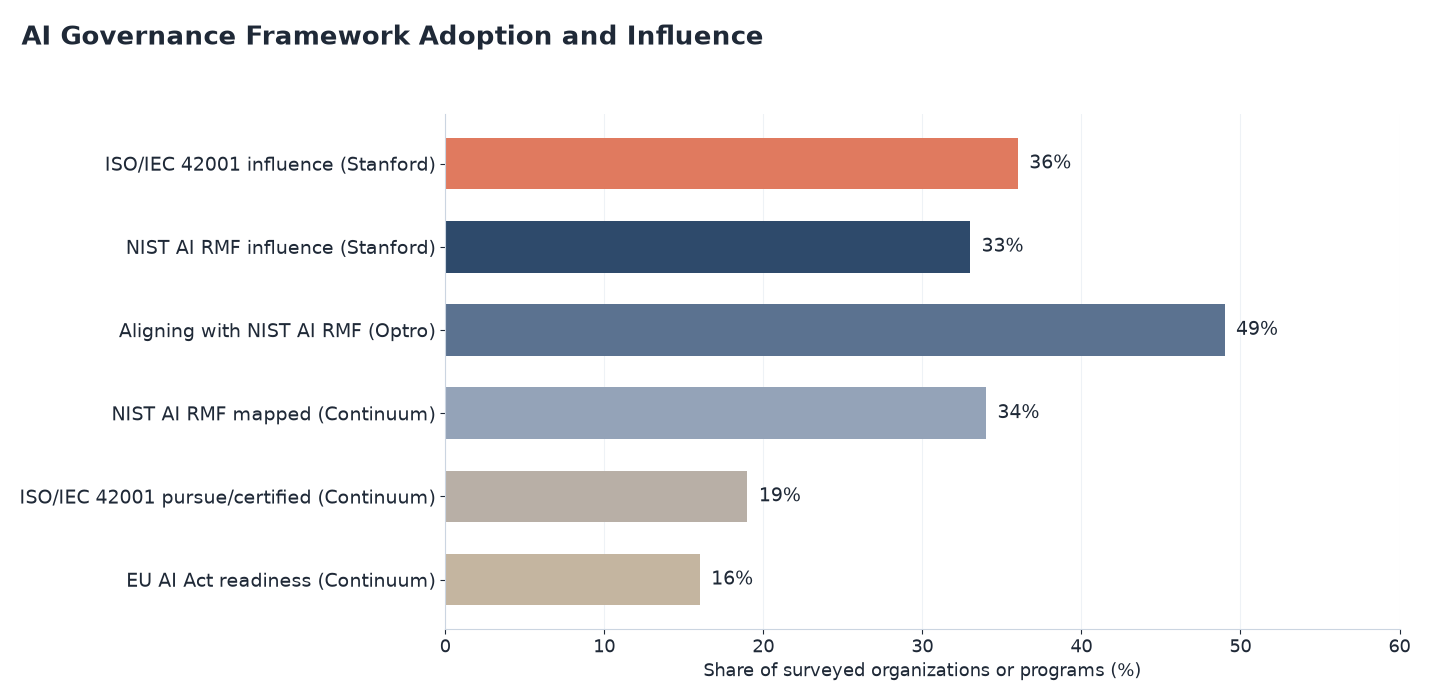
Source: AI Services Companies analysis of Stanford AI Index 2026, Panterra and Optro, and Continuum GRC, conducted November 2026.
Key Findings
- GDPR remains the most-cited regulatory influence in Stanford’s survey, though it slipped from 65% to 60%, and organizations reporting no regulatory influence fell from 17% to 12%.
- Businesses with no responsible AI policy fell to 11% from 24% in the Stanford Index, and AI-specific governance roles grew 17% in 2025.
- In IBM’s EMEA sample, 41% of EU executives are accelerating governance investment ahead of the EU AI Act’s high-risk obligations in December 2027, and another 35% report structured compliance plans.
Most AI-Active Compliance Programs Are Still Foundational
Continuum GRC’s sample of 187 AI-active programs puts a maturity label on programs that already have AI in scope for a formal assessment, which shows how far compliance teams have moved past a policy memo.
| Maturity band | Share of AI-active programs | Typical state |
|---|---|---|
| Ad hoc | 24% | AI in use, no register, reactive answers to assessors |
| Foundational | 41% | Policy exists, partial inventory, limited testing evidence |
| Managed | 26% | Full inventory, risk tiers, mapped controls, recurring review |
| Advanced | 9% | ISO 42001 or equivalent operating, continuous monitoring, vendor AI clauses enforced |
Source: Continuum GRC, 2026 AI Governance Benchmark Report, analysis of 187 AI-active programs in a 275-program sample (January 2025 to June 2026). Data: ai-governance-maturity-bands.csv
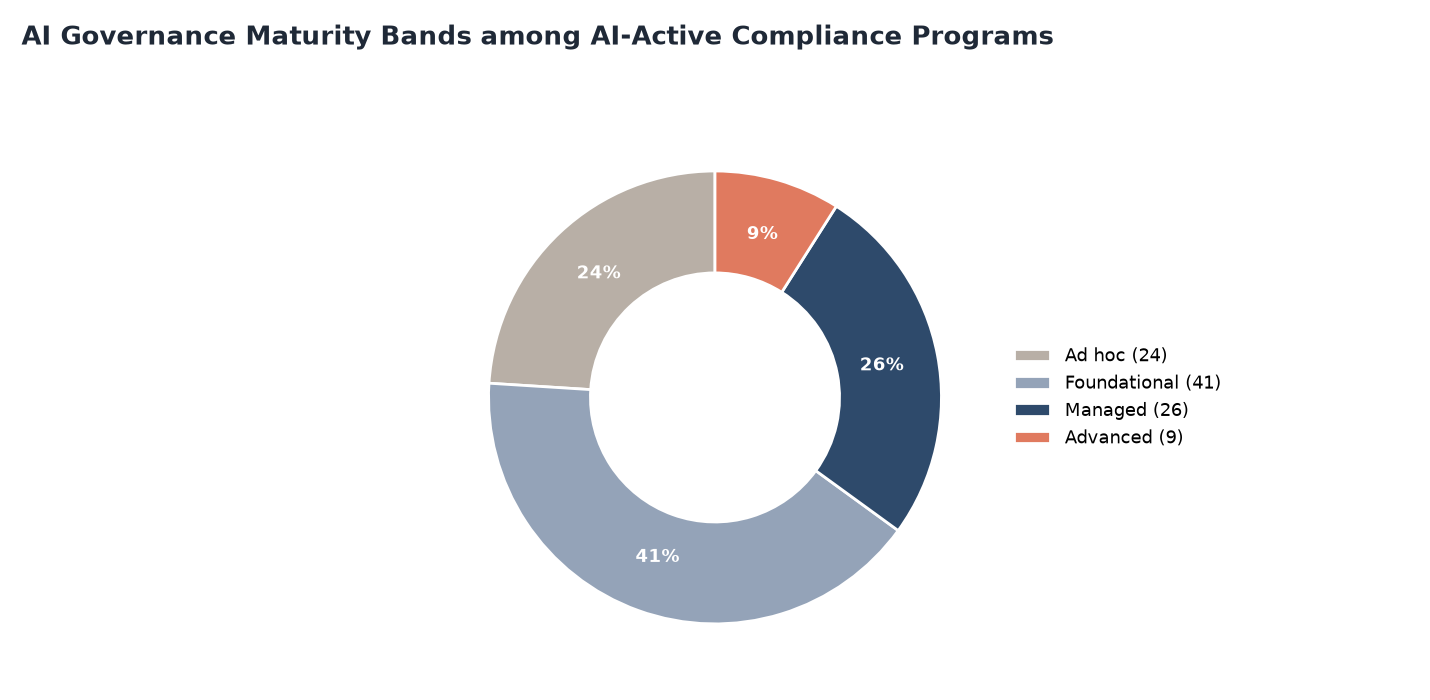
Source: Continuum GRC, 2026 AI Governance Benchmark Report.
Key Findings
- 68% of the full 275 Continuum programs had at least one AI system in scope, with an average of 4.2 AI systems or services inventoried among AI-active programs.
- 59% of listed systems still lacked a formal risk classification at the last review snapshot, which blocks prioritized testing and oversight.
- A buyer evaluating an AI services firm can ask which maturity band the firm’s own delivery systems would fall into: ad hoc and foundational programs struggle to produce assessor-ready evidence on demand.
Control Evidence Is Thinnest on Testing and Monitoring
Assessors ask for proof, not policy language. Continuum GRC’s evidence checklist shows where AI-active programs still fail to produce current records.
| Evidence type | Share with current evidence |
|---|---|
| Approved AI use policy | 71% |
| AI system inventory | 63% |
| Human oversight or escalation design | 52% |
| Complete system or model cards | 41% |
| Data-handling or training-data notes | 36% |
| Bias or fairness testing evidence | 28% |
| Post-deployment monitoring records | 24% |
Source: Continuum GRC, 2026 AI Governance Benchmark Report. Data: ai-governance-control-evidence.csv
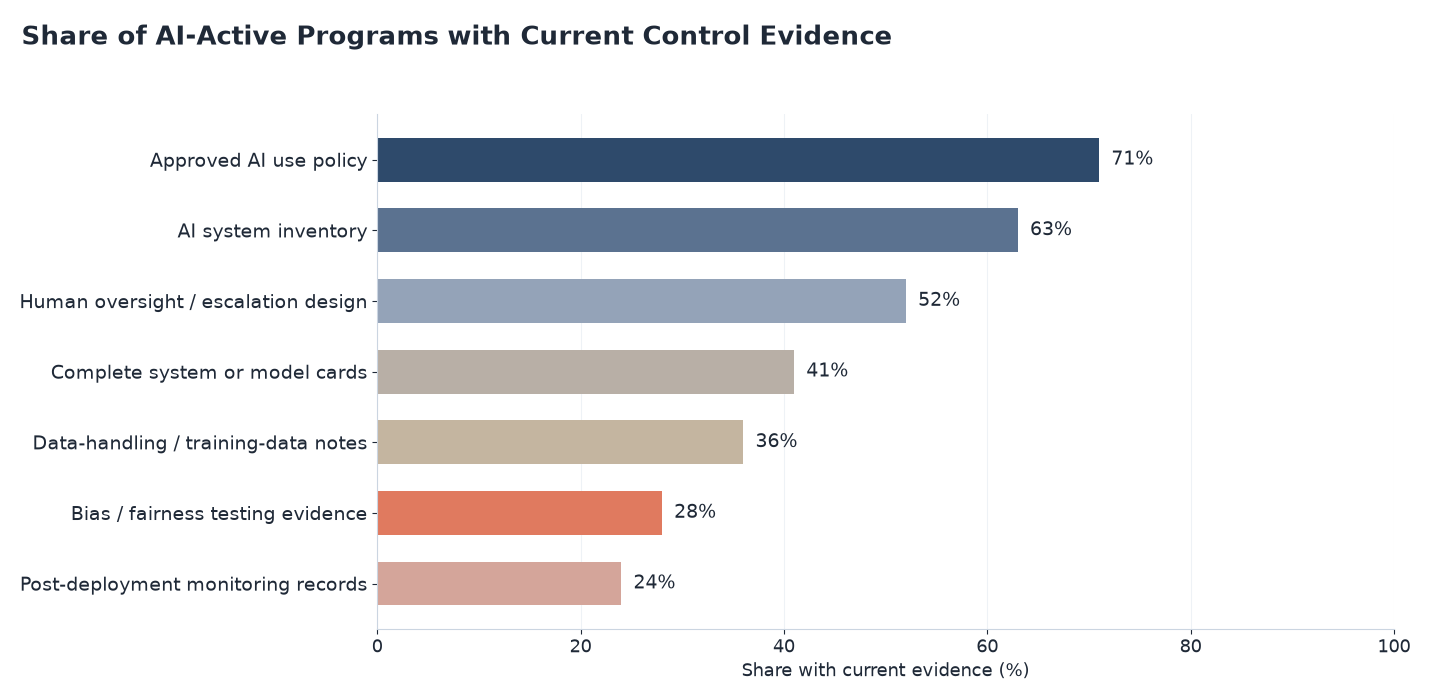
Source: Continuum GRC, 2026 AI Governance Benchmark Report.
Key Findings
- Third-party AI is the main exposure path: 38% of inventoried items are SaaS generative AI features, yet only 46% of third-party AI vendors had a completed AI-specific assessment, and 31% of contracts had explicit AI data-use and model-training clauses.
- Manual AI-governance labor ran about 180 hours a year in Continuum’s sample ($22,500 at a $125 blended rate), against about 55 hours when inventory and mapping were automated.
- Pacific AI’s broader sample matches the weak monitoring story: fewer than half of organizations (48%) monitor production AI, and that figure falls to 9% at small companies.
AI Incidents Are Rising, and Boards See Them More Often
Incident counts and board escalation show what happens when governance lags deployment, both in public databases and inside large EMEA enterprises.
| Metric | Value |
|---|---|
| AI incidents logged in the AI Incident Database, 2024 | 233 |
| AI incidents logged in the AI Incident Database, 2025 | 362 |
| EMEA executives whose organization saw an AI-related incident reach the board or C-suite in the past year | 80% |
| Of those, changed AI governance policy or framework in response | 40% |
| EMEA executives whose governance is designed to scale with agentic AI | 37% |
| EMEA executives with a formal, board-reviewed quantification of financial risk from AI governance gaps | 37% |
Source: AI Services Companies analysis of Stanford 2026 AI Index incident figures (via ComplexDiscovery) and IBM’s October 14, 2026 EMEA AI governance study, conducted November 2026. Data: ai-incidents-and-board-response.csv
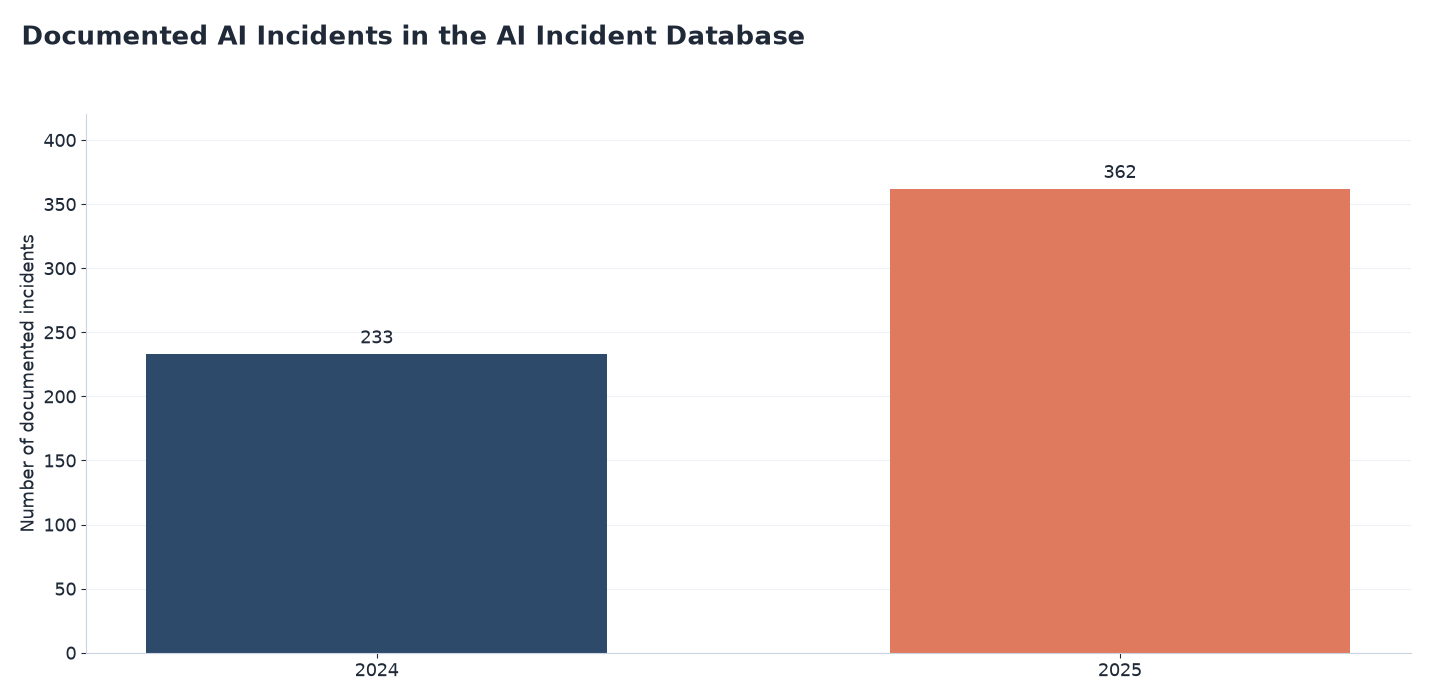
Source: Stanford 2026 AI Index citing the AI Incident Database, as reported by ComplexDiscovery.
Key Findings
- When deployment outruns governance readiness, 56% of IBM’s EMEA executives say they continue within agreed risk limits while governance catches up, and only 33% delay deployment until governance is ready.
- 98% of those executives have assigned AI-risk responsibility at board level, including 26% with a dedicated board-level AI committee, yet only 37% quantify the financial risk from governance gaps in a board-reviewed form.
- 35% of respondents already run agentic AI in production, and 75% expect agents to have some decision autonomy by 2027, which will test the 37% who say their governance can scale with agents.
What AI Governance and Compliance Statistics Mean for Buyers of AI Services
Written AI policies are now common, and frameworks such as NIST AI RMF and ISO/IEC 42001 are entering more programs each year. Full programs, testing evidence, and post-deployment monitoring still trail adoption, and documented incidents are rising as boards see more of those failures first-hand.
The gap matters for companies that hire AI services firms as much as for companies that build models in house. A vendor that can show an inventory, risk tiers, monitoring records, and AI-specific contract language is in a different maturity band from a vendor that only publishes principles.
So if you are buying AI development or consulting work in 2026, ask for the same evidence an assessor would: the system register, the risk classification, the monitoring record, and the incident playbook, not only the policy page.
Data Collection and Methodology
This article aggregates published survey and program statistics. Pacific AI’s 2025 AI Governance Survey ran online from February 14 to May 29, 2025, with 351 respondents recruited through newsletters, partners, and ads; 91% were at organizations with US operations. Figures on policies, roles, playbooks, and monitoring use Pacific AI’s published percentages. The Panterra and Optro survey covers more than 400 GRC professionals and is cited from Optro’s July 30, 2025 summary for the 25% fully implemented program figure, the 49% NIST AI RMF alignment figure, and related barrier findings.
Continuum GRC’s 2026 AI Governance Benchmark Report analyzes 275 customer compliance programs from January 2025 through June 2026; maturity, inventory, and evidence metrics use the 187 AI-active programs unless noted. Labor cost figures use Continuum’s $125 fully loaded blended rate. IBM’s study was fielded by Censuswide among 3,221 executive management respondents at organizations with 1,000 or more employees in the UK, France, Germany, Italy, Spain, the Netherlands, Saudi Arabia, and the UAE, from September 14 to 24, 2026. Stanford 2026 AI Index figures for ISO/IEC 42001 (36%), NIST AI RMF (33%), responsible AI policy coverage, and AI Incident Database counts (233 in 2024, 362 in 2025) are taken from ComplexDiscovery’s April 20, 2026 summary of the Index and cross-checked against Stanford HAI’s public chapter pages where available.
We calculated products, differences, and ratios from the published values where noted in prose. Midpoint and share figures are taken at the precision each source published. This article does not claim a primary survey of our own beyond the aggregation and comparison described here.
Sources (8)
- AI Services Companies analysis of Pacific AI, Panterra and Optro, Continuum GRC, IBM, and Stanford AI Index governance and compliance data, conducted November 2026.
- Pacific AI, 2025 AI Governance Survey (2025)
- Optro, Benchmarking AI governance: 4 key survey findings (July 30, 2025)
- Continuum GRC, 2026 AI Governance Benchmark Report (August 2026)
- IBM, Eight in Ten EMEA Enterprises Escalate AI Incidents to Board or C-Suite (October 14, 2026)
- ComplexDiscovery, Stanford’s 2026 AI Index highlights rapid growth and widening governance gaps (April 20, 2026)
- Stanford HAI, AI Index Report: Policy and Governance chapter
- AI Services Companies, AI Consultant Use Statistics 2026