
AI Consultant Use Statistics 2026
Published November 4, 2026
Our analysts reviewed four surveys conducted or released in 2026, three of which reached 2,175 business and technology decision-makers, along with the typical clients listed in all 96 of our AI services firm reviews, to show how many companies hire outside help with AI as of Q4 2026 and which companies the firms doing that work serve.
Key Findings
- 52% of middle market companies in the US and Canada are engaging external AI consultants or advisors, and another 37% plan to within 12 months (RSM, March 2026 survey of 1,030 leaders).
- 88% of consulting clients in Source Global Research’s Q1 2026 survey paid for AI-related consulting support in the previous 12 months, up from 81% in Q2 2025.
- 50% of small and midsize businesses already work with a strategic partner or IT service provider on AI (GTIA, August 2026).
- 55 of the 96 AI services firms we review (57.3%) list enterprise or large companies among their typical clients, including 67.7% of US-based firms and 38.2% of the others.
- Financial services is the industry most AI services firms serve: 45 of 96 firms (46.9%) list financial services clients such as banks, insurers, fintechs, or investment firms.
Most companies that adopt AI ask for outside help at some point, whether for a strategy, a first pilot, or a production system. That help comes from management consultants, IT service providers, and specialist AI firms, and surveys rarely ask about it the same way. Some ask whether a company works with consultants today, some ask about plans for the next year, and one asks consulting clients what they have already paid for. We wanted to know how common outside AI help has become and what kinds of companies the specialist firms work for. The answers depend on who was asked.
Our analysts collected outside-help figures from RSM’s Middle Market AI Survey 2026, GTIA’s 2026 study of small and midsize businesses, a February 2026 survey of cloud decision-makers by Southworks and theCUBE Research, and Source Global Research’s survey of consulting clients. We recorded each survey’s sample, date, and question. We then read the typical clients entry of all 96 AI services firm reviews published as of November 3, 2026, and tagged each firm by the client sizes and industries it lists.
In the following sections, we compare how many organizations use outside AI help by survey, what middle market companies are doing to get AI help, the client sizes AI services firms serve in the US and elsewhere, and the industries they list most often.
Half or More of Companies Use Outside Help With AI
Each survey asked a different group of buyers about consultants, service providers, or partners, so we start by lining up what each one measured and how many said yes.
| Survey | Respondents | Measure | Share |
|---|---|---|---|
| RSM Middle Market AI Survey 2026 | 1,030 middle market leaders (827 in the US and 203 in Canada), March 2026 | Currently engaging external consultants or advisors | 52% |
| RSM Middle Market AI Survey 2026 | 1,030 middle market leaders (827 in the US and 203 in Canada), March 2026 | Planning to engage external consultants or advisors in the next 12 months | 37% |
| GTIA End-User AI Adoption study, 2026 | 520 SMB and microbusiness decision-makers, released August 2026 | Already work with a strategic partner or IT service provider on AI | 50% |
| GTIA End-User AI Adoption study, 2026 | 520 SMB and microbusiness decision-makers, released August 2026 | Considering outside assistance with AI | 12% |
| Southworks and theCUBE Research, 2026 | 625 cloud architects and decision-makers, released February 2026 | Plan to source agentic AI through IT or consulting service providers | 68.6% |
| Southworks and theCUBE Research, 2026 | 625 cloud architects and decision-makers, released February 2026 | Plan to build agentic AI mainly in-house | 31.5% |
| Source Global Research client survey, Q1 2026 | Consulting clients worldwide (sample size not published) | Paid for AI-related support from consultants in the previous 12 months | 88% |
| Source Global Research client survey, Q2 2025 | Consulting clients worldwide (sample size not published) | Paid for AI-related support from consultants in the previous 12 months | 81% |
Source: AI Services Companies analysis of RSM (2026), GTIA (August 2026), Southworks (February 2026), and Source Global Research (March 2026), conducted November 2026. Data: organizations-using-outside-ai-help-by-survey.csv
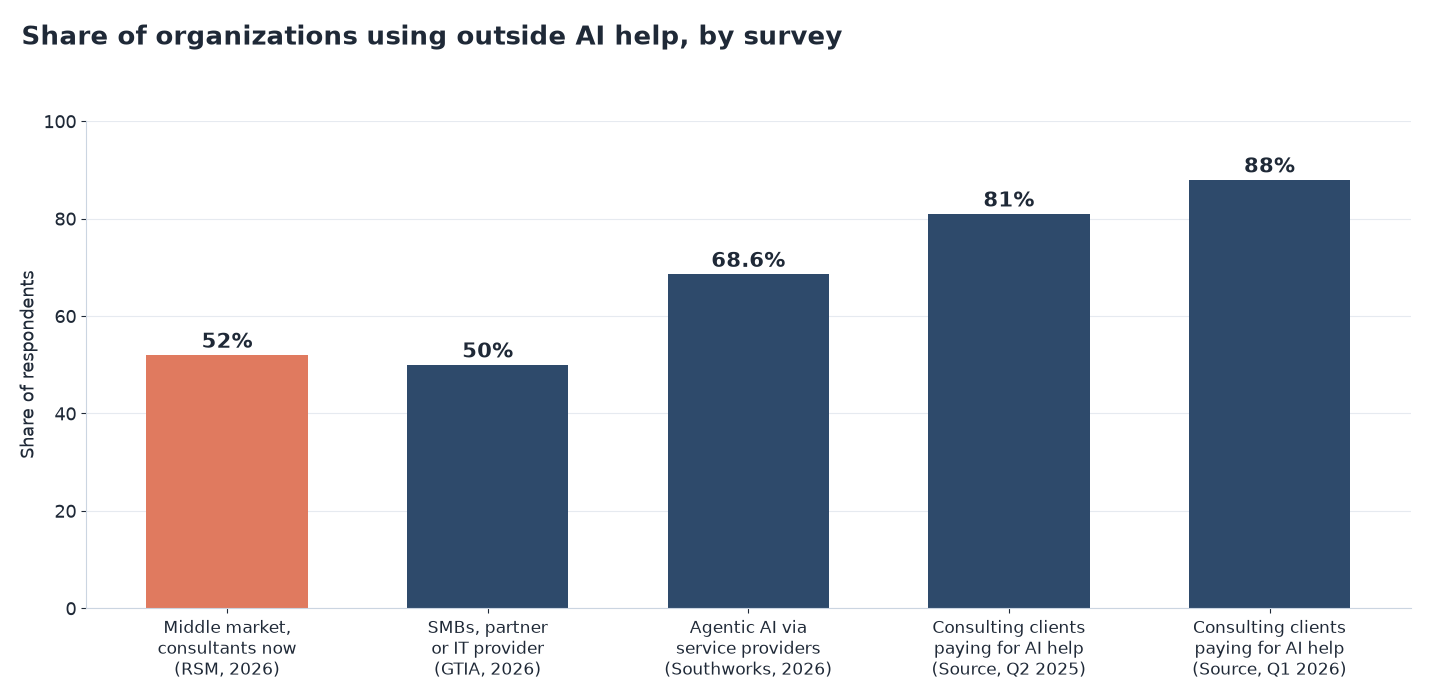
Source: AI Services Companies analysis of RSM (2026), GTIA (August 2026), Southworks (February 2026), and Source Global Research (March 2026), conducted November 2026.
Key Findings
- Consulting clients have moved from interest to spending. The share of Source Global Research’s clients who paid consultants for AI-related support rose from 81% to 88% in about a year, and help with using AI effectively went from 11th to first among the consulting services in Source’s survey. 97% of those clients said they were satisfied with the work, and 43% were highly satisfied.
- For agentic AI, outside providers come first in most plans. 68.6% of the cloud decision-makers in the Southworks survey plan to use IT or consulting service providers, and 70.9% plan to use agentic AI platform vendors, while 31.5% plan to build the capabilities mainly in-house.
- Smaller companies look for outside help about as often as mid-sized ones. Half of the SMBs in GTIA’s study already work with a strategic partner or IT service provider on AI, and another 12% are considering it, so about six in ten use or are weighing outside help. The areas where they said they need the most support were training employees to use AI and identifying the right AI tools, each cited by 38%, followed by integrating AI into existing systems at 31%.
Middle Market Companies Hire Consultants While Building In-House AI Skills
RSM asked middle market leaders in the US and Canada which of four steps their company is taking to reach its AI goals over the next year, which shows how outside consultants fit next to in-house hiring and buying software.
| Step | Currently doing | Planning in the next 12 months | No plans | Not sure |
|---|---|---|---|---|
| Establishing strategic partnerships with AI providers | 56% | 37% | 5% | 2% |
| Building additional AI capabilities in-house | 54% | 37% | 7% | 2% |
| Buying additional AI capabilities from external providers | 52% | 40% | 6% | 2% |
| Engaging external consultants or advisors | 52% | 37% | 9% | 2% |
Source: RSM, Middle Market AI Survey 2026: U.S. and Canada, survey of 1,030 respondents, March 2026. Data: ai-sourcing-plans-of-middle-market-companies.csv
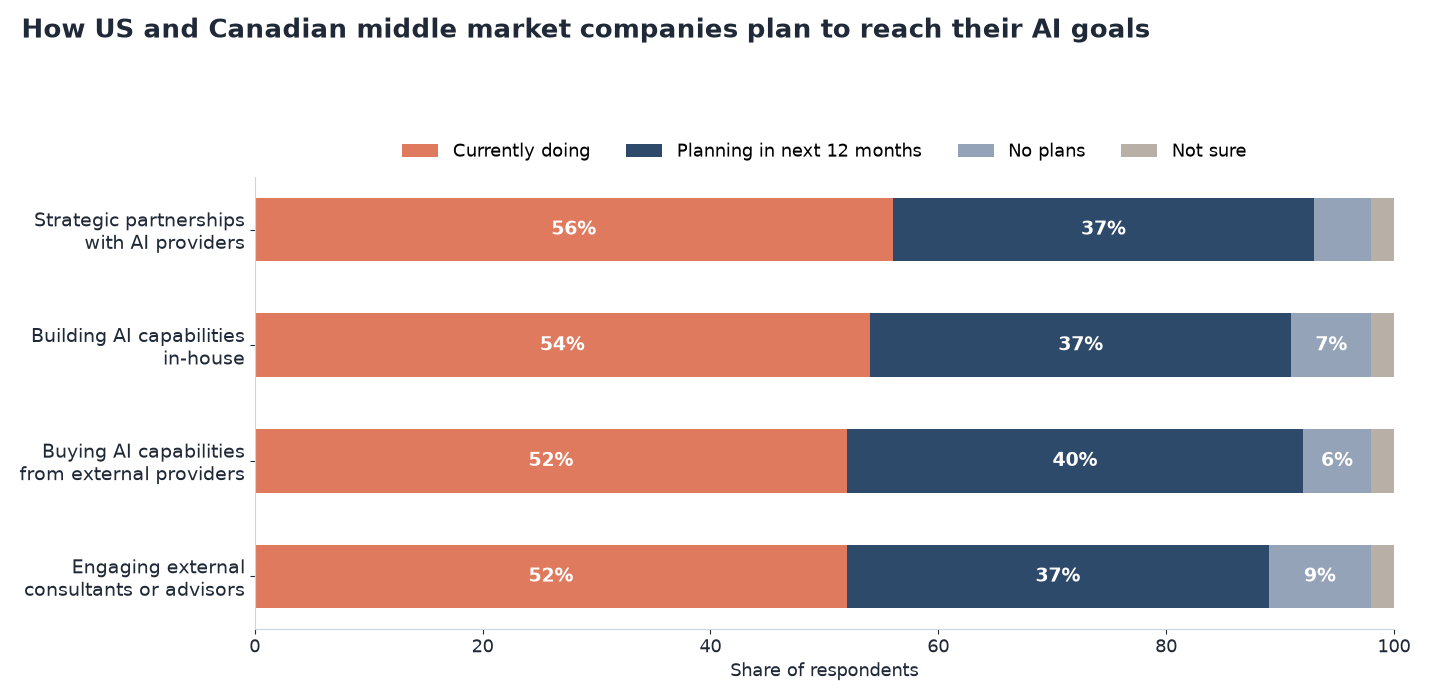
Source: RSM, Middle Market AI Survey 2026: U.S. and Canada, survey of 1,030 respondents, March 2026.
Key Findings
- Middle market companies are building their own AI skills at the same pace as they hire outside help. 54% are adding AI capabilities in-house and 52% are engaging consultants, and 88% agreed that their organization has the right in-house AI experts to implement AI.
- Engaging consultants has the largest share of companies with no plans, at 9%, against 5% to 7% for the other three steps. Among the companies expecting to spend more on AI next year, 40% said external consulting and advisory services are likely to be cut as a result of their AI investments, after business intelligence or analytics initiatives (43%) and cybersecurity (41%).
- Working with outside partners has a better record in at least one study. MIT NANDA found that partnerships with outside vendors on customized AI tools reached deployment about 67% of the time, against about 33% for tools built in-house, based on self-reported outcomes from its interviews and surveys. Our AI build vs buy research compares more studies of that choice.
US-Based AI Services Firms Focus More on Enterprise Clients
The firms companies hire are the other side of this market. Each of our firm reviews lists the firm’s typical clients, so we sorted all 96 firms by the client sizes and types they list and compared firms based in the US with the rest.
| Client size or type | All 96 firms | Share of 96 firms | 62 US-based firms | Share of US firms | 34 other firms | Share of other firms |
|---|---|---|---|---|---|---|
| Enterprise or large companies | 55 | 57.3% | 42 | 67.7% | 13 | 38.2% |
| Mid-market or midsize companies | 40 | 41.7% | 30 | 48.4% | 10 | 29.4% |
| Startups or small businesses | 17 | 17.7% | 7 | 11.3% | 10 | 29.4% |
| Investors and private equity-backed companies | 9 | 9.4% | 7 | 11.3% | 2 | 5.9% |
| Government or public bodies | 9 | 9.4% | 4 | 6.5% | 5 | 14.7% |
| No client size listed | 14 | 14.6% | 7 | 11.3% | 7 | 20.6% |
Source: AI Services Companies analysis of the typical clients listed in 96 AI services firm reviews, conducted November 2026. Data: client-sizes-listed-by-ai-services-firms.csv
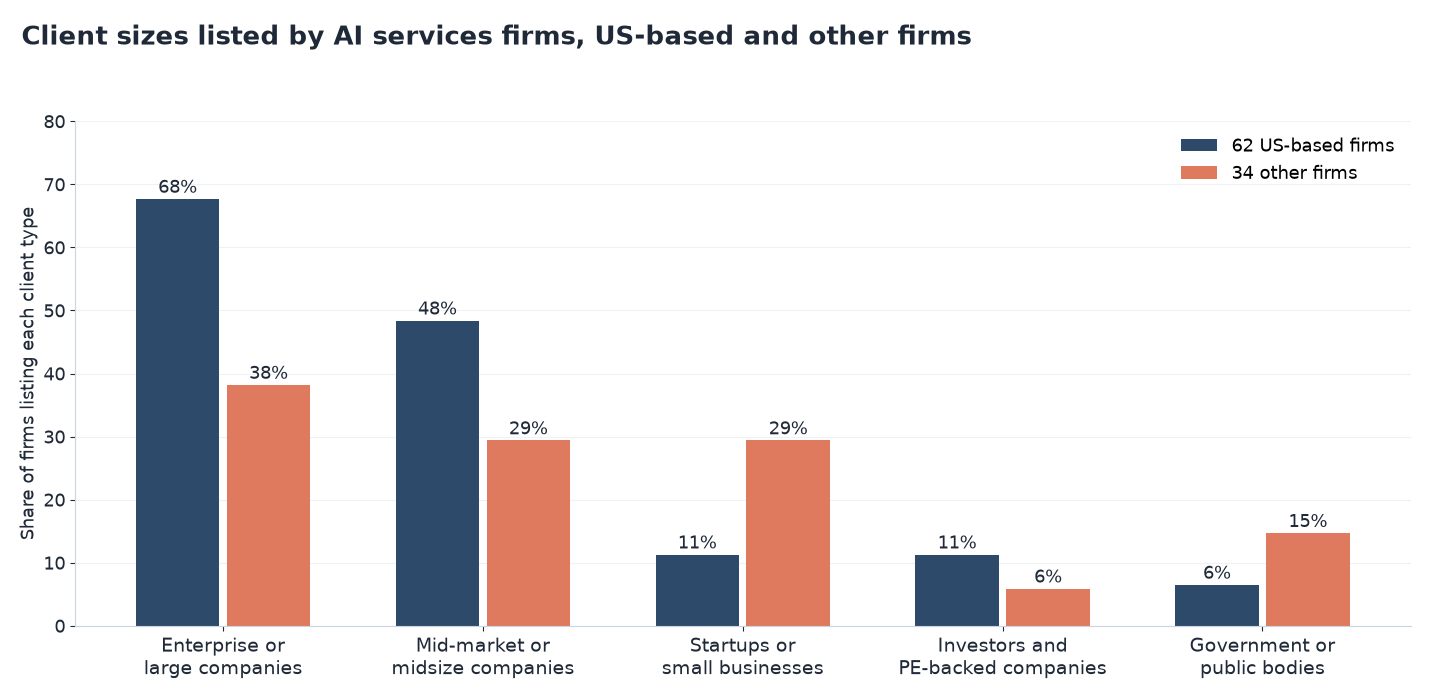
Source: AI Services Companies analysis of the typical clients listed in 96 AI services firm reviews, conducted November 2026.
Key Findings
- Enterprise clients are the most common. 55 of the 96 firms (57.3%) list enterprise or large companies, 40 (41.7%) list mid-market or midsize companies, and 24 list both, such as BairesDev and Keyhole Software.
- The other 34 firms, all but one based outside the US, are more than twice as likely to list startups or small businesses, at 29.4% against 11.3% of US firms. Examples include Leanware in Colombia, NaNLABS in Argentina, and YuSMP Group in Armenia.
- 14 firms list no client size, only industries, regions, or a platform, such as 10Clouds, which works with banks, insurers, and fintechs. A smaller company will find more firms that list companies its size among those based outside the US, and our AI consulting pricing models research shows how those firms price their work.
Financial Services and Healthcare Lead the Industries AI Services Firms Serve
Firms also list the industries their clients work in, which tells a buyer how many firms already know its field, so we counted each industry mentioned across the 96 reviews.
| Industry | Firms listing it | Share of 96 firms | US-based firms listing it | Examples |
|---|---|---|---|---|
| Financial services and insurance | 45 | 46.9% | 27 | 10Clouds, Neurons Lab, Nimble Gravity |
| Healthcare and life sciences | 35 | 36.5% | 28 | Appsilon, KUNGFU.AI, Teragonia |
| Retail, ecommerce, and consumer brands | 27 | 28.1% | 18 | Master of Code Global, MobiDev, Brainforge |
| Manufacturing, industrial, and construction | 22 | 22.9% | 18 | Enthought, Vooban, Sparq |
| Software and technology | 11 | 11.5% | 6 | TensorOps, Unkapped, NaNLABS |
| Logistics and supply chain | 10 | 10.4% | 7 | Mosaic Data Science, Valliance, Koantek |
| Energy | 9 | 9.4% | 5 | MindTitan, ML6, Fusemachines |
| Media and advertising | 9 | 9.4% | 3 | Mutt Data, Rearc, AE Belgium |
| Telecom | 8 | 8.3% | 5 | Miquido, AuxoAI, Blend360 |
| No industry listed | 33 | 34.4% | 22 | Provectus, Distyl AI, BairesDev |
Source: AI Services Companies analysis of the typical clients listed in 96 AI services firm reviews, conducted November 2026. Data: client-industries-listed-by-ai-services-firms.csv
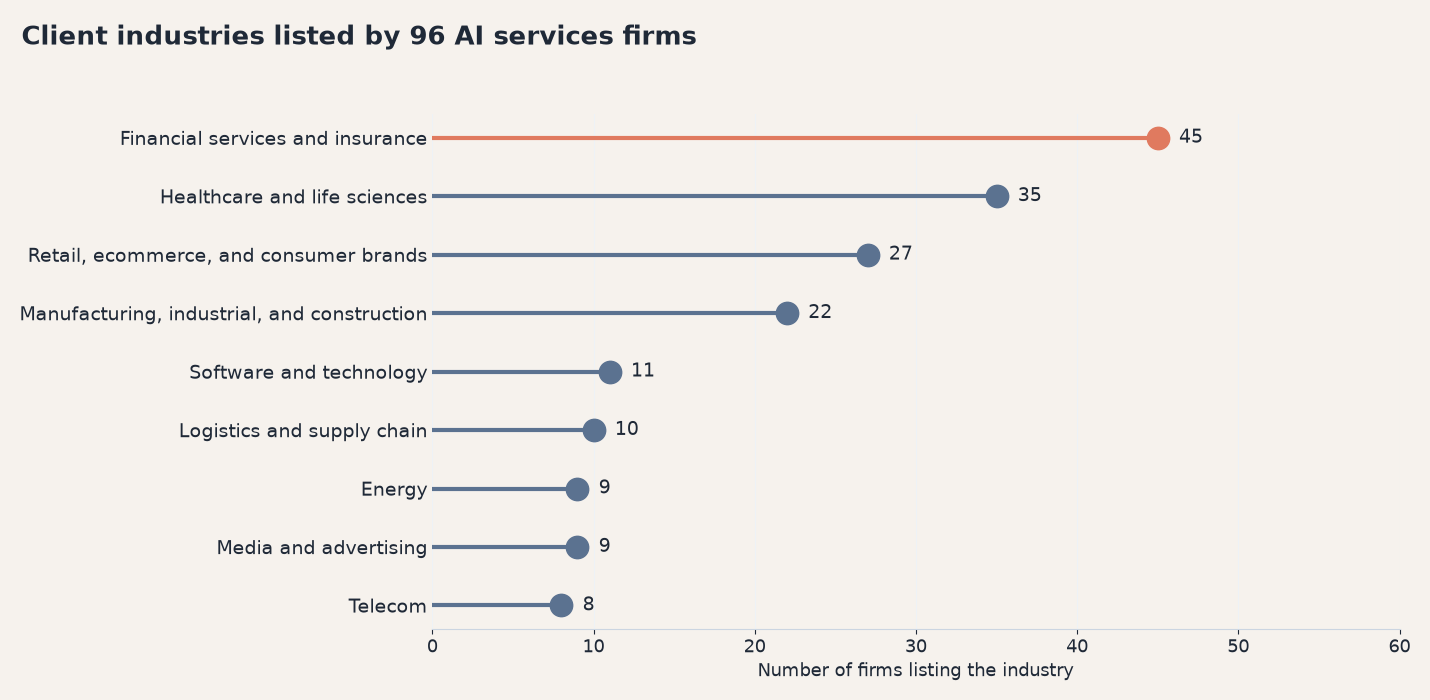
Source: AI Services Companies analysis of the typical clients listed in 96 AI services firm reviews, conducted November 2026.
Key Findings
- 45 of the 96 firms (46.9%) list financial services clients such as banks, insurers, fintechs, or investment firms, more than any other industry. Some focus on finance clients alone, such as Neurons Lab and Accordion, which works with private equity sponsors and the finance teams of their portfolio companies.
- Healthcare and life sciences come second, with 35 firms (36.5%), and the gap between US and other firms is widest there: 28 of the 62 US firms (45.2%) list healthcare clients, against 7 of the other 34 (20.6%). Appsilon, for example, works mostly with pharmaceutical and biotech companies.
- 33 firms (34.4%) list no industry at all, only client sizes, such as Provectus and Distyl AI. For a company in a regulated field such as banking or healthcare, the industries listed in each review are a quick first filter, and our directory lists every firm we review.
What AI Consultant Use Statistics Mean for Companies Hiring Outside Help
Hiring outside help has become a normal part of adopting AI. In each of the four surveys, half or more of the companies asked already work with consultants, service providers, or partners, or plan to, and middle market companies are doing it while they build their own AI teams.
The firms that do this work are not spread evenly. US-based firms list enterprise clients more often, firms based elsewhere list startups and small businesses more often, and financial services and healthcare are the industries the most firms already serve. Our State of AI Services Q4 2026 report covers where these firms are based and how they score.
So if you are planning an AI project with outside help, start with firms that list both your company size and your industry among their typical clients.
Data Collection and Methodology
The study covers four surveys and our own review data. RSM surveyed 1,030 mid-level managers or more senior leaders (827 in the US and 203 in Canada) at middle market organizations that use AI, from March 5 to 16, 2026. RSM defines the middle market as organizations with annual revenue of $30 million to $10 billion in the US or $30 million to $1 billion in Canada, plus US financial institutions with $500 million to $500 billion in assets under management, and gives a margin of error of plus or minus 3.1 percentage points. GTIA surveyed 520 SMB and microbusiness decision-makers for its End-User AI Adoption study, released on August 27, 2026. Southworks and theCUBE Research surveyed 625 cloud architects, cloud decision-makers, and cloud-native Azure professionals, released on February 10, 2026. Source Global Research reported the share of consulting clients in its global surveys who paid for AI-related consulting support in a March 20, 2026 article that does not give the sample size. The total of 2,175 decision-makers adds the RSM, GTIA, and Southworks samples. MIT NANDA’s deployment rates come from its January to June 2025 research, which included interviews with representatives of 52 organizations and survey responses from 153 senior leaders, and are self-reported.
Survey shares describe different groups and questions, so they are not directly comparable. RSM and Southworks asked about plans as well as current use, GTIA asked about strategic partners and IT service providers, and Source asked consulting clients what they had paid for.
Our own data: we read the typical clients entry in the facts panel of all 96 AI services firm reviews published as of November 3, 2026, and tagged each firm with every client size or type and every industry it lists. A firm can carry several tags, so shares add to more than 100%. Enterprise includes large companies, the Fortune 500, Fortune 1000, and Global 2000, and publicly traded companies. Startups includes scale-ups, venture-backed and product companies, and growth companies. Investors and private equity-backed companies includes private equity sponsors, investment firms and managers, private credit investors, and companies backed by private equity. Government or public bodies includes public-sector teams, federal agencies, and research institutions and consortiums. Financial services includes banks, insurers, fintechs, and investment firms; manufacturing includes industrial, materials, chemical, semiconductor, automotive, aerospace, and construction companies; and logistics includes airlines, aviation, and distribution. 62 firms are headquartered in the US. The other 34 include 33 headquartered in other countries and 1 that does not publish a headquarters. We used the first headquarters location listed in each review.
We calculated shares, sums, and differences from the counts and published values, including the 62% of GTIA respondents who work with an AI partner or are considering one (50% plus 12%), described as about six in ten. This article contains no estimates.
Sources (9)
- AI Services Companies analysis of four 2026 surveys on outside AI help and the typical clients listed in 96 AI services firm reviews, conducted November 2026.
- RSM, Middle Market AI Survey 2026: U.S. and Canada (2026)
- GTIA, GTIA Reports: SMBs Taking a ‘Slow and Steady’ Approach to AI Adoption as Business Benefits Outpace Hype (August 27, 2026)
- Southworks, Southworks Research Finds Enterprises Rely on External Partners to Deliver Agentic AI (February 10, 2026)
- Source Global Research, Understanding the market for AI-related consulting services (March 20, 2026)
- MIT NANDA, The GenAI Divide: State of AI in Business 2025 (July 2025)
- AI Services Companies, AI Build vs Buy 2026
- AI Services Companies, AI Consulting Pricing Models 2026
- AI Services Companies, State of AI Services Q4 2026