
AI Build vs Buy 2026
Published October 30, 2026
Our analysts compared the build-versus-buy findings of four 2025 studies of corporate AI, which together surveyed more than 3,300 executives, with the platform partnerships listed by the 76 AI services firms we review, to show how companies source AI in the most recent large studies available in Q4 2026 and which approach reaches production more often.
Key Findings
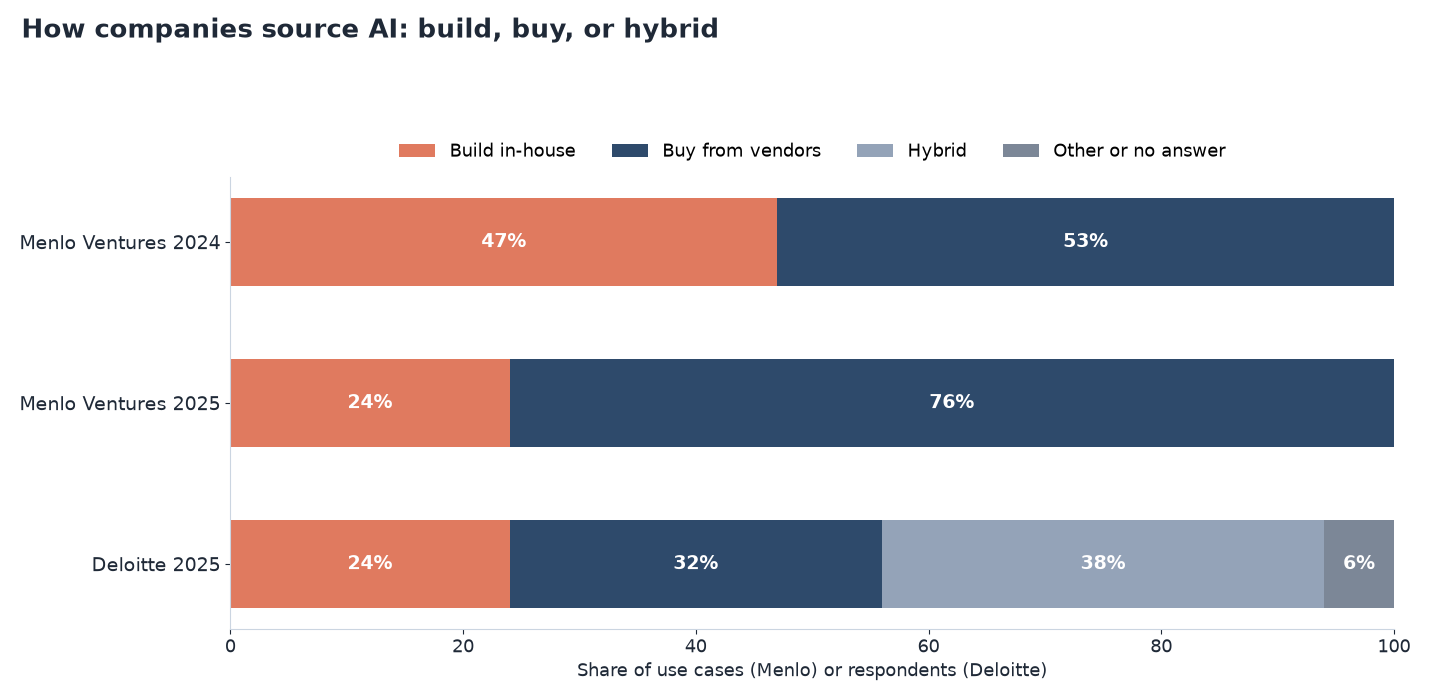
- 76% of enterprise AI use cases were purchased in 2025, up from 53% in 2024, according to Menlo Ventures’ survey of 495 US enterprise AI decision-makers.
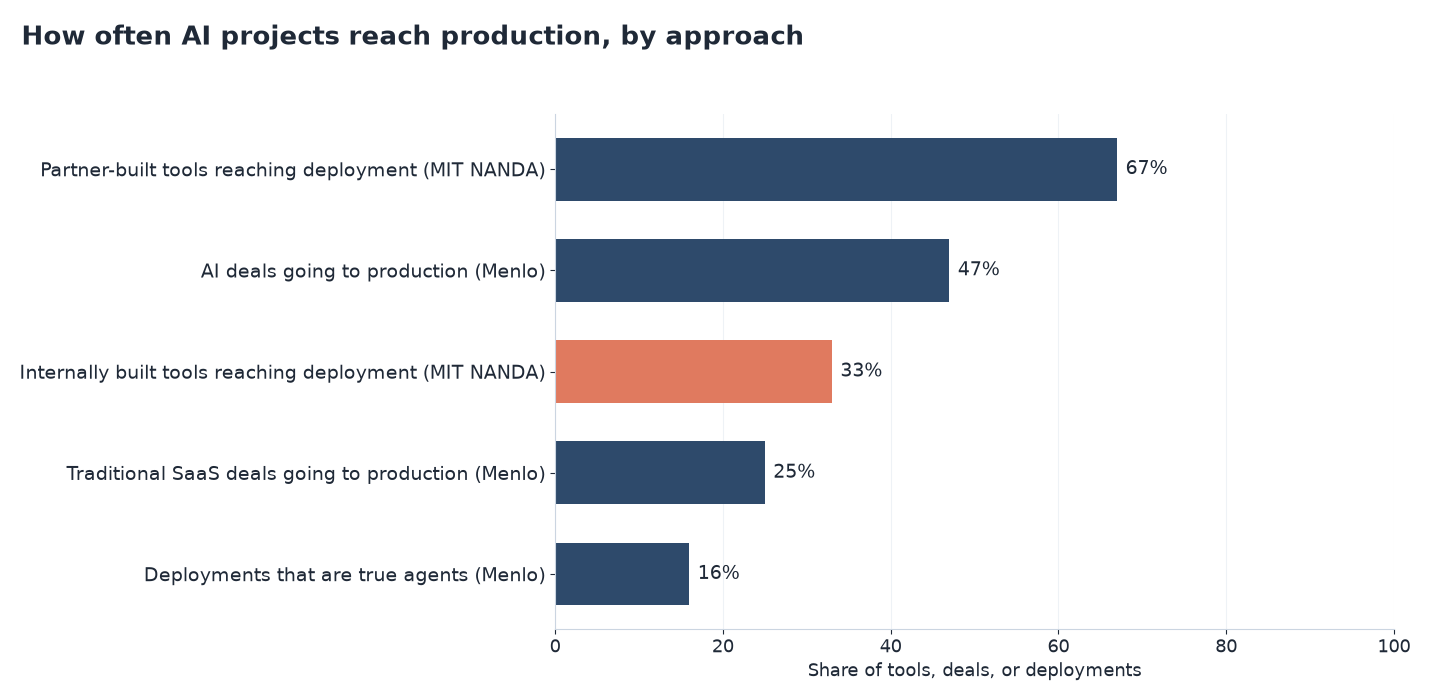
- 47% of AI deals that enterprises explore go to production, against 25% for traditional software (Menlo Ventures, 2025).
- AI tools built with outside partners reached deployment about 67% of the time, against about 33% for tools built in-house, in MIT NANDA’s 2025 research.
- 38% of organizations in Europe and the Middle East favor a hybrid of in-house development and outside tools, and 24% plan to invest in internal build capabilities (Deloitte, 2025).
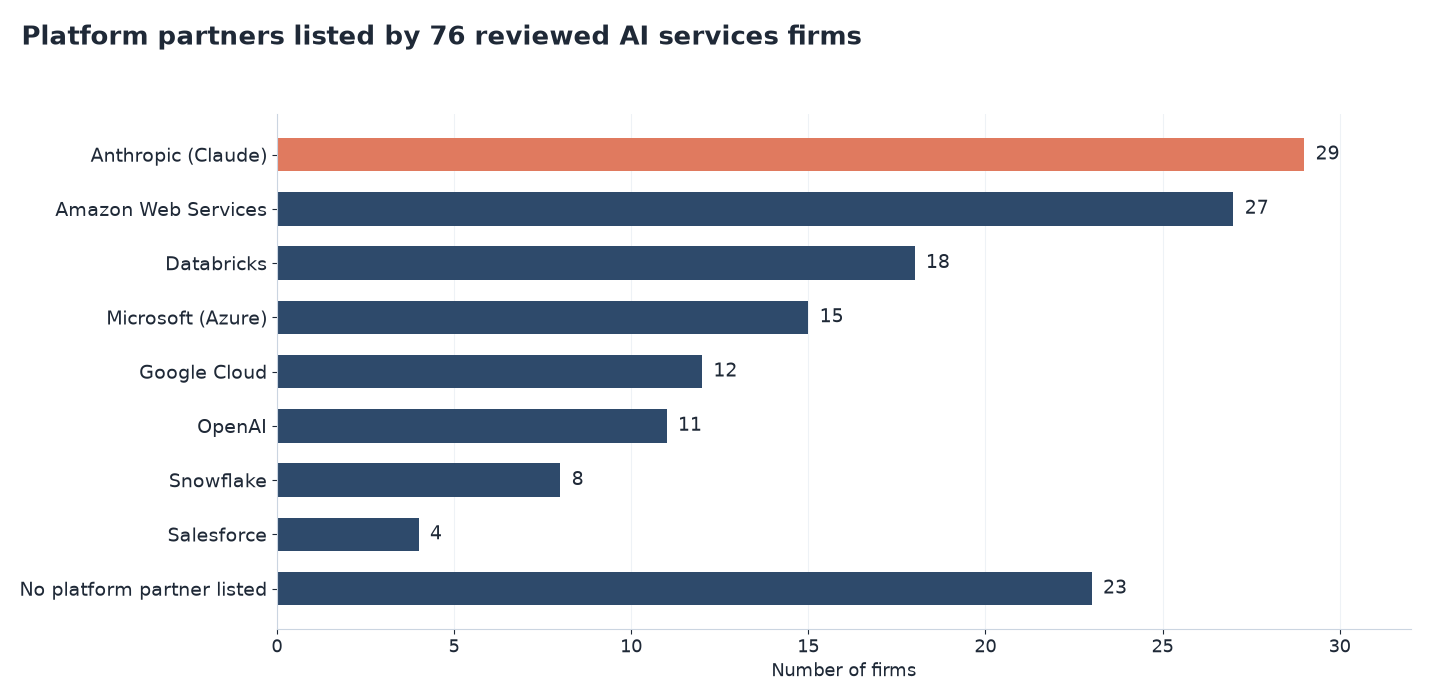
- Anthropic is the platform partner most often listed by the 76 AI services firms we review, at 29 firms (38%), followed by AWS at 27 (36%).
For a while, many large companies expected to build their own AI, and Bloomberg trained its own finance model in 2022 (Menlo Ventures). By 2025 the ready-made products had improved, and AI development firms had grown into a market of their own, so a company now chooses between three paths: buy a product, build in-house, or hire a partner to build for it. Our AI development cost statistics cover what each path tends to cost. The evidence on which path works better is newer and less settled. Our AI ROI statistics cover the returns companies report.
Our analysts collected sourcing and deployment figures from Menlo Ventures’ 2025 State of Generative AI in the Enterprise, Deloitte’s 2025 survey on AI returns, the 2025 Wharton and GBK Collective AI adoption report, and MIT NANDA’s State of AI in Business 2025, and recorded each study’s sample and question. We also counted the platform partners listed in the facts panel of each of the 76 firm reviews on this site as of October 30, 2026.
In the following sections, we compare how companies split AI between building and buying, how often each approach reaches production, and which platforms the AI services firms that build for clients work on.
Enterprises Bought Three Quarters of Their AI Use Cases in 2025
The studies measure sourcing in different units, from use cases to investment plans to budgets, so we show each figure beside its question.
| Study | Measure | Build in-house | Buy from vendors | Hybrid |
|---|---|---|---|---|
| Menlo Ventures, 2024 | Share of enterprise AI use cases | 47% | 53% | Not measured |
| Menlo Ventures, 2025 | Share of enterprise AI use cases | 24% | 76% | Not measured |
| Deloitte, 2025 | Investment approach favored | 24% | 32% | 38% |
| Wharton and GBK Collective, 2025 | Share of generative AI technology budgets for internal R&D | About one third | Not measured | Not measured |
Source: AI Services Companies analysis of Menlo Ventures (December 2025), Deloitte (October 2025), and Wharton and GBK Collective executive summary (October 2025), conducted October 2026. Data: how-companies-source-ai.csv
Source: AI Services Companies analysis of Menlo Ventures (December 2025), Deloitte (October 2025), and Wharton and GBK Collective executive summary (October 2025), conducted October 2026.
Key Findings
- The build share halved in a year in Menlo’s data, from 47% of AI use cases in 2024 to 24% in 2025. Menlo links the shift to ready-made AI products reaching production more quickly and showing value sooner.
- Building has not stopped. Wharton’s respondents put about one third of generative AI technology budgets into internal R&D, and 24% of Deloitte’s respondents plan to invest in internal build capabilities.
- Hybrid is the most common stance in Deloitte’s survey, at 38%. For most companies the decision is made use case by use case, buying standard tools and building where the data or workflow is specific to the business.
Bought and Partner-Built AI Reaches Production More Often
Whether a project reaches daily use is the test a buyer cares about most, so we compared what the studies found about deployment rates.
| Study | Measure | Share |
|---|---|---|
| MIT NANDA, 2025 | Partner-built, customized AI tools that reached deployment | About 67% |
| MIT NANDA, 2025 | Internally built AI tools that reached deployment | About 33% |
| Menlo Ventures, 2025 | AI deals that go to production once an enterprise explores them | 47% |
| Menlo Ventures, 2025 | Traditional SaaS deals that go to production | 25% |
| Menlo Ventures, 2025 | Enterprise AI deployments that qualify as true agents | 16% |
Source: AI Services Companies analysis of MIT NANDA (2025) and Menlo Ventures (December 2025), conducted October 2026. Data: ai-deployment-rates-by-approach.csv
Source: AI Services Companies analysis of MIT NANDA (2025) and Menlo Ventures (December 2025), conducted October 2026.
Key Findings
- In MIT NANDA’s research, partner-built tools reached deployment about twice as often as internal builds, 67% against 33%. The authors note the figures are self-reported, so the gap may reflect which organizations choose partners as well as the approach itself.
- AI purchases convert at nearly twice the rate of other software in Menlo’s survey. 47% of the AI deals enterprises explored went to production, against 25% for traditional SaaS.
- Only 16% of enterprise AI deployments in Menlo’s data are true agents that plan and act on their own, and most are fixed workflows around a model. A buyer comparing a product with a custom build should ask which kind of system each one delivers.
Anthropic, AWS, and Databricks Lead the Platforms AI Services Firms Build On
A company that hires a partner to build still chooses a platform, so we counted the platform partnerships listed by the AI services firms we review.
| Platform | Firms listing a partnership | Share of 76 firms |
|---|---|---|
| Anthropic (Claude) | 29 | 38% |
| Amazon Web Services | 27 | 36% |
| Databricks | 18 | 24% |
| Microsoft (Azure) | 15 | 20% |
| Google Cloud | 12 | 16% |
| OpenAI | 11 | 14% |
| Snowflake | 8 | 11% |
| Salesforce | 4 | 5% |
| No platform partner listed | 23 | 30% |
Source: AI Services Companies analysis of platform partners listed in 76 AI services firm reviews, October 2026. Data: platform-partners-of-ai-services-firms.csv
Source: AI Services Companies analysis of platform partners listed in 76 AI services firm reviews, October 2026.
Key Findings
- 29 of the 76 firms (38%) list Anthropic as a partner, the most of any platform, and 27 (36%) list AWS. Many of the Anthropic partnerships come through its Claude Partner Network, which a number of the firms we review joined in 2026.
- Data platforms are a common base. 18 firms list Databricks and 8 list Snowflake, so a company that keeps its data on either platform can find several partners that build on it.
- 23 firms (30%) list no major platform partner, and several of them describe themselves as independent of model vendors or build on the client’s own infrastructure. A buyer who wants a partner without ties to one platform can find one, and a buyer committed to a platform can ask for that partnership in the first call.
What the AI Build vs Buy Data Means for Buyers
Across the studies, companies have moved toward buying AI products for common tasks, and the evidence suggests that bought and partner-built tools reach daily use more often than tools a company builds alone.
Building keeps a large place in work that depends on a company’s own data and processes. About a third of generative AI technology budgets in the Wharton study go to internal R&D, and the most common approach in Deloitte’s survey mixes building and buying.
So if you are deciding how to source an AI project, buy where a product covers the task, and where it does not, compare an internal build with a partner build on each one’s record of reaching production. Our directory of AI services firms lists the platform partners of every firm we review.
Data Collection and Methodology
The study covers four studies published in 2025: Menlo Ventures’ 2025 State of Generative AI in the Enterprise (495 US enterprise AI decision-makers, surveyed November 7 to 25, 2025, with 2024 figures from Menlo’s prior report as cited in the 2025 edition), Deloitte’s AI ROI survey (1,854 senior executives in 14 countries in Europe and the Middle East, surveyed August 15 to September 5, 2025), the Wharton Human-AI Research and GBK Collective report Accountable Acceleration (about 800 US enterprise decision-makers at companies with 1,000 or more employees and more than $50 million in revenue), and MIT NANDA’s State of AI in Business 2025 (52 structured interviews, 153 surveyed leaders, and a review of more than 300 public AI initiatives).
Deloitte’s three approaches add to 94%; the chart shows the remaining 6% as other or no answer. Menlo’s 2024 and 2025 figures measure use cases, and Deloitte’s measure respondents, so the bars are not directly comparable. The total of more than 3,300 executives adds the four survey samples (495, 1,854, about 800, and 153).
For the platform count, we read the platform partners field of each of the 76 firm reviews published on this site as of October 30, 2026, which records partnerships each firm lists on its own website or in announcements. A firm can list several platforms, so shares add to more than 100%. Partners listed by one firm, such as SAP and NVIDIA, are not shown separately. Firms whose review lists no major cloud, data, or model platform, including firms that list only open-source tools or say they work on the client’s own infrastructure, are counted as no platform partner listed.
Sources (7)
- AI Services Companies analysis of four 2025 studies on AI sourcing and platform partners listed in 76 AI services firm reviews, conducted October 2026.
- Menlo Ventures, 2025: The State of Generative AI in the Enterprise (December 9, 2025)
- Deloitte, AI ROI: The paradox of rising investment and elusive returns (October 22, 2025)
- Wharton Human-AI Research and GBK Collective, 2025 AI Adoption Report executive summary (October 2025)
- MIT NANDA, The GenAI Divide: State of AI in Business 2025
- AI Services Companies, directory of 76 reviewed AI services firms
- AI Services Companies, AI Development Cost Statistics 2026