
AI ROI Statistics 2026
Published October 30, 2026
Our analysts compared the return-on-investment findings of five large studies of corporate AI published between May and December 2025, which together surveyed more than 5,000 executives, to show what the most recent large studies available in Q4 2026 say about how many companies report returns from AI, how long payback takes, and how spending is moving.
Key Findings
- Only 25% of AI initiatives delivered the ROI that CEOs expected over the past few years, and 16% were scaled across the enterprise, in IBM’s 2025 survey of 2,000 CEOs.
- Just 6% of executives in Europe and the Middle East report payback on a typical AI use case in under a year; most report two to four years (Deloitte, 2025).
- 10% of organizations using agentic AI report significant, measurable ROI from it, against 15% of generative AI users (Deloitte, 2025).
- 81% of US vice presidents and above say their generative AI ROI is positive, against 69% of mid-level managers (Wharton and GBK Collective, 2025).
- 91% of organizations plan to raise AI investment in the next 12 months, after 85% raised it in the past year (Deloitte, 2025).
Most large companies now pay for some form of AI, and their boards want to know what it returns. In 2025 an MIT study reported that 95% of the organizations it studied were getting zero return from generative AI, a figure that spread quickly through the business press (MIT NANDA). Other surveys from the same year found most leaders reporting positive returns. We covered why projects stall in our AI project failure rate statistics. But the return figures only make sense next to the question each study asked. Our AI build vs buy statistics cover how companies source the AI they pay for.
Our analysts collected the ROI findings from five studies: IBM’s 2025 CEO Study, Deloitte’s 2025 survey on AI returns, the 2025 Wharton and GBK Collective AI adoption report, Menlo Ventures’ 2025 survey of US enterprise AI buyers, and MIT NANDA’s State of AI in Business 2025. We recorded each study’s sample, its fieldwork dates, and the exact question behind each figure. We grouped the figures into three measures: whether returns were reported, how long payback takes, and how spending is changing.
In the following sections, we compare reported return rates across the studies, the payback periods companies report and expect, and how AI budgets are moving while returns lag.
Reported AI Returns Range From 5% to 81% Depending on the Question
The studies ask about returns in different ways, from “positive ROI” to “expected ROI” to “significant, measurable ROI,” so we set each figure beside the question it answers.
| Study | Respondents | Measure | Share |
|---|---|---|---|
| Wharton and GBK Collective, 2025 | About 800 US enterprise leaders | Vice presidents and above who say generative AI ROI is positive | 81% |
| Wharton and GBK Collective, 2025 | About 800 US enterprise leaders | Mid-level managers who say generative AI ROI is positive | 69% |
| IBM Institute for Business Value, 2025 | 2,000 CEOs in 33 countries | AI initiatives that delivered expected ROI | 25% |
| IBM Institute for Business Value, 2025 | 2,000 CEOs in 33 countries | AI initiatives scaled enterprise-wide | 16% |
| Deloitte, 2025 | 1,854 executives in Europe and the Middle East | Generative AI users with significant, measurable ROI | 15% |
| Deloitte, 2025 | 1,854 executives in Europe and the Middle East | Agentic AI users with significant, measurable ROI | 10% |
| MIT NANDA, 2025 | 52 organizations interviewed and 153 leaders surveyed | Integrated AI pilots extracting millions in value | 5% |
Source: AI Services Companies analysis of Wharton and GBK Collective (October 2025), IBM Institute for Business Value (May 2025), Deloitte (October 2025), and MIT NANDA (2025), conducted October 2026. Data: reported-ai-returns-by-study.csv
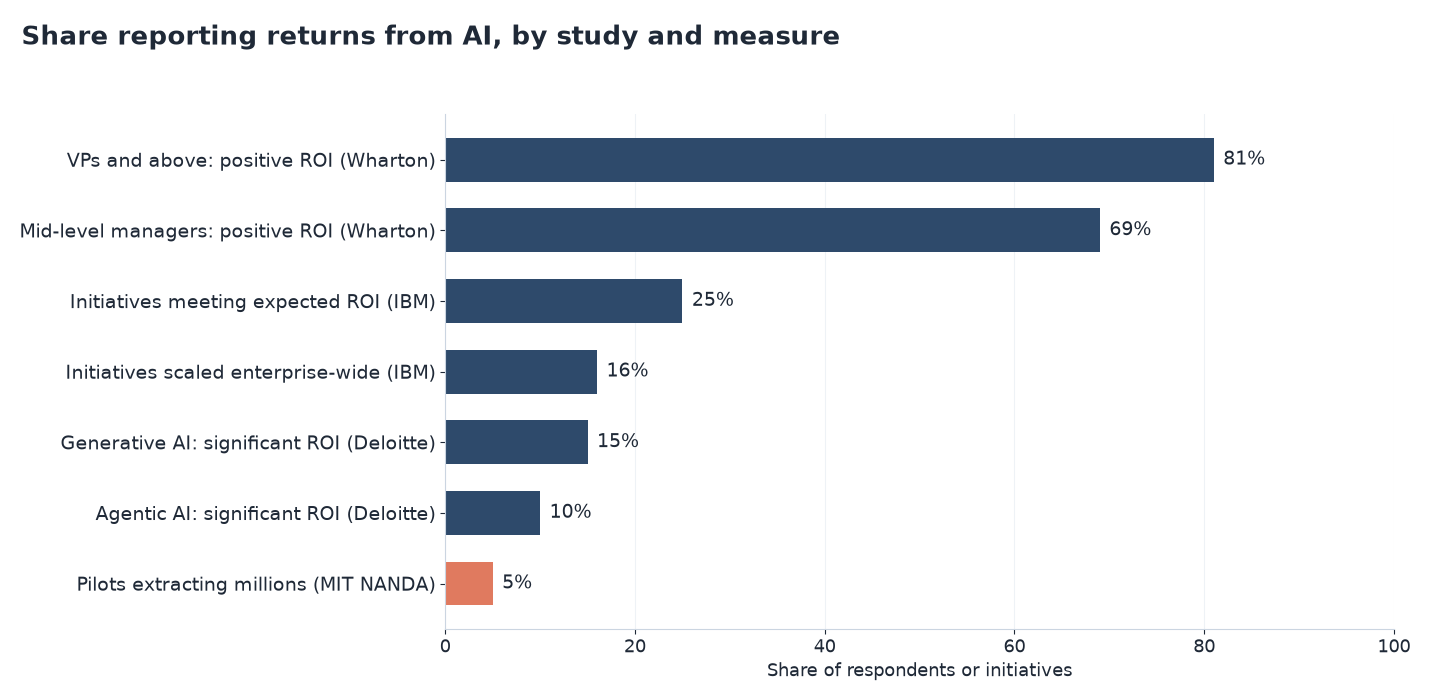
Source: AI Services Companies analysis of Wharton and GBK Collective (October 2025), IBM Institute for Business Value (May 2025), Deloitte (October 2025), and MIT NANDA (2025), conducted October 2026.
Key Findings
- The highest figure, 81%, comes from senior US executives asked whether ROI is positive at all. Mid-level managers in the same survey are 12 points lower, at 69%.
- When the bar is the return a company expected, the share drops sharply. IBM’s CEOs say 25% of their AI initiatives met expected ROI, and 16% reached enterprise-wide scale.
- Agentic AI trails generative AI in Deloitte’s survey, at 10% against 15% reporting significant ROI. A company planning an agent project should expect a longer path to measurable returns than for a writing or coding assistant.
Most Companies Report AI Payback in Two to Four Years
Payback period is how long an investment takes to return its cost, and it is the measure finance teams use to compare AI with other technology spending.
| Study | Measure | Share |
|---|---|---|
| Deloitte, 2025 | Typical AI use case pays back within one year | 6% |
| Deloitte, 2025 | Most successful AI projects pay back within one year | 13% |
| Deloitte, 2025 | Generative AI users who expect significant ROI within one year | 38% |
| Deloitte, 2025 | Agentic AI users who expect returns within three years | About half |
| Wharton and GBK Collective, 2025 | Leaders who expect positive returns within two to three years | 80% (four in five) |
| IBM Institute for Business Value, 2025 | CEOs who expect positive ROI from scaled AI efficiency and cost savings by 2027 | 85% |
| IBM Institute for Business Value, 2025 | CEOs who expect positive ROI from scaled AI growth and expansion by 2027 | 77% |
Source: AI Services Companies analysis of Deloitte (October 2025), Wharton and GBK Collective executive summary (October 2025), and IBM Institute for Business Value (May 2025), conducted October 2026. Data: ai-payback-periods.csv
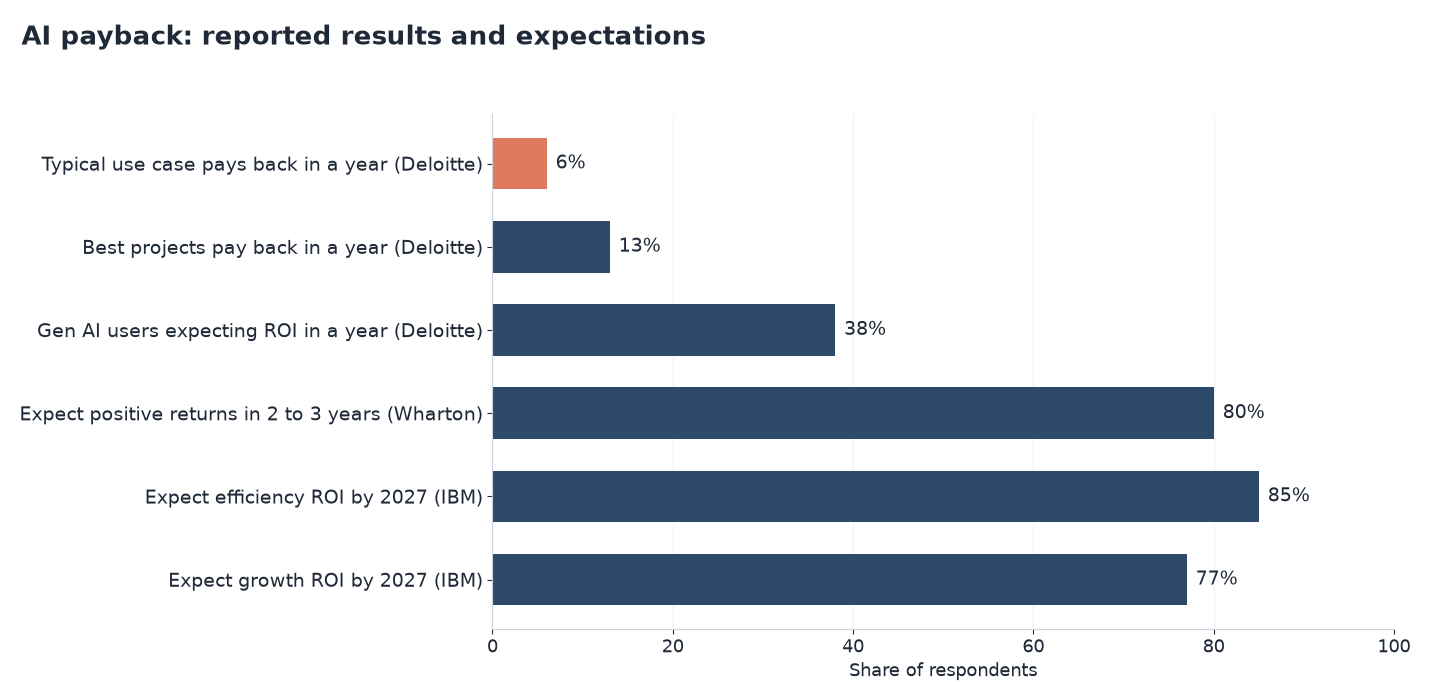
Source: AI Services Companies analysis of Deloitte (October 2025), Wharton and GBK Collective executive summary (October 2025), and IBM Institute for Business Value (May 2025), conducted October 2026.
Key Findings
- Deloitte’s respondents most often report payback in two to four years, against the seven to 12 months typical for other technology investments. Only 6% see payback on a typical use case within a year.
- Expectations run well ahead of results. 85% of IBM’s CEOs expect efficiency-focused AI to show positive ROI by 2027, and four in five Wharton respondents expect positive returns within two to three years.
- A business case built on first-year payback is an outlier in these surveys. A two-to-three-year horizon, with interim productivity measures along the way, matches what most companies report.
AI Budgets Keep Rising While Returns Lag
Spending plans show whether slow returns are changing how companies behave, so we compared what each study found about AI budgets and measurement.
| Study | Measure | Value |
|---|---|---|
| Deloitte, 2025 | Organizations that increased AI investment in the past 12 months | 85% |
| Deloitte, 2025 | Organizations planning to increase AI investment in the next 12 months | 91% |
| Wharton and GBK Collective, 2025 | Leaders expecting generative AI budget increases in the next 12 months | 88% |
| Wharton and GBK Collective, 2025 | Leaders formally tracking business-linked ROI metrics | 72% |
| IBM Institute for Business Value, 2025 | CEOs whose organizations choose AI use cases based on ROI | 65% |
| Menlo Ventures, 2025 | US enterprise spending on generative AI in 2025 | $37 billion |
| Menlo Ventures, 2025 | US enterprise spending on generative AI in 2024 | $11.5 billion |
Source: AI Services Companies analysis of Deloitte (October 2025), Wharton and GBK Collective executive summary (October 2025), IBM Institute for Business Value (May 2025), and Menlo Ventures (December 2025), conducted October 2026. Data: ai-investment-trends.csv
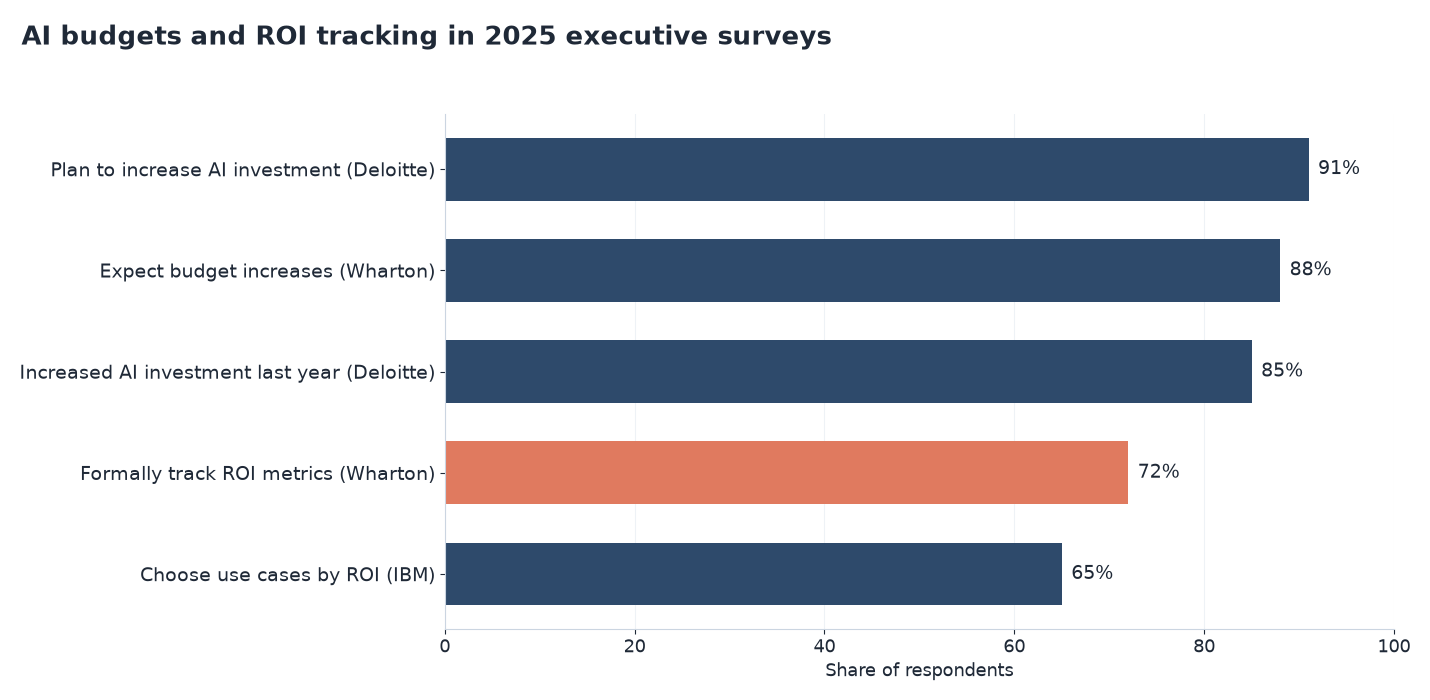
Source: AI Services Companies analysis of Deloitte (October 2025), Wharton and GBK Collective executive summary (October 2025), IBM Institute for Business Value (May 2025), and Menlo Ventures (December 2025), conducted October 2026.
Key Findings
- Nine in ten organizations in Deloitte’s survey plan to spend more on AI, even though most report multi-year payback. Wharton finds the same pattern, with 88% expecting budget increases.
- US enterprise spending on generative AI reached $37 billion in 2025, up from $11.5 billion in 2024, a 3.2-fold increase by Menlo Ventures’ estimate.
- Measurement is catching up with spending. 72% of Wharton’s respondents track business-linked ROI metrics and 65% of IBM’s CEOs choose use cases by ROI, so AI vendors can expect more requests for measured client outcomes.
What AI ROI Statistics Mean for Companies Buying AI
The studies agree more than their headlines suggest. Most leaders believe AI is paying off in some form, a minority can point to the return they planned, and payback takes longer than for other technology.
The gap is widest for agentic AI and for projects that must change how a whole company works. Generative AI users in Deloitte’s survey expect returns sooner, and the companies spending most heavily are also the ones building ROI tracking into their plans.
So if you are building the case for an AI project, set a two-to-three-year payback target, agree in advance on the business metric it should move, and ask any AI services firm you hire for results it has measured at other clients.
Data Collection and Methodology
The study covers five studies published between May and December 2025: IBM Institute for Business Value’s 2025 CEO Study (2,000 CEOs in 33 countries and 24 industries, surveyed February to April 2025 with Oxford Economics), Deloitte’s AI ROI survey (1,854 senior executives in 14 countries in Europe and the Middle East, surveyed August 15 to September 5, 2025), the Wharton Human-AI Research and GBK Collective report Accountable Acceleration (about 800 US enterprise decision-makers at companies with 1,000 or more employees and more than $50 million in revenue), Menlo Ventures’ 2025 State of Generative AI in the Enterprise (495 US enterprise AI decision-makers, surveyed November 7 to 25, 2025), and MIT NANDA’s State of AI in Business 2025 (52 structured interviews, 153 surveyed leaders, and a review of more than 300 public AI initiatives).
We report each figure as published and keep the study’s own wording for the measure. Figures from different studies are not directly comparable because samples, regions, and questions differ; the tables place each figure beside its question for that reason. “Four in five” in the Wharton report is shown as 80%. “About half” of Deloitte’s agentic AI users is shown in words and left out of the chart.
The total of more than 5,000 executives adds the survey samples of the five studies (2,000, 1,854, about 800, 495, and 153). MIT NANDA’s figures come from a small sample and are self-reported; its authors note the limits of the sample.
Sources (7)
- AI Services Companies analysis of five 2025 executive studies on returns from AI, conducted October 2026.
- IBM Institute for Business Value, IBM Study: CEOs Double Down on AI While Navigating Enterprise Hurdles (May 6, 2025)
- Deloitte, AI ROI: The paradox of rising investment and elusive returns (October 22, 2025)
- Wharton Human-AI Research and GBK Collective, 2025 AI Adoption Report executive summary (October 2025)
- Menlo Ventures, 2025: The State of Generative AI in the Enterprise (December 9, 2025)
- MIT NANDA, The GenAI Divide: State of AI in Business 2025
- AI Services Companies, AI Project Failure Rate Statistics 2026