
AI Inference Cost Statistics 2026
Published November 11, 2026
Our analysts compiled 15 historical price points from Epoch AI's inference price data covering November 2021 to February 2025, the November 11, 2026 list prices of 21 models from OpenAI, Anthropic, and Google, compute spending estimates from the Stanford AI Index 2026, and token volumes reported by Google, to show what AI inference costs as of Q4 2026 and how quickly that cost is changing.
Key Findings
- The lowest price for a model scoring at GPT-3.5's level on the MMLU knowledge test fell from $20.00 per million tokens in November 2022 to $0.07 in October 2024, making it 286 times cheaper in about 22 months.2,3
- GPT-4-level capability (MMLU 86 or higher) fell from $37.50 per million tokens in March 2023 to $0.18 in February 2025, a 208-fold drop.2
- In November 2026, OpenAI's newest top-tier model, GPT-6 Astra, costs $50.00 per million output tokens, 100 times the $0.50 charged for the small GPT-6 Luna and Claude Haiku 5.5 models.5,6
- OpenAI's compute spending on inference rose from $1.80 billion in 2024 to $8.00 billion in 2025, according to Epoch AI estimates published in the Stanford AI Index 2026.8
- Gartner forecasts that inference on a 1-trillion-parameter model will cost AI providers over 90% less in 2030 than in 2025, while agentic models use 5 to 30 times more tokens per task than a standard chatbot.11
Inference is the work an AI model does each time it answers a request, as opposed to the one-time work of training it. Companies that use models from OpenAI, Anthropic, or Google through an API pay for inference by the token, a unit of text of roughly four characters, with separate rates for the text sent in (input) and the text the model writes back (output).11 Two claims about these prices circulate at once. One is that the cost of AI has collapsed, with the same capability now costing a tiny fraction of what it did in 2022. The other is that AI bills keep rising, because new models cost more and new uses consume far more tokens. We gathered the numbers behind both claims so they can be compared in one place, with the date and source of each.
Our analysts took Epoch AI's record of the cheapest model reaching set scores on six benchmarks, which tracks blended list prices per million tokens from November 2021 to February 2025. We added the standard, batch, cached, and fast-mode list prices published on the OpenAI, Anthropic, and Google developer pricing pages, checked on November 11, 2026. Spending figures come from Epoch AI estimates of OpenAI and Anthropic compute costs in the Stanford AI Index 2026, token volumes come from Google's May 2026 and October 2026 remarks, and forecasts come from Gartner's March 2026 analysis. All prices are in US dollars.
In the following sections, we compare how the price of fixed capability has fallen, how the rate of decline varies by task, what models cost per token in November 2026, how top-tier prices have moved between model generations, how pricing options change the cost of the same model, and how inference spending and token demand have grown.
The Price of GPT-3.5-Level AI Fell 286-Fold in Under Two Years
The cleanest way to see whether AI is getting cheaper is to hold capability steady and ask what the cheapest qualifying model costs over time. Epoch AI tracks exactly that, so we pulled its price history for models that match GPT-3.5 and GPT-4 on the MMLU general knowledge test.
| Capability level | Date | Cheapest qualifying model | Price per 1M tokens |
|---|---|---|---|
| GPT-3.5 level (MMLU 64.8+) | Nov 30, 2022 | GPT-3.5 | $20.00 |
| GPT-3.5 level (MMLU 64.8+) | Mar 6, 2023 | GPT-3.5 Turbo | $2.00 |
| GPT-3.5 level (MMLU 64.8+) | Nov 6, 2023 | GPT-3.5 Turbo (Nov 2023) | $0.75 |
| GPT-3.5 level (MMLU 64.8+) | Mar 4, 2024 | Claude 3 Haiku | $0.50 |
| GPT-3.5 level (MMLU 64.8+) | May 10, 2024 | Gemini 1.5 Flash (May 2024) | $0.13 |
| GPT-3.5 level (MMLU 64.8+) | Jul 23, 2024 | Llama 3.1 Instruct 8B | $0.10 |
| GPT-3.5 level (MMLU 64.8+) | Oct 3, 2024 | Gemini 1.5 Flash-8B | $0.07 |
| GPT-4 level (MMLU 86+) | Mar 14, 2023 | GPT-4 (Mar 2023) | $37.50 |
| GPT-4 level (MMLU 86+) | Nov 6, 2023 | GPT-4 Turbo | $15.00 |
| GPT-4 level (MMLU 86+) | May 13, 2024 | GPT-4o (May 2024) | $7.50 |
| GPT-4 level (MMLU 86+) | May 23, 2024 | Gemini 1.5 Pro (May 2024) | $2.19 |
| GPT-4 level (MMLU 86+) | Feb 5, 2025 | Gemini 2.0 Flash | $0.18 |
Source: AI Services Companies analysis of Epoch AI, LLM inference prices have fallen rapidly but unequally across tasks, lowest inference prices at fixed performance, conducted November 2026. Data: price-per-million-tokens-fixed-capability-2022-2025.csv
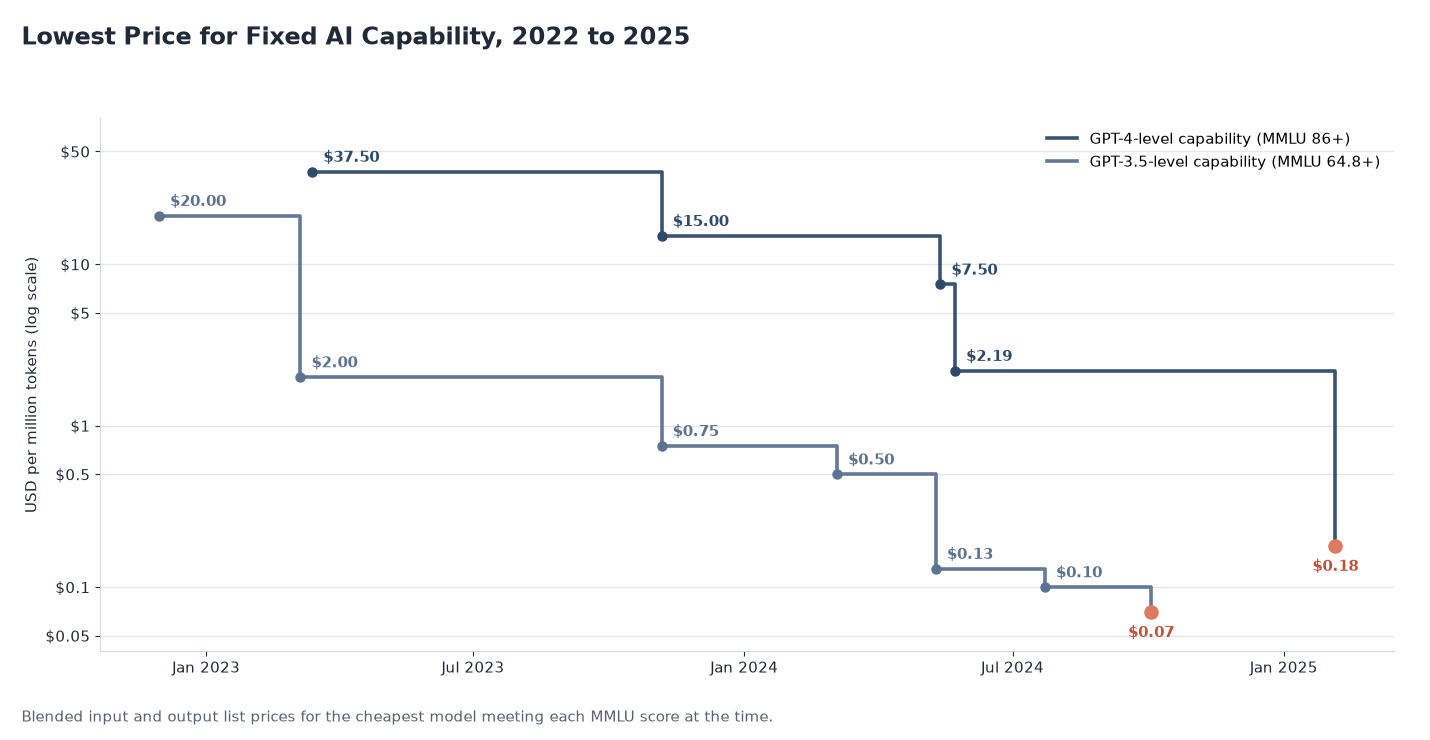
Source: AI Services Companies analysis of Epoch AI inference price data, conducted November 2026.
Key Findings
- The biggest single step for GPT-3.5-level capability came in March 2023, when OpenAI's GPT-3.5 Turbo cut the price from $20.00 to $2.00 per million tokens. Later steps came from OpenAI's November 2023 GPT-3.5 Turbo update and then from smaller models by Anthropic, Google, and Meta that reached the same score at lower prices.2
- The Stanford AI Index 2025 reported the same drop as "over 280-fold" between November 2022 and October 2024, and Andreessen Horowitz measured a decline of about 10 times per year for models of equal MMLU performance.3,4
- These are list prices for the cheapest model that clears a test score, so a buyer who stays on the same model does not see this drop. The savings go to teams that switch to newer, smaller models once those models are good enough for the task.2
Price Declines Ranged From 33-Fold to 857-Fold Depending on the Capability Level
A single headline rate hides a lot of spread. Epoch AI ran the same fixed-capability test on coding, math, science, and chatbot benchmarks, and we compared the first and lowest price it recorded at each level to see where costs fell fastest.
| Capability level | Benchmark | First price (model, date, per 1M tokens) | Lowest price (model, date, per 1M tokens) | Months | Times cheaper |
|---|---|---|---|---|---|
| GPT-3 level | MMLU | GPT-3, Nov 20, 2021, $60.00 | Gemini 1.5 Flash-8B, Oct 3, 2024, $0.07 | 34 | 857x |
| GPT-3.5 level | MMLU | GPT-3.5, Nov 30, 2022, $20.00 | Gemini 1.5 Flash-8B, Oct 3, 2024, $0.07 | 22 | 286x |
| GPT-4 level | MMLU | GPT-4 (Mar 2023), Mar 14, 2023, $37.50 | Gemini 2.0 Flash, Feb 5, 2025, $0.18 | 23 | 208x |
| GPT-4 level | HumanEval (coding) | GPT-4 (Mar 2023), Mar 14, 2023, $37.50 | Llama 3.1 Instruct 8B, Jul 23, 2024, $0.10 | 16 | 375x |
| GPT-4 level | GPQA Diamond (PhD-level science) | GPT-4 (Mar 2023), Mar 14, 2023, $37.50 | Phi 4, Dec 13, 2024, $0.12 | 21 | 312x |
| GPT-4 Turbo level | MATH-500 (math) | GPT-4 Turbo, Nov 6, 2023, $15.00 | Phi 4, Dec 13, 2024, $0.12 | 13 | 125x |
| GPT-4o level | GPQA Diamond (PhD-level science) | GPT-4o (May 2024), May 13, 2024, $7.50 | Phi 4, Dec 13, 2024, $0.12 | 7 | 62x |
| GPT-4o level | Chatbot Arena rating | GPT-4o (May 2024), May 13, 2024, $7.50 | Gemini 2.0 Flash, Feb 5, 2025, $0.18 | 9 | 42x |
| Claude 3.5 Sonnet level | GPQA Diamond (PhD-level science) | Claude 3.5 Sonnet (Jun 2024), Jun 20, 2024, $6.00 | Gemini 2.0 Flash, Feb 5, 2025, $0.18 | 8 | 33x |
Source: AI Services Companies analysis of Epoch AI inference price data, conducted November 2026. Data: price-decline-by-capability-level.csv
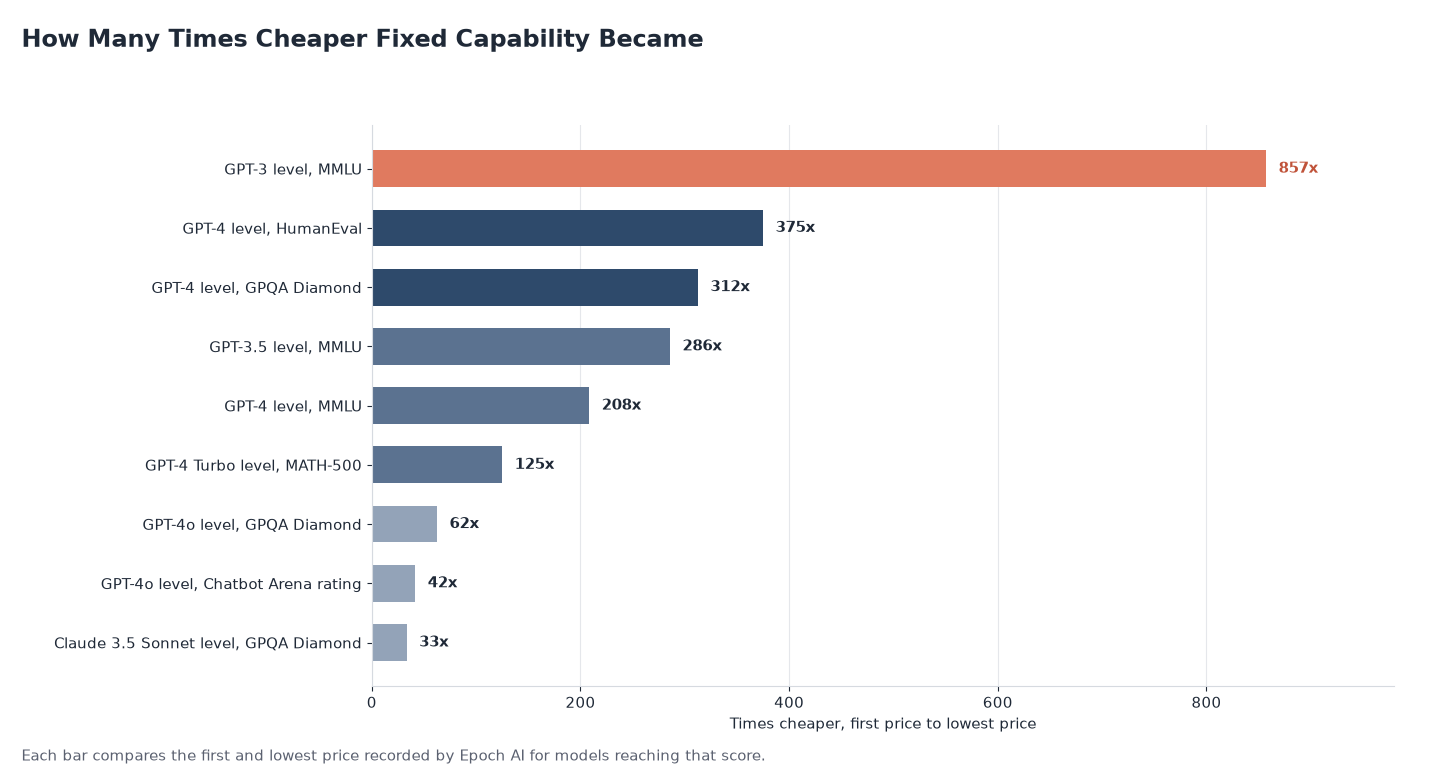
Source: AI Services Companies analysis of Epoch AI inference price data, conducted November 2026.
Key Findings
- Epoch AI's own trend fits put the rate of decline between 9 times and 900 times per year depending on the benchmark and score, and it found that the price of GPT-4's performance on PhD-level science questions fell by 40 times per year.2
- The largest drops are at the oldest and lowest capability levels, which have had the longest time to fall. GPT-3-level capability went from $60.00 per million tokens in November 2021 to $0.07 in October 2024.2
- Epoch AI notes that the fastest declines happened in the most recent year of its data, so it is less clear that they will continue. Anyone projecting future prices from these rates should use the slower, longer-run figures as the base case.2
Top-Tier Models Cost 100 Times More per Output Token Than Small Models in November 2026
Historical trend lines matter less to a budget than what a model costs today. We took the standard published rates for the top, middle, and small models in the newest model families at OpenAI, Anthropic, and Google as listed on November 11, 2026.
| Vendor | Model | Tier | Input | Output | Note |
|---|---|---|---|---|---|
| OpenAI | GPT-6 Astra | Top tier | $10.00 | $50.00 | short context |
| OpenAI | GPT-6.1 Sol | Mid tier | $2.00 | $10.00 | short context |
| OpenAI | GPT-6.1 Terra | Mid tier | $1.00 | $5.00 | short context |
| OpenAI | GPT-6 Luna | Small | $0.10 | $0.50 | short context |
| Anthropic | Claude Fable 5.2 | Top tier | $8.00 | $40.00 | |
| Anthropic | Claude Opus 5.5 | Mid tier | $4.00 | $20.00 | |
| Anthropic | Claude Sonnet 5.5 | Mid tier | $2.00 | $10.00 | |
| Anthropic | Claude Haiku 5.5 | Small | $0.10 | $0.50 | prompts up to 100,000 tokens |
| Gemini 4 Carbon | Top tier | $2.00 | $10.00 | $4.00 / $20.00 from Dec 1, 2026 | |
| Gemini 3.8 Flash | Mid tier | $0.75 | $3.75 | $1.50 / $7.50 from Jan 1, 2027 | |
| Gemini 3.5 Flash-Lite | Small | $0.30 | $2.50 |
Source: AI Services Companies analysis of OpenAI API pricing, Anthropic Claude API pricing, and Google Gemini Developer API pricing, standard tier, conducted November 2026. Data: ai-model-list-prices-november-2026.csv
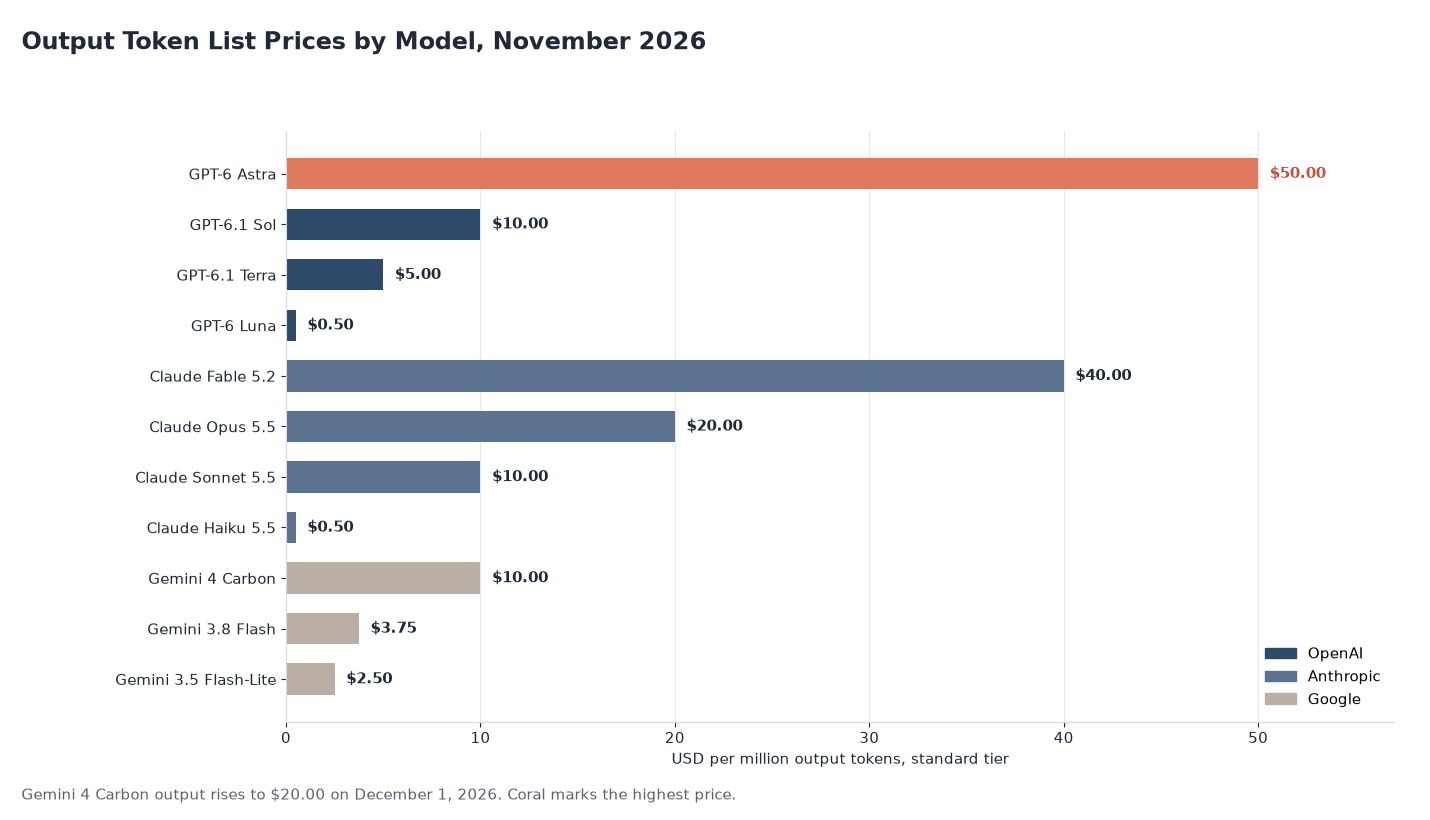
Source: AI Services Companies analysis of OpenAI, Anthropic, and Google pricing pages, conducted November 2026.
Key Findings
- Output tokens cost five times as much as input tokens on every OpenAI and Anthropic model in the table, so tasks that make a model write long answers or reasoning steps cost far more than tasks that mostly read. Google bills the model's thinking tokens at the output rate on Gemini 4 Carbon.5,6,7
- Google lists promotional prices that end soon. Gemini 4 Carbon moves from $2.00 / $10.00 to $4.00 / $20.00 per million tokens on December 1, 2026, and Gemini 3.8 Flash doubles to $1.50 / $7.50 on January 1, 2027.7
- OpenAI's and Anthropic's lists span 80 to 100 times from the smallest to the largest model in the table, while three models from different vendors cost the same $10.00 per million output tokens (GPT-6.1 Sol, Claude Sonnet 5.5, and Gemini 4 Carbon before its increase). The choice of model size moves a bill far more than the choice of vendor.5,6,7
Newest Top-Tier List Prices Rose at OpenAI and Google and Fell at Anthropic
The fixed-capability figures above follow the cheapest model that is good enough. Many buyers instead move to each vendor's newest and strongest model, so we lined up the successive top models that remain on each vendor's price list, from oldest to newest.
| Vendor | Model | Input per 1M tokens | Output per 1M tokens | Note |
|---|---|---|---|---|
| OpenAI | GPT-4o | $2.50 | $10.00 | |
| OpenAI | GPT-5 | $1.25 | $10.00 | |
| OpenAI | GPT-5.4 | $2.50 | $15.00 | under 272K tokens |
| OpenAI | GPT-5.5 | $5.00 | $30.00 | under 272K tokens |
| OpenAI | GPT-6 Astra | $10.00 | $50.00 | short context |
| Anthropic | Claude Opus 4 | $15.00 | $75.00 | retired June 15, 2026; price still listed |
| Anthropic | Claude Opus 4.5 | $5.00 | $25.00 | |
| Anthropic | Claude Opus 5 | $5.00 | $25.00 | |
| Anthropic | Claude Opus 5.5 | $4.00 | $20.00 | |
| Anthropic | Claude Fable 5 | $10.00 | $50.00 | |
| Anthropic | Claude Fable 5.2 | $8.00 | $40.00 | |
| Gemini 2.5 Pro | $1.25 | $10.00 | prompts up to 200K tokens | |
| Gemini 3.1 Pro Preview | $2.00 | $12.00 | prompts up to 200K tokens | |
| Gemini 4 Carbon | $2.00 | $10.00 | $4.00 / $20.00 from Dec 1, 2026 |
Source: AI Services Companies analysis of OpenAI, Anthropic, and Google pricing pages, conducted November 2026. Data: top-tier-model-prices-by-generation.csv
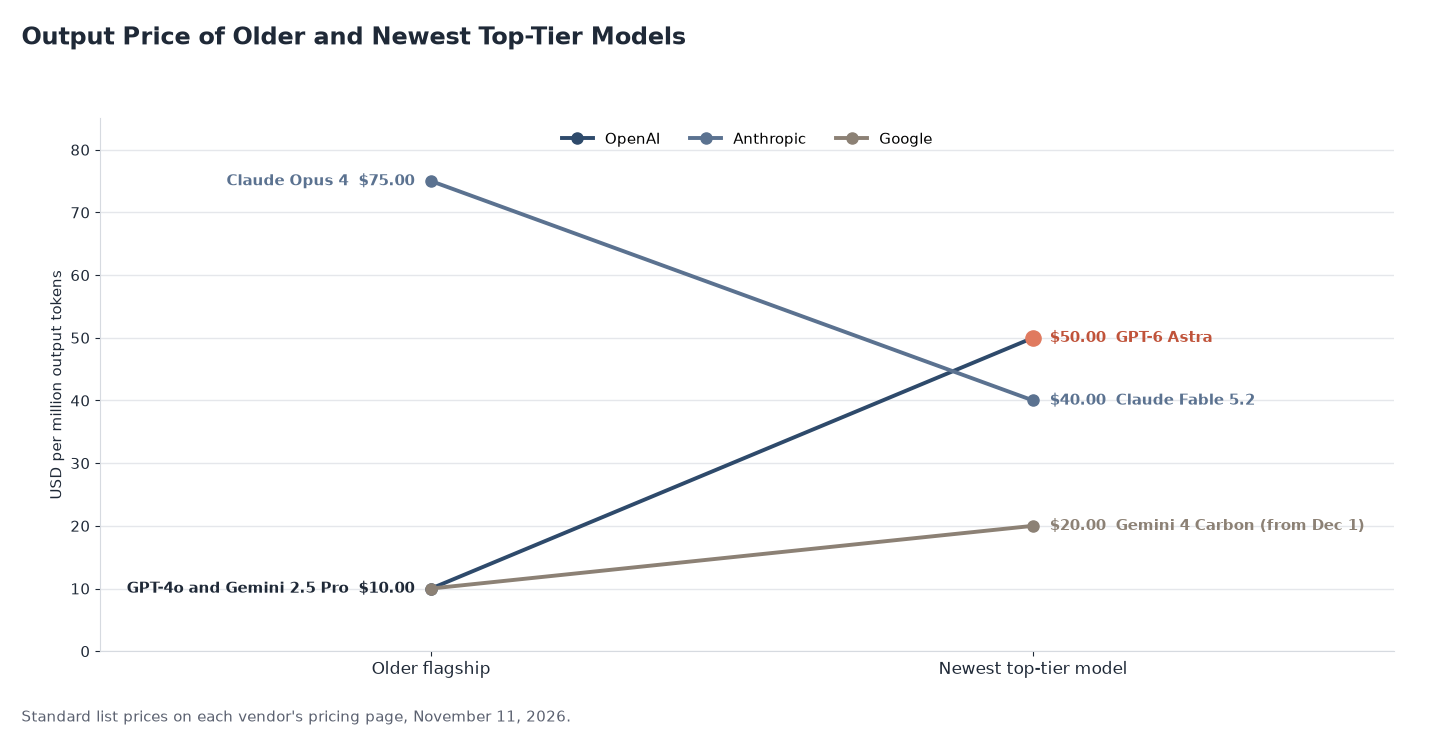
Source: AI Services Companies analysis of OpenAI, Anthropic, and Google pricing pages, conducted November 2026.
Key Findings
- OpenAI's newest top model, GPT-6 Astra, costs five times as much per output token as GPT-4o ($50.00 vs. $10.00), and each step from GPT-5 onward carried a higher output price.5
- Anthropic moved the other way within its Opus line, from $75.00 per million output tokens for Claude Opus 4 to $20.00 for Claude Opus 5.5, but added a higher Fable tier at $40.00 to $50.00.6
- Andreessen Horowitz pointed out in November 2024 that OpenAI's leading model at the time, o1, had the same output price as GPT-3 at launch, $60 per million tokens. The top of the market has kept its price while older capability gets cheaper.4
Processing Options Move the Price of the Same Model From Half to Six Times the Standard Rate
The rate on a price list is only a starting point. Each vendor sells discounts for work that can wait or reuse the same prompt text, and premiums for speed, longer prompts, or keeping data in one region, so we compared those options side by side.
| Option | What it is | OpenAI | Anthropic | |
|---|---|---|---|---|
| Batch processing | Requests processed asynchronously | 50% off: GPT-6.1 Sol $1.00 / $5.00 | 50% off: Claude Opus 5.5 $2.00 / $10.00 | 50% off: Gemini 4 Carbon $1.00 / $5.00 |
| Cached input | Repeated prompt text read from cache | GPT-6.1 Sol $0.10 vs. $2.00 input (5%) | 10% of input on most models; 5% on Opus 5.5 and Sonnet 5.5; 2.5% on Fable 5.1 and 5.2 | Gemini 4 Carbon $0.10 vs. $2.00 input (5%) |
| Fast mode | Faster output at a premium | 2x: GPT-6.1 Sol $4.00 / $20.00 | 2x: Claude Opus 5.5 $8.00 / $40.00 | Priority tier offered |
| Ultrafast | Highest-speed tier | 6x: GPT-6.1 Sol $12.00 / $60.00 | Not offered | Not offered |
| Long prompts | Input above a length threshold | Over 272K tokens: GPT-6.1 Sol $4.00 / $15.00 | Full 1M context at standard price on Claude 4.6 and later (except Haiku 5.5) | Over 200K tokens: Gemini 3.1 Pro Preview $4.00 / $18.00 |
| Data residency | Processing kept in one region | +10% for models released on or after Mar 5, 2026 | +10% (1.1x) for US-only inference on Claude 4.6 and later | Not covered in this comparison |
Source: AI Services Companies analysis of OpenAI, Anthropic, and Google pricing pages, prices shown as input / output per million tokens, conducted November 2026. Data: inference-pricing-options-november-2026.csv
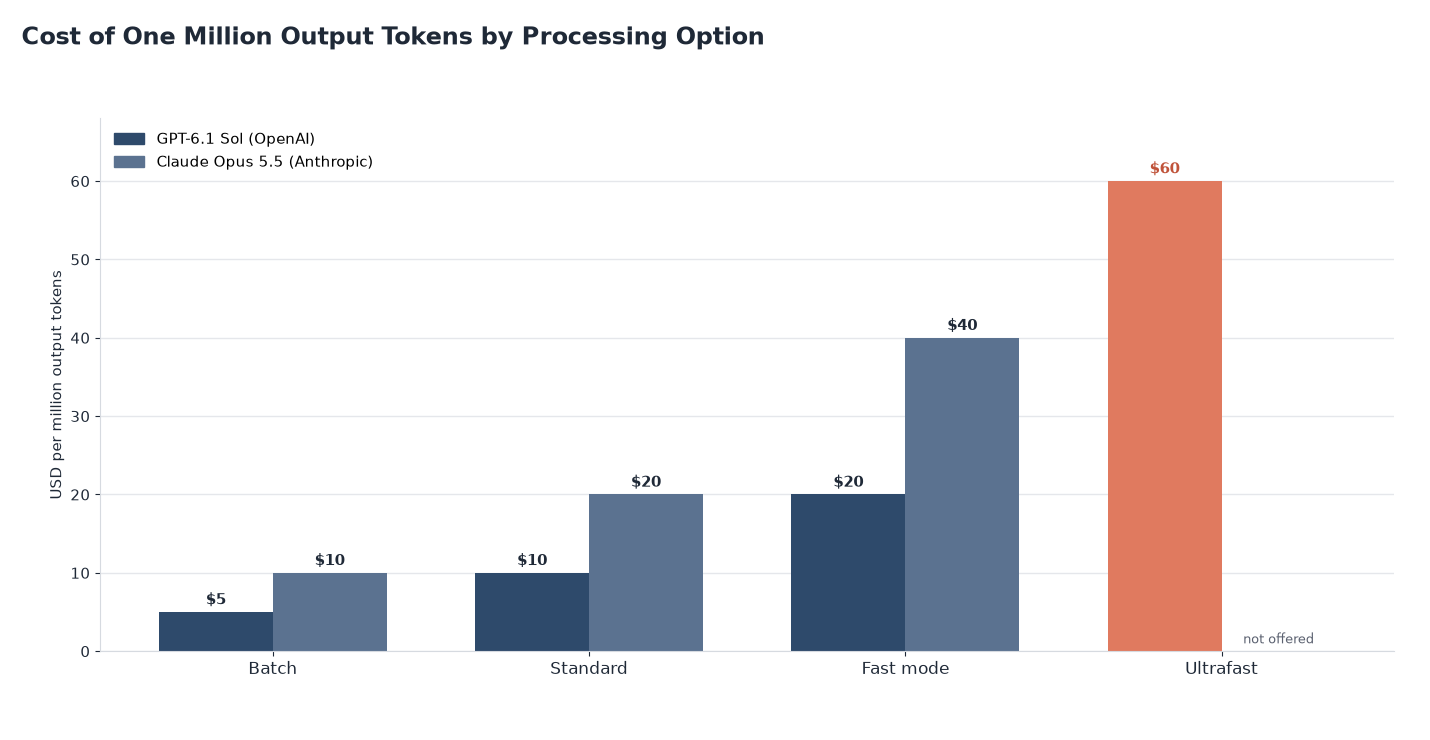
Source: AI Services Companies analysis of OpenAI and Anthropic pricing pages, conducted November 2026.
Key Findings
- All three vendors charge half price for batch jobs, which return results later in exchange for the discount. On GPT-6.1 Sol, the same million output tokens cost $5.00 in a batch job and $60.00 on the ultrafast tier, a 12-fold spread.5
- Cached input is the deepest discount. Reading repeated prompt text from cache costs 5% of the input rate on GPT-6.1 Sol and Gemini 4 Carbon and 2.5% on Claude Fable 5.2, which favors applications that send the same long instructions or documents with every request.5,6,7
- Anthropic notes that its Claude 4.7 and later models use a tokenizer that produces about 30% more tokens for the same text. Comparing per-token prices across model generations can understate the real change in cost per task.6
Inference Spending and Token Volumes Grew Faster Than Prices Fell
Cheaper tokens do not mean smaller bills if usage grows faster. We gathered the few public measures of total inference demand and spending: Google's token counts, Epoch AI's estimates of OpenAI and Anthropic compute costs, and Gartner's forecasts.
| Measure | Period | Value |
|---|---|---|
| Tokens Google processed per month across its products | May 2024 | 9.7 trillion9 |
| Tokens Google processed per month across its products | May 2025 | About 480 trillion9 |
| Tokens Google processed per month across its products | May 2026 | Over 3.2 quadrillion9 |
| Tokens processed per minute by Google's model APIs | May 2026 | About 19 billion9 |
| Tokens processed per minute by Google's first-party model APIs | Q3 2026 | Nearly 32 billion (more than 4x a year earlier)10 |
| Google Cloud customers that each processed over 1 trillion tokens | 12 months to May 2026 | Over 3759 |
| OpenAI compute spend on inference | 2024 | $1.80 billion of $5.80 billion8 |
| OpenAI compute spend on inference | 2025 | $8.00 billion of $16.30 billion8 |
| Anthropic compute spend on inference | 2025 | $2.70 billion of $6.80 billion8 |
| Tokens per task for agentic models vs. a standard chatbot | Gartner, March 2026 | 5 to 30 times more11 |
| Forecast cost of inference on a 1-trillion-parameter model, 2030 vs. 2025 | Gartner, March 2026 | Over 90% lower11 |
Source: AI Services Companies analysis of Google I/O 2026 keynote, Alphabet Q3 2026 earnings remarks, Stanford AI Index 2026, Figure 4.2.20, and Gartner, conducted November 2026. Data: inference-demand-and-spending-2024-2026.csv
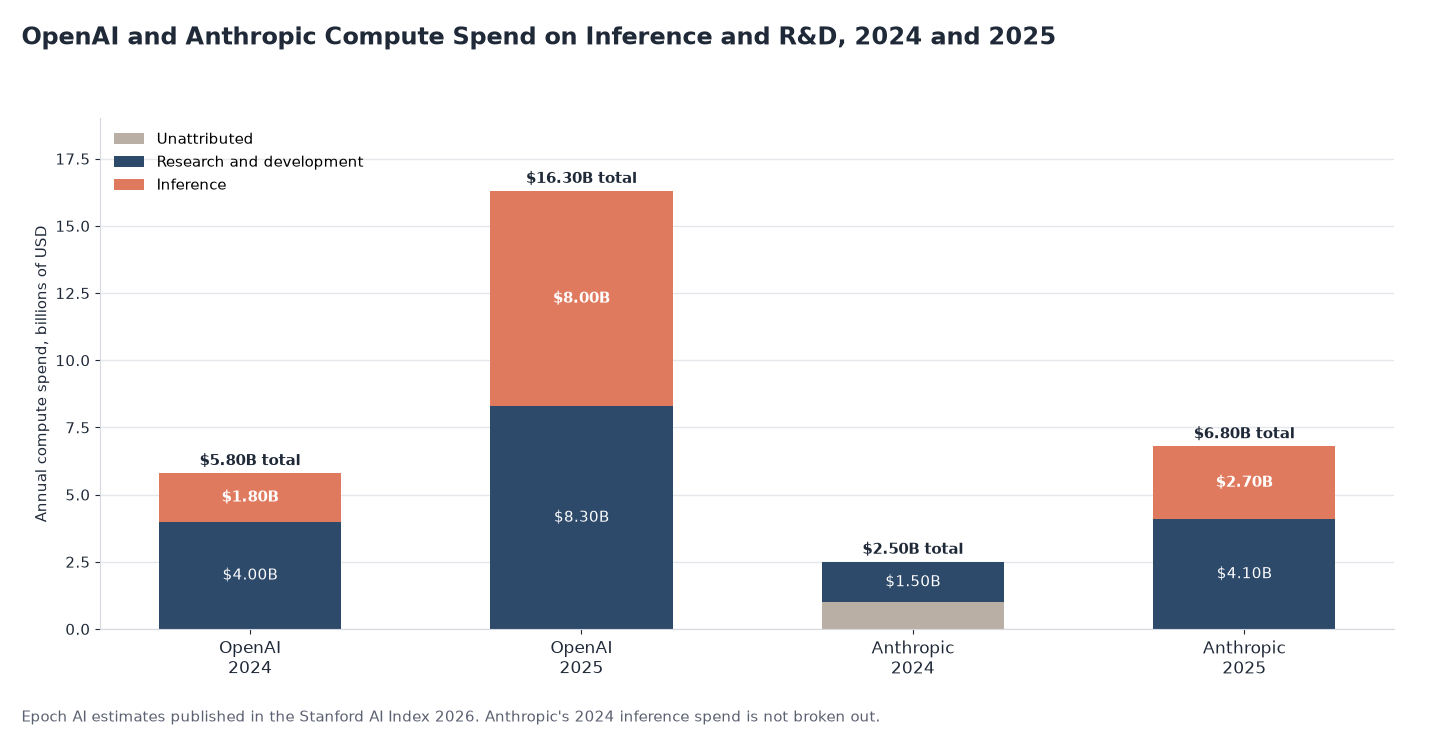
Source: AI Services Companies analysis of Epoch AI estimates in the Stanford AI Index 2026, conducted November 2026.
Key Findings
- OpenAI's inference spending grew about 4.4 times in one year, from $1.80 billion in 2024 to $8.00 billion in 2025, and inference made up 49% of its estimated $16.30 billion compute bill in 2025.8
- Google processed over 3.2 quadrillion tokens a month across its products in May 2026, about 7 times the roughly 480 trillion a year earlier and over 300 times the 9.7 trillion of May 2024.9
- Gartner expects token demand to outrun falling unit costs, so that total inference costs rise even as each token gets cheaper. It also expects providers not to pass the full cost savings on to enterprise customers.11
What AI Inference Cost Statistics Mean for Buyers in 2026
For a team building on AI models, the price of a given level of capability has fallen by two orders of magnitude since 2022, and a task that needed a frontier model in 2023 can often run on a small model for cents per million tokens. At the same time, the newest top-tier models from OpenAI and Google cost more per token than the flagships they followed, and agent-style applications use many more tokens per task. Our AI development cost statistics and AI implementation cost by industry cover the build costs that come on top of these usage bills.
Falling unit prices and rising total spending are happening together. Cheap tokens make new uses affordable, those uses consume far more tokens, and the companies selling inference spend more on compute each year to serve them.
So if you are citing an AI inference cost figure, state whether it is a fixed-capability price, a current list price for a specific model, or a total spending figure, since each moves in a different direction.
Data Collection and Methodology
We collected 15 historical price points from Epoch AI's table of the lowest inference prices at fixed performance, published March 12, 2025, which covers models released from November 2021 to February 2025. Epoch AI reports one blended price per million tokens, a 3:1 weighted average of input and output prices taken from the first-party API where one exists and otherwise the median across providers; it excludes reasoning models and records the cheapest model whose score meets or exceeds the stated benchmark threshold at each date. For the decline table, we took the first and the lowest price Epoch AI lists for each threshold; months elapsed are calendar days divided by 30.44 and rounded. Epoch AI's own annual decline rates (9 to 900 times per year, and 40 times per year for GPT-4-level PhD science questions) come from its fitted trends and are quoted as published.
Current prices for 21 models are the standard, batch, cached-input, fast, and long-context rates on the OpenAI, Anthropic, and Google developer pricing pages as displayed on November 11, 2026. OpenAI prices are short-context rates (272K input tokens or fewer) unless noted, Claude Haiku 5.5 prices are for prompts up to 100,000 tokens, and Gemini prices are paid-tier rates for prompts up to 200K tokens where tiered. Promotional prices are shown with their scheduled end dates. Vendor tier labels (top, mid, and small) are our grouping by price within each vendor's newest model family; specialized higher-compute variants such as OpenAI's GPT-5.5 Pro ($30.00 / $180.00) and limited-access models are not included. The "older flagship" comparison uses GPT-4o, Claude Opus 4, and Gemini 2.5 Pro, the oldest general-purpose flagship models whose prices still appear on each vendor's pricing page (Anthropic retired Claude Opus 4 from its API on June 15, 2026, but its price remains on the page).
Compute spending figures are Epoch AI estimates shown in Figure 4.2.20 of the Stanford AI Index Report 2026; Anthropic's 2024 figure is split only into research and development and unattributed spending. Token volumes are as stated by Google's chief executive in May 2026 and October 2026. All money is in US dollars as published. We calculated products, differences, and ratios from the published values.
Sources (11)
- AI Services Companies analysis of fixed-capability inference prices, November 2026 API list prices for 21 models, compute spending estimates, and token volume disclosures from 10 published sources, conducted November 2026.
- Epoch AI, LLM inference prices have fallen rapidly but unequally across tasks (March 12, 2025)
- Stanford HAI, The 2025 AI Index Report, Top Takeaways (April 2025)
- Andreessen Horowitz, Welcome to LLMflation: LLM inference cost is going down fast (November 12, 2024)
- OpenAI, API Pricing (accessed November 11, 2026)
- Anthropic, Claude API Pricing (accessed November 11, 2026)
- Google, Gemini Developer API Pricing (accessed November 11, 2026)
- Stanford HAI, Artificial Intelligence Index Report 2026, Figure 4.2.20: Annual compute spend of select frontier AI companies (April 2026)
- Google, I/O 2026: Welcome to the agentic Gemini era, Sundar Pichai keynote remarks (May 19, 2026)
- Google, Q3 2026 earnings call: Remarks from our CEO (October 28, 2026)
- Gartner, Gartner Predicts That by 2030, Performing Inference on an LLM With 1 Trillion Parameters Will Cost GenAI Providers Over 90% Less Than in 2025 (March 25, 2026)