
AI Literacy Statistics 2026
Published November 20, 2026
Our analysts gathered results from four survey programs fielded from December 2022 to February 2026, covering 48,340 adults in 47 countries, 23,216 adults in 30 countries, 3,839 university students in 16 countries, and repeated national samples of US adults, to show how much people know about AI and how well they can use it as of Q4 2026.
Key Findings
- 48% of US adults said in February 2026 that they had heard or read a lot about AI, up from 26% in 2022.3
- Only 30% of US adults correctly identified AI in all six everyday examples in a Pew Research Center quiz, including 53% of postgraduates and 14% of adults with a high school diploma or less.6
- Across 47 countries, 48% of adults report low knowledge of AI and 39% report any AI training or education, yet 60% believe they can use AI tools effectively.2
- 90% of adults in 47 countries use social media, but 47% do not know it relies on AI.2
- 58% of university students in a 16-country survey said they do not have sufficient AI knowledge and skills, and 72% want their university to offer more AI literacy courses.8
AI literacy is the knowledge and skill a person needs to understand what AI is, recognize when it is being used, use AI tools well, and judge whether their output is accurate.
Surveys measure it in three main ways: how much people say they have heard or know about AI, whether they can correctly spot AI in everyday products, and whether they feel able to use and evaluate AI tools.2,6,7
Since 2 February 2025, the EU AI Act has also required companies that provide or deploy AI systems to take measures to support the AI literacy of their staff.9
Our analysts read the global study on trust and use of AI by KPMG and the University of Melbourne, five Pew Research Center reports from 2023 to 2026, the Ipsos AI Monitor 2025, the Digital Education Council Global AI Student Survey 2024, and the European Commission's AI literacy questions and answers. All sources were opened on November 20, 2026.
For workplace AI training rates, see our Employee AI Training Statistics 2026.
In the following sections, we compare US awareness of AI over time and by group, self-reported AI knowledge and skills worldwide, literacy in advanced and emerging economies, how many people know which everyday technologies use AI, understanding of AI in 30 countries, and AI literacy among students.
48% of US Adults Have Heard a Lot About AI, Up From 26% in 2022
Pew Research Center has asked US adults how much they have heard or read about AI every year since 2022. We collected that trend along with its 2022 knowledge quiz, which tested whether adults could identify AI in six common products and services.
| Measure | Value | Source |
|---|---|---|
| Heard or read a lot about AI, 2022 | 26% (a little: 59%) | Pew Research Center |
| Heard or read a lot about AI, 2023 | 33% (a little: 56%) | Pew Research Center |
| Heard or read a lot about AI, 2024 | 40% (a little: 53%) | Pew Research Center |
| Heard or read a lot about AI, 2025 | 47% (a little: 48%) | Pew Research Center |
| Heard or read a lot about AI, February 2026 | 48% (a little: 48%) | Pew Research Center |
| Heard at least a little about AI chatbots, 2024 vs. 2026 | 72% vs. 87% | Pew Research Center |
| Adults under 30 who heard a lot about AI, 2022 vs. 2025 | 33% vs. 62% | Pew Research Center |
| Adults 65 and older who heard a lot about AI, 2025 | 32% | Pew Research Center |
| Heard a lot about AI, postgraduate degree vs. high school or less, 2025 | 60% vs. 38% | Pew Research Center |
| Heard a lot about AI, men vs. women, 2025 | 53% vs. 41% | Pew Research Center |
| Correctly identified AI in all six everyday examples, December 2022 | 30% (mean score 3.7 of 6) | Pew Research Center |
| Not too or not at all confident they can tell if content was made by AI, June 2025 | 53% | Pew Research Center |
Source: AI Services Companies analysis of Pew Research Center data from Americans and AI 2026, AI in Americans' Lives (2025), How Americans View AI (2025), and Public Awareness of AI in Everyday Activities (2023), conducted November 2026. Data: us-ai-awareness-2022-2026.csv
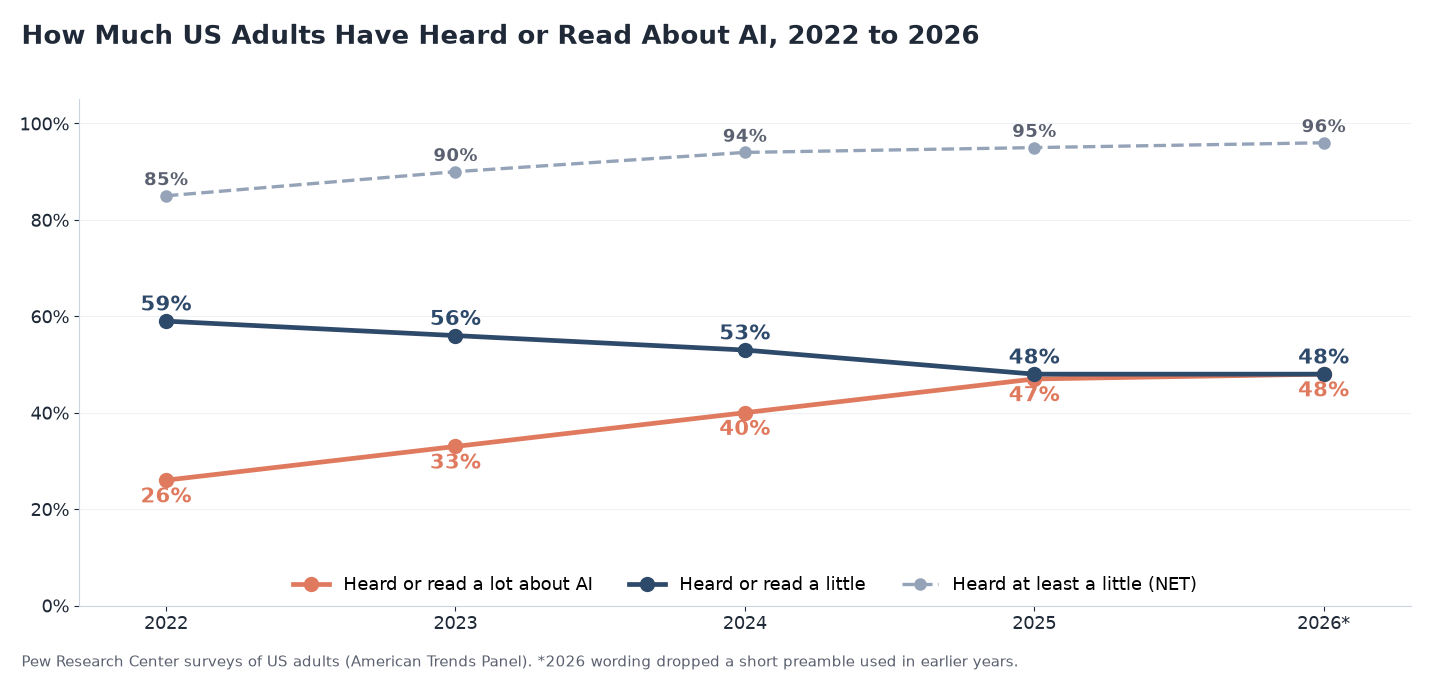
Source: AI Services Companies analysis of Pew Research Center data, conducted November 2026.
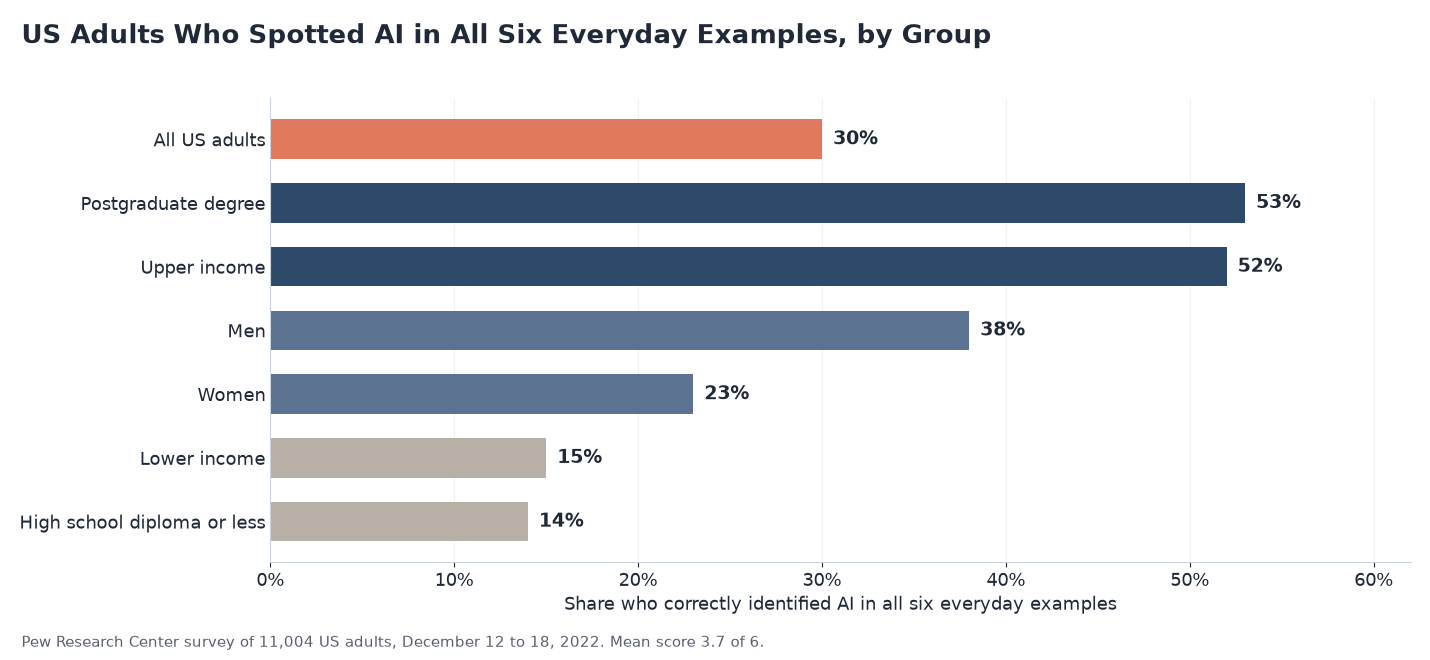
Source: AI Services Companies analysis of Pew Research Center data, conducted November 2026. Data: us-ai-awareness-quiz-by-group-2022.csv
Key Findings
- The share of US adults who have heard a lot about AI rose 21 points from 2022 to 2025, then held almost flat at 48% in 2026, when Pew dropped a short preamble from the question.3,4
- In Pew's 2022 quiz, 68% of US adults identified AI in fitness trackers, 65% in customer service chatbots, and 64% in product recommendations, but only 51% knew that email spam filters use AI.6
- Upper-income adults (52%) were more than three times as likely as lower-income adults (15%) to answer all six quiz questions correctly.6
- 76% of US adults say it is extremely or very important to be able to tell whether content was made by AI or by people, yet 53% are not confident they can.5
Nearly Half of Adults in 47 Countries Say They Know Little About AI
The largest global study of AI literacy asked 48,340 adults in 47 countries about their AI training, how much they know about AI, and whether they can use AI tools well. We gathered the global results for each measure.
| Measure | Value | Source |
|---|---|---|
| Adults with any AI-related training or education | 39% | KPMG and University of Melbourne, 2025 |
| Adults with low self-reported AI knowledge | 48% (moderate: 31%, high: 21%) | KPMG and University of Melbourne, 2025 |
| Agree they can skillfully use AI applications for daily work or activities | 62% | KPMG and University of Melbourne, 2025 |
| Agree they can communicate effectively with AI applications | 60% | KPMG and University of Melbourne, 2025 |
| Agree they can choose the most appropriate AI tool for a task | 59% | KPMG and University of Melbourne, 2025 |
| Agree they can evaluate the accuracy of AI responses | 55% (disagree: 24%) | KPMG and University of Melbourne, 2025 |
| Adults who intentionally use AI regularly | 66% (weekly or daily: 38%) | KPMG and University of Melbourne, 2025 |
| Adults interested in learning more about AI | 83% (97% in Nigeria, 59% in Australia) | KPMG and University of Melbourne, 2025 |
| Change in average self-reported AI knowledge, 2022 to 2024 | None (mean 2.6 in both years) | KPMG and University of Melbourne, 2025 |
| Self-reported AI knowledge in Estonia, 2022 vs. 2024 (published shares) | 26% vs. 50% | KPMG and University of Melbourne, 2025 |
| Self-reported AI knowledge in Brazil, 2022 vs. 2024 (published shares) | 38% vs. 63% | KPMG and University of Melbourne, 2025 |
Source: AI Services Companies analysis of KPMG and University of Melbourne, Trust, attitudes and use of AI: A global study 2025 data, conducted November 2026. Data: self-reported-ai-efficacy-2025.csv
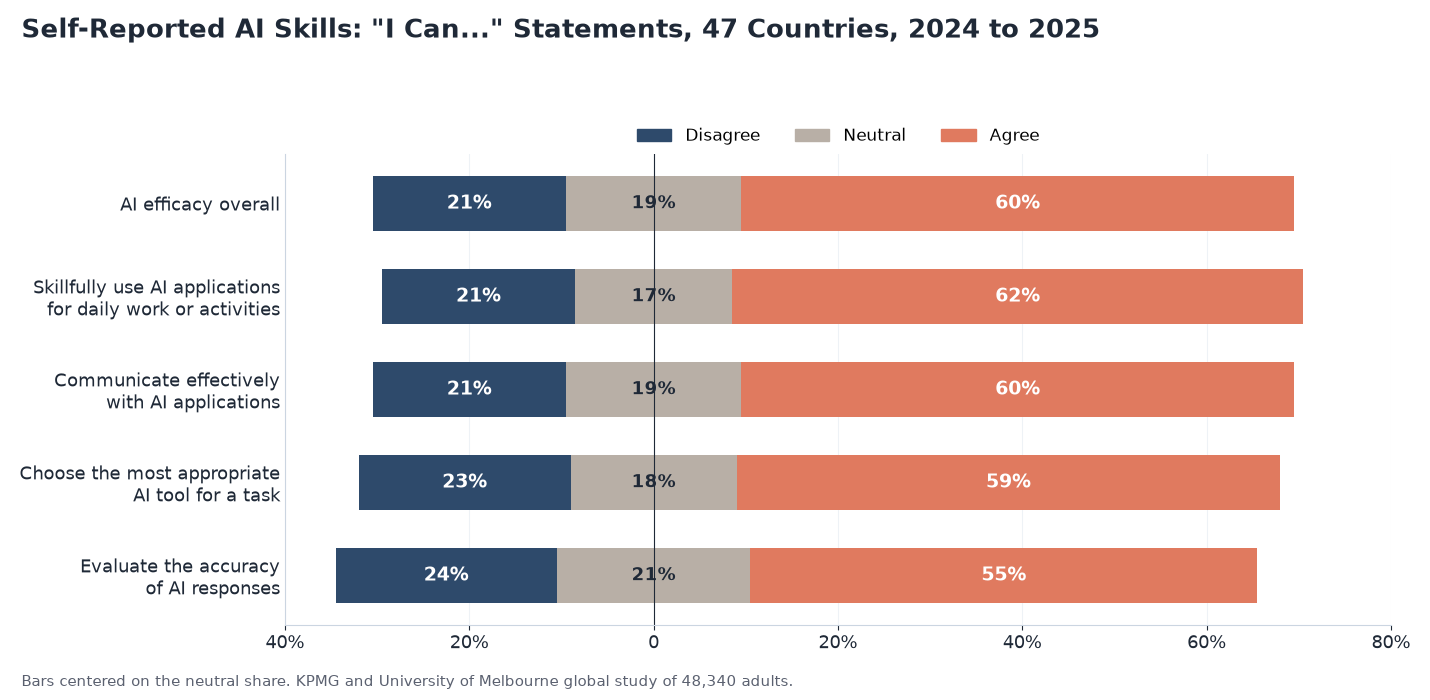
Source: AI Services Companies analysis of KPMG and University of Melbourne data, conducted November 2026.
Key Findings
- Checking AI output is the weakest skill: 55% of adults agree they can evaluate the accuracy of AI responses, the lowest of the four skills asked about.2
- Average self-reported AI knowledge did not change between 2022 and 2024 despite the spread of generative AI, though it rose in Estonia, Brazil, China, and South Africa.2
- Interest in learning about AI is lowest in Australia and Finland, where 41% report no or low interest.2
AI Literacy Is Higher in Emerging Economies Than in Advanced Ones
The same study split its 47 countries into 29 advanced economies and a group of emerging economies. We compared training, knowledge, and skills across the two groups.
| Measure | All 47 countries | Advanced economies | Emerging economies |
|---|---|---|---|
| AI-related training or education | 39% | 32% | 50% |
| Moderate or high AI knowledge | 52% | 46% | 64% |
| AI efficacy (believe they can use AI effectively) | 60% | 51% | 74% |
| Aware that common technologies use AI | n/a | 61% | 70% |
| Use common AI-enabled technologies | 79% | 74% | 88% |
Source: AI Services Companies analysis of KPMG and University of Melbourne data, conducted November 2026. Data: ai-literacy-by-economy-group-2025.csv
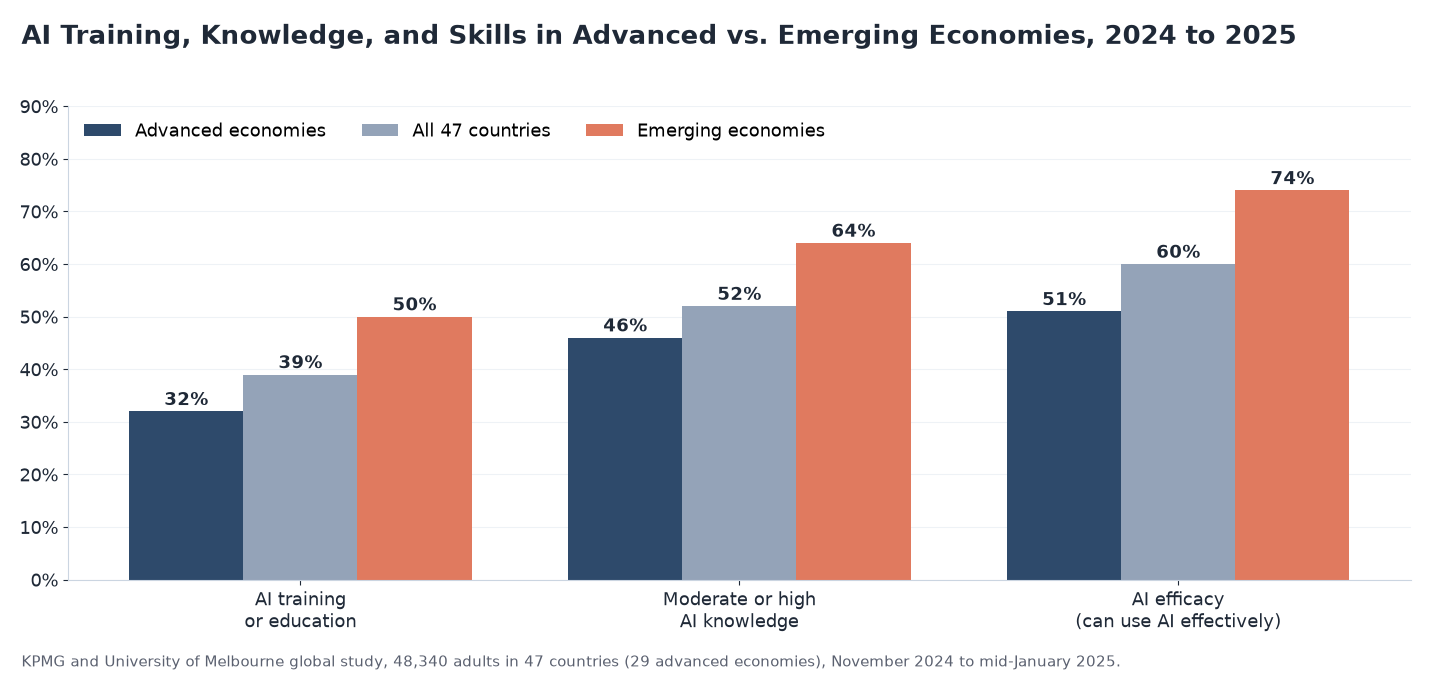
Source: AI Services Companies analysis of KPMG and University of Melbourne data, conducted November 2026.
Key Findings
- Half of adults in emerging economies report AI training or education, compared with fewer than a third in advanced economies.2
- AI training, knowledge, and skills are highest in Nigeria, Egypt, the United Arab Emirates, India, China, and Saudi Arabia, and AI training and knowledge are lowest in Germany, the Czech Republic, and Japan.2
- In most emerging economies, more than 90% of adults want to learn more about AI, while interest ranges from 59% to 67% in Australia, New Zealand, the US, Canada, the UK, Japan, and Finland.2
More Than a Third of Adults Do Not Know Common Apps Use AI
Knowing when AI is at work is a basic part of AI literacy. The global study asked people whether they use three common technologies and whether those technologies rely on AI. We collected the results alongside the item-level answers from Pew's US quiz.
| Technology or measure | Use it | Unaware it uses AI or answered incorrectly | Source |
|---|---|---|---|
| Three common technologies combined (47 countries) | 79% | 36% | KPMG and University of Melbourne, 2025 |
| Social media (47 countries) | 90% | 47% | KPMG and University of Melbourne, 2025 |
| Facial recognition (47 countries) | 69% | 38% | KPMG and University of Melbourne, 2025 |
| Virtual assistants (47 countries) | 77% | 22% | KPMG and University of Melbourne, 2025 |
| Social media, countries surveyed in 2022 and 2024 | 88% in both years | 44% (2022) vs. 46% (2024) | KPMG and University of Melbourne, 2025 |
| Wearable fitness trackers (US, 2022 quiz) | n/a | 32% (68% correct) | Pew Research Center |
| Customer service chatbots (US, 2022 quiz) | n/a | 35% (65% correct) | Pew Research Center |
| Product recommendations (US, 2022 quiz) | n/a | 36% (64% correct) | Pew Research Center |
| Facial recognition security cameras (US, 2022 quiz) | n/a | 38% (62% correct) | Pew Research Center |
| Music playlist recommendations (US, 2022 quiz) | n/a | 43% (57% correct) | Pew Research Center |
| Email spam filters (US, 2022 quiz) | n/a | 49% (51% correct) | Pew Research Center |
Source: AI Services Companies analysis of KPMG and University of Melbourne and Pew Research Center data, conducted November 2026. US quiz "unaware" figures are 100% minus the published correct share and include wrong answers, "not sure," and no answer. Data: ai-use-vs-awareness-common-technologies-2025.csv
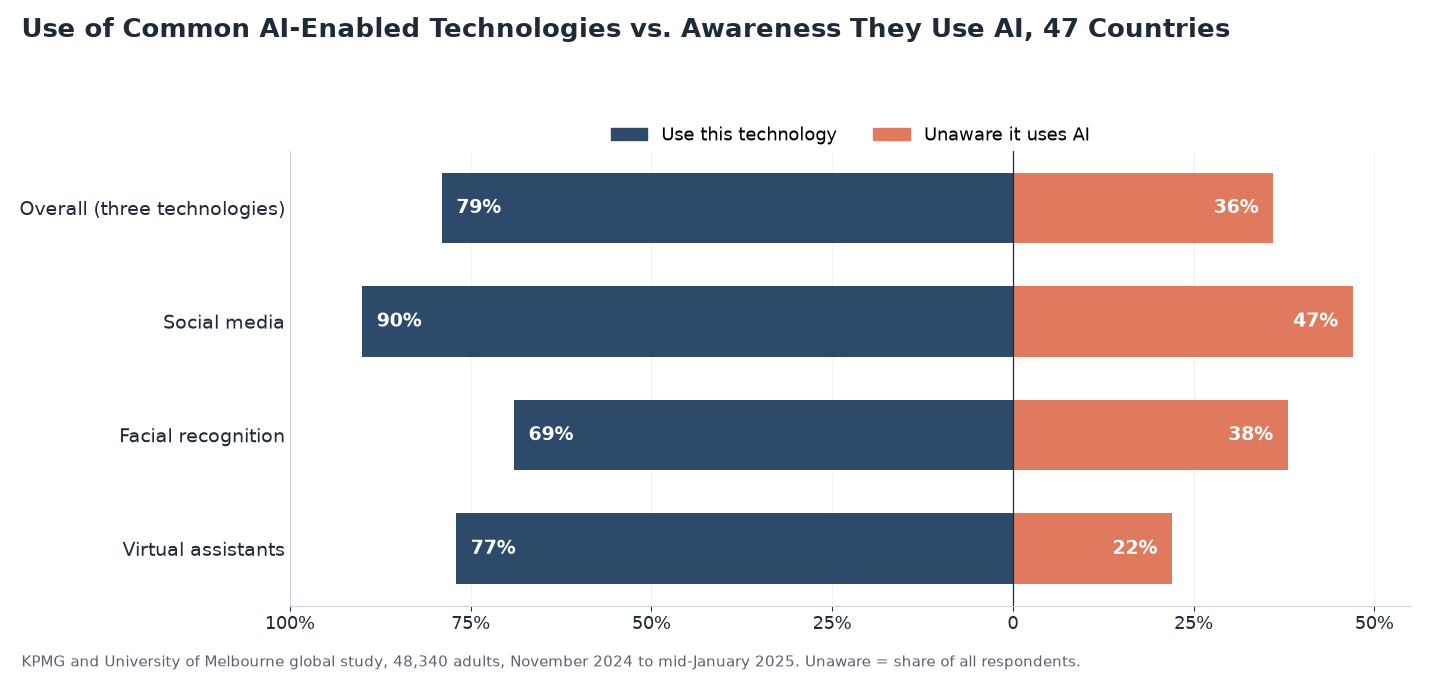
Source: AI Services Companies analysis of KPMG and University of Melbourne data, conducted November 2026.
Key Findings
- Social media has the widest gap: nine in ten adults use it, and almost half do not know it relies on AI.2
- Awareness that social media uses AI barely moved between 2022 and 2024, with the unaware share at 44% and then 46%.2
- Adults in emerging economies are more likely than those in advanced economies to know these technologies use AI (70% vs. 61%).2
Two-Thirds Say They Understand AI, but Only Half Know Where It Is Used
The Ipsos AI Monitor asks adults in 30 countries whether they have a good understanding of what AI is and whether they know which products and services use it. We collected every country's 2025 result, with the 2023 and 2024 results where Ipsos published them.
| Country | Good understanding of AI, 2025 | Good understanding, 2023 | Know which products use AI, 2025 | Know which products, 2023 |
|---|---|---|---|---|
| 30-country average | 67% | n/a | 52% | n/a |
| Indonesia | 91% | 84% | 84% | 76% |
| Thailand | 79% | 78% | 76% | 73% |
| South Africa | 77% | 78% | 58% | 60% |
| Peru | 76% | 73% | 61% | 65% |
| Mexico | 75% | 75% | 63% | 61% |
| Netherlands | 75% | 71% | 41% | 42% |
| Chile | 75% | 70% | 60% | 58% |
| Hungary | 74% | 73% | 41% | 37% |
| Singapore | 74% | 67% | 69% | 57% |
| Colombia | 73% | 73% | 54% | 53% |
| Türkiye | 73% | 73% | 67% | 71% |
| South Korea | 70% | 76% | 63% | 68% |
| Malaysia | 70% | 65% | 71% | 68% |
| India | 67% | 64% | 65% | 62% |
| Australia | 67% | 59% | 42% | 38% |
| Poland | 67% | 69% | 50% | 46% |
| Brazil | 66% | 74% | 56% | 62% |
| Argentina | 66% | 67% | 49% | 44% |
| United States | 66% | 67% | 44% | 35% |
| Spain | 66% | 66% | 44% | 46% |
| Sweden | 65% | 67% | 43% | 36% |
| Great Britain | 64% | 64% | 41% | 43% |
| Ireland | 64% | 58% | 43% | 36% |
| Canada | 59% | 59% | 39% | 38% |
| Belgium | 59% | 56% | 35% | 35% |
| Germany | 59% | 61% | 40% | 39% |
| France | 59% | 58% | 40% | 37% |
| Switzerland | 58% | n/a | 43% | n/a |
| Italy | 50% | 53% | 46% | 50% |
| Japan | 41% | 43% | 38% | 38% |
Source: AI Services Companies analysis of Ipsos AI Monitor 2025 data, conducted November 2026. Data: ai-understanding-vs-product-knowledge-by-country-2025.csv
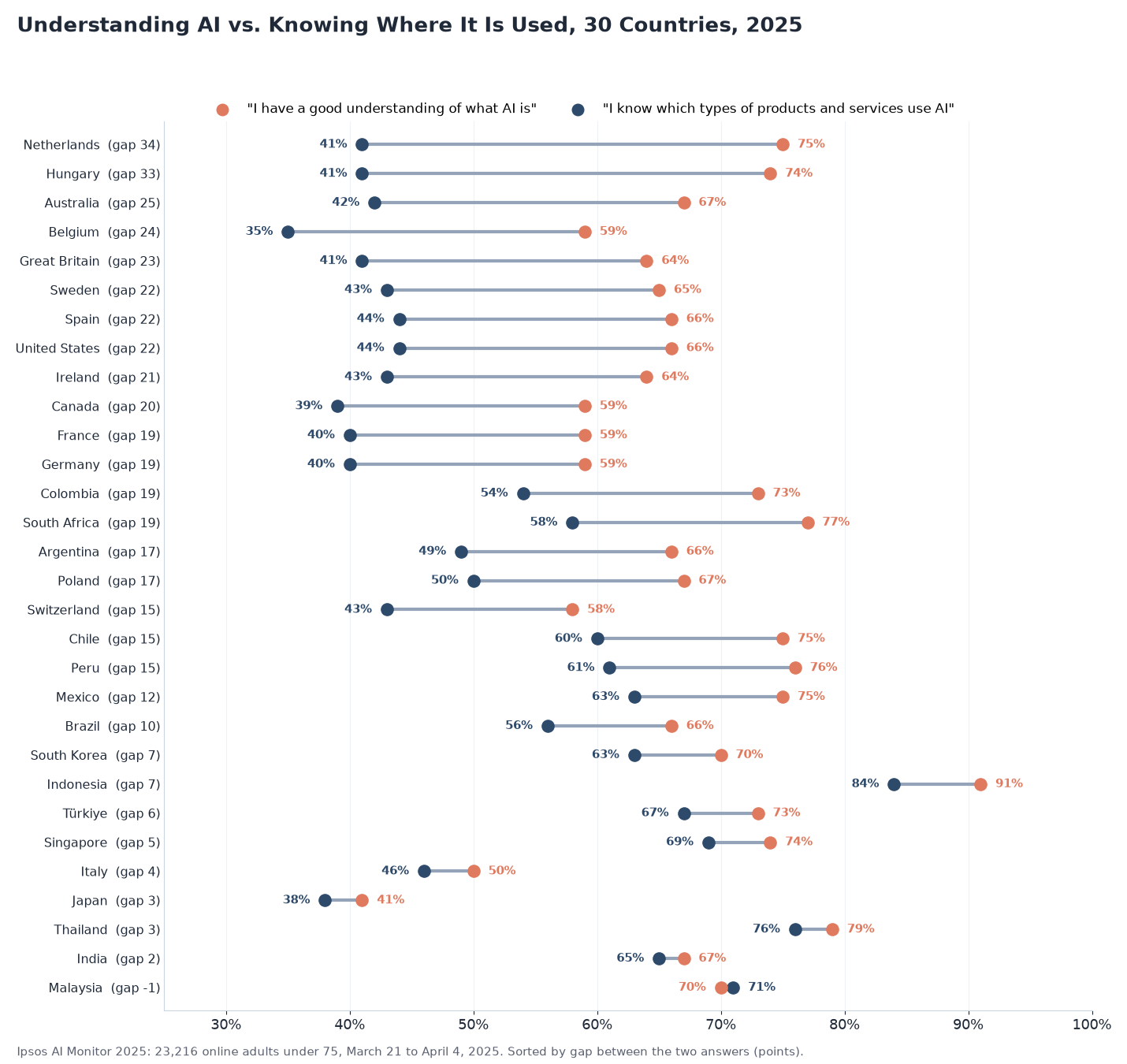
Source: AI Services Companies analysis of Ipsos data, conducted November 2026.
Key Findings
- Indonesia leads both measures, at 91% for understanding AI and 84% for knowing which products use it; Japan is lowest for understanding (41%) and Belgium for product knowledge (35%).7
- In 10 of 30 countries, the share who say they understand AI is at least 20 points higher than the share who know which products use it, led by the Netherlands (34 points) and Hungary (33 points).1,7
- US adults who say they know which products use AI rose from 35% in 2023 to 44% in 2025, while self-reported understanding stayed at 66% to 68%.7
58% of University Students Say They Lack Sufficient AI Knowledge
Most university students already use AI in their studies, which makes schools and universities central to AI literacy. We gathered student survey results on AI skills and on how well their institutions support them.
| Measure | Value | Source |
|---|---|---|
| University students who use AI in their studies (16 countries) | 86% | Digital Education Council, 2024 |
| Students who do not feel they have sufficient AI knowledge and skills | 58% | Digital Education Council, 2024 |
| Students who do not feel adequately prepared for an AI-enabled workplace | 48% | Digital Education Council, 2024 |
| Students who want universities to train students on effective use of AI tools | 72% | Digital Education Council, 2024 |
| Students who want universities to offer more AI literacy courses | 72% | Digital Education Council, 2024 |
| Students who want universities to train faculty on effective use of AI tools | 73% | Digital Education Council, 2024 |
| Students who say AI in their university does not fully meet expectations | 80% | Digital Education Council, 2024 |
| Students who regularly use AI in their studies (47 countries) | 83% | KPMG and University of Melbourne, 2025 |
| Students who say their institution supports them to understand AI systems | 57% | KPMG and University of Melbourne, 2025 |
| Students who say they have access to training and resources to use AI responsibly | 50% | KPMG and University of Melbourne, 2025 |
| Students who say there are policies for responsible AI use in learning and assessment | 46% | KPMG and University of Melbourne, 2025 |
Source: AI Services Companies analysis of Digital Education Council Global AI Student Survey 2024 and KPMG and University of Melbourne data, conducted November 2026.
Key Findings
- In the 47-country study, 2,499 students took part; half said they have access to training and resources to use AI responsibly, and 46% said their institution has policies on responsible AI use in learning and assessment.2
- Asked what matters most for a satisfying experience with AI at university, students most often chose 24/7 chatbot help (63%), followed by clear guidelines on AI use (46%) and training on their own AI skills (45%).8
- In the EU, national market surveillance authorities began supervising the AI Act's AI literacy obligation for providers and deployers on 2 August 2026; amendments that took effect in mid-July 2026 kept the obligation but set no specific required level.9
What AI Literacy Statistics Show Going Into 2027
Awareness of AI has spread faster than understanding of it. Nearly all US adults have heard of AI and half have heard a lot, yet across 47 countries average self-reported AI knowledge did not rise between 2022 and 2024, and more than a third of adults still do not know that apps they use every day rely on AI.1,2,3
Confidence also runs ahead of knowledge: more adults say they can use AI tools than say they know much about AI, and checking AI output for accuracy is the skill people feel least sure of.
Literacy is highest where AI use is highest, in emerging economies such as Nigeria, India, and China, and among younger, more educated, and higher-income adults. Students want more help: most use AI in their studies, but more than half say they lack sufficient AI knowledge.2,6,8
So if you cite an AI literacy statistic, say whether it measures awareness, tested knowledge, or self-rated skill, because "heard a lot about AI," "know which products use AI," and "can use AI effectively" produce very different numbers for the same population.
Data Collection and Methodology
We collected figures from published survey reports and official pages, opened on November 20, 2026. Global training, knowledge, efficacy, awareness, and student figures come from the full report of Trust, attitudes and use of artificial intelligence: A global study 2025 by the University of Melbourne and KPMG, an online survey of 48,340 adults in 47 countries fielded from November 2024 to mid-January 2025, including 2,499 students.
Values were read from the labeled figures in the report (Figures 3 to 8 and 59). Knowledge means feeling one knows about AI to a moderate or greater extent; efficacy means somewhat agreeing or more with the "I can" statements. The 2022 to 2024 comparisons use the countries the report surveyed in both waves.
US awareness figures come from Pew Research Center surveys on its American Trends Panel: 5,119 adults on February 17 to 23, 2026 (in 2026 the question dropped a short preamble), 5,023 adults on June 9 to 15, 2025, and 11,004 adults on December 12 to 18, 2022, for the six-question knowledge quiz.
Thirty-country figures come from the Ipsos AI Monitor 2025, an online survey of 23,216 adults under age 75 fielded March 21 to April 4, 2025; earlier-year values are the comparison columns Ipsos published.
Student figures also come from the Digital Education Council Global AI Student Survey 2024, with 3,839 responses from bachelor, master's, and doctoral students in 16 countries.
EU rules come from the European Commission's AI literacy questions and answers page. Point gaps and quiz "unaware" shares are our own arithmetic. No figures in this article are estimates, and survey questions differ, so results from different surveys should not be compared directly.
Sources (9)
- AI Services Companies analysis of AI literacy surveys from KPMG and the University of Melbourne, Pew Research Center, Ipsos, and the Digital Education Council, 2022 to 2026, conducted November 2026.
- Nicole Gillespie and colleagues, University of Melbourne and KPMG, Trust, attitudes and use of artificial intelligence: A global study 2025 (full report)
- Pew Research Center, Americans and AI 2026: What Do Americans Think AI Is? (June 17, 2026)
- Pew Research Center, AI in Americans' Lives: Awareness, Experiences and Attitudes (September 17, 2025)
- Pew Research Center, How Americans View AI and Its Impact on People and Society (September 17, 2025)
- Pew Research Center, Public Awareness of Artificial Intelligence in Everyday Activities (February 15, 2023)
- Ipsos, Ipsos AI Monitor 2025 (June 2025)
- Digital Education Council, Global AI Student Survey 2024: AI or Not AI: What Students Want
- European Commission, AI Literacy: Questions and Answers