
AI Skills Wage Premium Statistics 2026
Published November 9, 2026
Our analysts compared AI skills wage premium figures from PwC’s 2026 Global AI Jobs Barometer and its US, UK, Canada, Australia, and Singapore editions, which draw on more than one billion job ads; Lightcast’s analysis of US job postings; Levels.fyi compensation submissions; two Dice salary and job posting reports; and an Oxford Internet Institute study of more than 10 million UK vacancies, covering 2018 through mid 2026, to show how much more employers pay for AI skills as of Q4 2026.
Key Findings
- PwC puts the average wage premium for job ads that require AI skills at 61.9% in 2025, up from 56% in 2024 and 25% in 2023.
- In the US, PwC’s 2025 premium ranges from 150% in consumer markets to 24% in government and public sector jobs, with technology, media, and telecoms at 65%.
- US job postings that mention at least one AI skill advertise salaries 28% higher than comparable postings, about $18,000 a year, and 43% higher when they list two or more AI skills (Lightcast).
- The pay premium for US AI engineers over non-AI engineers rose with seniority in 2025, from 6.2% at entry level to 18.7% at staff level (Levels.fyi).
- The UK premium for specialist AI skills rose from 11% in 2024 to 34.2% in 2025 (PwC UK).
An AI skills wage premium is the extra pay an employer offers for a job that asks for AI skills, such as machine learning, prompt engineering, or working with generative AI tools, compared with a similar job that does not. Employers have added those requirements quickly since generative AI tools spread after 2022. Publishers measure it in different ways, from job ads across a whole economy to the pay of software engineers at the same level, so the published figures range from under 10% to more than 100%. We wanted to set the main figures side by side, with US data first, so each number can be read against the group it is compared with.
We took annual premiums and sector breakdowns from PwC’s June 2026 Barometer reports, which cover job ads through the end of 2025, and the prior-year figures from PwC’s June 2025 release. We added Lightcast’s July 2025 report on US postings, Levels.fyi’s July 2025 level-by-level comparison and its August 2026 analysis for Lets Data Science, Dice’s 2025 salary survey of 2,835 US tech workers and its January to May 2026 posting data, and the Oxford Internet Institute’s study of UK vacancies from 2018 to 2024. All premiums are shown as published percentages, and dollar figures are in US dollars.
In the following sections, we compare how the premium has changed since 2023, how it differs across US sectors, how the US compares with Canada, Australia, and other countries, what different measures show for specific roles, and how the premium for AI engineers changes with seniority.
The Average AI Skills Wage Premium More Than Doubled from 2023 to 2025
PwC has published its AI wage premium each year from the same job ad source, which gives a consistent series, and a UK edition and Levels.fyi’s engineer pay data show whether other measures moved the same way.
| Measure | Data year | Premium | Source |
|---|---|---|---|
| Global average, job ads requiring AI skills | 2023 | 25% | PwC 2025 Barometer |
| Global average, job ads requiring AI skills | 2024 | 56% | PwC 2025 Barometer |
| Global average, job ads requiring AI skills | 2025 | 61.9% | PwC 2026 Barometer |
| UK, specialist AI-skilled workers | 2024 | 11% | PwC UK 2026 Barometer |
| UK, specialist AI-skilled workers | 2025 | 34.2% | PwC UK 2026 Barometer |
| US L3 ML/AI engineers vs non-AI peers, median total compensation | Late 2024 | 34% | Levels.fyi |
| US L3 ML/AI engineers vs non-AI peers, median total compensation | Mid 2026 | 29% | Levels.fyi |
Source: AI Services Companies analysis of PwC 2025 Global AI Jobs Barometer release (June 3, 2025), PwC 2026 Global AI Jobs Barometer global findings, PwC UK 2026 AI Jobs Barometer (June 2026), and Levels.fyi analysis for Lets Data Science (August 26, 2026), conducted November 2026. Data: ai-wage-premium-over-time.csv
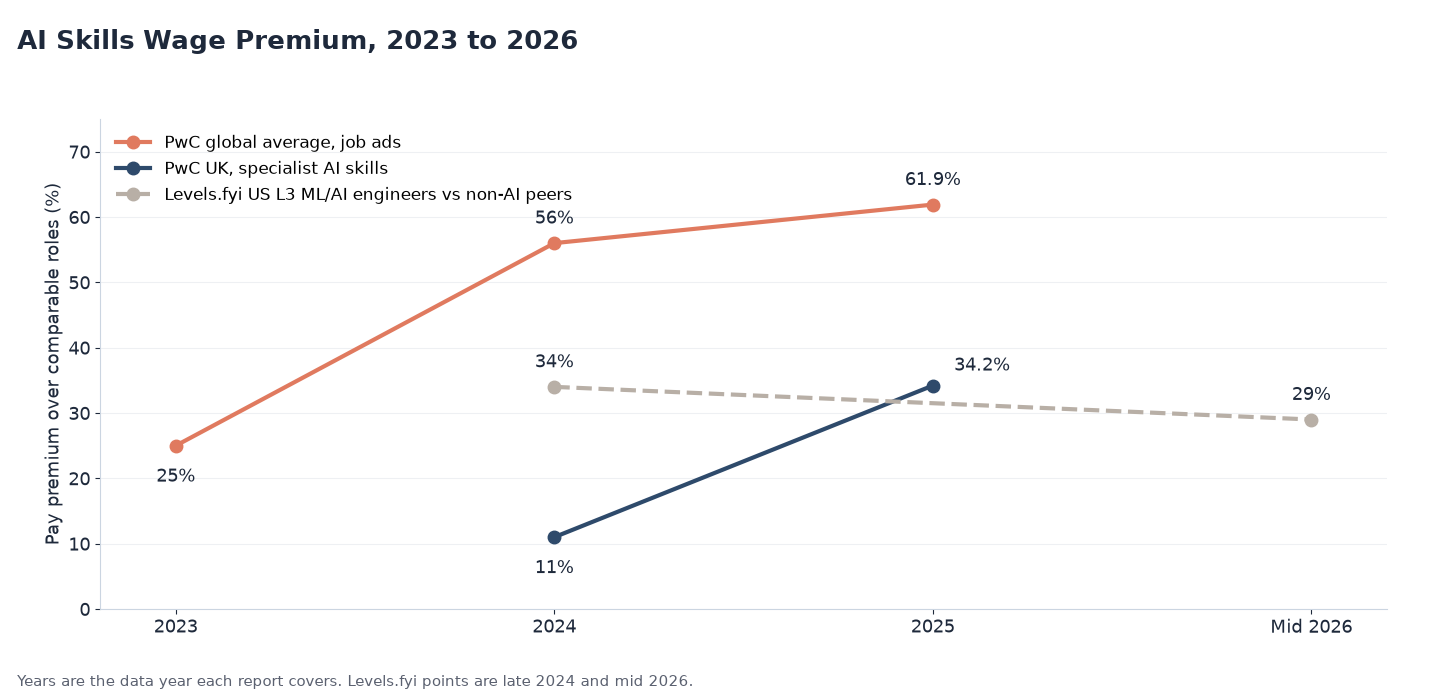
Source: AI Services Companies analysis of PwC Global AI Jobs Barometer editions and Levels.fyi compensation data, conducted November 2026.
Key Findings
- PwC’s 2026 report restates the 2024 average as 57%, so the latest yearly rise is about 5 points, against a 31-point jump from 2023 to 2024.
- Engineer pay compared at the same level moved the other way: a US L3 ML/AI engineer earned about $383,000 in median total compensation in mid 2026 against $297,000 for a non-AI peer, and Levels.fyi describes the series as flat for ML/AI engineers while non-AI pay catches up.
- The two series answer different questions. PwC compares job ads with and without AI skills inside each sector across the whole economy, while Levels.fyi compares software engineers at the same level, who were already among the highest-paid workers before AI skills were added.
Consumer Markets Pay the Largest US Premium for AI Skills
PwC’s US edition breaks the 2025 premium out across eight sectors, which shows where a requirement for AI skills lifts advertised pay the most for US employers.
| Sector | Premium in advertised pay |
|---|---|
| Consumer markets | 150% |
| Energy, utilities, and resources | 87% |
| Manufacturing | 78% |
| Technology, media, and telecoms | 65% |
| Professional services | 55% |
| Financial services | 54% |
| Health industries | 39% |
| Government and public sector | 24% |
Source: AI Services Companies analysis of PwC 2026 Global AI Jobs Barometer, US analysis, conducted November 2026. Data: us-ai-wage-premium-by-sector-2025.csv
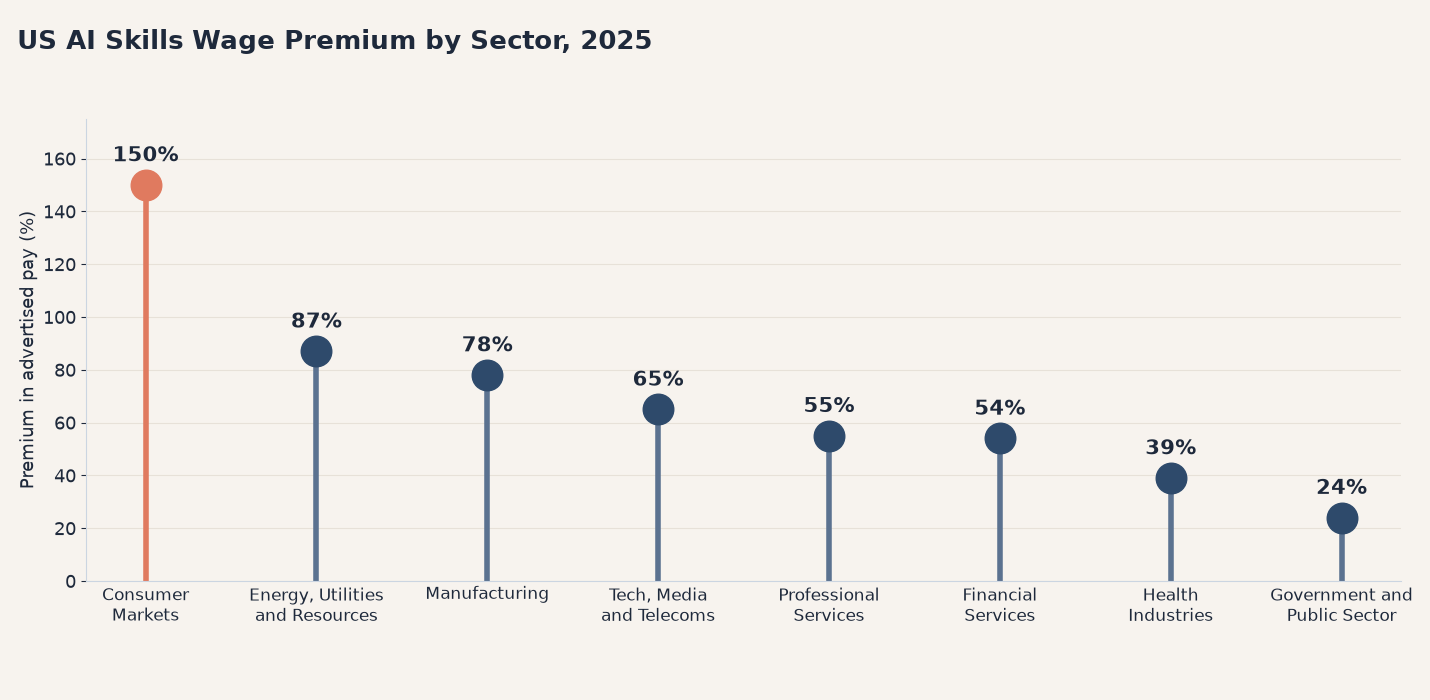
Source: AI Services Companies analysis of PwC 2026 US AI Jobs Barometer sector premiums, conducted November 2026.
Key Findings
- PwC describes the US pattern as U-shaped. Premiums are high in less AI-exposed sectors such as consumer markets, where AI skills are scarce, and in more exposed sectors such as technology, media, and telecoms, where AI skills are spread across the workforce.
- Worldwide, PwC’s 2025 sector premium reaches 118% in consumer markets, against an average of 61.9% across all 16 sectors it tracks.
- US job postings requiring AI skills rose 66% in 2025 to about 1.12 million, or 2.8% of all US postings. Government and public sector employers offer a 24% premium, while consumer and energy companies offer premiums three to six times as large.
AI Skills Premiums Run Higher in the US Than in Canada and Australia
PwC’s country editions use the same sectors, so setting the US beside Canada and Australia shows whether the size of the US premium is typical of other English-speaking job markets.
| Sector | United States | Canada | Australia |
|---|---|---|---|
| Consumer markets | 150% | 94% | 42% |
| Manufacturing | 78% | 42% | 57% |
| Technology, media, and telecoms | 65% | 59% | 59% |
| Financial services | 54% | 24% | 43% |
Source: AI Services Companies analysis of PwC 2026 AI Jobs Barometer US, Canada, and Australia reports, conducted November 2026. Data: ai-wage-premium-by-country-and-sector-2025.csv
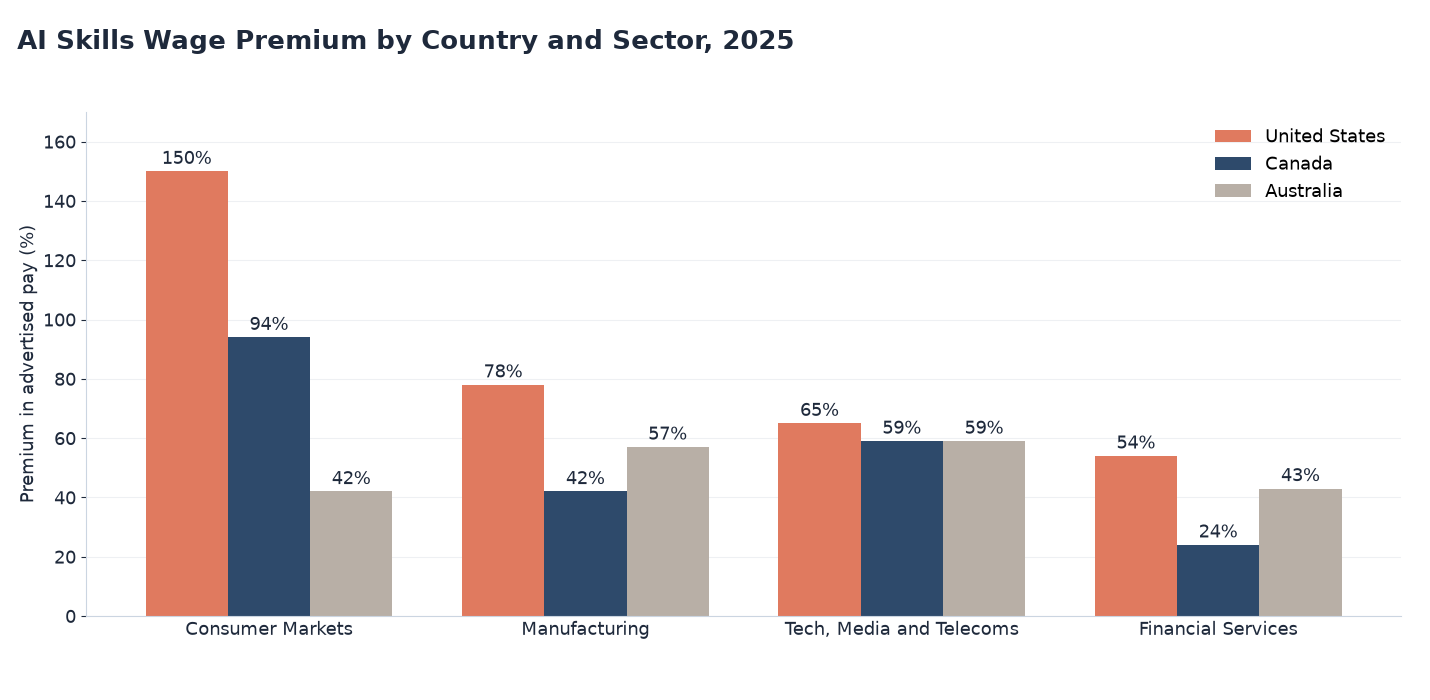
Source: AI Services Companies analysis of PwC 2026 AI Jobs Barometer country reports, conducted November 2026.
Key Findings
- The US premium is the highest of the three countries in all four sectors, and the widest gap is in consumer markets, where the US premium of 150% is more than three times Australia’s 42%.
- Outside North America and Australia, PwC UK reports a 34.2% average premium for specialist AI-skilled workers in 2025, and PwC Singapore reports premiums of at least 32% in every sector it analyzed, up to 107% in government and public sector jobs.
- Employers that set pay for AI roles in several of these countries face the closest premiums in technology, media, and telecoms, where all three are within 6 points, and the widest in consumer markets.
AI Pay Premiums for Specific Roles Range from 17.7% to 51%
Job ads across whole sectors are one way to measure the premium. Salary surveys, posted salaries for AI job titles, and compensation reported by US tech workers show how it looks for specific roles and comparison groups.
| Measure | Compared with | Premium | Period | Source |
|---|---|---|---|---|
| US ML/AI engineers at L3 | Data-focused engineers at L3, median total compensation ($367,398 vs $243,768) | 51% | Trailing year to mid 2026 | Levels.fyi |
| US job postings with two or more AI skills | Comparable postings without AI skills | 43% | 2024 postings | Lightcast |
| US ML engineers | Data scientists at the same level | About 40% | Two years to mid 2026 | Levels.fyi |
| US L3 ML/AI engineers | Non-AI peers at L3, median total compensation | 29% | Mid 2026 | Levels.fyi |
| US job postings with at least one AI skill | Comparable postings without AI skills | 28% | 2024 postings | Lightcast |
| UK vacancies requiring AI skills | Otherwise comparable vacancies | 23% | 2018 to 2024 | Oxford Internet Institute |
| US AI/ML job titles | Broader tech market, median advertised salary | 22% | January to May 2026 | Dice |
| US tech workers who design, develop, or implement AI | Tech peers not involved in AI work | 17.7% | 2024 survey | Dice |
Source: AI Services Companies analysis of Lightcast, Beyond the Buzz (July 2025), Levels.fyi analysis for Lets Data Science, University of Oxford (March 4, 2025), Dice, Tech Hiring Myths vs. Reality (2026), and Dice Tech Salary Report 2025, conducted November 2026. Data: ai-pay-premium-by-measure.csv
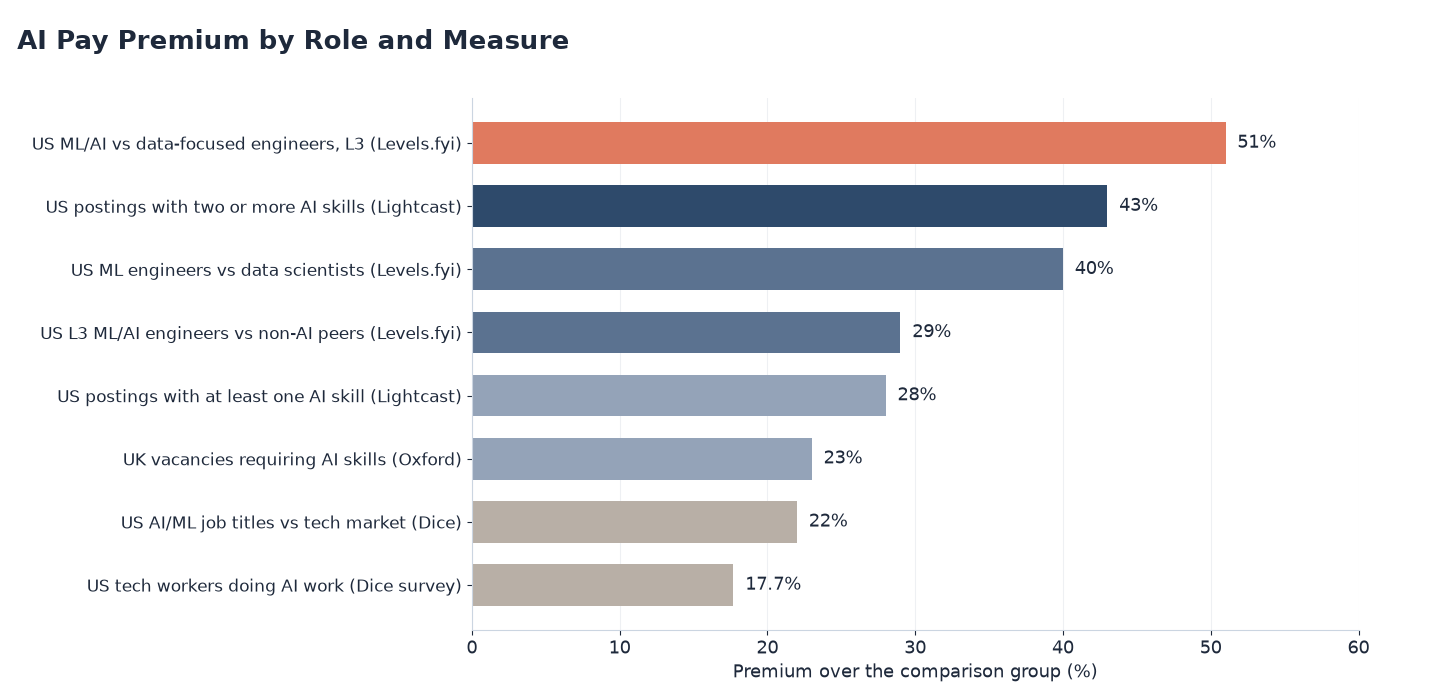
Source: AI Services Companies analysis of Lightcast, Levels.fyi, Oxford Internet Institute, and Dice data, conducted November 2026.
Key Findings
- Lightcast finds the three career areas with the largest AI premiums are customer and client support, sales, and manufacturing and production, all outside core technology work.
- Pay for ML/AI engineers is spreading out at the top. Levels.fyi found the ratio of 90th-percentile to median pay for ML/AI engineers widened from 2.06 to 2.23 over two years, while the ratio for the broader software population moved only from 1.99 to 2.06.
- The Oxford study puts the 23% AI skills premium in UK vacancies above the 13% premium for a master’s degree and below the 33% premium for a PhD. For employers budgeting an AI-focused tech hire, the 17.7% to 29% premiums from surveys, job titles, and same-level pay comparisons are a closer guide than economy-wide job ad averages.
The AI Engineer Pay Premium Grows with Seniority
Levels.fyi compares AI-focused software engineers with non-AI engineers at the same standard level, which shows how much of the premium a worker keeps as they move from entry level to staff roles.
| Level | 2024 | 2025 | Change (points) |
|---|---|---|---|
| Entry level engineer | 10.74% | 6.2% | -4.5 |
| Engineer | 11.6% | 11.9% | +0.3 |
| Senior engineer | 14.3% | 14.2% | -0.1 |
| Staff engineer | 15.8% | 18.7% | +2.9 |
Source: AI Services Companies analysis of Levels.fyi, AI Engineer Compensation Trends Q3 2025 (July 17, 2025), conducted November 2026. Data: ai-engineer-premium-by-seniority.csv
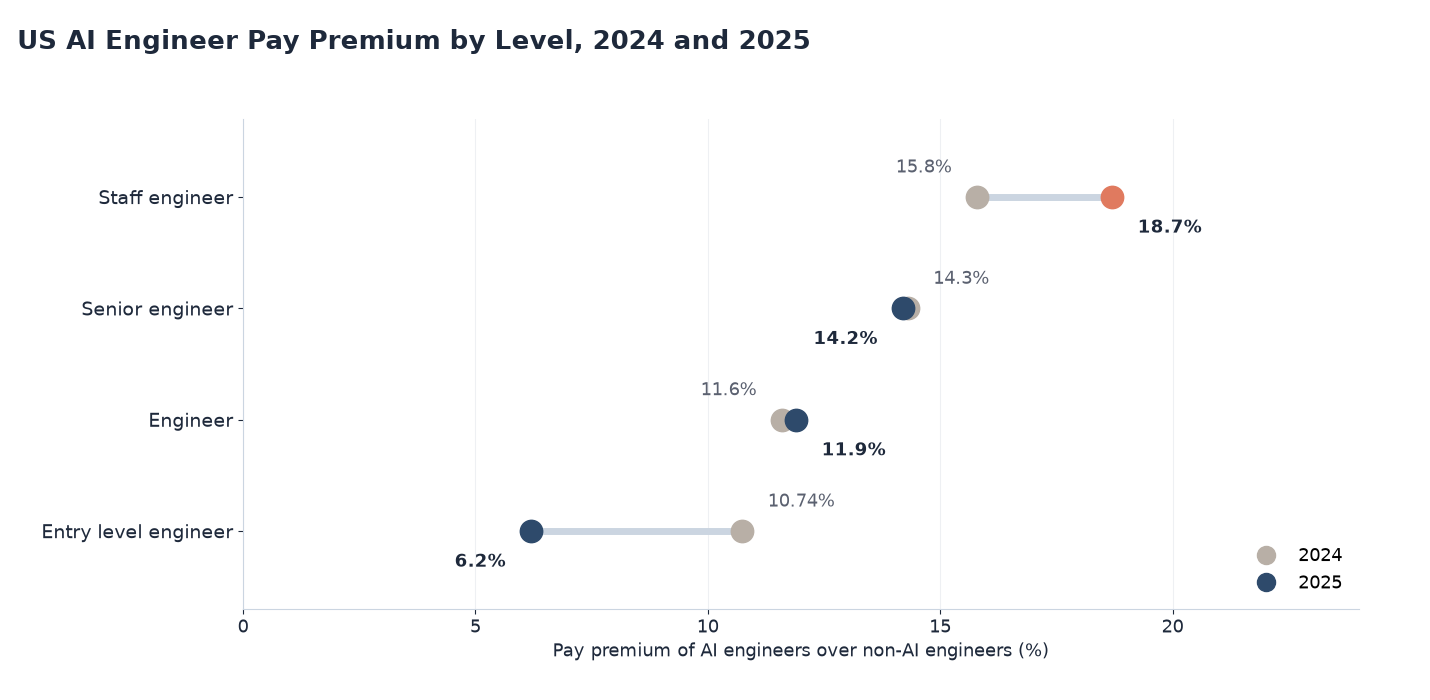
Source: AI Services Companies analysis of Levels.fyi AI engineer compensation data, conducted November 2026.
Key Findings
- AI-focused software engineers in the US earned $245,000 a year on average in Levels.fyi’s July 2025 data, and one of the widest company gaps Levels.fyi reported was at Intuit, where AI staff engineers earned close to $917,000 against about $515,000 for non-AI staff engineers.
- Demand is also tilting toward experience. Dice reports that postings for tech professionals with 10 or more years of experience grew 15% year over year in Q1 2026, while postings seeking 0 to 1 years remain 38% below 2019 levels.
- Entry-level AI engineers carried a smaller premium over non-AI peers in 2025 than in 2024, so most of the extra pay for AI skills now comes with experience. PwC finds that US entry-level roles highly exposed to AI that now ask for traditionally senior skills grew 35% from 2019 to 2025, while other entry-level roles in that group shrank 10%.
What the AI Skills Wage Premium Means in 2026
Jobs that ask for AI skills offer more pay in every industry PwC has analyzed. The extra pay is largest in US consumer, energy, and manufacturing companies, smaller in health and government work, and larger for experienced engineers than for new graduates.
AI skills are also becoming a standard part of technical jobs. Dice found that 73% of US tech job postings required at least one AI skill in May 2026, up from 15% in January 2024. As the requirement spreads, the premium for US engineers compared at the same level has stopped growing while job ad premiums across sectors are still rising. Our AI talent shortage statistics report covers how hard employers find these skills to hire, and our AI staff augmentation rates report shows what the same skills cost on contract.
So if you are citing an AI skills wage premium, pair the figure with its comparison: 61.9% for job ads worldwide in 2025, 28% for US job postings with one AI skill, and 6.2% to 18.7% for US AI engineers by level.
Data Collection and Methodology
PwC estimates its wage premium by splitting job postings in each sector into AI and non-AI roles, based on whether a posting requires at least one AI-related skill from the Lightcast AI skills taxonomy, and comparing average advertised salaries between the two groups. PwC states that these estimates do not control for education, experience, or location. The 61.9% global figure is the average across all 16 sectors in PwC’s scope. The 2023 (25%) and 2024 (56%) global figures come from PwC’s June 3, 2025 release; the 2026 global findings restate the 2024 figure as 57%. US, Canada, and Australia sector premiums come from PwC’s 2026 country reports for data year 2025. The UK figure covers specialist AI-skilled workers. Singapore figures come from PwC Singapore’s June 15, 2026 release, which covers about 1.6 million Singapore postings from 2025.
Lightcast’s premiums compare advertised salaries in US postings that mention at least one AI skill, or two or more, with postings that do not, using its US postings library of 1.3 billion postings. Levels.fyi’s level comparison (July 17, 2025) compares AI-focused software engineers with non-AI engineers at four standard levels in 2024 and 2025. Its analysis for Lets Data Science (August 26, 2026) uses US salary submissions and holds role and level constant; we converted its published ratios of about 1.34 and 1.29 to premiums of 34% and 29%. The 51% ML/AI versus data-focused engineer figure is calculated from the published L3 medians of $367,398 and $243,768.
Dice’s 17.7% figure comes from its 2024 salary survey of 2,835 employed US tech professionals, fielded August 30 to November 6, 2024, and compares those who design, develop, or implement AI with peers not involved in AI work. Dice’s 22% figure compares median advertised salaries for AI/ML job titles with the broader US tech market from January to May 2026. The Oxford Internet Institute study by Matthew Bone, Eugenia Ehlinger, and Fabian Stephany analyzed more than 10 million UK job vacancies from 2018 to 2024. Dollar figures are in US dollars as published. We calculated products, differences, and ratios from the published values.
Sources (16)
- AI Services Companies analysis of AI skills wage premium data from PwC, Lightcast, Levels.fyi, Dice, and the Oxford Internet Institute, conducted November 2026.
- PwC, 2026 Global AI Jobs Barometer: Global Report Findings (June 2026)
- PwC, 2026 Global AI Jobs Barometer: US Analysis (June 2026)
- PwC, 2026 Global AI Jobs Barometer: Canada Analysis (June 2026)
- PwC Australia, Two Futures for Australian Jobs in an AI Era (2026)
- PwC UK, 2026 AI Jobs Barometer (June 2026)
- PwC Singapore, AI Roles Command Wage Premiums across Sectors in Singapore (June 15, 2026)
- PwC, 2025 Global AI Jobs Barometer press release (June 3, 2025)
- Lightcast, Beyond the Buzz: The AI Skills That Make a Difference (July 2025)
- Levels.fyi, AI Engineer Compensation Trends Q3 2025 (July 17, 2025)
- Lets Data Science, Levels.fyi Tells LDS the AI Pay Premium Has Stopped Growing (August 26, 2026)
- Dice, Tech Hiring Myths vs. Reality (2026)
- Dice, Tech Salary Report 2025
- University of Oxford, Skills-Based Hiring Driving Salary Premiums in AI Sector (March 4, 2025)
- AI Services Companies, AI Talent Shortage Statistics 2026
- AI Services Companies, AI Staff Augmentation Rates 2026