
AI Talent Shortage Statistics 2026
Published November 4, 2026
Our analysts reviewed ManpowerGroup’s 2026 survey of 39,063 employers in 41 countries, including more than 6,000 in the US, Lightcast’s 2025 job posting figures from the Stanford AI Index 2026, US Bureau of Labor Statistics projections for 2025 to 2035, PwC’s 2026 AI Jobs Barometer, and the team sizes of the 96 AI services firms we review, to show how short the supply of AI talent is as of Q4 2026 and how large the firms that supply AI engineers to other companies are.
Key Findings
- 69% of US employers report difficulty finding the talent they need in 2026, from 61% at companies with fewer than 10 employees to 76% at companies with 1,000 to 4,999 (ManpowerGroup).
- AI model and application development (20%) and AI literacy (19%) are now the hardest skills for employers to find worldwide, and IT and data skills fell to seventh place (ManpowerGroup, 2026).
- AI skills appear in 2.5% of US job postings in 2025, up 55% from 2024 (Lightcast, Stanford AI Index 2026).
- The BLS projects data scientist jobs to grow 35% from 2025 to 2035, against 3% for all occupations, and their median wage was $120,230 in May 2025.
- 62 of the 87 AI services firms we review that publish a team size (71.3%) have fewer than 250 people, and all 7 with 1,000 or more are based in the US.
A talent shortage means employers cannot find enough people with the skills they need at the pay they can offer. Demand for AI skills has grown quickly since generative AI tools reached the workplace, and employers now report trouble hiring both the engineers who build AI systems and staff who can use AI tools well. Companies respond by training their own people, raising pay, or bringing in outside firms that already employ AI engineers. We wanted to know how deep the shortage runs, especially in the US, and how much capacity those outside firms have. The answers differ by company size, by skill, and by country.
Our analysts collected employer survey results from ManpowerGroup’s 2026 Talent Shortage Survey, using both its US report and its global release. We added Lightcast’s 2025 job posting figures from its summary of the Stanford AI Index 2026, employment projections and wages for three AI-related occupations from the BLS Occupational Outlook Handbook, and wage premium figures from PwC’s 2026 AI Jobs Barometer. We then read the size entry of all 96 AI services firm reviews published as of November 3, 2026, and grouped the firms by headcount.
In the following sections, we compare hiring difficulty among US employers by company size, the skills employers find hardest to hire worldwide, AI skills in job postings by country, federal projections for AI-related occupations, and the team sizes of AI services firms.
Larger US Employers Report the Most Difficulty Filling Roles
ManpowerGroup asks employers every year how much difficulty they have filling roles, and its US report breaks the answer down by company size, which shows where competition for skilled people is strongest.
| Company size | Share of US employers reporting difficulty filling roles |
|---|---|
| Fewer than 10 employees | 61% |
| 10 to 49 employees | 66% |
| 50 to 249 employees | 69% |
| 250 to 999 employees | 74% |
| 1,000 to 4,999 employees | 76% |
| 5,000 or more employees | 75% |
| All US employers | 69% |
Source: ManpowerGroup, 2026 U.S. Talent Shortage Survey, fieldwork October 2025. Data: us-employers-reporting-hiring-difficulty-by-company-size.csv
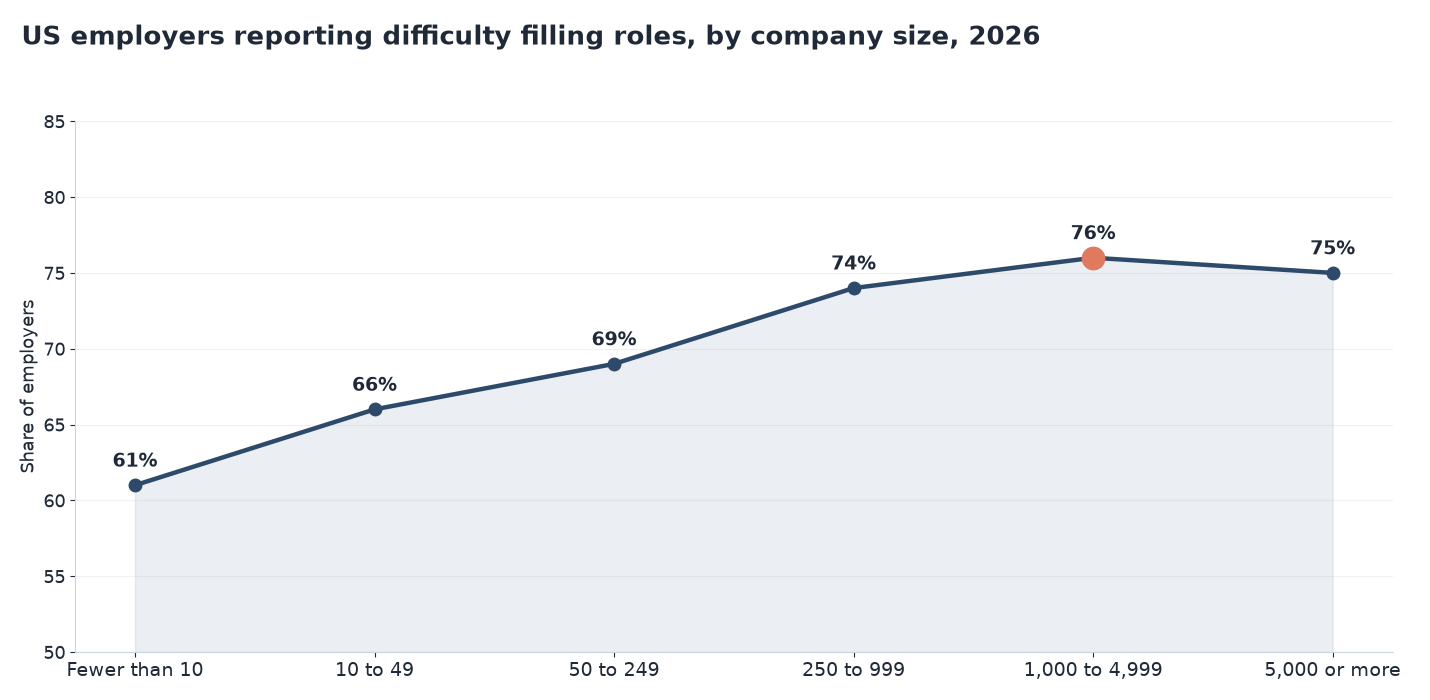
Source: ManpowerGroup, 2026 U.S. Talent Shortage Survey, fieldwork October 2025.
Key Findings
- Hiring difficulty eased slightly in the US, from 71% of employers in 2025 to 69% in 2026, just below the global average of 72%. Employers in Germany (83%) and the UK (73%) report more difficulty, and those in China (48%) the least of the 41 countries.
- Manufacturing employers report the most difficulty in the US, at 75%, followed by the information industry and professional, scientific, and technical services, both at 72%. AI literacy ranks fourth on the list of hard skills US employers find hardest to hire, after operations and logistics, sales and marketing, and front-office and customer-facing skills.
- US employers most often respond by upskilling and reskilling current employees (27%), increasing wages (25%), and expanding talent pools (24%). Fewer turn to outside help: 10% outsource functions completely, and 9% source talent globally from cost-effective markets.
AI Skills Are Now the Hardest Skills for Employers to Find Worldwide
The same survey asks employers which hard skills are the most difficult to find, and the 2026 ranking shows where AI skills now stand against engineering, IT, and other skills.
| Hard skill | Share of employers | Rank |
|---|---|---|
| AI model and application development | 20% | 1 |
| AI literacy | 19% | 2 |
| Engineering | 19% | 3 |
| Sales and marketing | 18% | 4 |
| Manufacturing and production | 17% | 5 |
| IT and data | 17% | 7 |
Source: ManpowerGroup, 2026 Talent Shortage Survey global release, February 26, 2026. Data: hardest-skills-for-employers-to-find-2026.csv
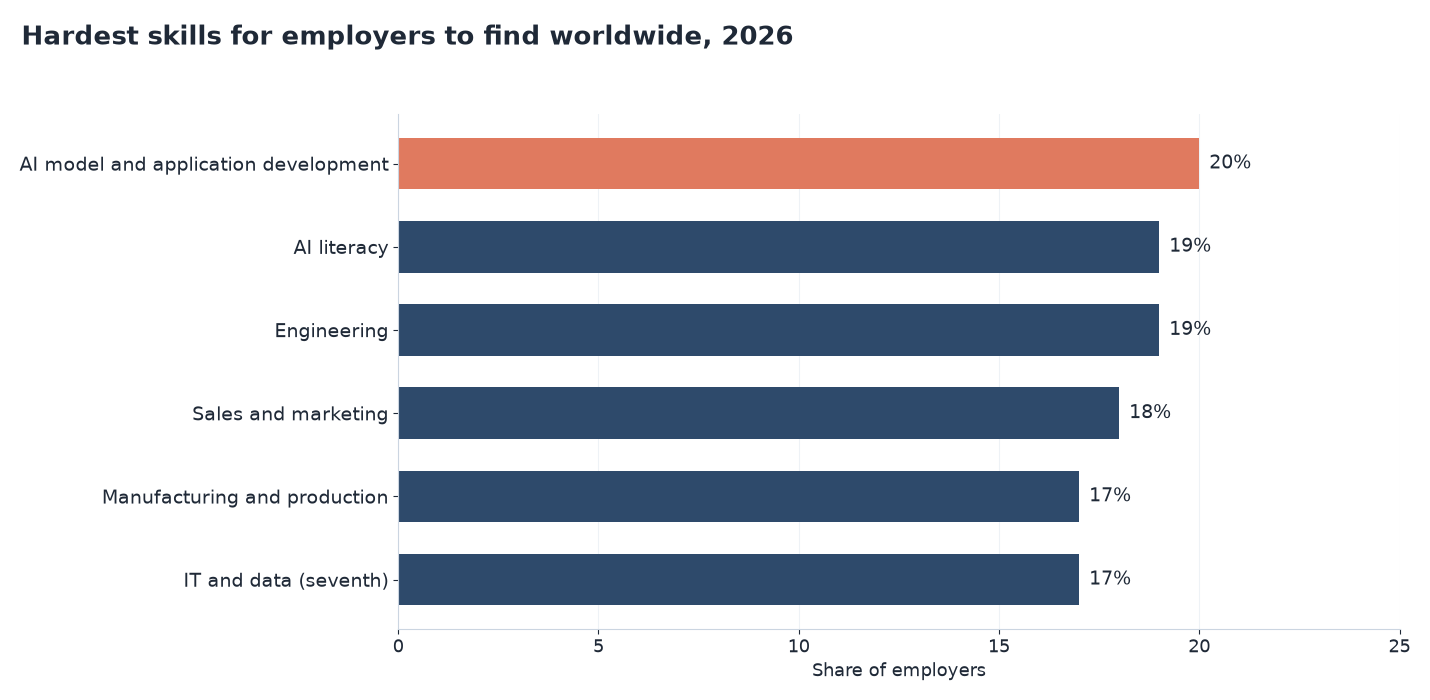
Source: ManpowerGroup, 2026 Talent Shortage Survey global release, February 26, 2026.
Key Findings
- ManpowerGroup says 2026 is the first year AI skills have topped its list of the hardest skills to find worldwide, overtaking engineering and IT. IT and data skills fell to seventh place, at 17%.
- Employers also rank the soft skills they need most: communication, collaboration, and teamwork (39%), professionalism and work ethic (36%), and adaptability and willingness to learn (34%). Our employee AI training statistics cover how many US workers get AI training from their employers.
- ManpowerGroup’s chief executive, Jonas Prising, said companies “will need to hire for potential” while “building AI literacy across their workforce.” For employers, that means hiring people who can learn AI skills on the job, because AI model and application development is the skill they find hardest to hire.
AI Skills Appear in a Growing Share of Job Postings
Job postings show what employers are trying to hire, so Lightcast’s count of postings that mention AI skills is a direct measure of demand, and it lets us compare the US with other countries.
| Country or territory | Share of job postings mentioning AI skills |
|---|---|
| Singapore | 4.7% |
| Hong Kong | 3.5% |
| Luxembourg | 3.4% |
| Spain | 3.3% |
| United States | 2.6% |
| Chile | 2.4% |
| United Kingdom | 1.9% |
Source: Lightcast, The Stanford AI Index Report 2026, 2025 job postings. Data: job-postings-mentioning-ai-skills-by-country-2025.csv
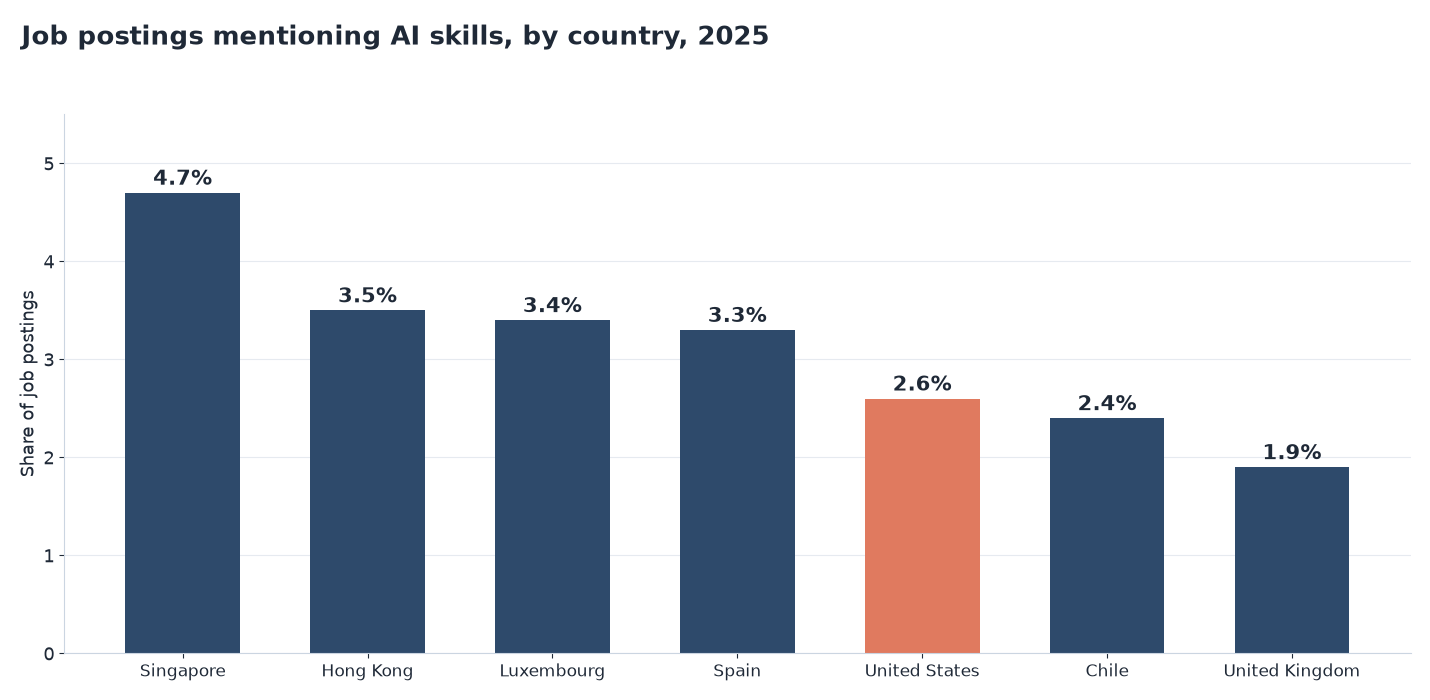
Source: Lightcast, The Stanford AI Index Report 2026, 2025 job postings.
Key Findings
- In the US, the share of job postings that mention AI skills rose 55% in one year, 72% since 2022, and 297% over a decade, reaching 2.5% in Lightcast’s headline figure for 2025.
- US demand is concentrated in a few states. California had 170,881 AI job postings in 2025 (17.18% of the US total), Texas 80,547 (8.10%), and New York 66,029 (6.64%). Washington, D.C., has the highest concentration, with AI skills in 6.18% of its postings.
- Employers are starting to hire for AI agents. Postings in Lightcast’s new agentic AI skill cluster rose from 0.06% of US postings in 2024 to 0.23% in 2025, about 90,000 postings, and Python was the most requested specialized skill, in 258,674 postings. Our AI coding productivity statistics cover how AI tools change developer output.
Federal Projections Show AI-Related Jobs Growing Far Faster Than Average
The BLS projects employment for hundreds of US occupations over ten years and publishes current wages, so we compared three occupations that do much of the work of building AI systems with all computer jobs and the workforce as a whole.
| Occupation | Jobs, 2025 | Projected jobs, 2035 | Projected growth, 2025 to 2035 | Openings per year | Median annual wage, May 2025 |
|---|---|---|---|---|---|
| Data scientists | 275,600 | 371,000 | 35% | 24,800 | $120,230 |
| Computer and information research scientists | 38,600 | 47,000 | 22% | 2,900 | $140,300 |
| Software developers | 1,717,800 | 1,892,600 | 10% | Not published separately | $135,980 |
| All computer occupations | Not shown | Not shown | 6% | Not shown | $109,470 |
| All occupations | Not shown | Not shown | 3% | Not shown | $50,980 |
Source: AI Services Companies analysis of US Bureau of Labor Statistics Occupational Outlook Handbook pages for data scientists, computer and information research scientists, and software developers, conducted November 2026. Data: ai-related-occupations-projections-and-wages.csv
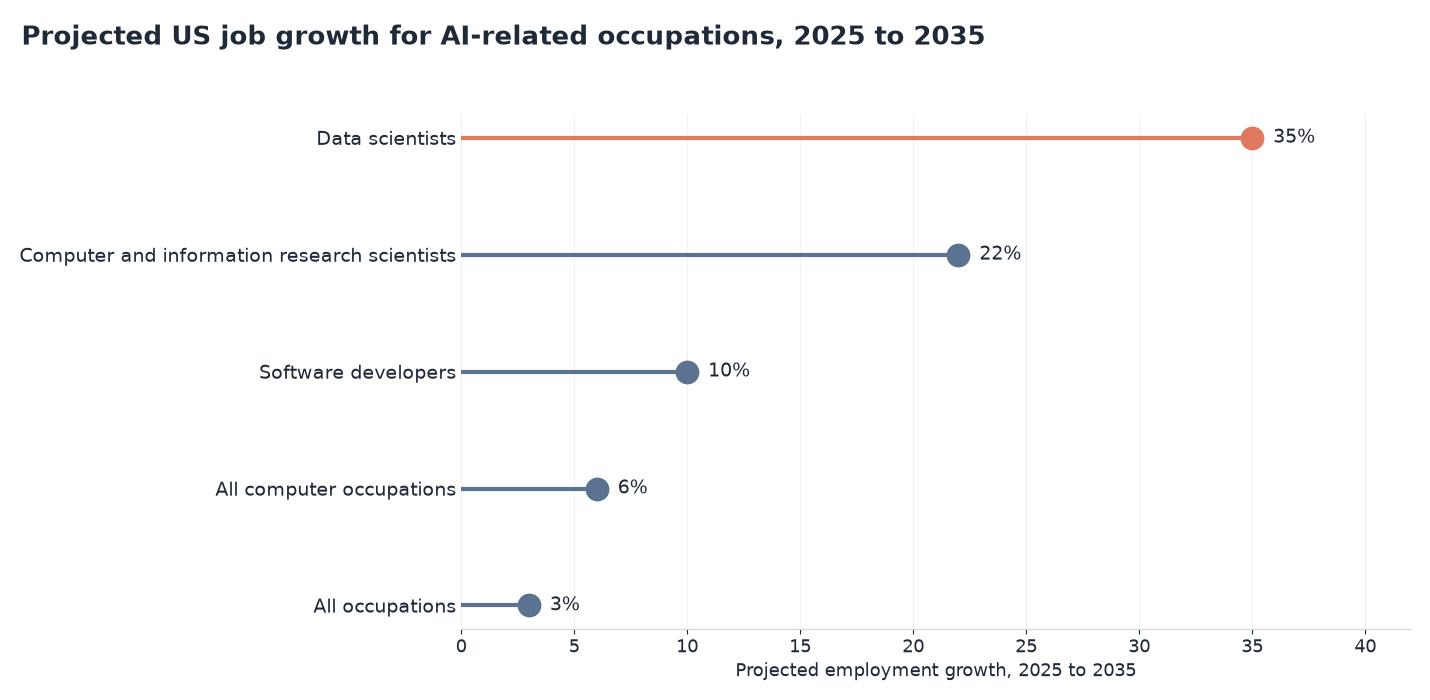
Source: AI Services Companies analysis of US Bureau of Labor Statistics Occupational Outlook Handbook pages for data scientists, computer and information research scientists, and software developers, conducted November 2026.
Key Findings
- Data scientists are the fastest-growing of the three occupations, with 95,400 more jobs projected by 2035 and about 24,800 openings a year. Their median wage of $120,230 is more than twice the $50,980 median for all US workers.
- Computer and information research scientists, whose expertise the BLS says will be needed to create new AI technologies, have the highest median wage of the three, at $140,300. It is a small field of 38,600 jobs, and 31% of them are in the federal government.
- Pay for AI skills is rising with demand. PwC’s 2026 AI Jobs Barometer, which analyzed more than one billion job ads in 27 countries and territories, found an average wage premium of 62% for AI skills, up from 57% a year earlier. The premium is as high as 118% in some sectors, such as consumer markets, and 16% in government and public sector work.
Most AI Services Firms Have Fewer Than 250 People
Companies that cannot hire AI engineers fast enough often bring in an outside firm, so we checked how large the teams are at the 96 AI services firms we review and where the largest ones are based.
| Team size | All 96 firms | Share of 96 firms | 62 US-based firms | 34 other firms |
|---|---|---|---|---|
| Fewer than 50 | 20 | 20.8% | 9 | 11 |
| 50 to 249 | 42 | 43.8% | 22 | 20 |
| 250 to 999 | 18 | 18.8% | 16 | 2 |
| 1,000 or more | 7 | 7.3% | 7 | 0 |
| Not published in a comparable form | 9 | 9.4% | 8 | 1 |
Source: AI Services Companies analysis of the team sizes listed in 96 AI services firm reviews, conducted November 2026. Data: team-sizes-of-ai-services-firms.csv
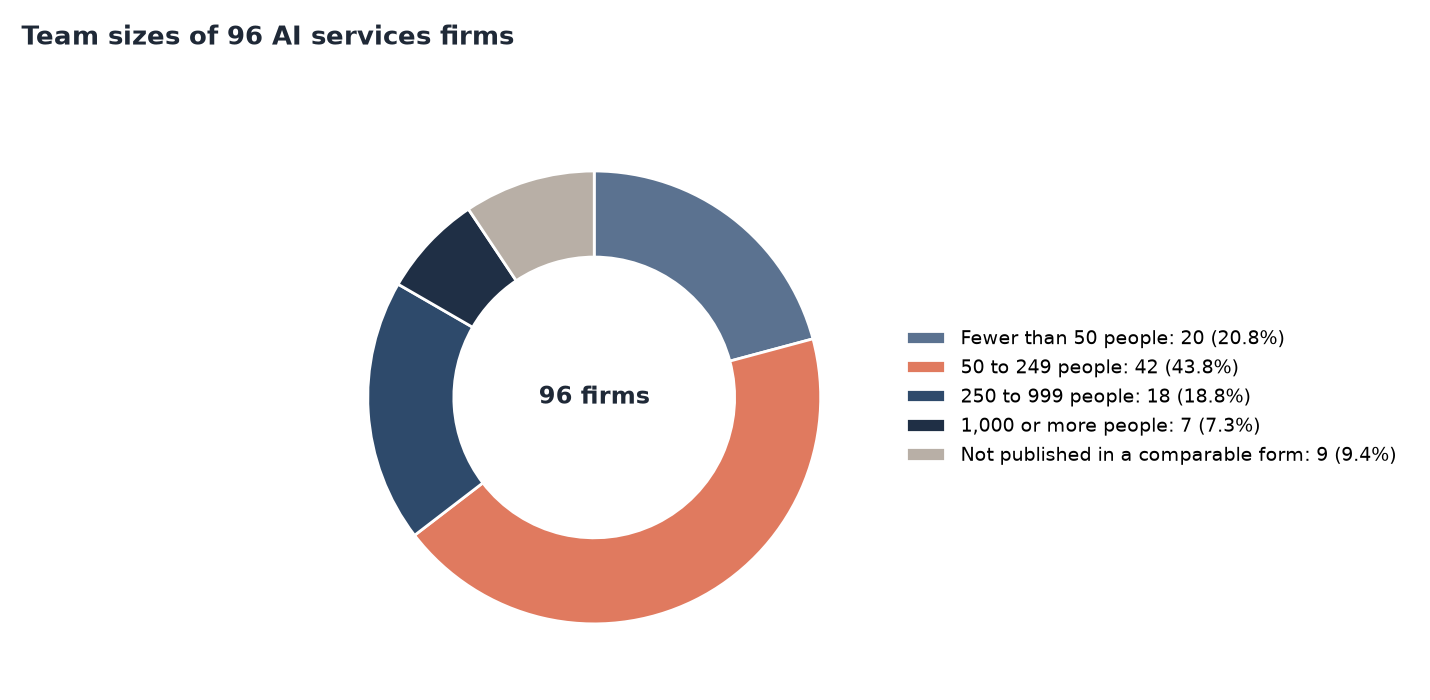
Source: AI Services Companies analysis of the team sizes listed in 96 AI services firm reviews, conducted November 2026.
Key Findings
- 62 of the 87 firms that publish a team size (71.3%) have fewer than 250 people, and 20 have fewer than 50, such as Xyonix, with 2 to 9 employees, and MindTitan, with 14.
- All 7 firms with 1,000 or more people are headquartered in the US, among them BairesDev, with more than 4,000 engineers, and Neurealm, with an estimated 3,000 to 4,000 employees. Among the other 34 firms, 31 of the 33 that publish a size have fewer than 250 people.
- A company short of AI engineers can bring in a firm of almost any size, from teams of fewer than 10 people to firms with thousands. Our AI consultant use statistics show which client sizes and industries these firms serve, and our AI consulting market size report compares estimates of the market they compete in.
What AI Talent Shortage Statistics Mean for Companies Hiring AI Skills
AI skills have become the hardest skills for employers to find, and US employers with 250 or more staff report the most trouble hiring. Pay reflects that, and jobs that require AI skills now pay a large premium.
Training current staff is the most common response, and a smaller share of employers bring in outside firms. The AI services firms that offer that help are mostly small, and the largest are concentrated in the US.
So if you need AI skills for a project and cannot hire them in time, compare the cost of training your own staff with the cost of a firm whose team size fits the project.
Data Collection and Methodology
The study covers four outside sources and our own review data. ManpowerGroup interviewed 39,063 employers in 41 countries from October 1 to 31, 2025, and released the global results on February 26, 2026. Its US report covers more than 6,000 US employers and publishes the US hard-skill ranking without percentages. The global hard-skill shares are the shares of employers who said each skill was among the most difficult to find; ManpowerGroup does not publish the skill ranked sixth in its release. Lightcast’s figures come from its summary of its contribution to the Stanford AI Index 2026 and count job postings that mention at least one of the more than 300 AI skills it tracks. Lightcast gives 2.5% as its headline US share and 2.6% in its country comparison, and we report each as published.
BLS projections cover 2025 to 2035 and wages are May 2025 medians from the Occupational Employment and Wage Statistics program, as shown on Occupational Outlook Handbook pages last modified August 27, 2026. The BLS publishes openings per year for software developers only together with quality assurance analysts and testers (106,100), so we do not show a separate figure. PwC’s 2026 AI Jobs Barometer analyzed more than one billion job ads in 27 countries and territories; we use the figures in PwC’s July 13, 2026 press release.
Our own data: we read the size entry in the facts panel of all 96 AI services firm reviews published as of November 3, 2026. For a range we used the midpoint, and for “about”, “more than”, or “X+” figures we used the number given. Mactores is counted at its LinkedIn range of 51 to 200 employees, Brainpool AI at 10 to 49 employees without its network of more than 500 specialists, and Mosaic Data Science at about 20 people, the number on its team page. Nine firms do not publish a size in a comparable form: seven publish none, Enthought gives only “under 100 employees”, and Tribe AI gives only a network of more than 500 contractors. Some sizes in our reviews are estimates, and we count them as listed. 62 firms are headquartered in the US, and the other 34 include 1 that does not publish a headquarters.
We calculated shares, ratios, and differences from the counts and published values, including the 71.3% of firms with a published size that have fewer than 250 people and the ratio of the data scientist median wage to the all-occupations median (2.36, described as more than twice). This article contains no estimates of our own.
Sources (12)
- AI Services Companies analysis of ManpowerGroup, Lightcast, BLS, and PwC labor data and the team sizes of 96 AI services firms, conducted November 2026.
- ManpowerGroup, 2026 U.S. Talent Shortage Survey (2026)
- ManpowerGroup, Global Talent Shortage Reaches Turning Point as AI Skills Claim Top Spot (February 26, 2026)
- Lightcast, The Stanford AI Index Report 2026 (2026)
- US Bureau of Labor Statistics, Occupational Outlook Handbook: Data Scientists (August 27, 2026)
- US Bureau of Labor Statistics, Occupational Outlook Handbook: Computer and Information Research Scientists (August 27, 2026)
- US Bureau of Labor Statistics, Occupational Outlook Handbook: Software Developers, Quality Assurance Analysts, and Testers (August 27, 2026)
- PwC Indonesia, AI reshapes global labour market into two distinct paths, rewarding human skills (July 13, 2026)
- AI Services Companies, AI Consultant Use Statistics 2026
- AI Services Companies, AI Consulting Market Size 2026
- AI Services Companies, Employee AI Training Statistics 2026
- AI Services Companies, AI Coding Productivity Statistics 2026