
Chief AI Officer Statistics 2026
Published November 2, 2026
Our analysts compared four executive surveys published between June 2024 and May 2026, which together reached more than 9,800 leaders and organizations, with two 2026 counts of chief AI officer titles at the largest US companies, to show how many companies have a chief AI officer as of Q4 2026, which industries appoint one, and what the role controls.
Key Findings
- 24 of the 2026 Fortune 500 (4.8%) have an enterprise-wide executive titled Chief AI Officer, and 54 (10.8%) do when combined titles such as Chief Data and AI Officer are counted (ProfessionLens, September 2026).
- 71 of 665 Fortune 500 and S&P 500 companies (10.7%) have a chief AI officer or an equivalent title, led by healthcare companies at 18.5% (Crist Kolder Associates, August 2026).
- 76% of organizations in IBM’s 2026 survey of 2,000 CEOs have a chief AI officer, up from 26% in IBM’s 2025 study and 11% in 2023.
- 57% of chief AI officers report directly to the CEO or board, and 61% control their organization’s AI budget (IBM, 2025).
- Organizations with a chief AI officer report 10% greater ROI on AI spending than those without one (IBM, 2025).
A chief AI officer is the executive in charge of a company’s AI strategy and its rollout across the business. Since 2020, companies such as Boeing, Eli Lilly, and McDonald’s have added it, according to executive search firm Crist Kolder Associates (CFO Dive). Estimates of how common it has become range from about 5% of large companies to three quarters of organizations, because each source counts something different. So we set the counts side by side.
Our analysts collected chief AI officer figures from IBM Institute for Business Value’s 2025 chief AI officer study and its 2026 CEO study, AWS’s 2025 Generative AI Adoption Index, and a 2024 Gartner poll of executive leaders. We added two counts of chief AI titles at large US companies: Crist Kolder Associates’ count across 665 Fortune 500 and S&P 500 companies, released in August 2026, and ProfessionLens’s census of the 2026 Fortune 500, compiled in September 2026. We recorded each source’s sample, date, and what it counted as a chief AI officer.
In the following sections, we compare title counts at the largest US companies, survey estimates of how many organizations have the role, the industries that appoint it most often, and where chief AI officers come from and what they control.
About One in Ten Large US Companies Has a Chief AI Officer
Counts of job titles at specific companies show how far the role has spread among the largest US employers, so we start with two that were compiled in 2026.
| Source | Companies counted | What was counted | Companies | Share |
|---|---|---|---|---|
| ProfessionLens, September 2026 | 2026 Fortune 500 | Enterprise-wide executive titled Chief AI Officer | 24 | 4.8% |
| ProfessionLens, September 2026 | 2026 Fortune 500 | Chief AI Officer or a combined title such as Chief Data and AI Officer | 54 | 10.8% |
| ProfessionLens, September 2026 | 2026 Fortune 500 | Any chief AI title, including at a division, region, or subsidiary | 68 | 13.6% |
| ProfessionLens, September 2026 | 2026 Fortune 500 | Had a Chief AI Officer who has since left or whose role was folded | 12 | 2.4% |
| Crist Kolder Associates, August 2026 | 665 Fortune 500 and S&P 500 companies | Chief AI Officer or equivalent title | 71 | 10.7% |
Source: AI Services Companies analysis of ProfessionLens (September 2026) and Crist Kolder Associates as reported by CFO Dive (October 2026), conducted November 2026. Data: chief-ai-officer-titles-large-us-companies.csv
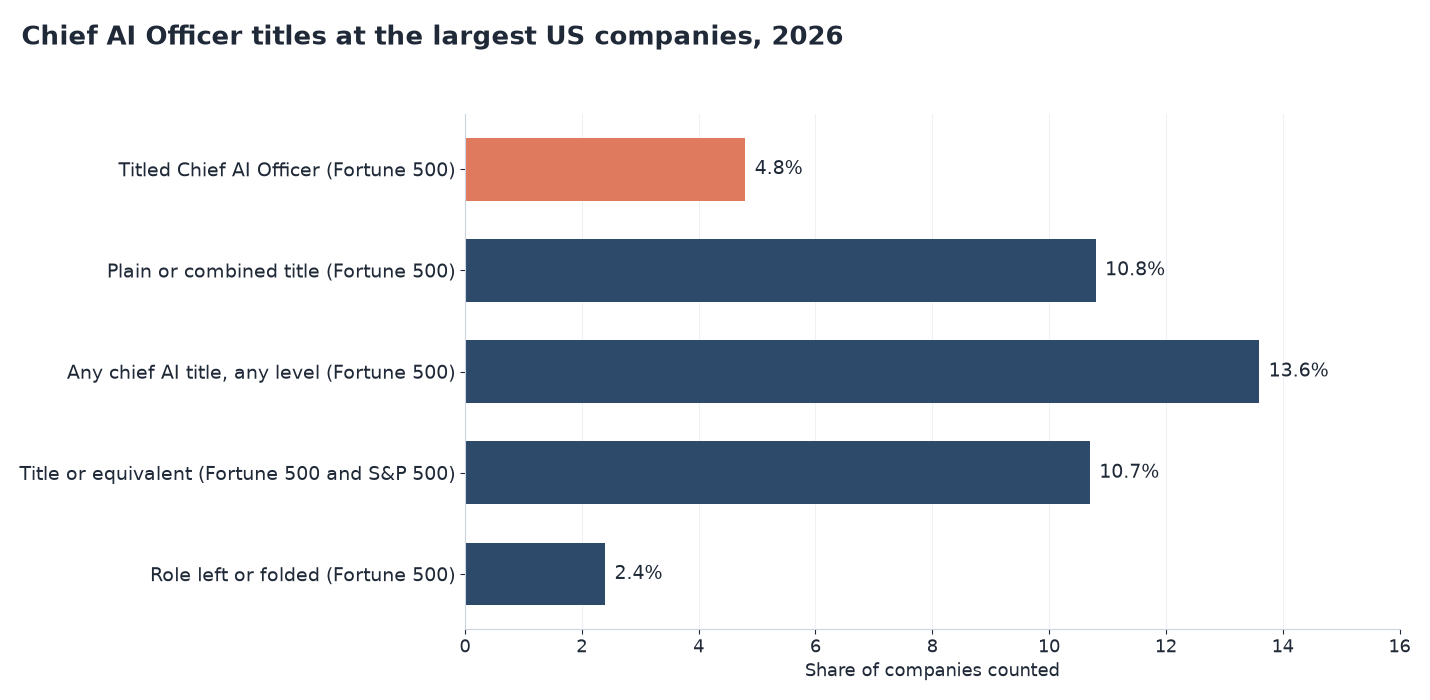
Source: AI Services Companies analysis of ProfessionLens (September 2026) and Crist Kolder Associates as reported by CFO Dive (October 2026), conducted November 2026.
Key Findings
- The plain title is rare. 24 of the 2026 Fortune 500 (4.8%) have an enterprise-wide Chief AI Officer, and among the 20 largest companies only Meta has one, according to ProfessionLens.
- Counting combined titles more than doubles the figure, to 54 companies (10.8%), close to Crist Kolder’s 10.7% across 665 Fortune 500 and S&P 500 companies. 30 of those 54 hold a combined title, such as Chief Data and AI Officer, which adds AI to an existing data or technology role.
- The role is also turning over. 12 Fortune 500 companies, including General Motors and Elevance Health, had a Chief AI Officer who has since left or whose role was folded, while Crist Kolder’s Josh Crist projects that nearly 20% of companies will have the role in some form in 2027.
Executive Surveys Find Far More Chief AI Officers Than Title Counts
Surveys ask executives whether their organization has a chief AI officer or a dedicated AI leader, and they reach a broader group of companies than the largest US employers, so we compared what four of them found.
| Survey | Respondents | Measure | Share |
|---|---|---|---|
| IBM Institute for Business Value CEO study, 2026 | 2,000 CEOs in 33 geographies, February to April 2026 | Organizations with a chief AI officer | 76% |
| AWS Generative AI Adoption Index, 2025 | 3,739 senior IT decision-makers in nine countries, including the US | Organizations with a dedicated AI executive, such as a chief AI officer | 60% |
| Gartner poll, 2024 | 1,808 executive leaders at a Gartner webinar, June 2024 | Organizations with a head of AI or AI leader | 54% |
| IBM Institute for Business Value chief AI officer study, 2025 | More than 2,300 organizations, first quarter of 2025 | Organizations with a chief AI officer | 26% |
| IBM Institute for Business Value, 2023, as cited in the 2025 study | Not stated in the 2025 study | Organizations with a chief AI officer | 11% |
| Gartner poll, 2024 | 1,808 executive leaders at a Gartner webinar, June 2024 | Organizations whose AI leader holds the chief AI officer title | An estimated 6% |
Source: AI Services Companies analysis of IBM (May 2026), AWS (May 2025), Gartner (June 2024), and IBM Institute for Business Value (July 2025), conducted November 2026. Data: organizations-with-a-chief-ai-officer-by-survey.csv
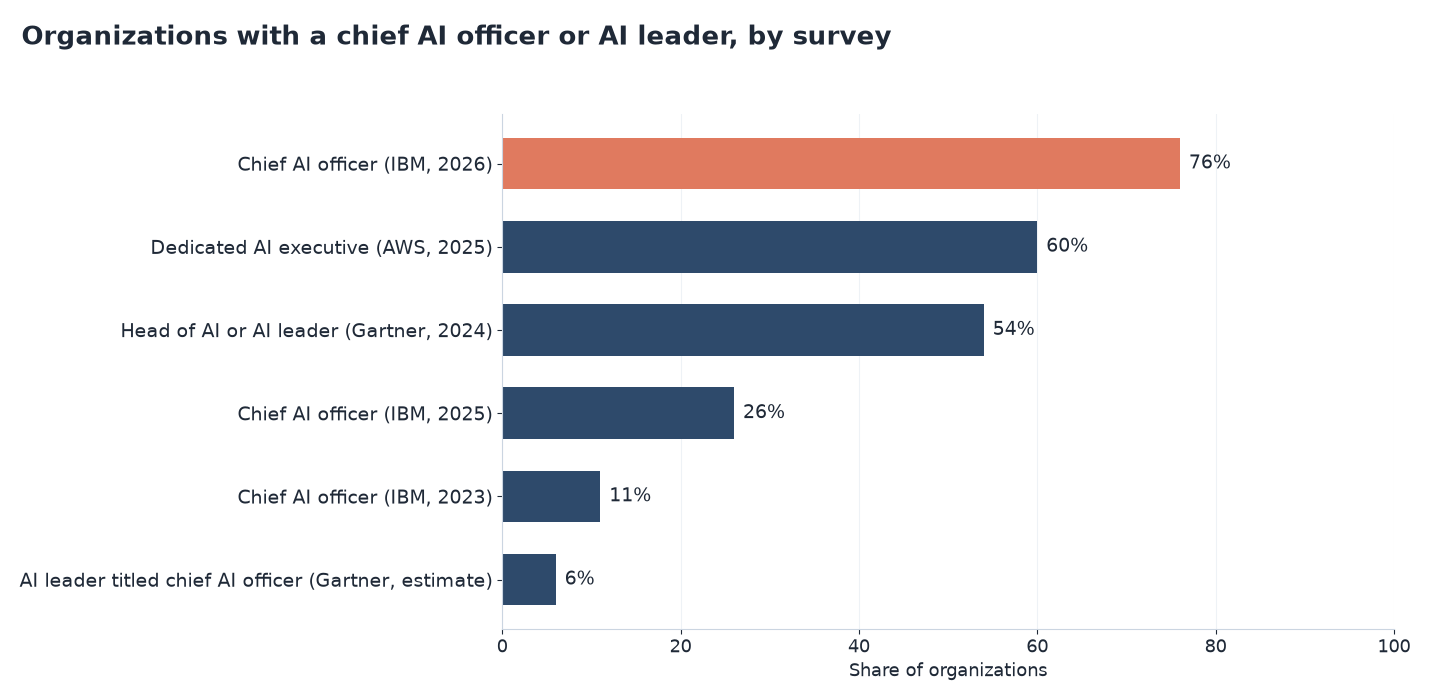
Source: AI Services Companies analysis of IBM (May 2026), AWS (May 2025), Gartner (June 2024), and IBM Institute for Business Value (July 2025), conducted November 2026.
Key Findings
- IBM’s figure nearly tripled in a year, from 26% of organizations in 2025 to 76% in 2026. The 2026 figure comes from the organizations of the CEOs who answered IBM’s annual CEO study, and the 2025 figure from IBM’s outreach to more than 2,300 organizations.
- Most AI leaders do not carry the title. In Gartner’s 2024 poll, 54% of organizations had a head of AI, but 88% of those leaders were not called chief AI officer, which puts the titled role at an estimated 6% of the organizations polled.
- Surveys describe the organizations of the executives who answer, and title counts cover every company on a list, which is why the shares differ so widely. A company setting up AI leadership gets a fairer benchmark from peers of its own size and sector than from a single headline share.
Healthcare and Financial Companies Appoint Chief AI Officers Most Often
Some industries moved to AI leadership sooner than others, so we compared the shares of large US companies with a chief AI officer by sector.
| Industry | Measure | Value | Source |
|---|---|---|---|
| Healthcare | Share of Fortune 500 and S&P 500 companies with a chief AI officer or equivalent | 18.5% | Crist Kolder Associates, August 2026 |
| Financials | Share of Fortune 500 and S&P 500 companies with a chief AI officer or equivalent | 15.3% | Crist Kolder Associates, August 2026 |
| Technology | Share of Fortune 500 and S&P 500 companies with a chief AI officer or equivalent | 12.6% | Crist Kolder Associates, August 2026 |
| Industrials | Share of Fortune 500 and S&P 500 companies with a chief AI officer or equivalent | Over 8% | Crist Kolder Associates, August 2026 |
| All 665 companies | Share with a chief AI officer or equivalent | 10.7% | Crist Kolder Associates, August 2026 |
| Financial companies | Share of the 54 Fortune 500 companies with a plain or combined chief AI title | 35.2% (19 of 54) | ProfessionLens, September 2026 |
Source: AI Services Companies analysis of Crist Kolder Associates as reported by CFO Dive (October 2026) and ProfessionLens (September 2026), conducted November 2026. Data: chief-ai-officers-by-industry.csv
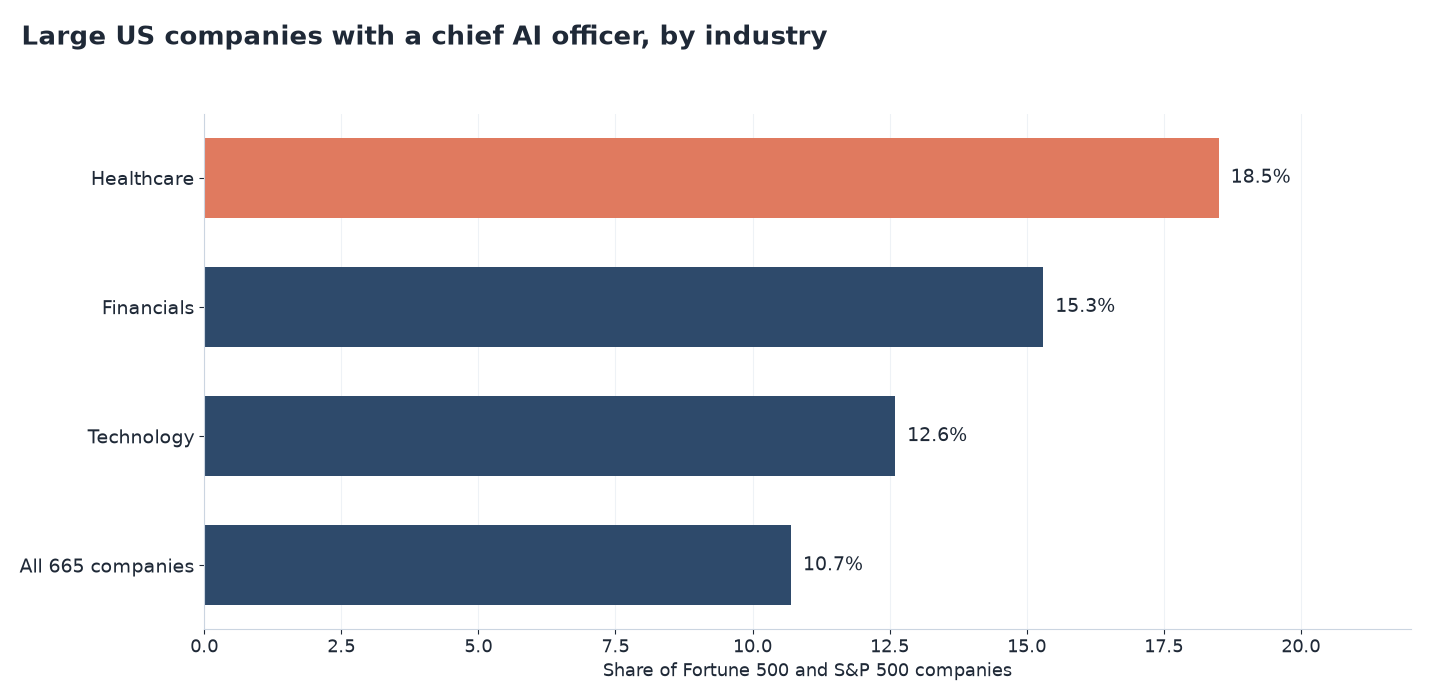
Source: AI Services Companies analysis of Crist Kolder Associates as reported by CFO Dive (October 2026) and ProfessionLens (September 2026), conducted November 2026.
Key Findings
- Healthcare leads at 18.5% of large companies, ahead of financial companies at 15.3% and technology companies at 12.6%. GE HealthCare, for example, hired its first chief AI officer in 2023.
- Financial companies account for 19 of the 54 Fortune 500 companies with a plain or combined chief AI title in ProfessionLens’s count, among them banks, insurers, asset managers, Mastercard, and S&P Global.
- Industrial companies trail at just over 8%, and Josh Crist expects manufacturing to catch up with healthcare and technology. For now, an AI services firm selling to a large manufacturer is more likely to work with a CIO or an operations head than with a chief AI officer.
Most Chief AI Officers Come From Data Roles and Report to the CEO or Board
What a chief AI officer controls and where the person comes from shape how a company runs its AI work, so we looked at what IBM’s 2025 survey of more than 600 chief AI officers found.
| Area | Measure | Share of chief AI officers |
|---|---|---|
| Background | Career focused on data | 73% |
| Background | Career focused on business strategy | 57% |
| Background | Career focused on innovation | 56% |
| Background | Career focused on technology | 54% |
| Background | Career focused on operations | 38% |
| Reporting | Report directly to the CEO or board | 57% |
| Reporting | Appointed from inside the organization | 57% |
| Reporting | Say they get sufficient support from the CEO | 80% |
| Mandate | Control the organization’s AI budget | 61% |
| Mandate | List direct AI implementation as a primary responsibility | 48% |
| Mandate | Prioritize building business cases for AI | 45% |
Source: AI Services Companies analysis of IBM Institute for Business Value (July 2025) and IBM and Dubai Future Foundation (July 2025), conducted November 2026. Data: chief-ai-officer-backgrounds-and-mandates.csv
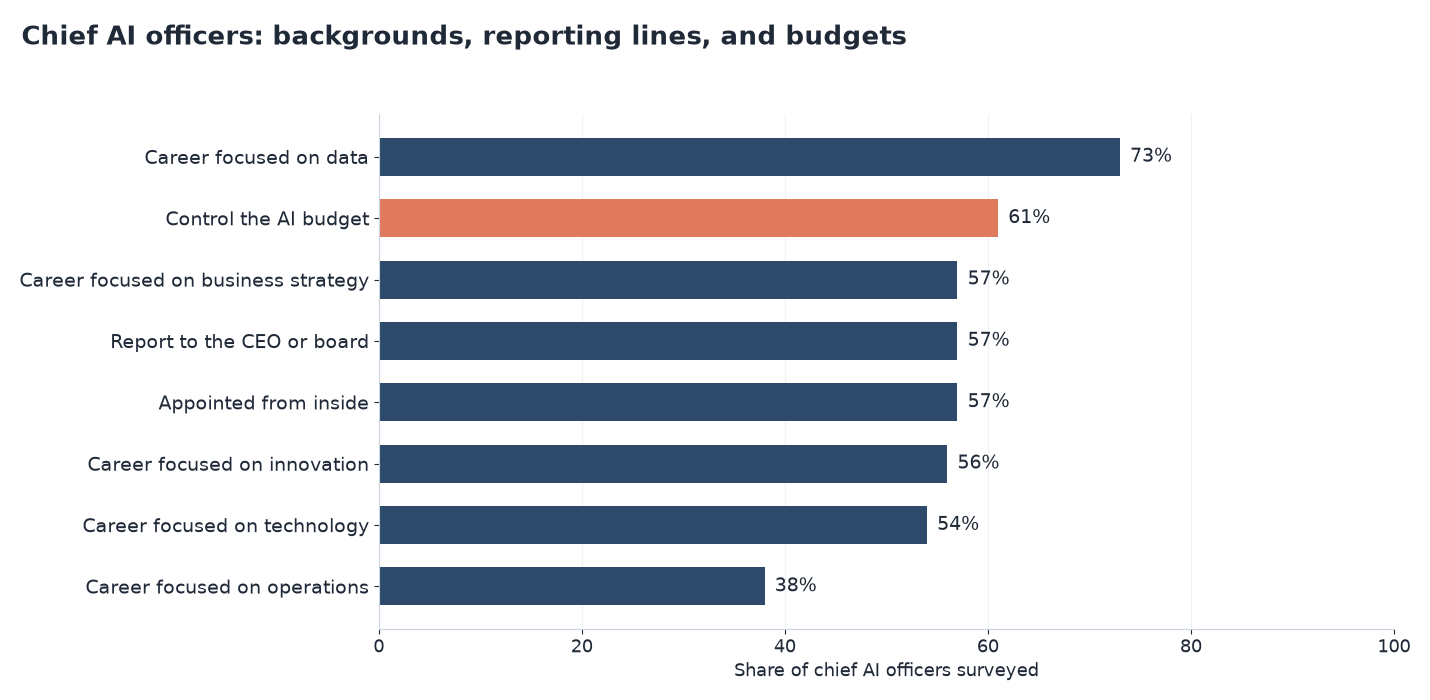
Source: AI Services Companies analysis of IBM Institute for Business Value (July 2025) and IBM and Dubai Future Foundation (July 2025), conducted November 2026.
Key Findings
- Data is the most common background, at 73%, but most chief AI officers have also worked in business strategy (57%) or innovation (56%), and 38% have focused on operations.
- 57% report directly to the CEO or board, and the same share were appointed from inside their organization. 80% say they get enough support from the CEO, and 61% control the AI budget.
- IBM finds 36% higher ROI on AI initiatives where the chief AI officer runs a centralized or hub-and-spoke operating model, against the 10% premium for having the role at all. A company creating the role can settle the operating model at the start, since that is the feature IBM links to the larger gain.
What Chief AI Officer Statistics Mean for Companies and the Firms They Hire
Most large organizations now have someone in charge of AI, but only about one in ten of the largest US companies gives that person a chief AI title, and many add AI to an existing data or technology job.
The role is spreading fastest in healthcare and finance, and it has already changed hands at some early adopters. All of the CEOs in IBM’s 2026 study whose organizations have a chief AI officer expect the role’s influence to grow by 2030. Our AI ROI statistics cover the wider evidence on returns.
So if you are deciding whether your company needs a chief AI officer, look first at whether one executive already controls the AI budget and the operating model, and give that person the mandate before you add a new seat to the leadership team.
Data Collection and Methodology
The study covers six sources. ProfessionLens counted chief AI titles across the 2026 Fortune 500 from press and company evidence read September 16 to 23, 2026. Crist Kolder Associates counted chief AI officers or equivalent titles at 665 Fortune 500 and S&P 500 companies in its Mid-Year Volatility Report, released in August 2026; we use the figures as reported by CFO Dive on October 2, 2026. IBM Institute for Business Value and Oxford Economics surveyed 2,000 CEOs in 33 geographies and 21 industries from February to April 2026. IBM Institute for Business Value, Oxford Economics, and the Dubai Future Foundation surveyed more than 600 chief AI officers in 22 geographies and 21 industries in the first quarter of 2025, from outreach to more than 2,300 organizations. AWS surveyed 3,739 senior IT decision-makers in nine countries, including the US, for its 2025 Generative AI Adoption Index. Gartner polled 1,808 executive leaders who attended a June 2024 webinar; Gartner notes that the poll does not represent the market as a whole.
Survey shares describe the organizations of the executives who answered, and title counts cover every company on a list, so figures from different sources are not directly comparable. AWS asked about a dedicated AI executive, such as a chief AI officer, and Gartner asked about a head of AI or AI leader. The 2023 IBM figure of 11% is as cited in IBM’s 2025 study. The total of more than 9,800 leaders and organizations adds the four survey samples (2,000, 3,739, 1,808, and more than 2,300).
Estimate: the estimated 6% of Gartner’s respondents whose AI leader holds the chief AI officer title multiplies the 54% of organizations with an AI leader by the 12% of those whose leader has the title (100% minus the 88% who said it does not), which gives 6.5%, rounded to 6%. We calculated products, differences, and ratios from the published values, including the 2.4% of the Fortune 500 (12 of 500) whose Chief AI Officer left or whose role was folded, the 30 combined titles (54 minus 24), and the 35.2% financial share (19 of 54).
Sources (9)
- AI Services Companies analysis of four executive surveys and two 2026 counts of chief AI officer titles at large US companies, conducted November 2026.
- ProfessionLens, Chief AI Officer 2026 Statistics (September 24, 2026)
- CFO Dive, Chief AI officers arrive in C-suites, reporting Crist Kolder Associates’ Mid-Year Volatility Report (October 2, 2026)
- IBM, IBM Study: CEOs are Reshaping C-suite Roles for the AI Era (May 4, 2026)
- IBM Institute for Business Value, Chief AI Officers: Solving the AI ROI puzzle (July 2025)
- IBM, CAIOs Key to AI Success: Up to 36% Higher ROI on AI spend, Finds IBM-Dubai Future Foundation Study (July 15, 2025)
- AWS, Generative AI Adoption Index (May 6, 2025)
- Gartner, Gartner Poll Finds 55% of Organizations Have an AI Board (June 26, 2024)
- AI Services Companies, AI ROI Statistics 2026