AI Adoption by Company Size: 2026 Statistics from the U.S. Census Bureau and Eurostat
Two government surveys measure AI use by business size on large samples: the U.S. Census Bureau’s Business Trends and Outlook Survey and Eurostat’s survey of ICT use in enterprises. Both show adoption climbing with headcount.
Published October 2026
Key findings
- In the United States, 31% of firms with 250 or more employees reported current AI use, against 18% of firms with 1 to 4 employees, in the Census Bureau’s survey covering November 2025 to January 2026.
- Across all U.S. firms, AI use reached 18% on a firm-weighted basis and 32% weighted by employment.
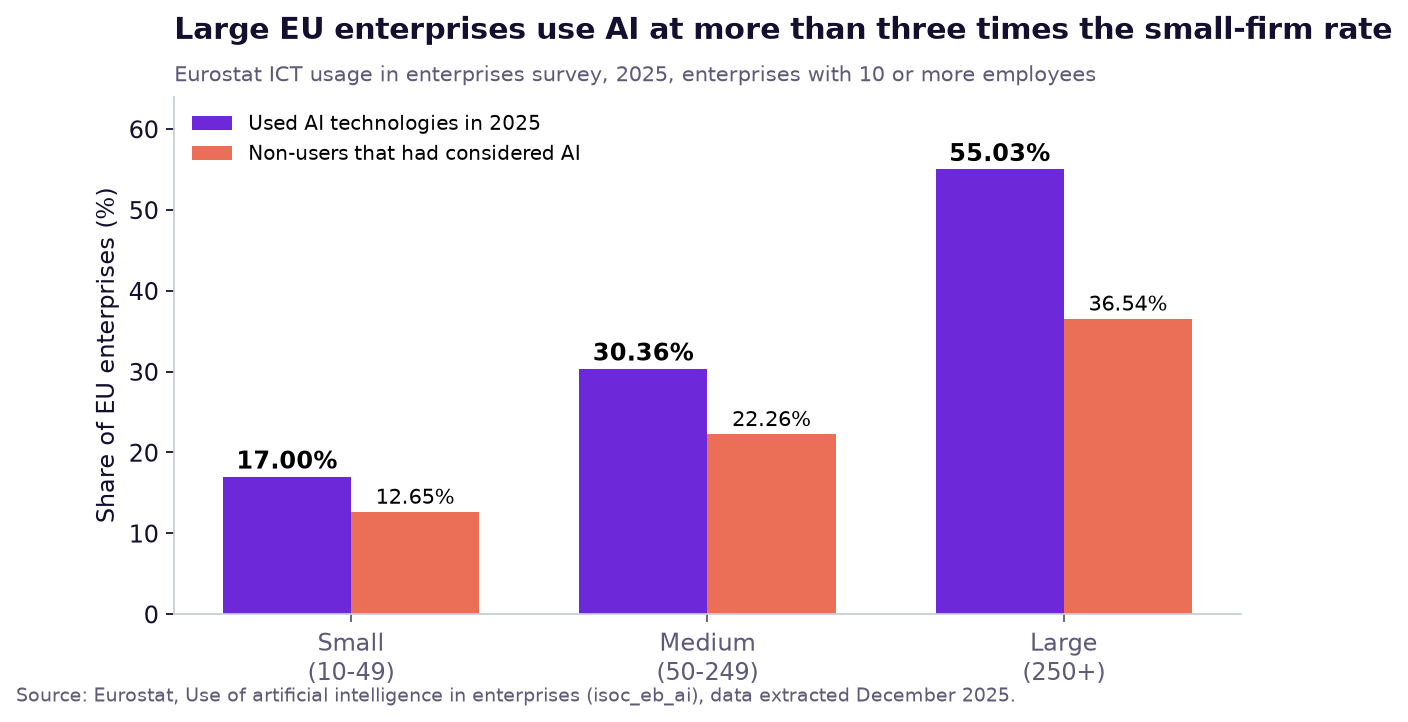
- In the EU, 55.03% of large enterprises used AI in 2025, against 17.00% of small enterprises and 19.95% of all enterprises with 10 or more employees.
- EU AI use among enterprises with 10 or more employees rose from 7.65% in 2021 to 19.95% in 2025.
- Among EU enterprises that considered AI but did not use it, 70.89% cited a lack of relevant expertise.
Company size is the strongest predictor of AI use in both of the large public surveys that track it. This report sets out the latest figures from each, with the survey design notes needed to quote them correctly.
United States: Census Bureau Business Trends and Outlook Survey
The Census Bureau’s Business Trends and Outlook Survey asks firms every two weeks whether they used AI to produce goods or services. In late 2025 the bureau revised its AI questions and added a supplement, which raised measured use across every size class. A working paper by Bonney and co-authors at the Census Bureau and the University of Maryland, published in April 2026, reports the results.
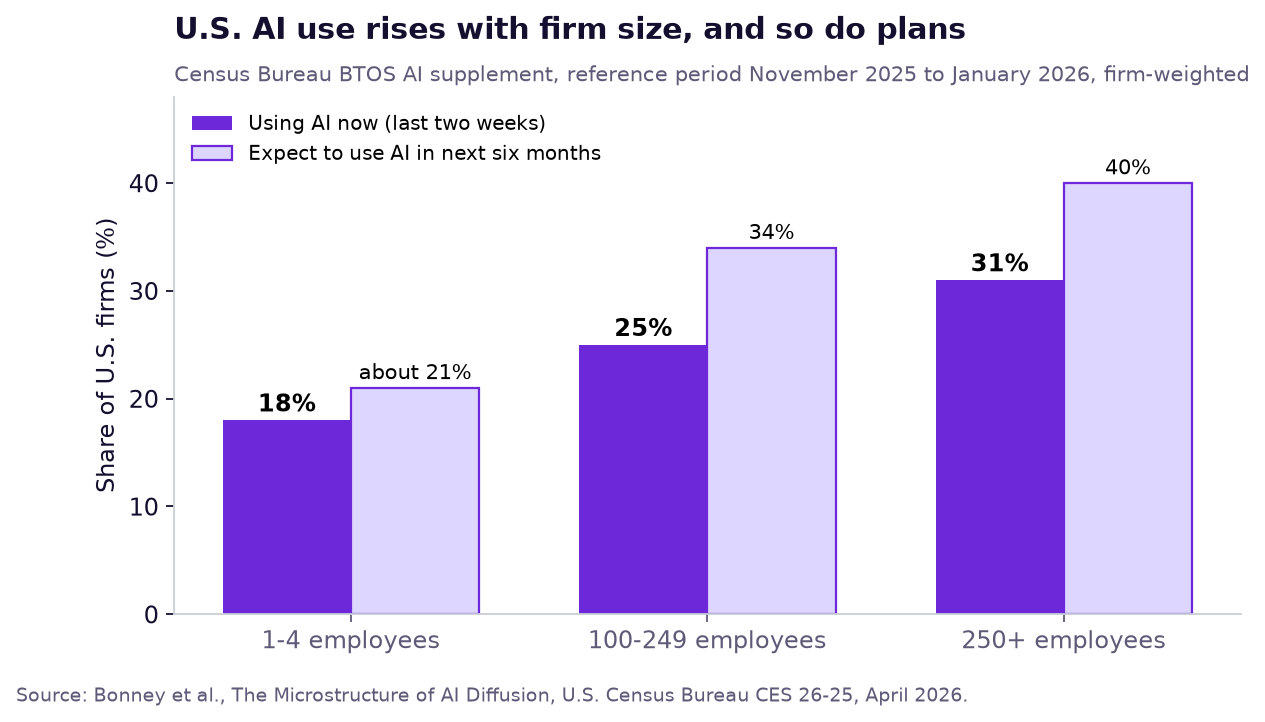
| Firm size | Using AI now | Expect to use AI in next six months | Before late-2025 question revision |
|---|---|---|---|
| 1 to 4 employees | 18% | About 21% | Rose from about 4% to about 10% |
| 100 to 249 employees | 25% | 34% | Not reported in the paper |
| 250 or more employees | 31% | 40% | Rose from about 5% to 13% |
| All firms | 18% (32% employment-weighted) |
The gap between current and planned use widens with size. The smallest firms expect to add about three points; firms with 250 or more employees expect to add nine. The authors also report worker-level use of 23% on a firm-weighted basis and 41% weighted by employment, and they find that most adopting firms use AI in only one to three business functions. About 4% of firms that use AI deploy it across business functions comprehensively.
European Union: Eurostat enterprise survey
Eurostat’s annual survey covers enterprises with 10 or more employees and asks whether they used any of a defined list of AI technologies, such as text mining, speech recognition, natural language generation or machine learning.
| Size class | 2021 | 2023 | 2024 | 2025 |
|---|---|---|---|---|
| Small (10 to 49 employees) | 6.12% | 6.41% | 11.21% | 17.00% |
| Medium (50 to 249) | 12.55% | 13.07% | 20.97% | 30.36% |
| Large (250 or more) | 28.41% | 30.48% | 41.17% | 55.03% |
| All enterprises, 10 or more employees | 7.65% | 8.06% | 13.48% | 19.95% |
Large enterprises use AI at 3.24 times the rate of small ones. All three size classes grew fastest between 2023 and 2025: small-enterprise use rose by 10.59 percentage points in two years, and large-enterprise use by 24.55 points.
Why firms that considered AI did not use it
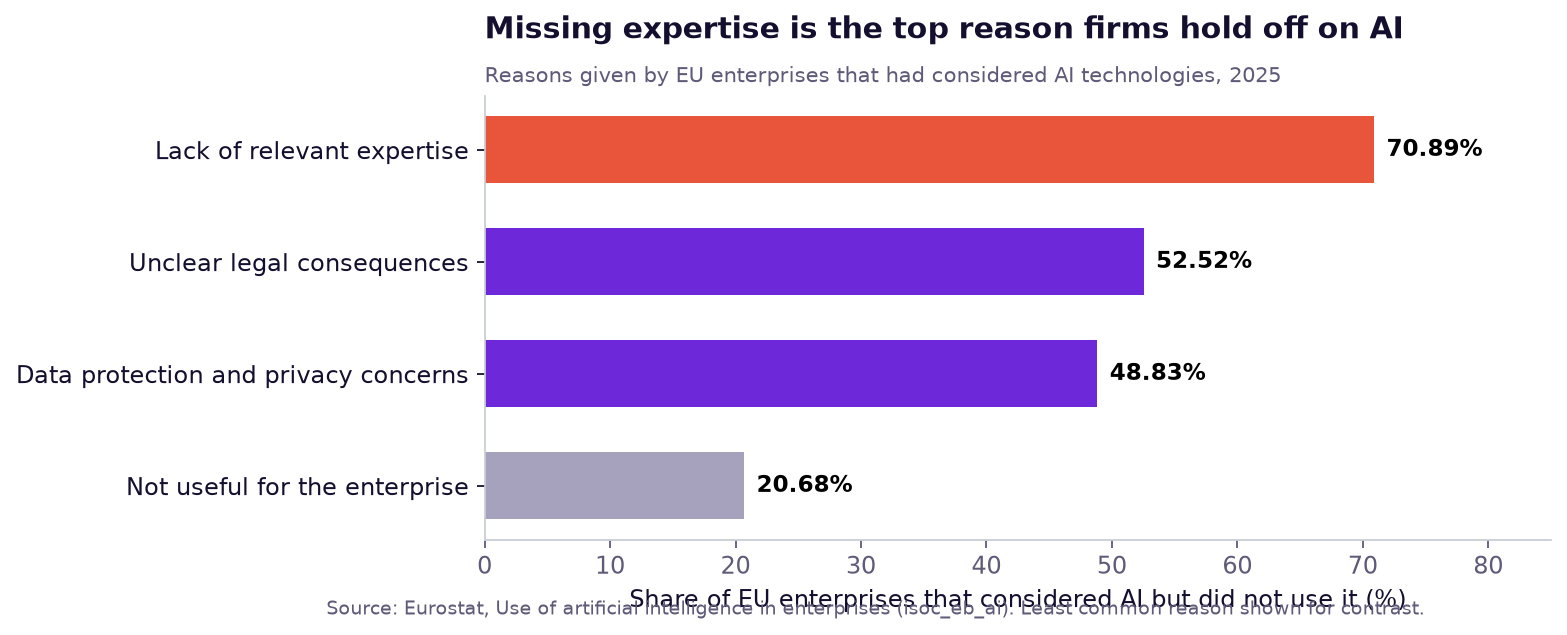
| Reason | Share of enterprises |
|---|---|
| Lack of relevant expertise | 70.89% |
| Unclear legal consequences | 52.52% |
| Data protection and privacy concerns | 48.83% |
| AI not useful for the enterprise | 20.68% |
Among non-users, 12.65% of small enterprises, 22.26% of medium enterprises and 36.54% of large enterprises had considered using AI. Missing expertise was the leading reason for holding off, well ahead of legal, privacy or usefulness concerns.
Comparing the two surveys
The figures are not directly comparable. The Census survey includes firms with fewer than 10 employees and measures use over a recent two-week period, while Eurostat excludes them and asks about use during the year. The Census authors note that the late-2025 question revision raised measured adoption in every size class, so changes across that revision should not be read as growth. Both surveys agree on the direction: the larger the firm, the more likely it uses AI and the more it plans to add.
Sources (4)
- Bonney, Breaux, Dinlersoz, Foster, Haltiwanger and Pande, The Microstructure of AI Diffusion: Evidence From Firms, Business Functions, and Worker Tasks, U.S. Census Bureau CES 26-25, April 2026
- U.S. Census Bureau, Business Trends and Outlook Survey
- Eurostat, Use of artificial intelligence in enterprises (isoc_eb_ai), data browser
- Eurostat, Statistics Explained: Use of artificial intelligence in enterprises