
AI Fraud Detection Statistics 2026
Published November 23, 2026
Our analysts gathered figures from three industry surveys of 713 anti-fraud professionals, 562 financial crime professionals, and 839 financial services respondents, a Stripe survey of payments leaders, results reported by Visa, Mastercard, and Stripe, and US Treasury reports, to show how widely AI is used to detect fraud and what it has stopped as of Q4 2026.
Key Findings
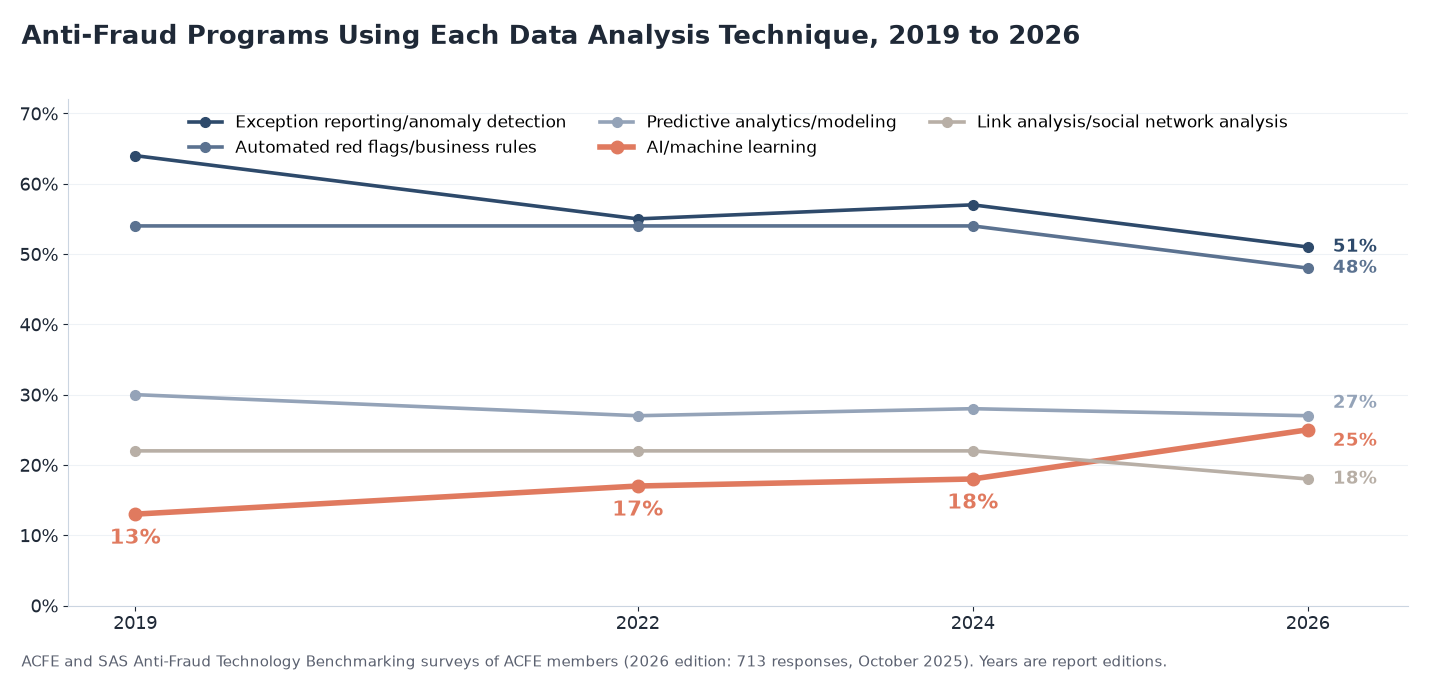
- 25% of organizations used AI or machine learning in their anti-fraud data analysis in 2026, up from 13% in 2019 and 18% in 2024, and another 28% expect to adopt it within two years.2
- 90% of financial institutions in a 562-respondent survey use AI to fight fraud and financial crime, and about two-thirds put AI in place within the past two years.3
- Visa helped block $40 billion in fraudulent activity in 2024, and Stripe Radar blocked $110 billion in fraud in 2025.9,6
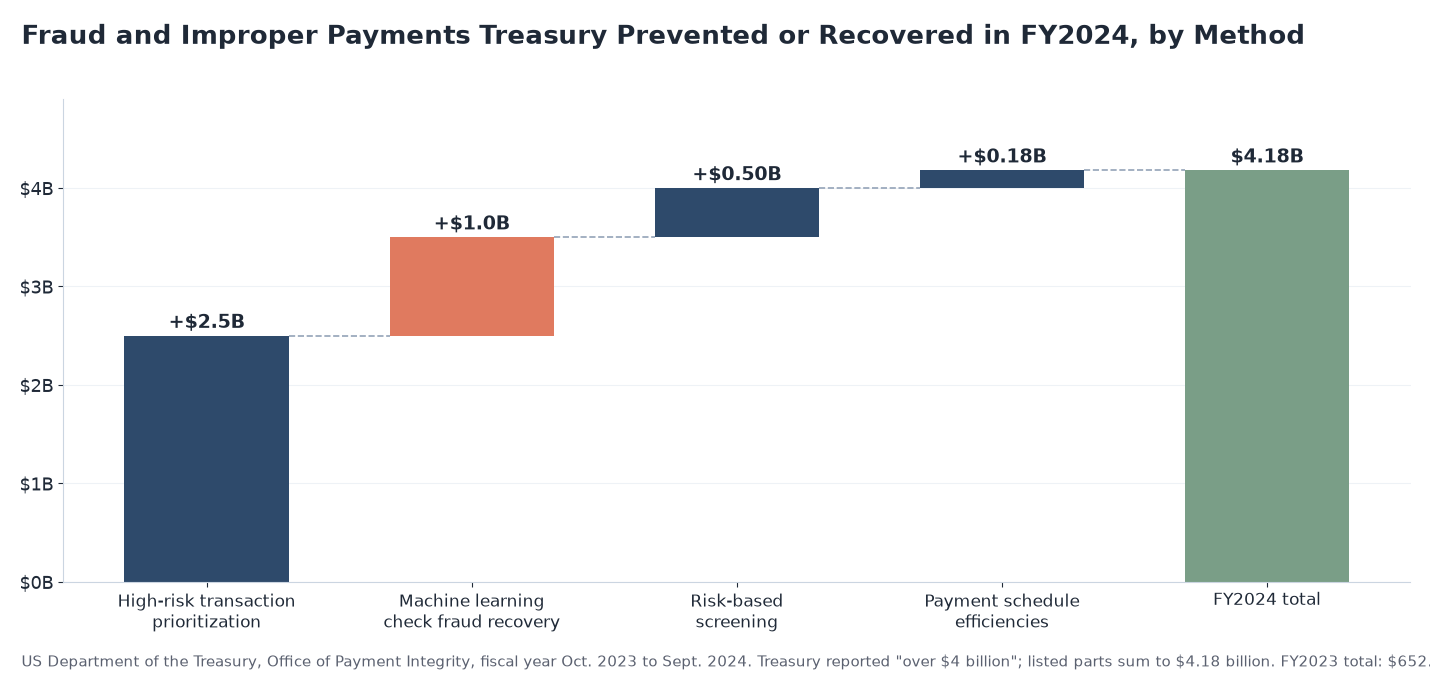
- The US Treasury prevented and recovered over $4 billion in fraud and improper payments in fiscal year 2024, up from $652.7 million in fiscal year 2023; machine learning check fraud detection accounted for $1 billion of the total.11
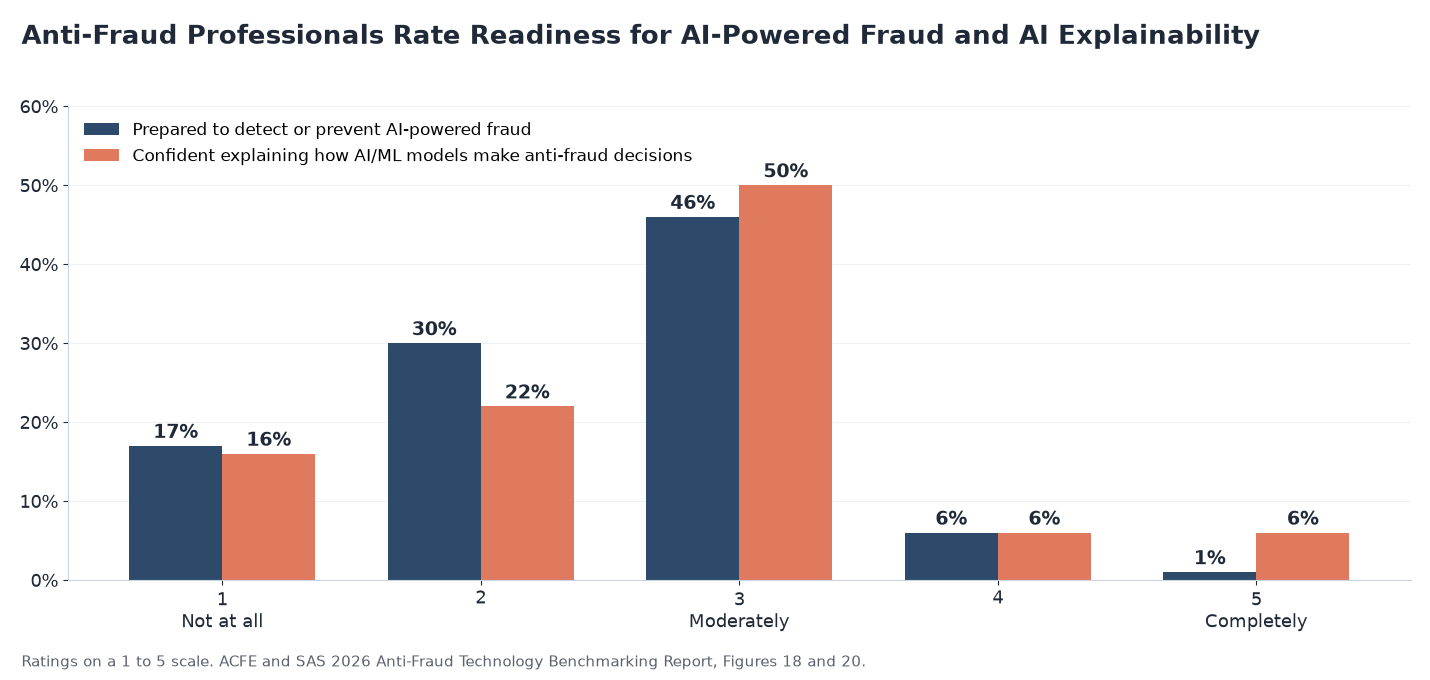
- Only 7% of anti-fraud professionals rate their organization as more than moderately prepared to detect or prevent AI-powered fraud, and 18% of organizations test their AI fraud models for bias or fairness.2
AI fraud detection means using machine learning models and other AI tools to spot payments, accounts, claims, or messages that look fraudulent, usually by comparing each event with patterns learned from past fraud and normal behavior.
Banks, card networks, payment processors, and government payment offices use these models to score transactions in milliseconds, flag suspicious checks, and screen new accounts. Anti-fraud teams also use generative AI to detect phishing, write reports, and screen hotline tips.2,9,12
Our analysts read the ACFE and SAS 2026 Anti-Fraud Technology Benchmarking Report, Feedzai's 2025 AI Trends in Fraud and Financial Crime Prevention report, NVIDIA's State of AI in Financial Services: 2026 Trends, Stripe's 2025 state of AI and fraud report, company announcements from Visa, Mastercard, and Stripe, and two US Treasury documents. All sources were opened on November 23, 2026.
For losses from deepfake scams, see our Deepfake Fraud Statistics 2026. For attacks on AI systems themselves, see AI Security Incident Statistics 2026.
In the following sections, we compare how many anti-fraud programs use AI over time, how they use generative AI, how financial companies use AI against fraud, what payment companies report their AI tools have stopped, what the US Treasury has recovered, and how prepared fraud teams feel.
25% of Anti-Fraud Programs Use AI or Machine Learning, Up From 13% in 2019
The Association of Certified Fraud Examiners (ACFE) and SAS have asked members which data analysis techniques their anti-fraud programs use in four editions since 2019. We tracked each technique across all four editions.
| Technique | 2019 | 2022 | 2024 | 2026 | Expect to adopt in 1 to 2 years |
|---|---|---|---|---|---|
| Exception reporting/anomaly detection | 64% | 55% | 57% | 51% | 13% |
| Automated red flags/business rules | 54% | 54% | 54% | 48% | 18% |
| Data visualization | 35% | 38% | 37% | 34% | 11% |
| Predictive analytics/modeling | 30% | 27% | 28% | 27% | 22% |
| AI/machine learning | 13% | 17% | 18% | 25% | 28% |
| Link analysis/social network analysis | 22% | 22% | 22% | 18% | 13% |
| Text mining | 18% | 16% | 14% | 14% | 12% |
Source: AI Services Companies analysis of ACFE and SAS, 2026 Anti-Fraud Technology Benchmarking Report data (Figure 1), conducted November 2026. Data: anti-fraud-analytics-techniques-2019-2026.csv
Source: AI Services Companies analysis of ACFE and SAS data, conducted November 2026.
Key Findings
- AI and machine learning was the only technique in the table whose use grew from 2024 to 2026; it also has the largest share of organizations planning to adopt it, at 28%.2
- If those plans hold, more than half of organizations would use AI or machine learning in anti-fraud analytics by 2028, according to the ACFE.2
- 82% of organizations use at least one type of data analytics in their anti-fraud programs, and physical biometrics use rose from 34% in 2022 to 45% in 2026.2
16% of Anti-Fraud Programs Use Generative AI, Most Often to Detect Phishing and Scams
The 2026 ACFE survey also asked which newer kinds of AI organizations use or plan to use, and what anti-fraud tasks they give generative AI. We gathered those answers by type of AI and by task.
| Measure | Value | Source |
|---|---|---|
| Organizations that currently use generative AI or large language models in anti-fraud programs | 16% | ACFE and SAS, 2026 |
| Expect to deploy generative AI in the next 1 to 2 years | 30% (more than 2 years: 28%) | ACFE and SAS, 2026 |
| Do not expect to use generative AI | 26% | ACFE and SAS, 2026 |
| Organizations that currently use agentic AI | 8% (expect within 1 to 2 years: 31%) | ACFE and SAS, 2026 |
| Organizations that currently use quantum AI | 5% (do not expect to use: 59%) | ACFE and SAS, 2026 |
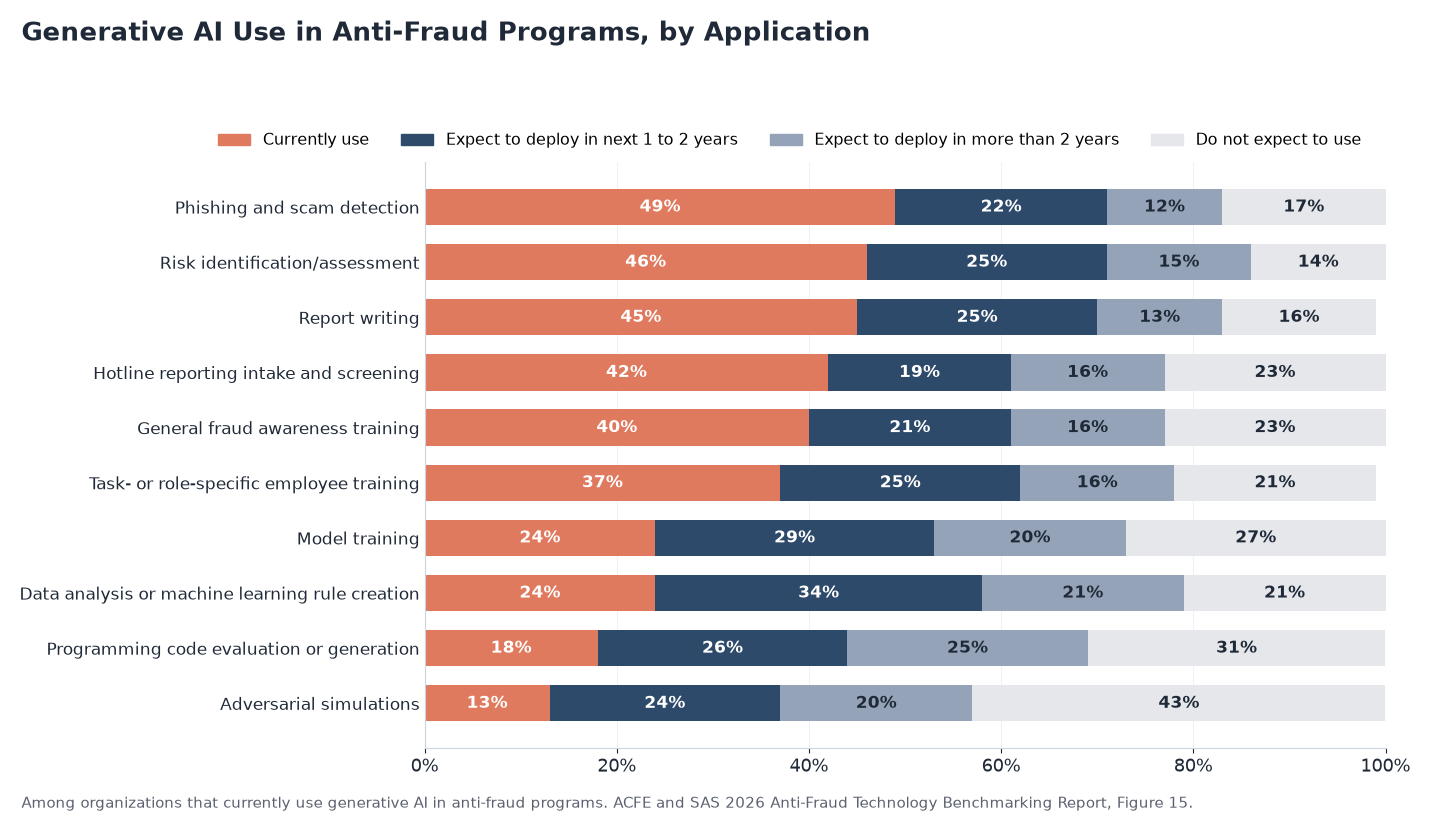
| Most common generative AI use among current users: phishing and scam detection | 49% | ACFE and SAS, 2026 |
| Risk identification/assessment and report writing among current users | 46% and 45% | ACFE and SAS, 2026 |
| Generative AI uses most often planned: rule creation, code, and model training | 55%, 51%, and 49% | ACFE and SAS, 2026 |
| Rate accuracy of results important or very important when deciding on generative AI | 86% | ACFE and SAS, 2026 |
Source: AI Services Companies analysis of ACFE and SAS data (Figures 14 to 16), conducted November 2026. Data: generative-ai-anti-fraud-applications-2026.csv
Source: AI Services Companies analysis of ACFE and SAS data, conducted November 2026.
Key Findings
- At least 70% of respondents' organizations use generative AI or expect to within two years for phishing and scam detection, risk assessment, and report writing.2
- Adversarial simulations, where teams use AI to test their own defenses, are the least common use: 13% use them now and 43% do not expect to.2
- Accuracy (62%) and security risks (57%) were the factors most often rated very important when deciding whether to use generative AI against fraud.2
90% of Financial Institutions Use AI to Fight Fraud
We gathered three 2025 surveys of banks, fintech companies, and payments businesses to show how common it is and where it ranks among other AI uses.
| Measure | Value | Source |
|---|---|---|
| Financial institutions that use AI to fight fraud and financial crime | 90% | Feedzai, 2025 |
| Financial institutions that put AI in place in the past two years | About two-thirds | Feedzai, 2025 |
| Use AI for scam detection, transaction fraud, and anti-money laundering | 50%, 39%, and 30% | Feedzai, 2025 |
| Say fraudsters use generative AI | 92% | Feedzai, 2025 |
| Cite data management as their biggest hurdle with AI | 87% | Feedzai, 2025 |
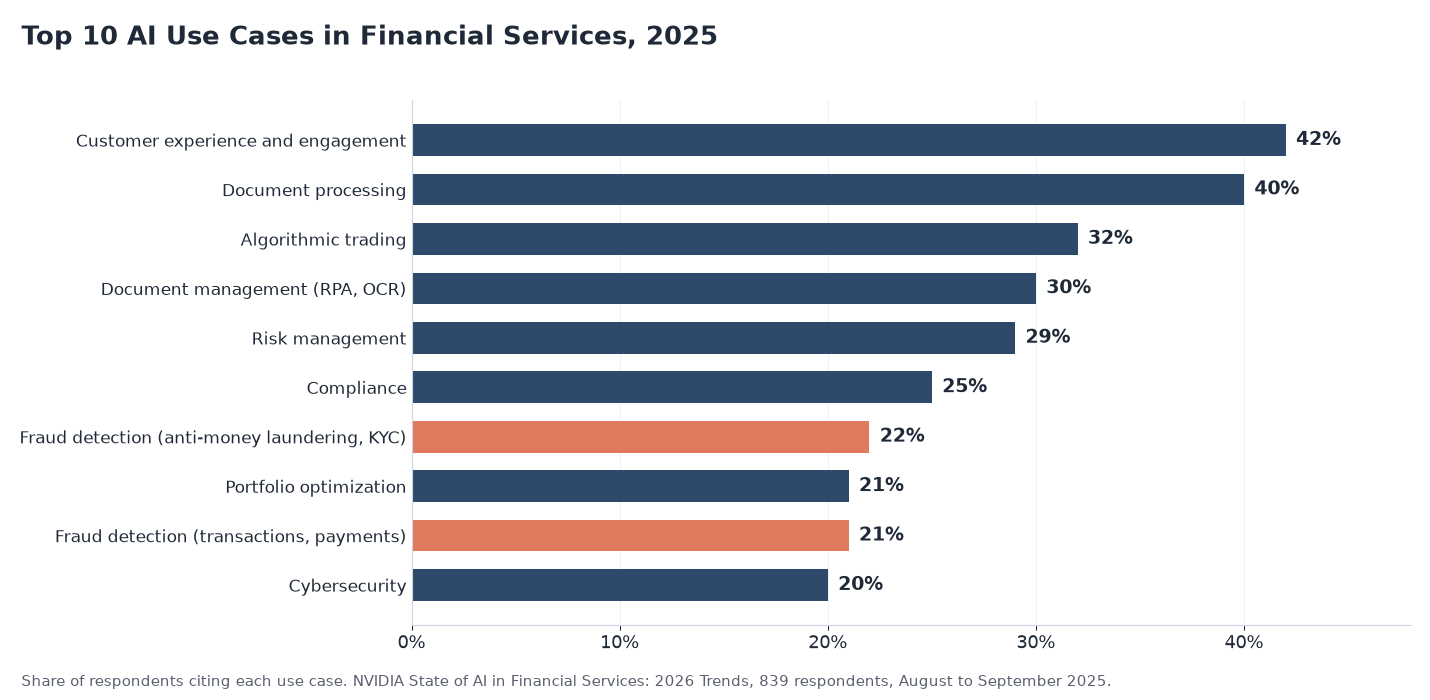
| Financial services respondents citing fraud detection for anti-money laundering/KYC as an AI use case | 22% | NVIDIA, 2026 |
| Respondents citing fraud detection for transactions and payments as an AI use case | 21% | NVIDIA, 2026 |
| Consumer finance respondents citing fraud detection and anti-money laundering among top ROI use cases | 24% | NVIDIA, 2026 |
| Businesses that use AI to detect and prevent fraud (most common AI use in payments) | 47% | Stripe |
| Business leaders who say AI is making merchant fraud worse | 30% | Stripe |
Source: AI Services Companies analysis of Feedzai, 2025 AI Trends in Fraud and Financial Crime Prevention, NVIDIA, State of AI in Financial Services: 2026 Trends, and Stripe, The 2025 state of AI and fraud data, conducted November 2026. Data: financial-services-ai-use-cases-2025.csv
Source: AI Services Companies analysis of NVIDIA data, conducted November 2026.
Key Findings
- Fraud detection appears twice in NVIDIA's top 10 AI use cases for financial services, once for anti-money laundering and know-your-customer checks (22%) and once for transactions and payments (21%).4
- Survey wording matters: Feedzai asked fraud professionals at financial institutions whether they use AI against fraud (90%), while NVIDIA asked all financial services respondents to pick their top use cases.3,4
- In Stripe's survey, three in four platform and marketplace leaders said fraud is changing too fast for their business to keep up.5
Visa and Stripe Report Blocking Tens of Billions of Dollars in Fraud
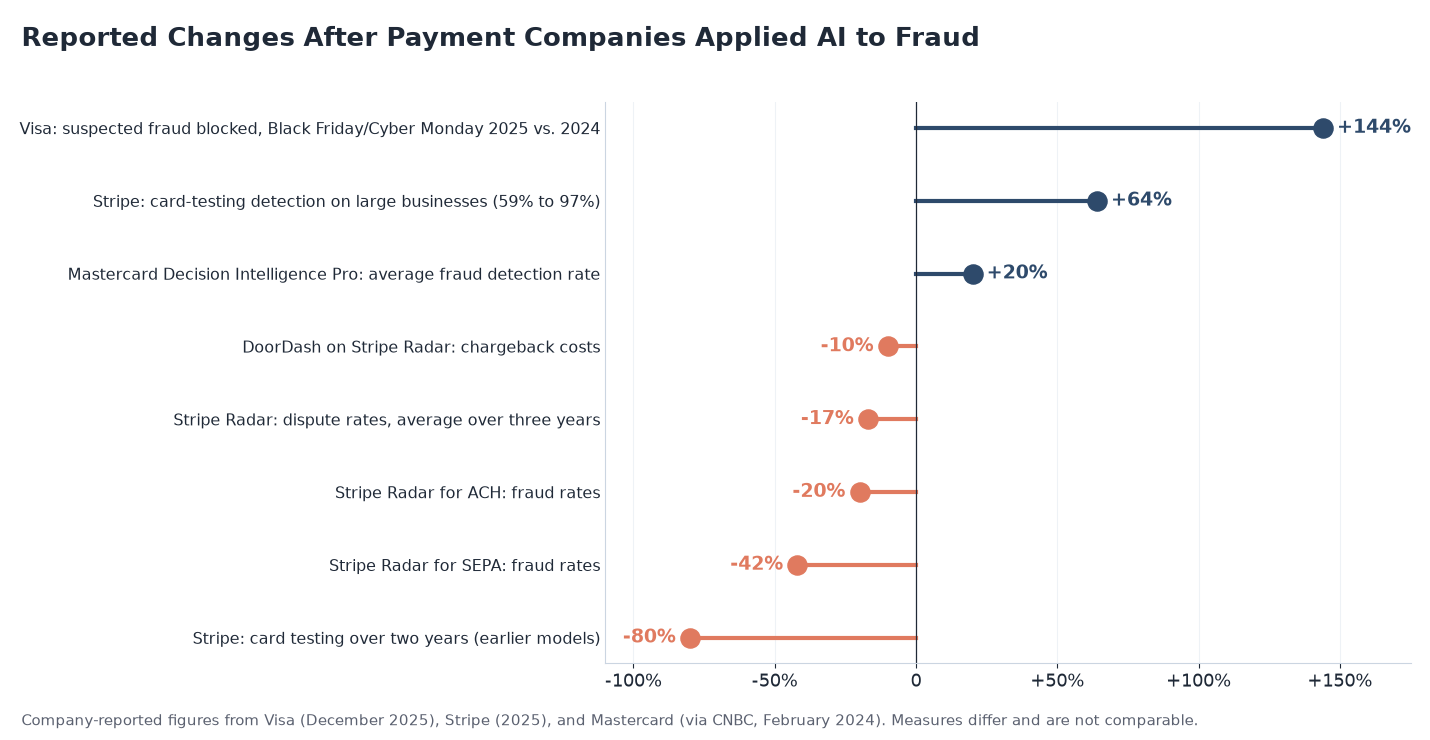
Card networks and payment processors publish their own figures on fraud their AI models have blocked. We collected the dollar totals and the percentage changes each company reported.5,6,7,8,9,10
| Company and measure | Value | Source |
|---|---|---|
| Visa: fraudulent activity Visa helped block, 2024 | $40 billion | Visa |
| Visa: technology investment over the last five years | $13 billion | Visa |
| Visa: increase in suspected fraud blocked over Black Friday/Cyber Monday weekend, 2025 vs. 2024 | 144% | Visa |
| Stripe Radar: fraud blocked, 2025 | $110 billion | Stripe |
| Stripe: card-testing detection rate on large businesses with its Payments Foundation Model | 59% to 97% (a 64% increase) | Stripe |
| Stripe: reduction in card testing over two years with earlier models | 80% | Stripe |
| Stripe Radar: average reduction in dispute rates over the last three years | 17% | Stripe |
| Stripe Radar for ACH and SEPA payments: average reduction in fraud rates | 20% and 42% | Stripe |
| DoorDash: decrease in chargeback costs after adding Stripe Radar risk scores | 10% | Stripe |
| Mastercard Decision Intelligence Pro: average improvement in fraud detection rates | 20% (up to 300% in some cases) | Mastercard via CNBC |
Source: AI Services Companies analysis of Visa, Visa holiday fraud release, Stripe Radar, Stripe Sessions 2025, Stripe state of AI and fraud, and CNBC figures, conducted November 2026. Data: reported-ai-fraud-tool-results.csv
Source: AI Services Companies analysis of Visa, Stripe, and Mastercard figures, conducted November 2026.
Key Findings
- In a Visa study, 78% of people surveyed globally said fraud schemes are getting harder to detect.8
- Stripe says it cut dispute rates for Radar users by 17% in the year before its 2025 report, while industry-wide ecommerce fraud rose 15%.5
- Mastercard says Decision Intelligence Pro scores a transaction in about 50 milliseconds, and the company has invested more than $7 billion in cybersecurity and AI over five years.10
The US Treasury Prevented and Recovered Over $4 Billion With AI-Assisted Fraud Detection in FY2024
The US Treasury's Office of Payment Integrity added machine learning to its fraud screening after pandemic-era losses. We collected the totals it reported for fiscal years 2023 to 2025 and the methods behind them.
| Measure | Value | Source |
|---|---|---|
| Fraud and improper payments prevented and recovered, FY2023 | $652.7 million | US Treasury |
| Fraud and improper payments prevented and recovered, FY2024 | Over $4 billion | US Treasury |
| Prevention from identifying and prioritizing high-risk transactions, FY2024 | $2.5 billion | US Treasury |
| Check fraud recovery from machine learning detection, FY2024 | $1 billion | US Treasury |
| Prevention from expanded risk-based screening, FY2024 | $500 million | US Treasury |
| Prevention from payment schedule efficiencies, FY2024 | $180 million | US Treasury |
| Check fraud prevented and recovered with machine learning, FY2024 and FY2025 combined | Over $1.9 billion | US Treasury |
| Improper payments 19 new data sets could potentially prevent | About $28 billion | US Treasury |
| Federal programs with access to all Do Not Pay databases, FY2024 | 4% | US Treasury |
Source: AI Services Companies analysis of US Treasury press release, October 17, 2024 and Treasury testimony to the House Oversight Subcommittee on Government Operations, January 13, 2026, conducted November 2026. Data: treasury-fraud-prevention-fy2024-waterfall.csv
Source: AI Services Companies analysis of US Treasury data, conducted November 2026.
Key Findings
- Treasury's FY2024 total was more than six times its FY2023 total of $652.7 million.11
- Treasury uses machine learning to spot check fraud in near real time and speed up recovery of potentially fraudulent payments from financial institutions.12
- The four methods Treasury listed for FY2024 add up to $4.18 billion; Treasury reported the total as "over $4 billion."1,11
Only 7% of Organizations Feel More Than Moderately Prepared for AI-Powered Fraud
Fraud teams now face criminals who use AI as well as tools that use it. The 2026 ACFE survey asked how prepared organizations are for AI-powered fraud and how well they can explain and check their own AI models.
| Measure | Value | Source |
|---|---|---|
| Rate their organization more than moderately prepared to detect or prevent AI-powered fraud | 7% | ACFE and SAS, 2026 |
| Rate their organization not at all prepared | 17% | ACFE and SAS, 2026 |
| Organizations that test AI fraud models for bias or fairness | 18% | ACFE and SAS, 2026 |
| Completely confident explaining how AI/ML models make anti-fraud decisions | 6% (not at all confident: 16%) | ACFE and SAS, 2026 |
| More than moderately confident explaining AI/ML decisions | 12% | ACFE and SAS, 2026 |
| Consider explainability or auditability important when adopting generative AI | 82% | ACFE and SAS, 2026 |
| Consider bias or lack of fairness important when adopting generative AI | 75% | ACFE and SAS, 2026 |
| Say deepfake social engineering increased significantly in the past two years | 44% | ACFE and SAS, 2026 |
| Expect generative AI document fraud/forgery to increase significantly in the next two years | 55% | ACFE and SAS, 2026 |
Source: AI Services Companies analysis of ACFE and SAS data (Figures 16 to 21), conducted November 2026. Data: ai-fraud-readiness-and-explainability-2026.csv
Source: AI Services Companies analysis of ACFE and SAS data, conducted November 2026.
Key Findings
- 47% of anti-fraud professionals rated their organization below the midpoint on readiness for AI-powered fraud, compared with 7% above it.1,2
- Explainability matters for fraud teams because they may have to tell customers, auditors, or regulators why a model flagged a payment; only 12% feel more than moderately able to do so.2
- 89% of banks in Feedzai's survey say they prioritize explainability and transparency in their AI systems.3
What AI Fraud Detection Statistics Show Going Into 2027
AI is now standard at the largest payment companies and at most financial institutions, where it scores transactions and flags scams in milliseconds. Visa, Stripe, and the US Treasury each report billions of dollars blocked or recovered with its help.3,6,9,11
Outside banking and payments, adoption is slower. One in four organizations in the ACFE survey uses AI or machine learning against fraud, and few can explain or test their models for bias.2
So if you cite an AI fraud detection statistic, say who was surveyed and whether the figure is a company's own result, because financial institutions, all organizations, and a single payment network give very different numbers.
Data Collection and Methodology
We collected figures from published reports, company pages, and government documents, opened on November 23, 2026. Anti-fraud program figures come from the ACFE and SAS 2026 Anti-Fraud Technology Benchmarking Report, a 30-question survey sent to 77,392 ACFE members in October 2025 that produced 713 usable responses.
Values were read from the report's labeled figures (Figures 1 and 14 to 21). The 2019, 2022, and 2024 values are the prior-edition comparison columns the report publishes.
Financial institution figures come from Feedzai's 31-question survey of 562 fraud and financial crime professionals, fielded in March and April 2025. NVIDIA's survey had 839 respondents across fintech, consumer finance, and capital markets, fielded August to September 2025. Stripe's survey figures come from its early-2025 surveys with Milltown Partners.
Company results are each company's own reported figures and use different measures, periods, and baselines, so they should not be compared with each other. Mastercard's figures come from CNBC's February 2024 report. Treasury figures come from its October 17, 2024 press release and January 13, 2026 testimony to Congress.
The $4.18 billion Treasury sum, the six-times comparison, and the 47% below-midpoint readiness share are our own arithmetic. No figures in this article are estimates.
Sources (12)
- AI Services Companies analysis of AI fraud detection figures from ACFE and SAS, Feedzai, NVIDIA, Stripe, Visa, Mastercard, and the US Treasury, conducted November 2026.
- Association of Certified Fraud Examiners and SAS, 2026 Anti-Fraud Technology Benchmarking Report
- Feedzai, 2025 AI Trends in Fraud and Financial Crime Prevention (press release, May 6, 2025)
- NVIDIA, State of AI in Financial Services: 2026 Trends (survey report)
- Stripe, The 2025 state of AI and fraud
- Stripe, Stripe Radar: Transaction and credit card fraud prevention
- Stripe, Stripe accelerates the utility of AI and stablecoins with major launches (Sessions 2025)
- Visa, Visa's AI-Powered Fraud Defense Delivers Record Protection for Holiday Shoppers (December 10, 2025)
- Visa, AI and Trust at Scale: Securing the Future of Payments
- CNBC, Mastercard jumps into generative AI race with model it says can boost fraud detection by up to 300% (February 1, 2024)
- US Department of the Treasury, Treasury Announces Enhanced Fraud Detection Processes, Including Machine Learning AI, Prevented and Recovered Over $4 Billion in Fiscal Year 2024 (October 17, 2024)
- Statement of Renata Miskell, US Department of the Treasury, before the House Oversight Subcommittee on Government Operations (January 13, 2026)