
AI Security Incident Statistics 2026
Published November 10, 2026
Our analysts compiled yearly AI incident counts from the AI Incident Database for 2012 through 2025, IBM's study of 600 breached organizations, surveys by Gartner, HiddenLayer, and McKinsey, the FBI's 22,364 AI-related fraud complaints from 2025, and threat reports from CrowdStrike, Microsoft, and Anthropic, to show how often AI systems are attacked or misused as of Q4 2026, what those incidents involve, and what they cost.
Key Findings
- The AI Incident Database recorded 362 AI incidents in 2025, up from 233 counted for 2024 a year earlier, and the OECD's news-based monitor logged a monthly peak of 435 incidents in January 2026 (Stanford AI Index 2026).2
- 13% of the breached organizations IBM studied reported a breach of an AI model or application, and 97% of those organizations lacked proper AI access controls (IBM, July 2025).3
- 62% of organizations experienced a deepfake attack and 32% experienced an attack on AI applications through the prompt in the 12 months before Gartner's March to May 2025 survey of 302 cybersecurity leaders.5
- The FBI's Internet Crime Complaint Center received 22,364 complaints that referenced AI in 2025, with $893.3 million in reported losses, $632.0 million of it from investment scams.8
- The average US data breach cost a record $10.22 million in IBM's 2025 study, and organizations with high levels of shadow AI paid $670,000 more per breach than those with little or none.3,4
An AI security incident is any event in which an AI system is attacked, misused, or causes harm: a chatbot tricked by a hidden instruction into leaking files, a cloned voice used to authorize a payment, or an AI model pulled from a public repository with malware inside it. Companies have put AI assistants, agents, and models into email, code, customer service, and finance work much faster than most security teams could write rules for them, and attackers have started using the same tools to write phishing emails and run intrusions. Reporters and security teams quote incident figures from many places, but each source counts something different, from news reports of harm to breaches inside a single study panel. We wanted one place where the main figures sit side by side with their source, sample, and date.
Our analysts took the AI Incident Database and OECD AI Incidents and Hazards Monitor counts published in the Stanford AI Index 2026, and McKinsey survey results reported in the same chapter. We added breach and cost data from IBM's 2025 Cost of a Data Breach Report, conducted by the Ponemon Institute across 600 organizations breached between March 2024 and February 2025. Survey results come from Gartner, HiddenLayer's 2025 and 2026 AI Threat Landscape Reports, and the FBI's 2025 Internet Crime Report, and attacker activity comes from CrowdStrike's 2026 Global Threat Report and Microsoft's 2025 Digital Defense Report. US results come first wherever a source reports them separately, and all money is in US dollars.
In the following sections, we compare reported AI incidents by year, how many organizations report AI security incidents, which kinds of attacks hit AI systems, what breaches cost, how much AI-related fraud Americans reported to the FBI, and how attackers are using AI in their own operations.
Reported AI Incidents Rose Every Year from 2021 to 2025
Public incident databases are the longest-running record of AI going wrong in the real world. They collect news and research reports of harm, including security failures, fraud, and unsafe outputs, so we pulled the yearly counts from the AI Incident Database, the source the Stanford AI Index relies on.
| Year | Reported incidents | Year | Reported incidents |
|---|---|---|---|
| 2012 | 8 | 2019 | 43 |
| 2013 | 6 | 2020 | 90 |
| 2014 | 13 | 2021 | 77 |
| 2015 | 24 | 2022 | 104 |
| 2016 | 41 | 2023 | 168 |
| 2017 | 50 | 2024 | 281 |
| 2018 | 45 | 2025 | 362 |
Source: AI Services Companies analysis of Stanford HAI, AI Index Report 2026, Chapter 3: Responsible AI, chart of reported AI incidents (AI Incident Database data), conducted November 2026. Data: reported-ai-incidents-2012-2025.csv
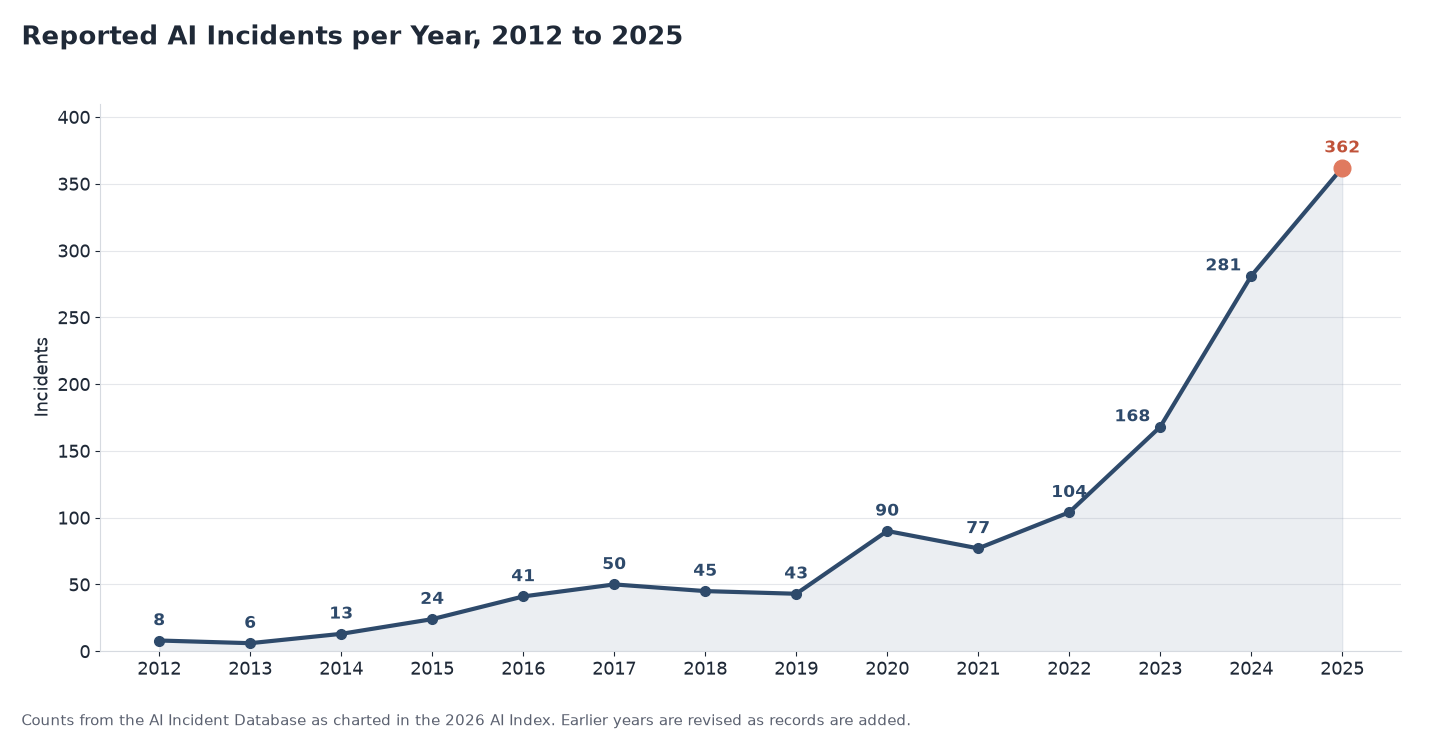
Source: AI Services Companies analysis of AI Incident Database counts in the Stanford AI Index Report 2026, conducted November 2026.
Key Findings
- The 362 incidents recorded for 2025 are more than three times the 104 recorded for 2022, and the count has risen every year since 2021. The yearly total stayed below 100 in every year through 2021.2
- The OECD AI Incidents and Hazards Monitor, which collects incidents automatically from news in many languages, counts far more. Its monthly total peaked at 435 in January 2026, with a six-month moving average of 326.2
- Both databases count incidents that reached the news, so they show the direction of the trend more than the full number of incidents. Earlier years keep rising as editors add records, so the 2025 count may also change in future editions.2
Between 8% and 74% of Organizations Report AI Incidents, Depending on the Survey
Incident databases only see what becomes public, so we also gathered what organizations say about their own AI incidents. The surveys below ask different people different questions, from breached companies in IBM's study to security leaders polled by Gartner and HiddenLayer, so each row carries its own sample and period.
| Source | Sample and period | Measure | Share |
|---|---|---|---|
| HiddenLayer, 2025 report | 250 IT leaders, incidents in 2024 | Definitely knew they had an AI breach (67% a year earlier) | 74% |
| HiddenLayer, 2025 report | 250 IT leaders, incidents in 2024 | Chose not to report an AI-related breach over reputational concerns | 45% |
| Gartner | 302 cybersecurity leaders, Mar to May 2025 | Deepfake attack in the past 12 months | 62% |
| Gartner | 302 cybersecurity leaders, Mar to May 2025 | Attack on AI applications through the prompt | 32% |
| HiddenLayer, 2026 report | 250 IT and security leaders, released Mar 2026 | Do not know whether they had an AI breach in the past 12 months | 31% |
| Gartner | 302 cybersecurity leaders, Mar to May 2025 | Attack on enterprise GenAI application infrastructure | 29% |
| IBM and Ponemon Institute | 600 breached organizations, Mar 2024 to Feb 2025 | Breach involving shadow AI | 20% |
| IBM and Ponemon Institute | 600 breached organizations, Mar 2024 to Feb 2025 | Breach in which attackers used AI | 16% |
| IBM and Ponemon Institute | 600 breached organizations, Mar 2024 to Feb 2025 | Breach of an AI model or application | 13% |
| McKinsey, in Stanford AI Index 2026 | Business leaders, 2025 | Experienced an AI incident (also 8% in 2024) | 8% |
Source: AI Services Companies analysis of HiddenLayer 2025, Gartner, HiddenLayer 2026, IBM, and Stanford AI Index 2026 survey results, conducted November 2026. Data: organizations-reporting-ai-security-incidents.csv
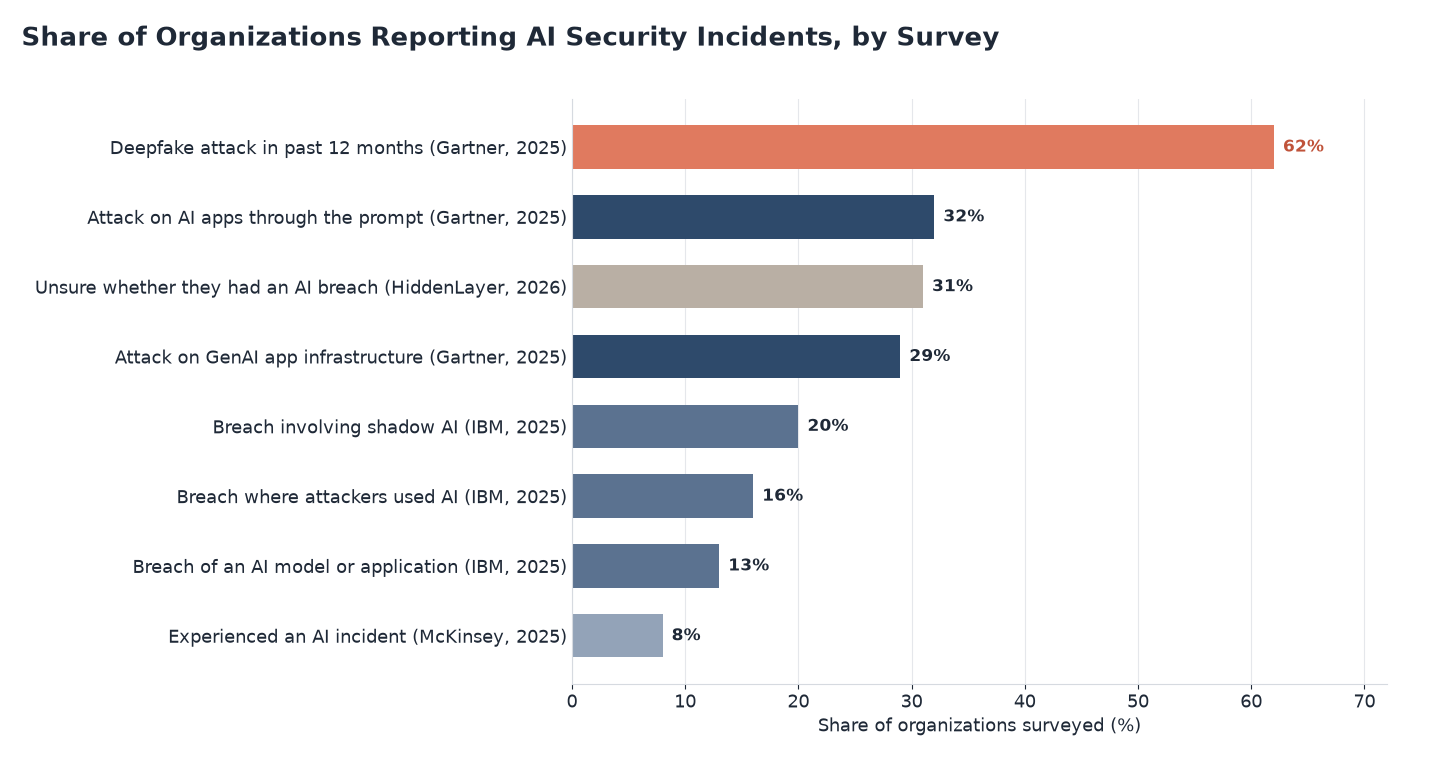
Source: AI Services Companies analysis of Gartner, HiddenLayer, IBM, and McKinsey survey results, conducted November 2026.
Key Findings
- Many incidents go unreported. 53% of HiddenLayer's 2026 respondents said they had withheld breach reporting for fear of backlash, even though 85% support mandatory breach disclosure, and another 8% of IBM's breached organizations did not know whether an AI model or application was involved.7,3
- Organizations that do report AI incidents are reporting more of them. In McKinsey's survey, the share of affected organizations with three to five incidents rose from 30% in 2024 to 50% in 2025, and the share rating their response as excellent fell from 28% to 18%.2
- The gap between the 8% and 74% figures comes mostly from who is asked and how an incident is defined, so a single share of organizations hit by AI attacks means little without its survey. HiddenLayer polls IT leaders, 89% of whom say AI models in production are critical to their organization's success, while McKinsey polls business leaders in general.2,6
Supply Chain Compromise Was the Most Common Cause of AI Breaches
Knowing how often AI systems are breached matters less to a security team than knowing how they are breached. IBM's 2025 study was the first edition to ask organizations with an AI security incident what caused it and what it damaged, and HiddenLayer asked a similar question about where AI breaches came from.
| Category | Item | Share of organizations with an AI security incident |
|---|---|---|
| Cause | Supply chain compromise (apps, APIs, and plug-ins) | 30% |
| Cause | Model inversion | 24% |
| Cause | Model evasion | 21% |
| Cause | Prompt injection | 17% |
| Cause | Data poisoning | 15% |
| Impact | Operational disruption | 31% |
| Impact | Unauthorized access to sensitive data | 31% |
| Impact | Loss of data integrity | 29% |
| Impact | Financial loss | 23% |
| Impact | Reputational damage | 17% |
| Source of AI | Third-party vendor, delivered as SaaS | 29% |
| Source of AI | Trained in-house or open source | 26% |
| Source of AI | Third-party vendor, deployed on premises | 19% |
Source: AI Services Companies analysis of IBM, Cost of a Data Breach Report 2025, Figures 19 to 21, conducted November 2026. More than one response permitted. Data: ibm-ai-security-incident-types-and-impacts.csv
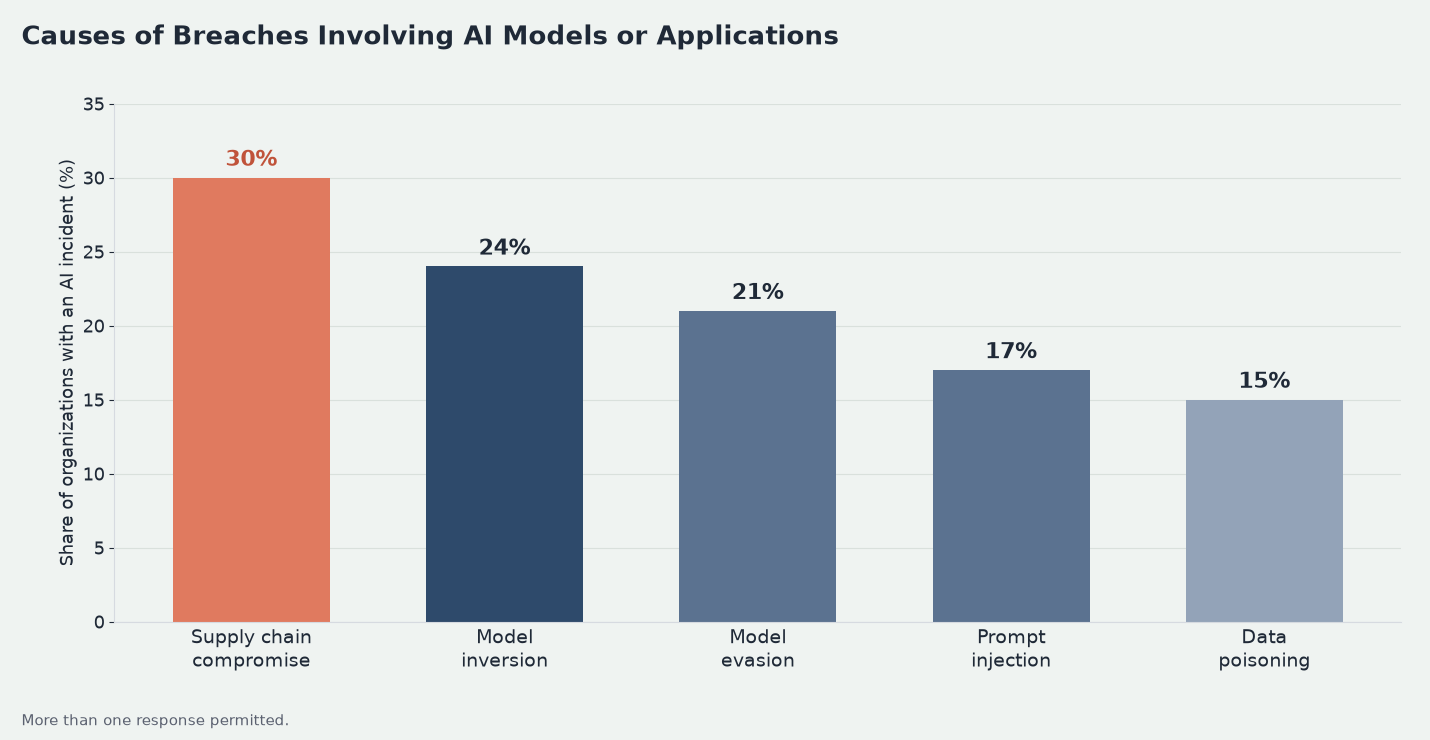
Source: AI Services Companies analysis of IBM, Cost of a Data Breach Report 2025, conducted November 2026.
Key Findings
- Third-party code is the weak point in both studies. Supply chain compromise led IBM's list at 30%, and HiddenLayer's 2026 respondents most often traced AI breaches to malware hidden in public model and code repositories (35%), while 93% still rely on those repositories.4,7
- AI incidents usually reach company data. IBM found that 60% of AI-related security incidents led to compromised data and 31% to operational disruption, and HiddenLayer found that autonomous agents were linked to more than 1 in 8 reported AI breaches in its 2026 survey.3,7
- Prompt injection ranked fourth in IBM's data at 17%, but CrowdStrike found attackers injecting malicious prompts into legitimate GenAI tools at more than 90 organizations in 2025. As more companies give AI agents access to email, files, and code, attacks that plant instructions in content an agent reads have more systems to reach.4,9
Breach Costs Fell Globally in 2025 but Reached a Record in the US
Cost is the figure most often quoted alongside incident counts. IBM and the Ponemon Institute have measured the average cost of a data breach every year, and the 2025 edition also priced the extra cost of shadow AI, the use of AI tools at work that IT has not approved.
| Measure | Study year | Average cost |
|---|---|---|
| Global average cost of a data breach | 2018 | $3.86 million |
| Global average cost of a data breach | 2019 | $3.92 million |
| Global average cost of a data breach | 2020 | $3.86 million |
| Global average cost of a data breach | 2021 | $4.24 million |
| Global average cost of a data breach | 2022 | $4.35 million |
| Global average cost of a data breach | 2023 | $4.45 million |
| Global average cost of a data breach | 2024 | $4.88 million |
| Global average cost of a data breach | 2025 | $4.44 million |
| US average cost of a data breach | 2024 | $9.36 million |
| US average cost of a data breach | 2025 | $10.22 million |
| Breach at organizations with high levels of shadow AI | 2025 | $4.74 million |
| Breach at organizations with low or no shadow AI | 2025 | $4.07 million |
| Healthcare, the costliest industry | 2025 | $7.42 million |
Source: AI Services Companies analysis of IBM, Cost of a Data Breach Report 2025 and the IBM news release of July 30, 2025, conducted November 2026. Data: average-data-breach-cost-2018-2025.csv
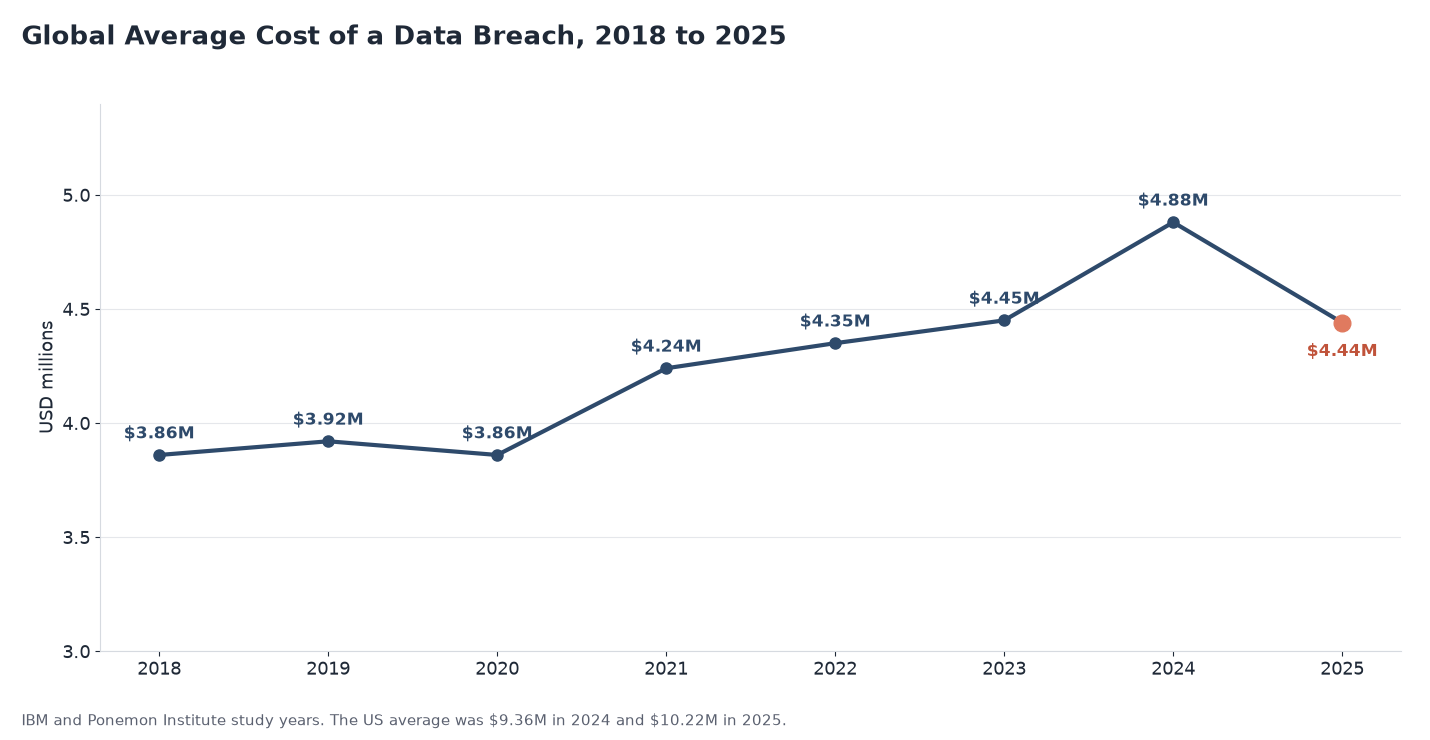
Source: AI Services Companies analysis of IBM, Cost of a Data Breach Report 2025, conducted November 2026.
Key Findings
- The global average fell 9% in 2025, the first decline in five years, which IBM tied to faster detection and containment. The US average rose 9% to $10.22 million, driven in part by higher regulatory fines and detection costs.4
- AI cuts costs on the defense side. Organizations that used AI and automation extensively in security operations saved an average of $1.9 million per breach and shortened the breach lifecycle by 80 days.3
- Governance gaps sit behind the shadow AI premium. 63% of breached organizations had no AI governance policy or were still developing one, and only 34% of those with a policy audited regularly for unsanctioned AI. Only 37% of organizations had policies to manage AI or detect shadow AI, which leaves most of them unable to see the tools behind the $670,000 difference.3
AI-Related Fraud Complaints to the FBI Reported $893 Million in Losses in 2025
Government complaint data shows the consumer and small-business side of AI misuse, which company surveys miss. The FBI's Internet Crime Complaint Center counts complaints that mention artificial intelligence in its 2025 annual report, so we broke them out by crime type.
| Crime type | AI-related complaints | Reported losses |
|---|---|---|
| Investment | 4,356 | $632,041,188 |
| Business email compromise | 135 | $30,256,592 |
| Tech or customer support | 574 | $19,457,078 |
| Confidence or romance | 626 | $19,041,653 |
| Personal data breach | 1,204 | $18,767,964 |
| Employment | 691 | $12,550,185 |
| Phishing or spoofing | 803 | $10,283,732 |
| IPR, copyright, and counterfeit | 63 | $10,103,789 |
| Government impersonation | 260 | $7,061,628 |
| Extortion | 1,764 | $2,940,642 |
| All AI-related complaints | 22,364 | $893,346,472 |
| AI-related complaints from people aged 60 and over | 3,143 | $352,496,231 |
Source: AI Services Companies analysis of FBI Internet Crime Complaint Center, 2025 IC3 Annual Report, AI References by Complaint Count and by Complaint Loss, conducted November 2026. Ten largest crime types by loss shown; a complaint can carry more than one crime type. Data: fbi-ic3-ai-related-complaints-by-crime-type-2025.csv
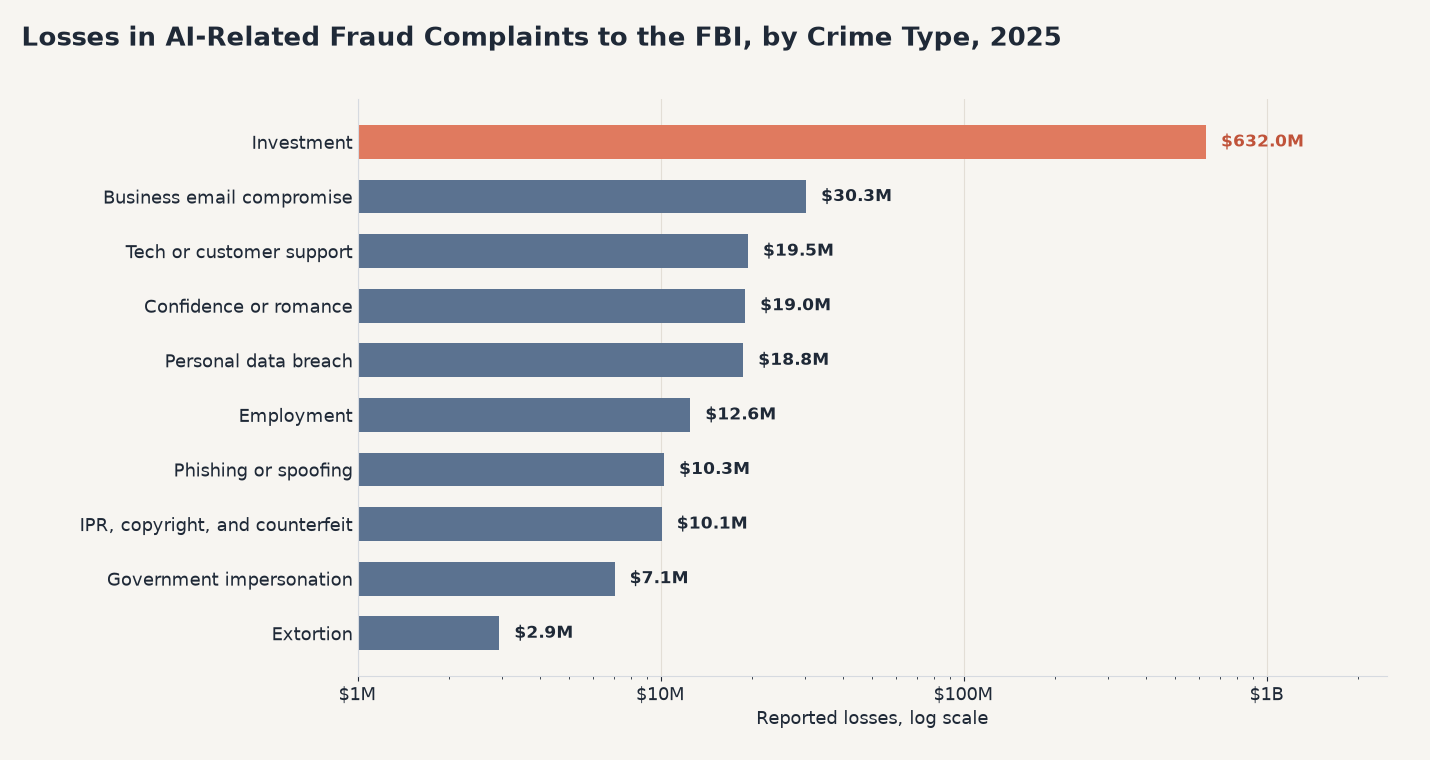
Source: AI Services Companies analysis of FBI Internet Crime Complaint Center, 2025 IC3 Annual Report, conducted November 2026.
Key Findings
- Investment scams account for 71% of AI-related losses. The FBI says investment schemes use AI-generated videos and voices of celebrities and executives to draw victims in.8
- AI-related complaints were 2.2% of the 1,008,597 complaints the FBI received in 2025 but 4.3% of the $20.877 billion in reported losses. The average AI-related complaint carried about $39,946 in losses, close to twice the $20,699 average across all complaints.8
- Older Americans carry a large share of the cost. People aged 60 and over filed 3,143 of the AI-related complaints but reported $352.5 million, or 39% of AI-related losses. The FBI notes that all investment scam losses exceeded $8 billion in 2025, against $632 million in complaints with a reported AI link, which shows many victims do not realize AI was involved.8
How Attackers Used AI in Documented Incidents
Statistics on attack rates are easier to read next to specific cases. We collected the main figures threat intelligence teams published on attackers' use of AI, along with several documented incidents that reporters and security teams cite most often.
| Source and date | Incident or measure | Figure |
|---|---|---|
| CrowdStrike, Feb 2026 | Year-over-year increase in operations by AI-enabled adversaries, 2025 | 89% |
| CrowdStrike, Feb 2026 | Organizations where attackers injected malicious prompts into legitimate GenAI tools | More than 90 |
| CrowdStrike, Feb 2026 | Average eCrime breakout time in 2025 (fastest observed) | 29 minutes (27 seconds) |
| Microsoft, Oct 2025 | Click-through rate of AI-automated phishing emails versus other phishing, July 2024 to June 2025 | 54% vs 12% |
| Microsoft, Oct 2025 | Samples of AI-generated content from government-backed groups: July 2023, July 2024, January 2025, July 2025 | 0, 50, about 125, about 225 |
| IBM, Jul 2025 | Breaches involving attackers using AI that used AI-generated phishing or deepfake impersonation | 37% and 35% |
| IBM, Jul 2025 | Time to write a convincing phishing email with and without generative AI | 5 minutes vs 16 hours |
| Arup, Jan 2024 (confirmed May 2024) | Hong Kong finance employee paid out after a video call with deepfakes of the CFO and colleagues, across 15 transfers | About $25.6 million |
| Microsoft 365 Copilot, Jun 2025 | EchoLeak, CVE-2025-32711: AI command injection that let an unauthorized attacker disclose information over a network | Published June 11, 2025 |
| Anthropic, Nov 2025 | State-sponsored espionage campaign using Claude Code against roughly 30 targets, with a small number of successful intrusions | 80% to 90% of the work done by AI |
Source: AI Services Companies analysis of CrowdStrike, Microsoft via The Register, IBM, CNN, NIST National Vulnerability Database, and Anthropic, conducted November 2026. Data: attacker-ai-use-and-documented-incidents.csv
Key Findings
- Attackers now use AI on both ends of an intrusion. CrowdStrike tracked Russia-linked FANCY BEAR deploying malware that uses a large language model to automate reconnaissance, and Anthropic reported that human operators stepped in at only about four to six decision points per campaign in the espionage case it disrupted.9,13
- Deepfakes turn ordinary payment approvals into an attack surface. In the Arup case, the employee first suspected a phishing email but sent the money after a video call in which every other participant was a deepfake, and Arup said none of its internal systems were compromised.11
- Faster attacks shrink the time defenders have to respond. With average breakout times under half an hour and AI-written phishing clicked 4.5 times as often, leave less time for detection and response that depend on a person reviewing each alert.9,10
What AI Security Incident Statistics Mean for Organizations in 2026
AI incidents are now a routine part of security work. Public databases recorded more incidents in 2025 than in any earlier year, most organizations in Gartner's survey had faced a deepfake attack, and AI-related complaints to the FBI carried close to $900 million in reported losses in 2025.
The figures also show where the risk sits. Breaches of AI systems most often start in third-party apps, plug-ins, and public model repositories, they usually reach company data, and they hit organizations that never set access controls or approval rules for AI. Our shadow AI usage statistics and AI governance and compliance statistics show how far those controls trail employee AI use.
So if you are citing AI security incident figures, give the source, sample, and period with each number, since the share of organizations reporting an AI incident ranges from 8% to 74% depending on who was asked and how an incident was defined.
Data Collection and Methodology
We collected published counts, percentages, and dollar figures from 10 reports and databases released between May 2024 and March 2026, plus three documented incidents. Yearly AI Incident Database counts for 2012 through 2025 come from the chart of reported AI incidents in the Stanford AI Index Report 2026; the report labels only the 2025 value (362), so we read the other years from the figure's bar heights in the published PDF, which resolve to whole numbers. The AI Index text compares 2025 with the 233 incidents its 2025 edition counted for 2024; in the 2026 edition's chart, 2024 has been revised to 281 as the database added records. OECD AI Incidents and Hazards Monitor figures and McKinsey survey results come from the same AI Index chapter.
IBM's 2025 Cost of a Data Breach Report, conducted by the Ponemon Institute, covers 600 organizations breached from March 2024 through February 2025, and its study years are shown as the report labels them. Gartner surveyed 302 cybersecurity leaders in North America, EMEA, and Asia/Pacific from March to May 2025. HiddenLayer surveyed 250 IT leaders for its 2025 report (released March 2025, covering 2024) and 250 IT and security leaders for its 2026 report (released March 18, 2026). The FBI counts a complaint as AI-related when the information reported contains a reference to artificial intelligence; its loss figures are adjusted losses as reported by complainants. Microsoft's Digital Defense Report 2025 covers its fiscal year from July 2024 through June 2025, and we took its figures from The Register's report on the study. CrowdStrike's 2026 Global Threat Report covers 2025.
Survey measures differ in wording, sample, and time window, so we show each figure with its own source and do not average them. All money is in US dollars as published; the Arup loss is the US dollar conversion of HK$200 million reported by CNN. We calculated products, differences, and ratios from the published values.
Sources (13)
- AI Services Companies analysis of AI incident databases, breach studies, security surveys, FBI complaint data, and threat reports from 10 published sources, conducted November 2026.
- Stanford HAI, AI Index Report 2026, Chapter 3: Responsible AI (April 2026)
- IBM, IBM Report: 13% Of Organizations Reported Breaches Of AI Models Or Applications, 97% Of Which Reported Lacking Proper AI Access Controls (July 30, 2025)
- IBM and Ponemon Institute, Cost of a Data Breach Report 2025 (July 2025)
- Gartner, Gartner Survey Reveals GenAI Attacks Are on the Rise (September 22, 2025)
- HiddenLayer, AI Threat Landscape Report Reveals AI Breaches on the Rise (2025 report release)
- HiddenLayer, HiddenLayer Releases the 2026 AI Threat Landscape Report (March 18, 2026)
- FBI Internet Crime Complaint Center, 2025 IC3 Annual Report (April 2026)
- CrowdStrike, 2026 CrowdStrike Global Threat Report: AI Accelerates Adversaries and Reshapes the Attack Surface (February 24, 2026)
- The Register, AI makes phishing 4.5x more effective, Microsoft says, on the Microsoft Digital Defense Report 2025 (October 16, 2025)
- CNN, British engineering giant Arup revealed as $25 million deepfake scam victim (May 16, 2024)
- NIST National Vulnerability Database, CVE-2025-32711 (published June 11, 2025)
- Anthropic, Disrupting the first reported AI-orchestrated cyber espionage campaign (November 13, 2025)