
Shadow AI Usage Statistics 2026
Published November 9, 2026
Our analysts compared 18 published surveys and security telemetry reports released between November 2023 and September 2026, including KPMG's survey of 1,019 US respondents, PagerDuty's Shadow AI Survey of 1,250 office professionals, Netskope's Cloud and Threat Report 2026, and IBM's 2025 Cost of a Data Breach Report, to show how many employees use unapproved AI tools at work as of Q4 2026, what they share with those tools, and what it costs when it goes wrong.
Key Findings
- 44% of US workers knowingly use AI at work in ways their employer has not authorized, and 46% have uploaded sensitive company information or intellectual property to public AI platforms (KPMG, April 2025).2
- 66% of office professionals at companies with $500 million or more in revenue have used AI tools they believed were not permitted (PagerDuty, June 2026), and 45% of workers at enterprises with 1,000 or more employees used unsanctioned AI in the past 30 days (WalkMe, April 2026).3,5
- The share of workplace generative AI users on personal AI accounts fell from 78% to 47% in the year to October 2025, while use of company-managed accounts rose from 25% to 62% (Netskope).9
- 20% of the breached organizations IBM studied had a breach linked to shadow AI, which added as much as $670,000 to the average breach cost; breaches involving shadow AI averaged $4.63 million against a $4.44 million global average.20,21
- IT and telecoms workers report the highest shadow AI use at 73%, followed by finance at 59%, while healthcare workers report 41% and education is lowest at 38% (TrustedTech, September 2026).15
Shadow AI is the use of AI tools at work that the employer's IT or security team has not approved, often a free or personal ChatGPT, Gemini, or Copilot account opened in a browser. Employees turn to these tools because they save time, and many of them first learned the tools at home. The risk for the employer is that emails, customer records, source code, and financial documents end up in services the company cannot see, control, or delete from. Shadow AI figures appear in a great deal of security and workplace coverage, yet the surveys behind them ask very different questions. We wanted one place where the main numbers appear side by side with their samples and dates.
Our analysts took employee survey results from KPMG and the University of Melbourne, PagerDuty and Wakefield Research, BlackFog, WalkMe, UpGuard, Deloitte UK, Software AG, Salesforce, Microsoft and LinkedIn, TrustedTech, Wolters Kluwer, and ManageEngine. We added security telemetry from Netskope and Cyberhaven, which measure what employees do on company networks, and breach-cost data from IBM's 2025 Cost of a Data Breach Report. Cisco and Gartner supplied figures on bans and on what security leaders see. US results come first wherever a study reports them separately, and all money is in US dollars.
In the following sections, we compare headline shadow AI rates across surveys, how the picture changed from 2023 to 2026, which AI tools employees use and which ones companies block, what data employees share, how use differs by industry and role, and what policies, bans, and breaches show about the cost of shadow AI.
Between 31% and 88% of Workers Use Unapproved AI, Depending on the Survey
Each survey words its shadow AI question a little differently. Some ask about tools a worker believed were banned, some about any tool IT never approved, and some only about the past 30 days, so we lined up the main 2025 and 2026 results with the sample behind each one.
| Survey | Fieldwork or release | Sample | Measure | Share |
|---|---|---|---|---|
| KPMG and University of Melbourne | Nov 2024 to Jan 2025 | 1,019 US respondents | US workers using AI at work without knowing whether it is allowed | 50% |
| KPMG and University of Melbourne | Nov 2024 to Jan 2025 | 1,019 US respondents | US workers knowingly using AI without authorization or improperly | 44% |
| PagerDuty and Wakefield Research | Released Jun 2026 | 1,250 office professionals at $500M+ revenue firms (500 in the US) | Used AI tools they believed were not permitted | 66% |
| BlackFog | Released Jan 2026 | 2,000 workers at companies with 500+ employees | Adopted AI tools without employer approval | 49% |
| WalkMe | Released Apr 2026 | 2,050 workers at enterprises with 1,000+ employees, 14 countries | Used unsanctioned AI tools in the past 30 days | 45% |
| UpGuard | Jul to Aug 2025 | 1,020 US and UK employees | Use unapproved AI tools | 81% |
| UpGuard | Aug 2025 | 542 security leaders | Use unapproved AI tools | 88% |
| Deloitte UK | May to Jun 2026 | UK workers who use GenAI for work | Use GenAI at work without their employer knowing | 31% |
Source: AI Services Companies analysis of KPMG, PagerDuty, BlackFog via CIO, WalkMe, UpGuard, and Deloitte UK survey results, conducted November 2026. Data: shadow-ai-usage-rates-by-survey.csv
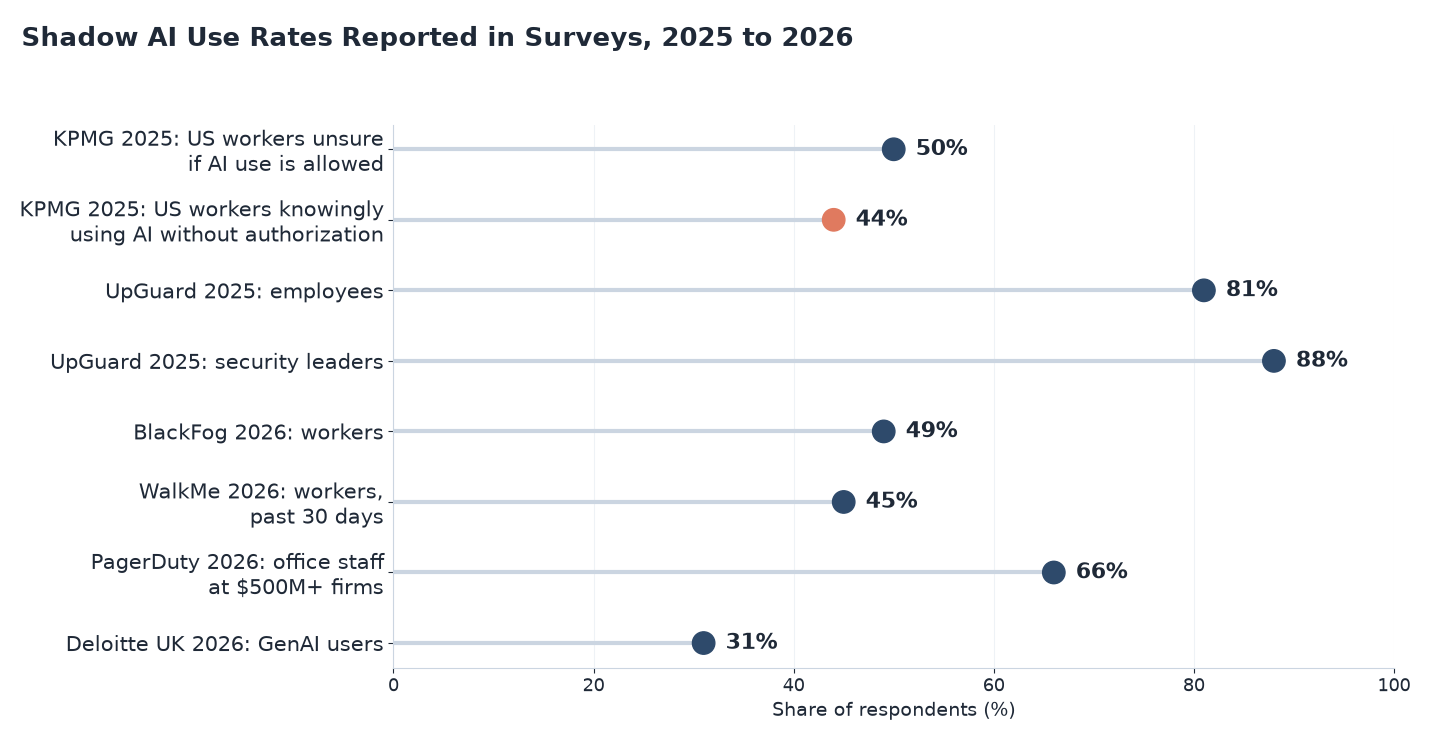
Source: AI Services Companies analysis of KPMG, UpGuard, BlackFog, WalkMe, PagerDuty, and Deloitte UK survey results, conducted November 2026.
Key Findings
- Senior people break the rules too. 69% of presidents and C-suite members and 66% of directors and senior vice presidents in BlackFog's sample are comfortable with unapproved AI use when it speeds up work, and UpGuard found 88% of security leaders using unapproved tools.4,6
- Older studies show the same pattern. Microsoft and LinkedIn found in 2024 that 78% of AI users brought their own AI tools to work, and Software AG found in late 2024 that about half of knowledge workers used shadow AI.13,14
- Many workers do not know where the line is. Half of US workers in KPMG's study use AI without knowing whether it is allowed, and 34% of WalkMe's workers do not know which AI tools their employer approves, even though 86% of PagerDuty's respondents believe their company has an AI policy. A written policy that staff cannot interpret does little to bring these rates down.2,5,3
Personal AI Accounts Declined from 2024 to 2025 While AI Use Kept Growing
Survey questions changed from year to year, so we paired the annual survey readings with two telemetry series that measure the same thing each time: Netskope's count of which accounts employees use to reach AI apps, and Cyberhaven's measure of how much of the data sent to AI tools is sensitive.
| Year | Measure | Value | Source |
|---|---|---|---|
| 2023 | Generative AI users at work using tools without formal employer approval | More than half | Salesforce (14,000+ workers, 14 countries) |
| 2023 | Share of corporate data put into AI tools that is sensitive (March) | 10.7% | Cyberhaven |
| 2024 | AI users bringing their own AI tools to work | 78% | Microsoft and LinkedIn (31,000 people, 31 countries) |
| 2024 | ChatGPT use at work through non-corporate accounts (March) | 73.8% | Cyberhaven |
| 2024 | Share of corporate data put into AI tools that is sensitive (March) | 27.4% | Cyberhaven |
| 2024 | Knowledge workers using shadow AI (US, UK, and Germany) | About half | Software AG (6,000 workers) |
| 2024 | Generative AI users on personal AI accounts (year-earlier baseline) | 78% | Netskope |
| 2025 | Generative AI users on personal AI accounts (October) | 47% | Netskope |
| 2025 | Generative AI users on company-managed AI accounts (October) | 62% | Netskope |
| 2025 | Share of corporate data put into AI tools that is sensitive | 34.8% | Cyberhaven |
| 2025 | US workers knowingly using AI without authorization | 44% | KPMG |
| 2026 | Office professionals who used AI they believed was not permitted | 66% | PagerDuty |
| 2026 | Workers using unsanctioned AI in the past 30 days | 45% | WalkMe |
Source: AI Services Companies analysis of Salesforce, Cyberhaven 2024, Cyberhaven 2025, Microsoft and LinkedIn, Software AG via eWeek, Netskope, KPMG, PagerDuty, and WalkMe data, conducted November 2026. Data: shadow-ai-trend-2023-2026.csv
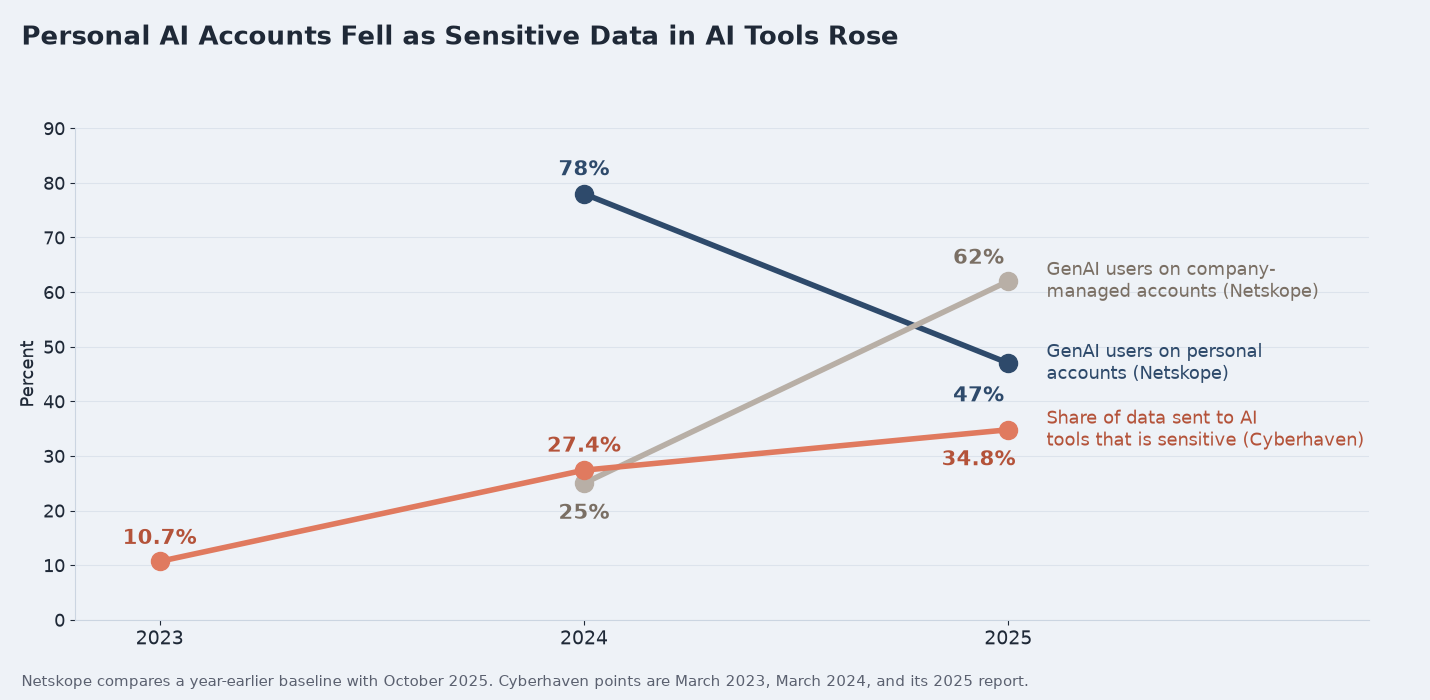
Source: Netskope Threat Labs, Cloud and Threat Report: 2026; Cyberhaven 2024 and 2025 AI adoption reports.
Key Findings
- Netskope found that the number of people using SaaS generative AI apps tripled in the average organization over the year, and prompts rose sixfold from 3,000 to 18,000 a month. The share of users switching between personal and company accounts grew from 4% to 9%.9
- Because users tripled while the personal-account share fell by about two-fifths, the number of people on personal AI accounts in the average organization still grew, by an estimated 1.8 times. Cyberhaven also measured AI usage frequency at work rising 4.6 times in one year and 61 times in two years.9,11
- Company-managed accounts now cover most AI users, which gives security teams more visibility than they had in 2024. The same data points to more total shadow AI activity through 2025, since overall AI use grew faster than the personal-account share fell.
ChatGPT and Gemini Lead Workplace AI Use, and DeepSeek Is Among the Most Blocked
Employers and reporters both ask which AI apps employees are reaching for, so we compared the apps organizations see on their networks, the ones they block outright, and how much use of the biggest apps ran through personal accounts.
| App | Organizations where it is in use (2025) | Organizations actively blocking it (2025) | Work use through non-corporate accounts (March 2024) |
|---|---|---|---|
| ChatGPT | 77% | n/a | 73.8% |
| Google Gemini | 69% | n/a | 94.4% |
| Microsoft 365 Copilot | 52% | n/a | n/a |
| Perplexity | 35% | n/a | n/a |
| Grok | 28% | n/a | n/a |
| ZeroGPT | n/a | 45% | n/a |
| DeepSeek | n/a | 43% | n/a |
Source: AI Services Companies analysis of Netskope Cloud and Threat Report: 2026 and Cyberhaven, May 2024, conducted November 2026. Data: genai-apps-used-and-blocked.csv
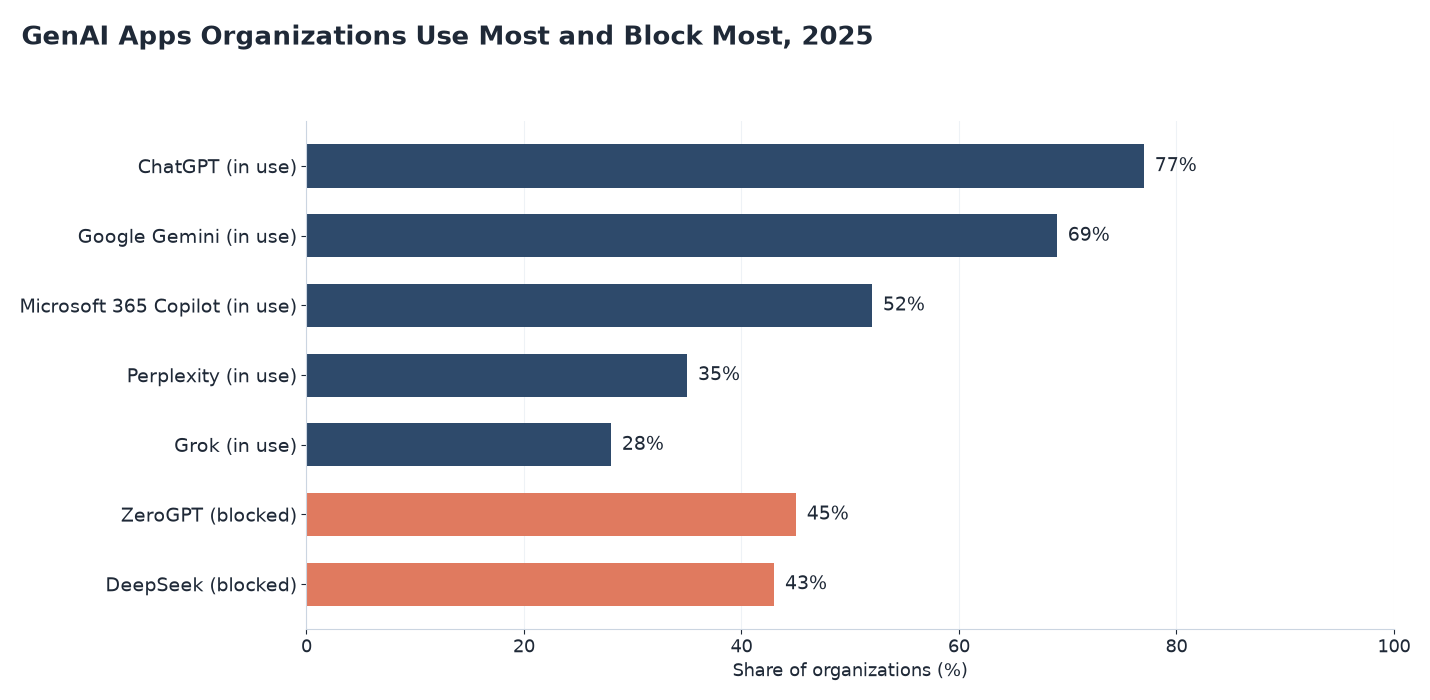
Source: Netskope Threat Labs, Cloud and Threat Report: 2026.
Key Findings
- Google Gemini rose from 46% to 69% of organizations over the year and Perplexity from 23% to 35%, while ChatGPT averaged 77%. Grok, once one of the most frequently blocked apps, began gaining ground in April 2025 and reached 28%.9
- 90% of organizations actively block at least one generative AI app, and the average organization blocks 10. Netskope tracked more than 1,600 generative AI apps, up from 317 a year earlier, yet the average organization uses 8, up from 6.9
- Free versions dominate shadow use: 58% of BlackFog respondents who use non-approved tools rely on free versions, and 34% of workers at companies that allow AI still choose the free version of an approved tool. Paid enterprise plans typically let the company turn off model training on its data, while virtually all free tools use what they ingest to train their models.4
Most Office Staff Have Put Work Information into Public AI Tools
The main harm from shadow AI comes from what employees paste into it, so we gathered the survey results on which kinds of company information workers say they have shared, along with what security tools catch on company networks.
| Information shared | Share of respondents | Survey |
|---|---|---|
| Any work-related information, with public AI tools | 88% | PagerDuty, 2026 |
| Emails and other correspondence | 43% | PagerDuty, 2026 |
| Meeting notes or summaries | 40% | PagerDuty, 2026 |
| Customer data or information | 34% | PagerDuty, 2026 |
| Financial information or confidential documents and strategies | 31% | PagerDuty, 2026 |
| Enterprise research or datasets, in unsanctioned tools | 33% | BlackFog, 2026 |
| Employee data such as salary or performance tracking | 27% | BlackFog, 2026 |
| Company financial information | 23% | BlackFog, 2026 |
| Sensitive company information or intellectual property, to public AI platforms (US workers) | 46% | KPMG, 2025 |
| Used unsanctioned AI with confidential data in the past 30 days | 36% | WalkMe, 2026 |
| Privacy and security professionals who have entered non-public company information into GenAI tools | 48% | Cisco, 2024 |
| Privacy and security professionals who have entered employee information into GenAI tools | 45% | Cisco, 2024 |
Source: AI Services Companies analysis of PagerDuty, BlackFog, KPMG, WalkMe, and Cisco 2024 Data Privacy Benchmark Study results, conducted November 2026. Data: data-shared-with-public-ai-tools.csv
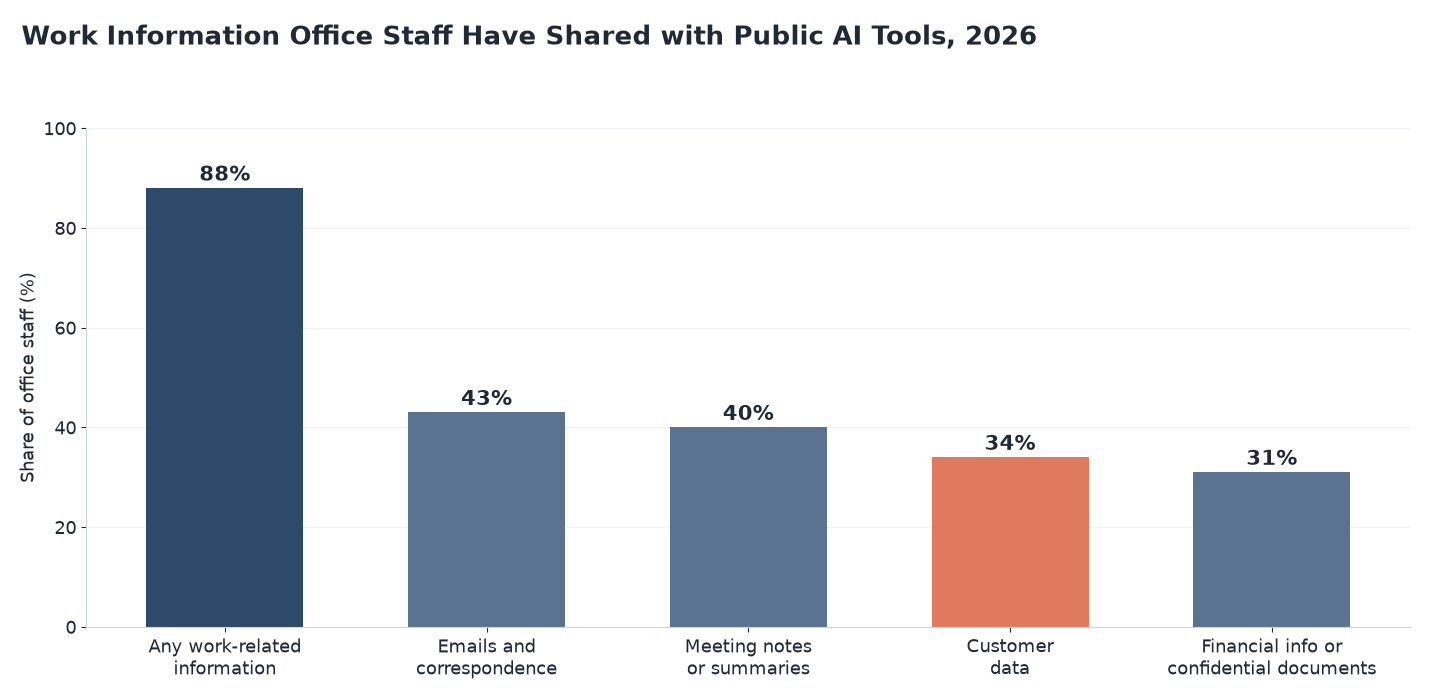
Source: PagerDuty Shadow AI Survey, June 2026.
Key Findings
- Netskope found that generative AI data policy violations doubled over the year, with the average organization logging 223 a month. Source code made up 42% of violations, regulated data 32%, and intellectual property 16%.9
- Cyberhaven reports that 34.8% of the corporate data employees put into AI tools is sensitive, and 83.8% of enterprise data flowing into AI tools goes to platforms it rates as critical or high risk.11
- 70% of UpGuard's employees know of sensitive data being shared with AI tools at their workplace, and 23% of CISOs know that passwords and other credentials are being shared. Once that data is in a free tool, the company usually cannot get it back.7,4
IT and Finance Workers Report the Highest Shadow AI Use
Shadow AI is not spread evenly across the workforce, so we compared industry results from TrustedTech's survey of 2,001 US and UK employees with healthcare and seniority data from other studies.
| Industry | Use unapproved AI tools | Would keep using AI if banned and disciplined | Recognize the risks |
|---|---|---|---|
| IT and telecoms | 73% | 48% | 84% |
| Finance | 59% | 41% | 80% |
| HR | 58% | 34% | n/a |
| Architecture, engineering, and building | 54% | 36% | n/a |
| Manufacturing and utilities | 52% | n/a | n/a |
| Healthcare | 41% | n/a | 76% |
| Education | 38% | 21% | 76% |
Source: AI Services Companies analysis of TrustedTech survey results reported by SecurityBrief UK, conducted November 2026. Data: shadow-ai-use-by-industry.csv
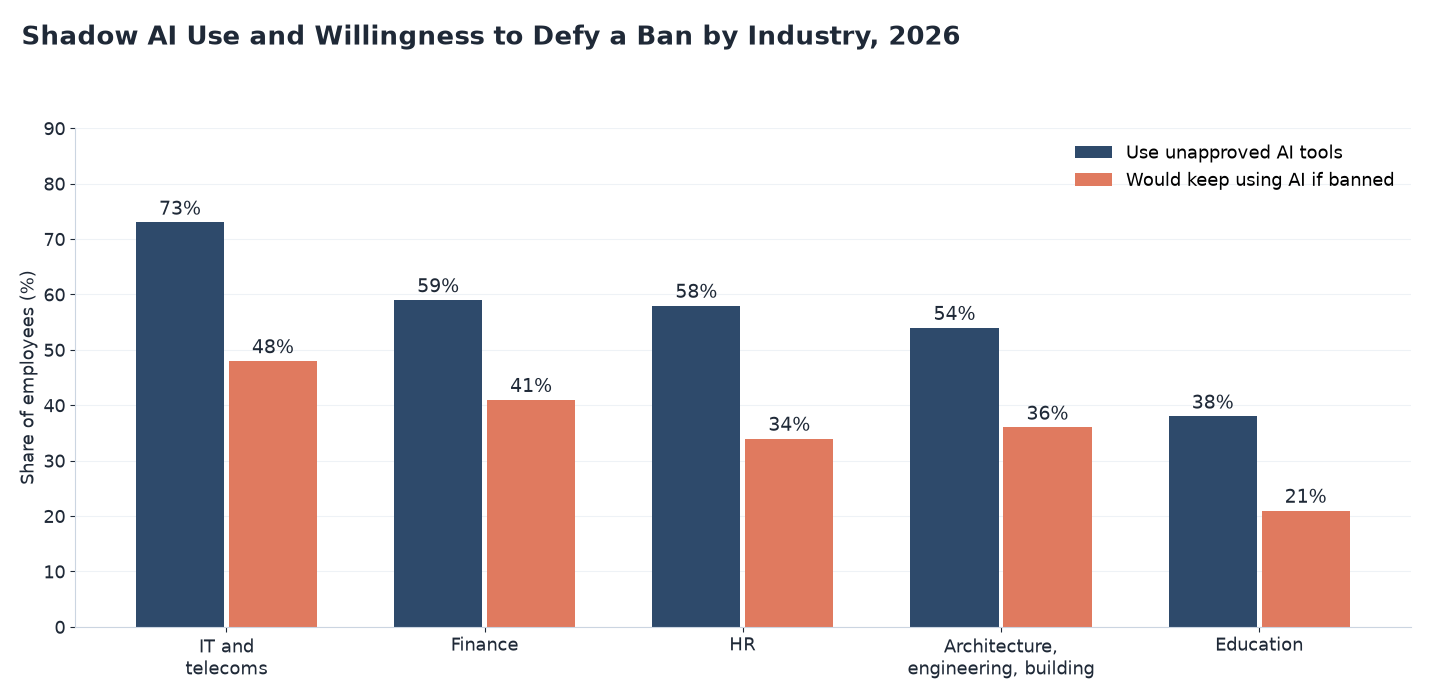
Source: TrustedTech, via SecurityBrief UK, September 2026.
Key Findings
- In US hospitals and health systems, 40% of healthcare professionals have encountered unauthorized AI tools and nearly 20% have used them, and one in 10 has used one for direct patient care (Wolters Kluwer, 518 respondents, December 2025).16
- Seniority cuts both ways. UpGuard found senior leaders 50% more likely to use shadow AI, and 81% of PagerDuty's office professionals believe leadership plays by different AI rules, rising to 85% at larger organizations. Cyberhaven, which measures all AI use, found mid-level employees using AI tools 3.5 times as much as their managers.7,3,11
- Knowing the risk does not stop use: in every TrustedTech sector the share who recognize the risks is higher than the share who avoid shadow AI. IT and telecoms workers are also the most likely to say their organization lacks clear AI guidance (57%) or enough training to use AI safely (58%).15
Shadow AI Breaches Cost More Than the Average Breach, and Most Policies Lag
Bans, approved-tool lists, and data loss prevention are how employers try to contain shadow AI, so we put the policy figures next to IBM's breach data to show what happens when those controls fall short.
| Measure | Value | Source |
|---|---|---|
| Breached organizations with a breach linked to shadow AI | 20% | IBM, 2025 |
| Added breach cost at organizations with high shadow AI use | Up to $670,000 | IBM, 2025 |
| Average cost of a breach involving shadow AI | $4.63 million | IBM, 2025 |
| Global average cost of a data breach | $4.44 million | IBM, 2025 |
| US average cost of a data breach | $10.22 million | IBM, 2025 |
| Shadow AI breaches that compromised customer personal data | 65% (53% for all breaches) | IBM, 2025 |
| Breached organizations with no AI governance policy or one still in development | 63% | IBM, 2025 |
| Organizations with AI governance policies that audit regularly for unsanctioned AI | 34% | IBM, 2025 |
| Organizations that banned GenAI, at least temporarily | 27% | Cisco, 2024 |
| Organizations limiting which GenAI tools employees can use | 61% | Cisco, 2024 |
| Organizations without enforceable data protection policies for GenAI apps | 50% | Netskope, 2026 |
| Security leaders who suspect or have evidence of prohibited public GenAI use | 69% | Gartner, 2025 |
| Knowledge workers who would keep using personal AI tools if banned | 46% | Software AG, 2024 |
| Workers who find workarounds to reach blocked AI apps | 45% | UpGuard, 2025 |
Source: AI Services Companies analysis of IBM Cost of a Data Breach Report 2025 figures (with VentureBeat coverage), Cisco, Netskope, Gartner, Software AG, and UpGuard, conducted November 2026. Data: shadow-ai-breach-costs.csv
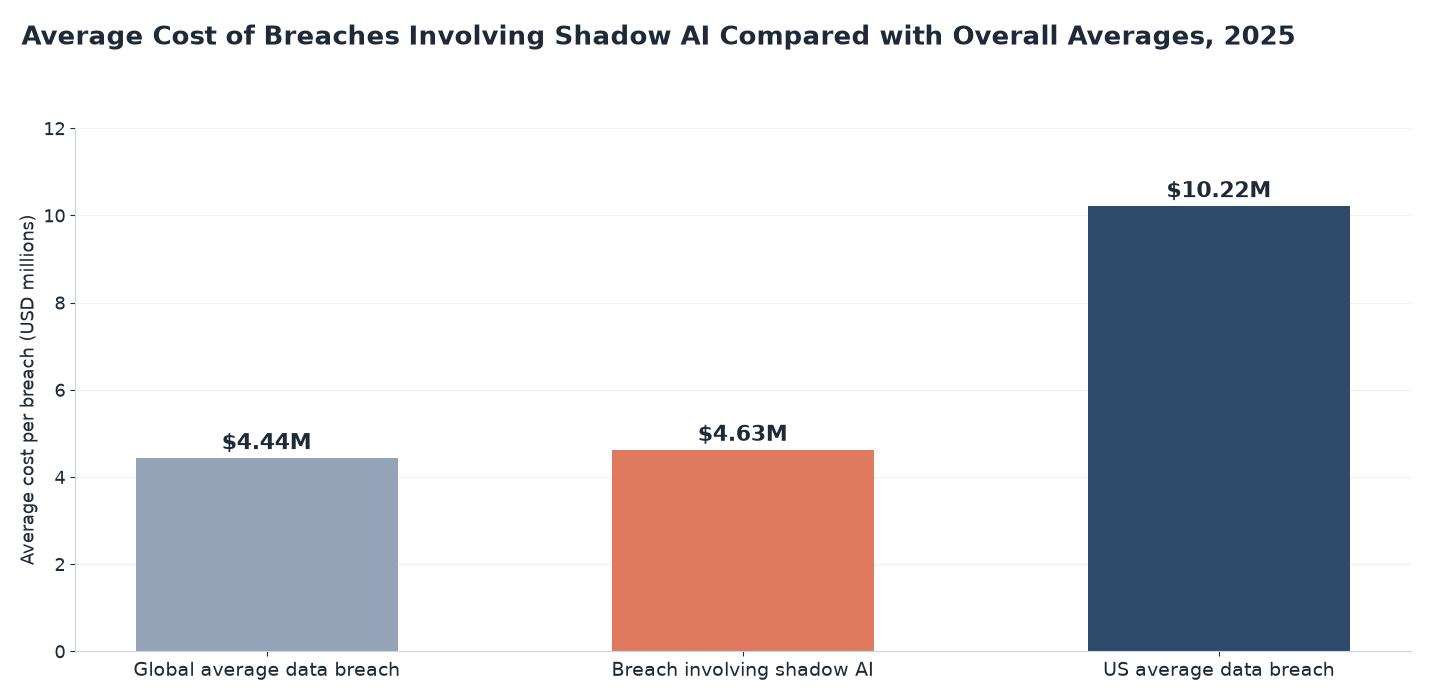
Source: IBM, Cost of a Data Breach Report 2025, as reported by VentureBeat.
Key Findings
- Intellectual property exposed in shadow AI breaches carried the highest cost per record at $178, and 97% of organizations that reported AI-related breaches lacked proper AI access controls.20
- Penalties are uneven. Of PagerDuty's respondents who used AI that may not have been allowed, 53% received informal feedback to stop and 48% faced formal consequences, and WalkMe found that 78% of executives want to discipline shadow AI use while only 21% of workers have ever been warned about AI policies.3,5
- Gartner predicts that by 2030 more than 40% of enterprises will have security or compliance incidents linked to shadow AI. In ManageEngine's US and Canada survey, the most common answer from IT decision makers on how to reduce shadow AI, at 63%, was integrating approved AI tools into standard workflows.19,17
What Shadow AI Usage Statistics Mean for Employers in 2026
Unapproved AI use is now an ordinary part of office work. Most surveys from 2025 and 2026 put it between about four in ten and eight in ten workers, and the rates are highest among technical staff, finance teams, and senior leaders. In ManageEngine's survey, the most common unapproved uses were summarizing meeting notes (56%), brainstorming ideas or content (55%), analyzing data or reports (47%), and drafting or editing emails and documents (47%).17
The trend is moving in two directions at once. Companies have moved most AI users onto managed accounts since 2024, but AI use grew so fast that the number of people on personal accounts and the sensitive share of data sent to AI tools both kept rising through 2025. IBM's breach figures show the cost of that gap, and our AI governance and compliance statistics and employee AI training statistics show how far policies, monitoring, and training still trail adoption.
So if you are reporting on shadow AI or setting policy for it, cite the survey's exact question, sample, and date along with the percentage, since surveys of similar office workers range from 31% to 81% depending on how the question is worded and who is asked.
Data Collection and Methodology
We collected published percentages, counts, and dollar figures from 18 studies released between November 2023 and September 2026 . Employee surveys: KPMG and the University of Melbourne (48,000+ people in 47 countries, including 1,019 in the US, November 2024 to January 2025); PagerDuty and Wakefield Research (1,250 office professionals in non-IT roles at organizations with $500 million or more in revenue in the US, UK, Australia, and Japan); BlackFog (2,000 workers at companies with more than 500 employees); WalkMe (3,750 respondents, including 2,050 workers, at enterprises with 1,000 or more employees in 14 countries); UpGuard (1,020 US and UK employees surveyed July 30 to August 11, 2025, and 542 security leaders surveyed August 18 to 31, 2025); Deloitte UK (GenAI Workforce Survey 2026, May to June 2026); Software AG (6,000 knowledge workers in the US, UK, and Germany); Salesforce and YouGov (14,000+ workers in 14 countries, October 18 to 31, 2023); Microsoft and LinkedIn (31,000 people in 31 countries); TrustedTech (2,001 UK and US employees); Wolters Kluwer and CITE Research (518 US healthcare professionals, December 2025); and ManageEngine (700 US and Canadian professionals and IT decision makers).
Telemetry and organization data: Netskope figures come from anonymized Netskope One platform data for October 1, 2024 through October 31, 2025, and its year-earlier values are shown as 2024. Cyberhaven figures come from its May 2024 analysis of 3 million workers (March 2023 and March 2024 data points) and its 2025 AI Adoption and Risk Report. Cisco's 2024 Data Privacy Benchmark Study surveyed 2,600 privacy and security professionals in 12 geographies, and Gartner surveyed 302 cybersecurity leaders from March to May 2025. IBM's 2025 Cost of a Data Breach Report, conducted with the Ponemon Institute, studied 600 breached organizations through 3,470 interviews; the $4.63 million, $4.44 million, and $10.22 million averages are taken from VentureBeat's report on the study, and the 20%, $670,000, 65%, 63%, 97%, and $178 figures from IBM's own summary.
Survey measures differ in wording, sample, and time window, so we show each figure with its own source and do not average them. Where a source gave a phrase such as "more than half" or "about half," we kept the phrase. We calculated products, differences, and ratios from the published values; the estimated 1.8-times growth in personal-account users multiplies Netskope's threefold user growth by the change in personal-account share (47% divided by 78%).
Sources (21)
- AI Services Companies analysis of shadow AI survey, telemetry, and breach-cost data from 18 published studies, conducted November 2026.
- KPMG, The American Trust in AI Paradox: Adoption Outpaces Governance (April 29, 2025)
- PagerDuty, PagerDuty Report Finds Two-Thirds (66%) of Office Professionals Have Used Unauthorized AI Tools at Work (June 11, 2026)
- CIO, Roughly half of employees are using unsanctioned AI tools, and enterprise leaders are major culprits, on BlackFog research (January 29, 2026)
- WalkMe, State of Digital Adoption 2026 news release (April 9, 2026)
- UpGuard, The State of Shadow AI report page
- UpGuard, State of Shadow AI news release and methodology (November 10, 2025)
- Deloitte UK, What we do in the AI shadows, GenAI Workforce Survey 2026
- Netskope Threat Labs, Cloud and Threat Report: 2026 (January 5, 2026)
- Cyberhaven, Surge in Shadow AI Accounts Poses Fresh Risks to Corporate Data (May 21, 2024)
- Cyberhaven Labs, 2025 AI Adoption and Risk Report
- Salesforce, More than Half of Generative AI Adopters Use Unapproved Tools at Work (November 15, 2023)
- Microsoft, Microsoft and LinkedIn release the 2024 Work Trend Index (May 8, 2024)
- eWeek, Software AG Study Shows Unauthorized Use of AI Tools at Work Rapidly Rising To Over 50% (November 28, 2024)
- SecurityBrief UK, IT and telecoms workers most likely to use shadow AI, on TrustedTech research (September 8, 2026)
- Wolters Kluwer, Survey finds broad presence of unsanctioned AI tools in hospitals and health systems (January 22, 2026)
- ManageEngine, The Shadow AI Surge in Enterprises: Insights from the US and Canada
- Cisco, More than 1 in 4 Organizations Banned Use of GenAI Over Privacy and Data Security Risks (January 25, 2024)
- Gartner, Gartner Identifies Critical GenAI Blind Spots That CIOs Must Urgently Address (November 19, 2025)
- IBM, What data leaders need to know from the Cost of a Data Breach Report 2025 (November 12, 2025)
- VentureBeat, Shadow AI adds $670K to breach costs while 97% of enterprises skip basic access controls, IBM reports (July 30, 2025)