
AI Translation Statistics 2026
Published November 24, 2026
Our analysts gathered figures from Nimdzi Insights, Microsoft Research, the U.S. Bureau of Labor Statistics, the Society of Authors, Google, and DeepL, published from 2016 to October 2026, to show how AI is changing the translation business, translation work, and the number of languages machines can translate as of Q4 2026.
Key Findings
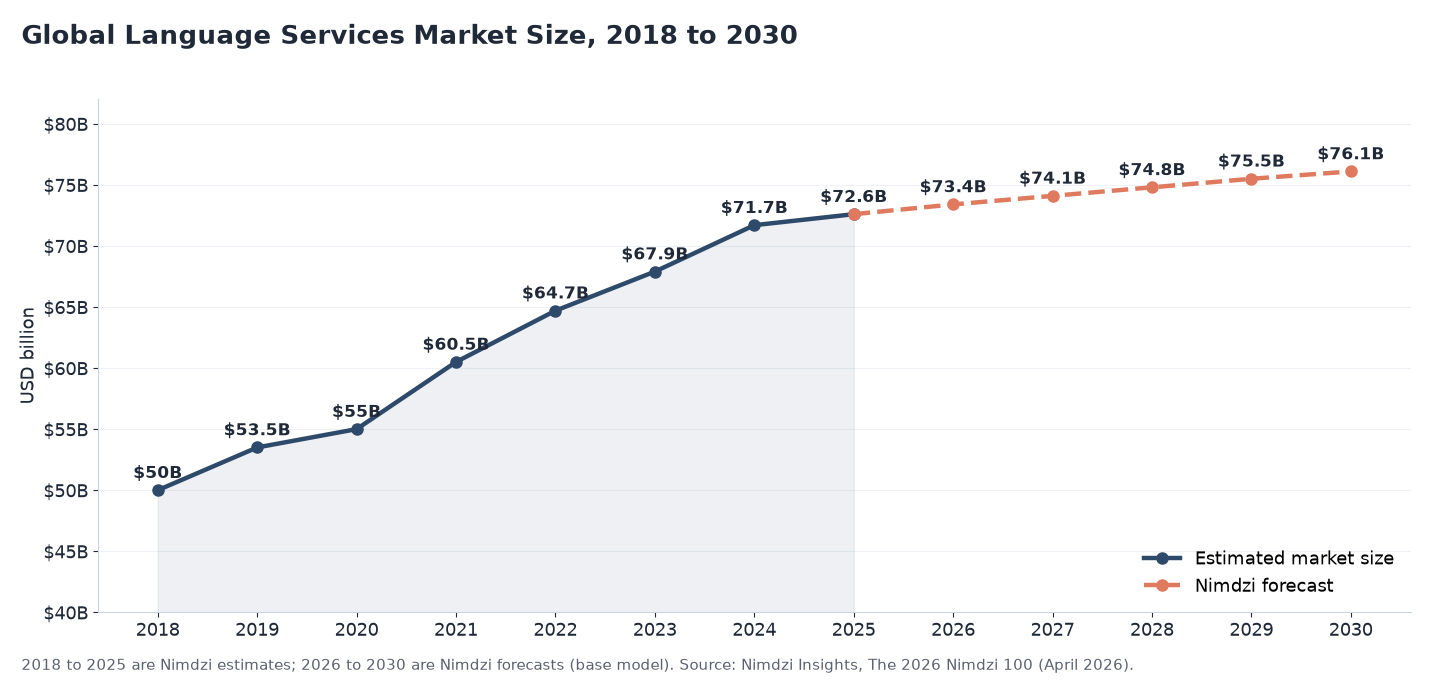
- Nimdzi estimates the global language services industry at $72.6 billion in 2025, up 1.2% from 2024, and forecasts growth below 1% a year to $76.1 billion by 2030.2
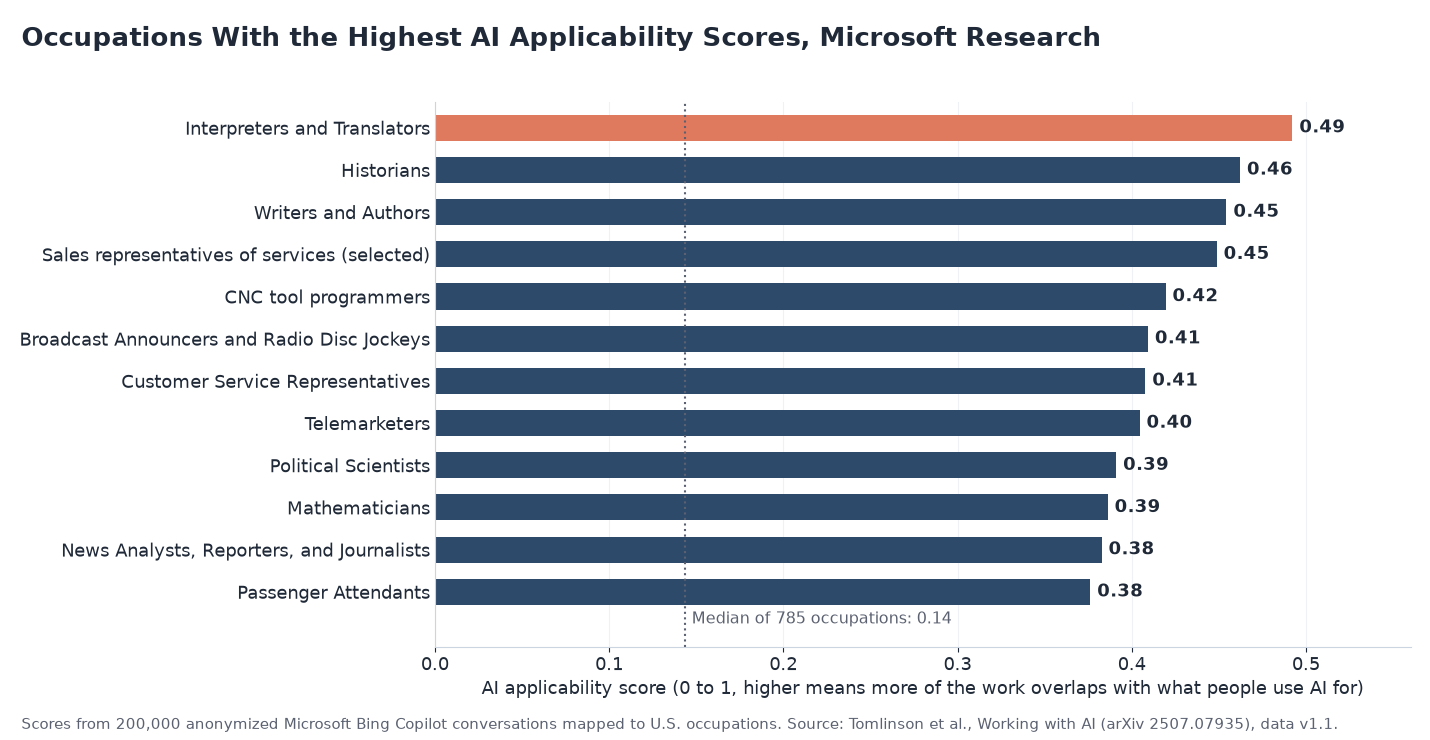
- Interpreters and translators have the highest AI applicability score of 785 U.S. occupations in Microsoft Research data, 0.49 against a median of 0.14.1,3,4
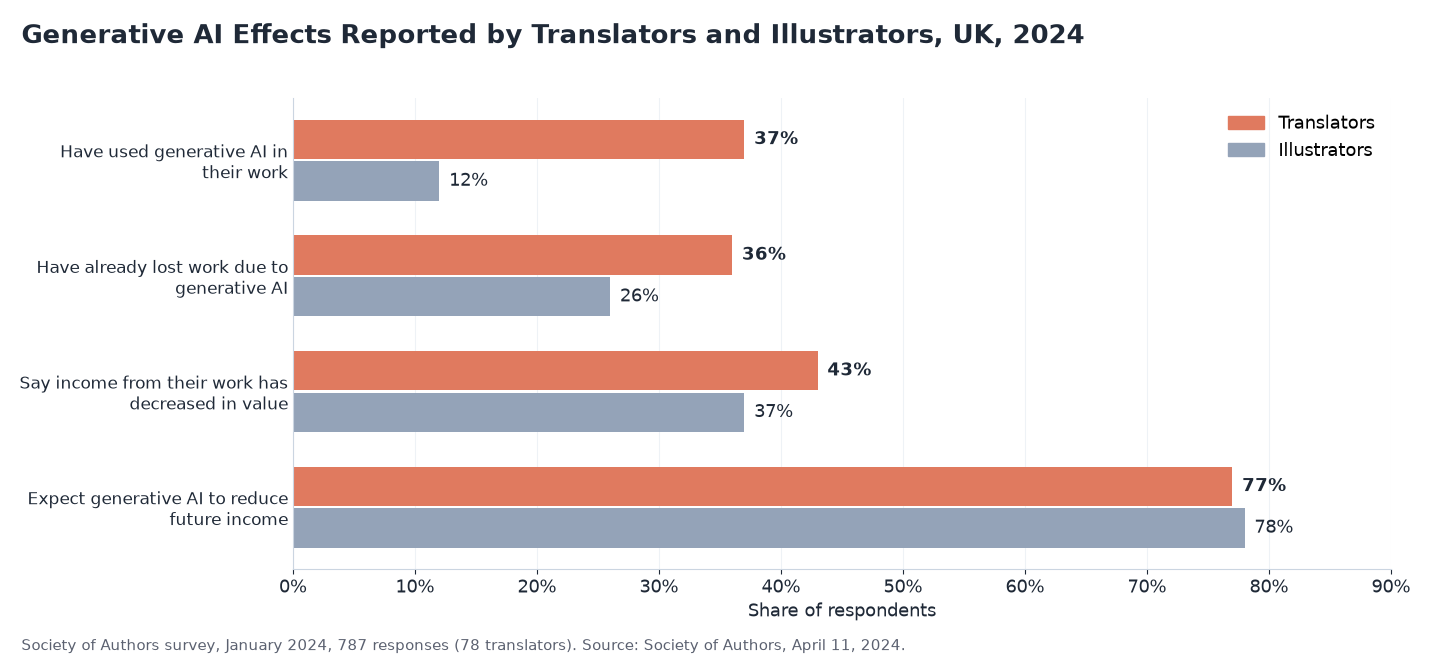
- In a 2024 Society of Authors survey, 36% of translators said they had already lost work because of generative AI, and 77% expected it to reduce their future income.6
- Half of language providers surveyed by Nimdzi expect lower revenue in 2026 from customers who adopt AI themselves, up from 45% for 2025.2
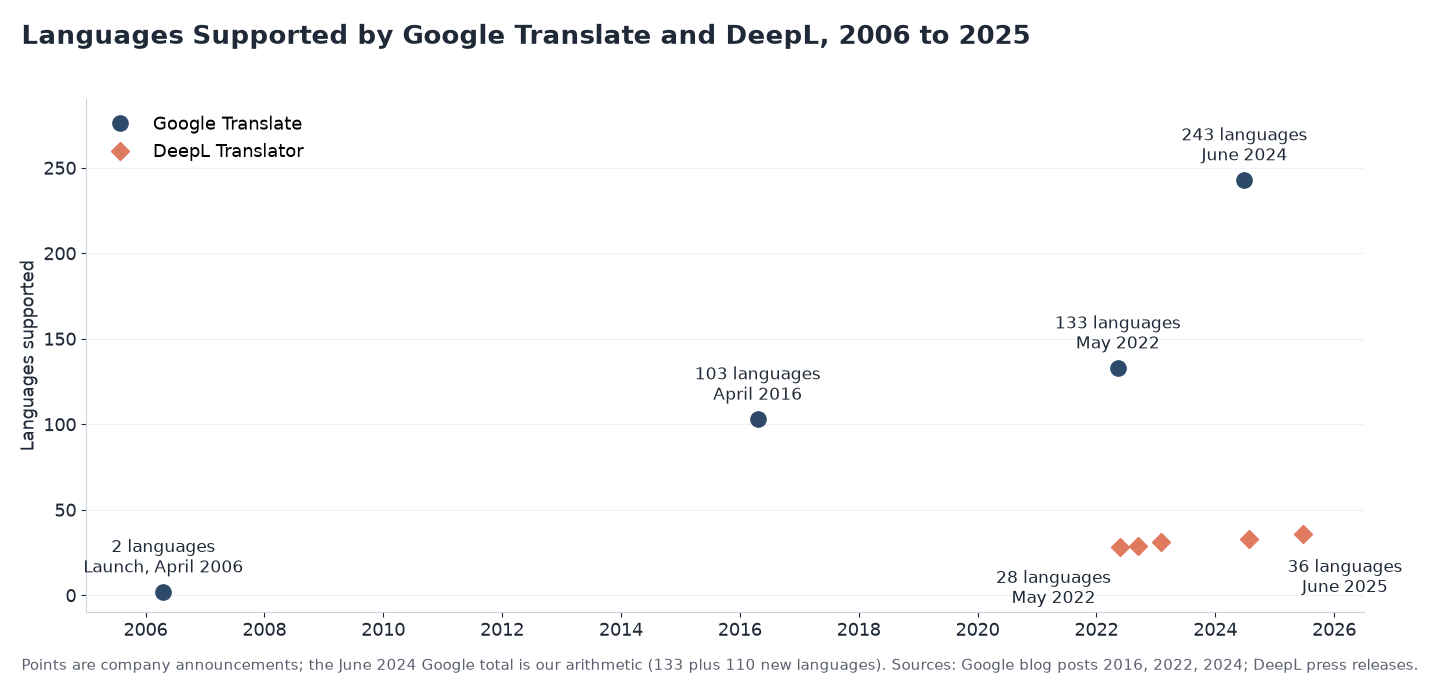
- Google Translate went from 133 languages in May 2022 to an estimated 243 in June 2024 after adding 110 languages with its PaLM 2 model.1,8,9
AI translation means converting text or speech from one language into another with machine learning models, from neural machine translation (MT) systems to large language models (LLMs). Nimdzi reports that DeepL's new system runs on LLMs and that Google Translate partly does.2
Our analysts read the 2026 Nimdzi 100 report, a Microsoft Research paper and its public data, a Bureau of Labor Statistics occupation profile, a Society of Authors survey, Google blog posts, and DeepL press releases.
For wider job effects of AI, see our AI Job Displacement Statistics 2026; for company use of generative AI, see Enterprise Generative AI Adoption Statistics 2026.
In the following sections, we compare the size and growth of the language services market, where buyers are, how AI is changing provider budgets, what tools providers built, how exposed translation jobs are to AI, what translators report, and how many languages leading AI translators cover.
The Language Services Market Reached an Estimated $72.6 Billion in 2025
Nimdzi estimates that the language services industry, which covers translation, localization, interpreting, and related technology, grew from $50 billion in 2018 to $72.6 billion in 2025. Growth slowed to 1.2% in 2025, after 5.6% in 2024.2
Its base forecast has growth below 1% a year after 2026, reaching $76.1 billion by 2030. A more optimistic Nimdzi model reaches $96.9 billion by 2030.2
| Year | Market size (USD) | Annual growth | Type |
|---|---|---|---|
| 2018 | $50 billion | n/a | Estimate |
| 2019 | $53.5 billion | 7.0% | Estimate |
| 2020 | $55 billion | 2.8% | Estimate |
| 2021 | $60.5 billion | 10.0% | Estimate |
| 2022 | $64.7 billion | 7.0% | Estimate |
| 2023 | $67.9 billion | 5.0% | Estimate |
| 2024 | $71.7 billion | 5.6% | Estimate |
| 2025 | $72.6 billion | 1.2% | Estimate |
| 2026 | $73.4 billion | 1.1% | Forecast |
| 2027 | $74.1 billion | 1.0% | Forecast |
| 2028 | $74.8 billion | 0.9% | Forecast |
| 2029 | $75.5 billion | 0.9% | Forecast |
| 2030 | $76.1 billion | 0.9% | Forecast |
Source: Nimdzi Insights, The 2026 Nimdzi 100, April 2026. Data: language-services-market-size-2018-2030.csv
Source: Nimdzi Insights, 2026; chart by AI Services Companies.
Key Findings
- The market grew 10.0% in 2021, its fastest year in the series, and 1.2% in 2025, its slowest year through 2025.2
- Nimdzi forecasts $73.4 billion for 2026, an increase of $0.8 billion over 2025.2
- The 100 largest providers made up 19.8% of the industry in 2025, and 52 of them reported growth.2
North America Bought $30.6 Billion of Language Services in 2025
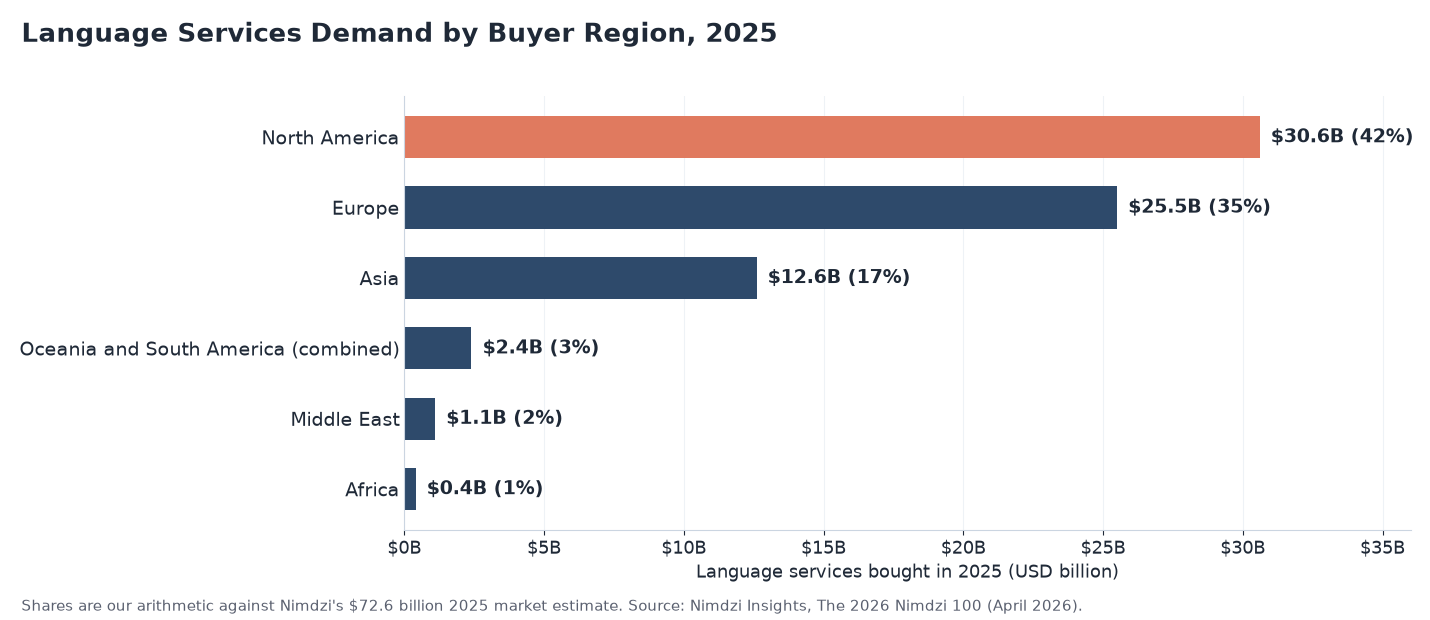
Nimdzi splits 2025 demand by where buyers are. North America bought $30.6 billion of services, about 42% of the market, and Europe bought $25.5 billion. Asia accounted for $12.6 billion.1,2
Among the 100 largest providers, growth was highest in Asia (7.2%) and North America (6.0%), and much lower in Europe (0.7%) and Oceania (0.2%). Of these 100 providers, 42 are based in Europe and 34 in North America.2
| Buyer region | Demand (USD) | Share of $72.6 billion |
|---|---|---|
| North America | $30.6 billion | 42% |
| Europe | $25.5 billion | 35% |
| Asia | $12.6 billion | 17% |
| Oceania and South America (combined) | $2.4 billion | 3% |
| Middle East | $1.1 billion | 2% |
| Africa | $0.4 billion | 1% |
Source: Nimdzi Insights, The 2026 Nimdzi 100, April 2026. Shares are our arithmetic. Data: language-services-demand-by-region-2025.csv
Source: Nimdzi Insights, 2026; chart by AI Services Companies.
Key Findings
- North America and Europe together bought $56.1 billion, or 77% of 2025 demand.1,2
- Africa and the Middle East together accounted for $1.5 billion, about 2% of the market.1,2
- Nimdzi notes that a weaker U.S. dollar against the euro in 2025 cut margins for EU-based providers serving U.S. buyers.2
Half of Language Providers Expect Lower Revenue From Clients Adopting AI in 2026
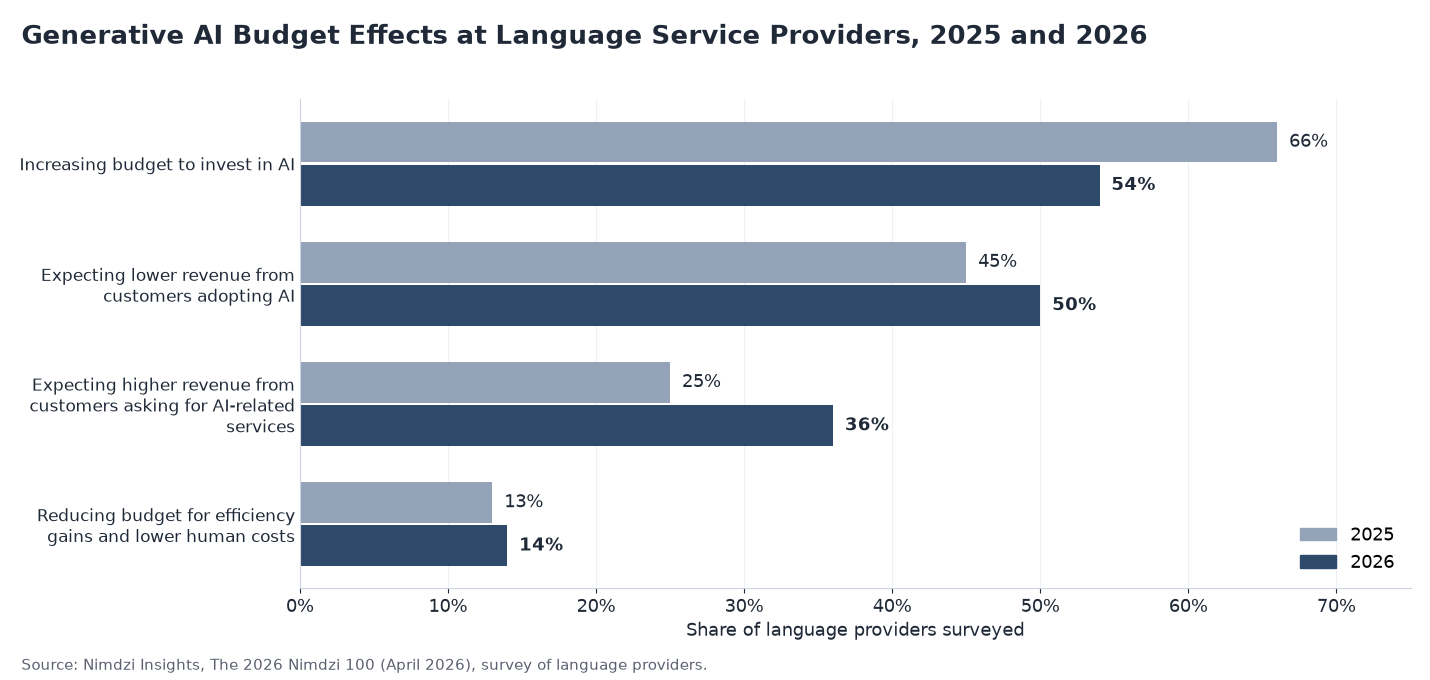
Nimdzi asked language providers how generative AI affected their budgets in 2025 and how it will in 2026. The share expecting lower revenue from customers who adopt AI in their own work rose from 45% to 50%.2
The share expecting more revenue from customers who ask for AI-related services rose from 25% to 36%. Nine in 10 respondents said they were concerned about how generative AI affects client behavior, including a view among clients that AI translation ought to be free.2
| Statement | 2025 | 2026 | Change (points) |
|---|---|---|---|
| Increasing budget to invest in AI | 66% | 54% | -12 |
| Expecting lower revenue from customers adopting AI | 45% | 50% | +5 |
| Expecting higher revenue from customers asking for AI-related services | 25% | 36% | +11 |
| Reducing budget for efficiency gains and lower human costs | 13% | 14% | +1 |
Source: Nimdzi Insights, The 2026 Nimdzi 100, April 2026. Point changes are our arithmetic. Data: generative-ai-budget-effects-language-providers.csv
Source: Nimdzi Insights, 2026; chart by AI Services Companies.
Key Findings
- 54% of providers plan to raise their AI budget in 2026, down from 66% that did so for 2025.2
- About one in eight providers is cutting its budget to reflect efficiency gains and lower human costs.2
- Nimdzi reports that some clients expect cost cuts of up to 75% through AI, pushing providers away from per-word pricing.2
44.3% of Language Providers Built an MT-Related AI Tool in 2025
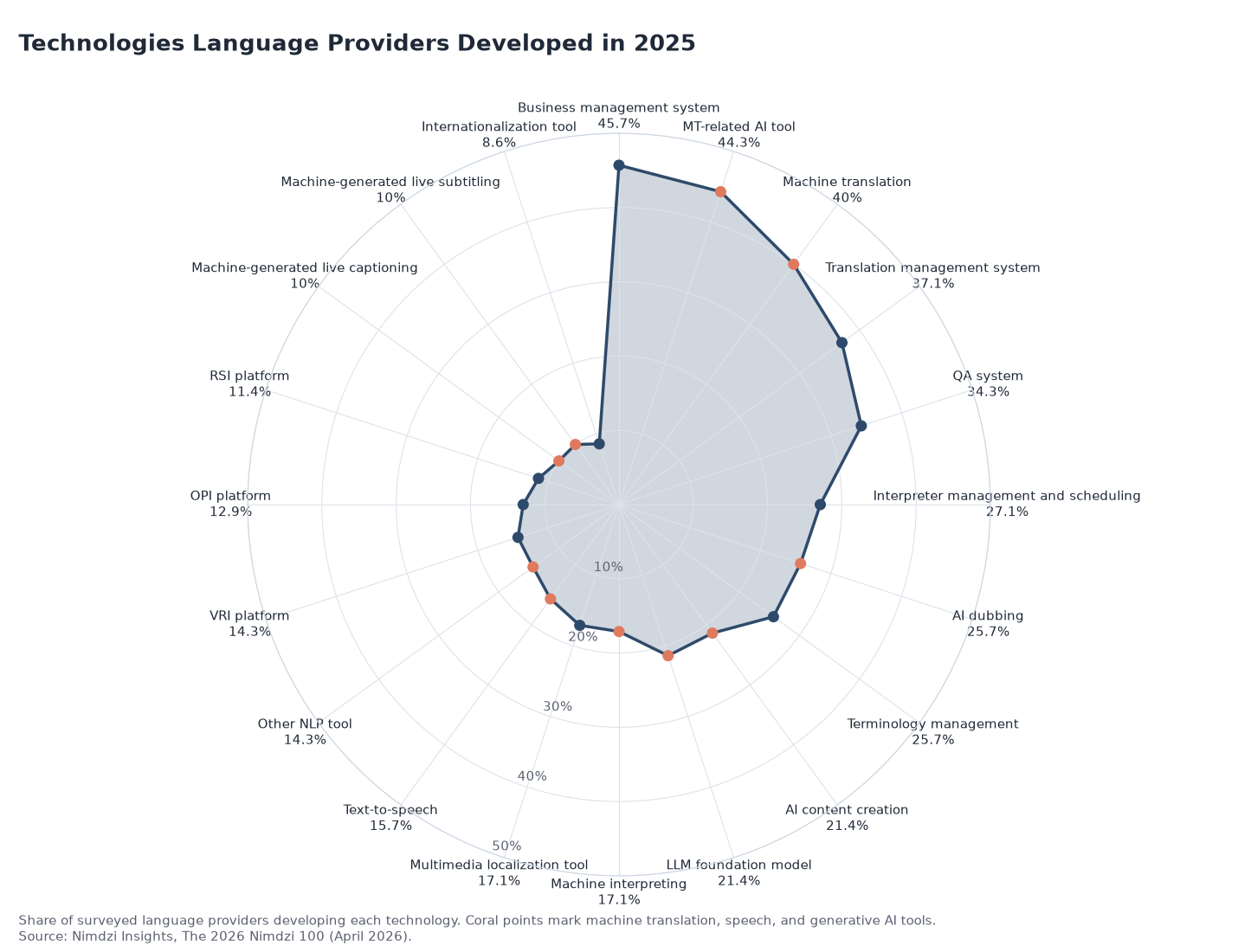
Nimdzi asked providers which technologies they developed in 2025. A business management system was the most common at 45.7%, followed closely by MT-related AI tools at 44.3% and machine translation itself at 40.0%.2
AI dubbing (25.7%) and AI content creation (21.4%) are in the top 10. Machine interpreting (17.1%) and text-to-speech (15.7%) fall just outside the top 10.2
| Technology | Share of providers |
|---|---|
| Business management system | 45.7% |
| MT-related AI tool | 44.3% |
| Machine translation | 40.0% |
| Translation management system | 37.1% |
| QA system | 34.3% |
| Interpreter management and scheduling | 27.1% |
| AI dubbing | 25.7% |
| Terminology management | 25.7% |
| AI content creation | 21.4% |
| LLM foundation model | 21.4% |
| Machine interpreting | 17.1% |
| Multimedia localization tool | 17.1% |
| Text-to-speech | 15.7% |
| Other NLP tool | 14.3% |
| VRI platform | 14.3% |
| OPI platform | 12.9% |
| RSI platform | 11.4% |
| Machine-generated live captioning | 10.0% |
| Machine-generated live subtitling | 10.0% |
| Internationalization tool | 8.6% |
Source: Nimdzi Insights, The 2026 Nimdzi 100, April 2026. Data: technologies-developed-language-providers-2025.csv
Source: Nimdzi Insights, 2026; chart by AI Services Companies.
Key Findings
- 21.4% of providers reported building an LLM foundation model in 2025.2
- Machine-generated live captioning and live subtitling were each developed by 10.0% of providers.2
- Nimdzi reports that proprietary AI and data services, such as data curation and custom LLM integration, drove the most revenue growth in 2025.2
Interpreters and Translators Rank First of 785 Occupations for AI Applicability
Microsoft Research analyzed 200,000 anonymized Microsoft Bing Copilot conversations and matched the work people did with AI to U.S. occupations. Interpreters and translators scored 0.49 on its AI applicability scale, the highest of 785 occupations; the median was 0.14.1,3,4
The score measures how much of an occupation's work overlaps with tasks people use AI for and how well AI completes them. It does not measure job losses. The Bureau of Labor Statistics counted 73,900 interpreter and translator jobs in 2025, with a median annual wage of $60,170.3,5
| Rank | Occupation | AI applicability score |
|---|---|---|
| 1 | Interpreters and Translators | 0.49 |
| 2 | Historians | 0.46 |
| 3 | Writers and Authors | 0.45 |
| 4 | Sales Representatives of Services, Except Advertising, Insurance, Financial Services, and Travel | 0.45 |
| 5 | Computer Numerically Controlled Tool Programmers | 0.42 |
| 6 | Broadcast Announcers and Radio Disc Jockeys | 0.41 |
| 7 | Customer Service Representatives | 0.41 |
| 8 | Telemarketers | 0.40 |
| 9 | Political Scientists | 0.39 |
| 10 | Mathematicians | 0.39 |
| 11 | News Analysts, Reporters, and Journalists | 0.38 |
| 12 | Passenger Attendants | 0.38 |
Source: Tomlinson et al., Working with AI: Measuring the Applicability of Generative AI to Occupations (arXiv 2507.07935, v7, October 2026); Microsoft working-with-ai data, v1.1. Ranks and median are our analysis. Data: ai-applicability-top-occupations.csv
Source: Microsoft Research data, 2026; chart by AI Services Companies.
Key Findings
- The interpreter and translator score of 0.49 is about 3.4 times the median score of 785 occupations.1,4
- BLS projects employment of interpreters and translators to grow 2% from 2025 to 2035, slower than the 3% average for all occupations.5
- BLS still expects about 6,000 openings a year for interpreters and translators, mostly to replace workers who leave.5
36% of Translators in a UK Authors Survey Said They Had Lost Work to Generative AI
The Society of Authors, which lobbies the UK government on authors' rights, surveyed its 12,500 members and other authors in January 2024. It received 787 responses, 78 of them from translators.6
Over a third of translators (36%) said they had already lost work because of generative AI, and 43% said income from their work had fallen in value. Translators were also the most likely group to use generative AI, at 37%.6
| Measure | Translators | Illustrators | Fiction writers | Nonfiction writers |
|---|---|---|---|---|
| Have used generative AI in their work | 37% | 12% | 20% | 25% |
| Have already lost work due to generative AI | 36% | 26% | n/a | n/a |
| Say income from their work has decreased in value | 43% | 37% | n/a | n/a |
| Expect generative AI to reduce future income | 77% | 78% | 65% | 57% |
| Used generative AI because a publisher or client asked | 8% | 5% | n/a | n/a |
Source: Society of Authors, SoA survey reveals a third of translators and quarter of illustrators losing work to AI, April 11, 2024. n/a means not reported. Data: translators-generative-ai-effects-2024.csv
Source: Society of Authors, 2024; chart by AI Services Companies.
Key Findings
- 8% of translators said they used generative AI because a publisher or commissioning organization asked them to.6
- 86% of all respondents said they were concerned that generative AI devalues human-made creative work.6
- Over 9 in 10 respondents said publishers should state prominently when generative AI was used, including for translation.6
Google Translate Added 110 Languages in 2024, Its Largest Expansion
Google Translate launched in 2006 with two languages and reached 103 by April 2016, when Google reported more than 500 million users and over 100 billion words translated a day. It reached 133 languages in May 2022.7,8
In June 2024, Google added 110 languages using its PaLM 2 model, bringing an estimated 243 in total. The new languages have more than 614 million speakers, about 8% of the world's population. DeepL reached 36 languages in June 2025, and Nimdzi reports its newer system covers more than 100.1,2,9,10
| Service | Date | Languages | Basis |
|---|---|---|---|
| Google Translate | April 2006 | 2 | Launch |
| Google Translate | April 2016 | 103 | Stated by Google |
| Google Translate | May 2022 | 133 | Stated by Google (24 added) |
| Google Translate | June 2024 | An estimated 243 | Our arithmetic: 133 plus 110 added |
| DeepL Translator | May 2022 | 28 | Stated by DeepL |
| DeepL Translator | September 2022 | 29 | Stated by DeepL |
| DeepL Translator | January 2023 | 31 | Stated by DeepL |
| DeepL Translator | July 2024 | 33 | Stated by DeepL |
| DeepL Translator | June 2025 | 36 | Stated by DeepL |
| DeepL (new system) | 2026 | More than 100 | Reported by Nimdzi |
Source: Google, Ten years of Google Translate, April 28, 2016; Google, 24 new languages, May 11, 2022; Google, 110 new languages, June 27, 2024; DeepL press releases, 2022 to 2025; Nimdzi Insights, The 2026 Nimdzi 100, April 2026. Data: languages-supported-google-deepl.csv
Source: Google and DeepL announcements; chart by AI Services Companies.
Key Findings
- Google's 2024 additions were its largest expansion, and about a quarter of the new languages come from Africa.9
- Nimdzi reports that Meta's OmniTranslate targets 1,600 languages and Google's TranslateGemma officially covers 55.2
- DeepL reported more than 200,000 business customers in 2025, up from over 100,000 in 2024.10
What AI Translation Figures Show Going Into 2027
Nimdzi reports that the cost of translation has dropped, and growth in the language services market has slowed to about 1% a year. Nimdzi expects growth under 1% a year after 2026, while more providers expect clients to cut spending as they adopt AI.2
Translation work is the most AI-exposed occupation in Microsoft's data, and translators report lost work and lower pay. Interpreting, which Nimdzi calls largely resistant to AI in high-stakes settings, continues to grow.2,4,6
So if you cite an AI translation statistic, say whether it describes the whole language services market, providers, translators, or a single product, and give the date, because language counts and survey shares change every year.
Data Collection and Methodology
All sources were opened on November 24, 2026. Market size, regional demand, budget effects, and technology figures come from the free 2026 Nimdzi 100 report (PDF, April 2026). Values were read from the report text and chart labels; 2018 to 2025 are Nimdzi estimates and 2026 to 2030 are its base-model forecasts.2
Nimdzi does not state the number of providers in its budget and technology surveys on the pages used. Regional shares and point changes are our arithmetic.1,2
AI applicability scores come from Microsoft's public working-with-ai data, version 1.1 (ai_applicability_scores.csv), which the paper's arXiv v7 uses. The scores cover 785 occupation codes; ranks and the median of 0.143 are our analysis. Employment and pay come from the BLS Occupational Outlook Handbook.1,3,4,5
Translator survey figures come from the Society of Authors announcement, which reports shares by author type; the count of 78 translators comes from a staff reply on the same page. The translator sample is small.6
Language counts come from Google blog posts and DeepL press releases. Google did not state a total in June 2024; the estimated 243 adds the 110 new languages to the 133 Google reported in May 2022. The 2006 figure comes from Google's 2016 post.1,7,8,9,10
Sources (10)
- AI Services Companies analysis of AI translation figures from Nimdzi Insights, Microsoft Research, the U.S. Bureau of Labor Statistics, the Society of Authors, Google, and DeepL, November 2026
- Nimdzi Insights, The 2026 Nimdzi 100: Ranking and Report (April 2026)
- Tomlinson, Jaffe, Wang, Counts, and Suri, Working with AI: Measuring the Applicability of Generative AI to Occupations, arXiv 2507.07935 v7 (October 23, 2026)
- Microsoft, working-with-ai data repository, v1.1 (read November 24, 2026)
- U.S. Bureau of Labor Statistics, Occupational Outlook Handbook: Interpreters and Translators (read November 24, 2026)
- Society of Authors, SoA survey reveals a third of translators and quarter of illustrators losing work to AI (April 11, 2024)
- Google, Ten years of Google Translate (April 28, 2016)
- Google, Google Translate learns 24 new languages (May 11, 2022)
- Google, 110 new languages are coming to Google Translate (June 27, 2024)
- DeepL, Press releases, 2018 to 2025 (read November 24, 2026)