
Enterprise AI Budget Statistics 2026
Published November 12, 2026
Our analysts compiled eight quarterly waves of KPMG's survey of US companies with $1 billion or more in revenue, four Gartner forecasts of worldwide AI spending released during 2026, and five other CIO surveys and market models published between December 2025 and November 2026 to show how large AI budgets are as of Q4 2026, how fast they are growing, and where the money goes.
Key Findings
- US companies with $1 billion or more in revenue plan to invest an average of $173 million in AI over the next 12 months, according to KPMG's Q3 2026 survey. That is up 33% from $130 million a year earlier and below the $207 million peak recorded in Q1 2026.2,4
- Enterprises spent an average of 4.7 times their 2025 AI levels in 2026 against a planned 1.9 times, roughly 2.5 times what they had budgeted, according to Menlo Ventures.11
- CIOs and technology executives planned to raise AI funding by an average of 36% and generative AI funding by 38% from 2025 to 2026, while their total IT budgets were expected to grow 2.79%.8
- 74% of US enterprise software buyers allocate more than 10% of their IT budget to AI in 2026, up from 23% in 2025, according to West Monroe.10
- Gartner forecasts worldwide AI spending of $2.75 trillion in 2026 and $4.05 trillion in 2027. Its 2026 forecast has risen from $2.53 trillion in January 2026.12,15
Most companies did not have a line in the budget called AI three years ago.9 Early generative AI projects were paid for largely out of innovation funds, and as late as 2024, 60% of enterprise generative AI spending still came from innovation budgets.16 That has changed quickly. Surveys of chief information officers now ask how much of the IT budget goes to AI, consulting firms track how much large companies plan to invest each quarter, and analysts publish forecasts of worldwide AI spending in the trillions of dollars.8,9,12 Reporters and analysts who need one number for enterprise AI budgets therefore face a dozen, each measuring something different. Some count what one company plans to spend, some count the share of an IT budget, and some count the whole market, including the data centers that technology companies build for themselves.
Our analysts gathered the most recent figures from each of these sources. We took KPMG's average planned AI investment from every US AI Pulse wave from Q4 2024 to Q3 2026 and the regional figures from its Q1 and Q3 2026 global surveys. We added Gartner's survey of more than 2,300 CIOs and technology executives on 2026 budgets, Foundry's December 2025 survey of 538 IT decision-makers, and West Monroe's 2026 survey of US software buyers. For market totals, we used Menlo Ventures' November 2026 estimate of enterprise AI spending and Gartner's four 2026 forecasts of worldwide AI spending, the latest released on November 12, 2026.
In the following sections, we compare how planned AI budgets at large US companies have changed by quarter, how they differ by region, how fast AI funding is growing against IT budgets as a whole, how companies are setting aside money for AI, how much enterprises spend on using AI, and how worldwide AI spending splits across markets.
Planned AI Budgets at Large US Companies Nearly Doubled From Late 2024 to Late 2026
The longest-running quarterly measure of company AI budgets comes from KPMG, which asks executives at US companies with $1 billion or more in annual revenue how much their organization plans to invest in AI over the next 12 months. Following the same question across eight survey waves shows how budget plans have moved from one quarter to the next.2
| Survey wave | Average planned AI investment | Change from previous wave | Reported in |
|---|---|---|---|
| Q4 2024 | $89 million | KPMG Q1 2025 release | |
| Q1 2025 | $114 million | +28% | KPMG Q1 2025 release |
| Q2 2025 | $88 million | -23% | KPMG Q4 2025 and Q2 2026 reports |
| Q3 2025 | $130 million | +48% | KPMG Q3 2026 report |
| Q4 2025 | $124 million | -5% | KPMG Q4 2025 report |
| Q1 2026 | $207 million | +67% | KPMG Q1 2026 report |
| Q2 2026 | $202 million | -2% | KPMG Q2 2026 release |
| Q3 2026 | $173 million | -14% | KPMG Q3 2026 report |
Source: AI Services Companies analysis of KPMG AI Quarterly Pulse Survey waves Q4 2024 to Q3 2026, conducted November 2026. Data: kpmg-us-planned-ai-investment-2024-2026.csv
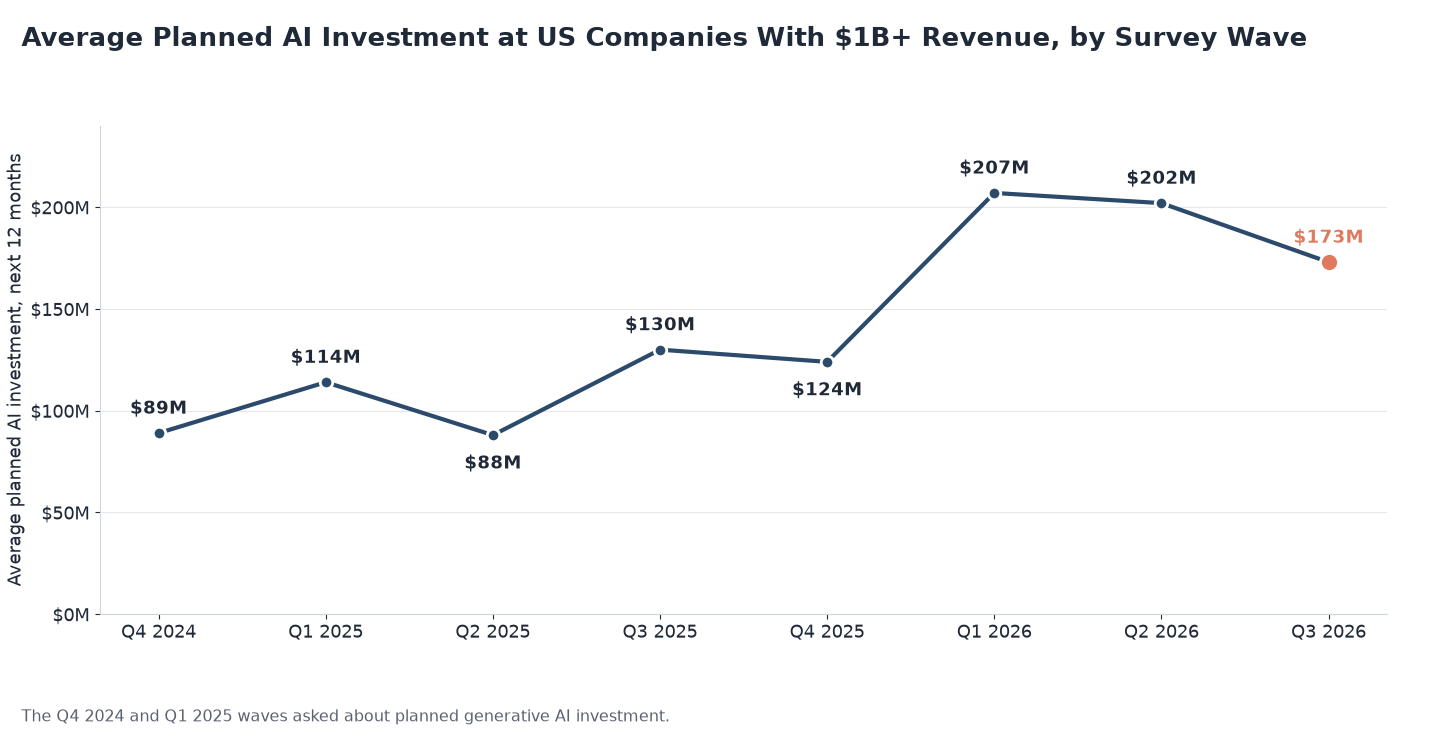
Source: AI Services Companies analysis of KPMG AI Quarterly Pulse Survey data, conducted November 2026.
Key Findings
- The average rose from $89 million in the Q4 2024 wave to $173 million in Q3 2026, an increase of 94%. The largest single jump came between Q4 2025 and Q1 2026, when the average went from $124 million to $207 million.4,6
- The two 2026 waves after the peak came in lower, at $202 million in Q2 and $173 million in Q3. KPMG still reported the Q3 figure as a 33% rise over the same quarter of 2025, and its samples changed size between waves, from 204 leaders in Q2 2026 to 314 in Q3 2026.2,3
- Companies are also putting controls around that money. In the Q3 2026 survey, 74% of leaders said they include cost reviews in AI approval processes, 70% use AI monitoring dashboards, and 43% have set usage or token budgets. Those controls track AI spending after a project is approved as well as before it.2
Planned AI Budgets Rose 29% in EMEA and Held Flat in Asia Pacific During 2026
KPMG runs the same budget question in its global survey of senior leaders in 20 countries, which lets us see whether US companies are spending differently from companies elsewhere. We compared the first and third quarters of 2026 for each region.7
| Region | Q1 2026 | Q3 2026 | Change |
|---|---|---|---|
| Global | $186 million | $210 million | +13% |
| Asia Pacific | $245 million | $246 million | 0% |
| EMEA | $157 million | $203 million | +29% |
| Americas | $178 million | $191 million | +7% |
Source: AI Services Companies analysis of KPMG International, Global AI Pulse Q1 and Q3 2026, weighted means, conducted November 2026. Data: kpmg-global-planned-ai-investment-by-region-2026.csv
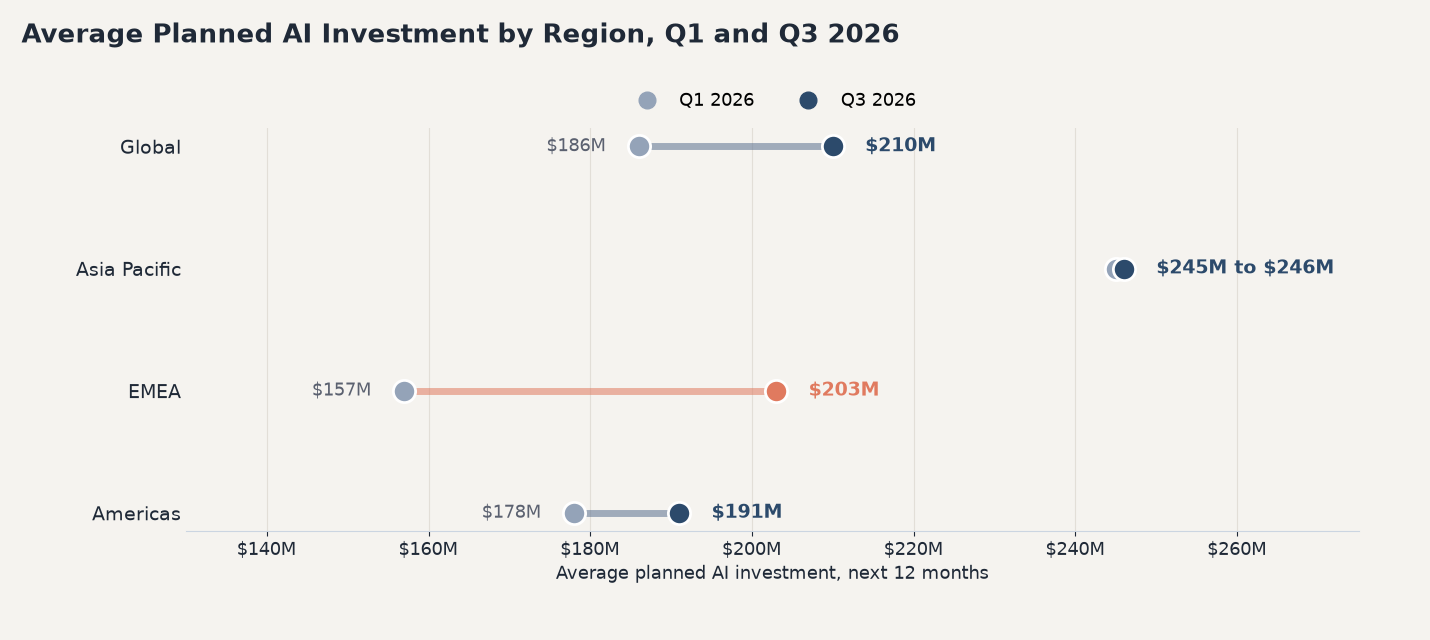
Source: AI Services Companies analysis of KPMG Global AI Pulse data, conducted November 2026.
Key Findings
- Companies in Asia Pacific plan the largest AI budgets of the three regions, at an average of $246 million in Q3 2026, almost unchanged from $245 million in Q1.7
- EMEA closed most of its gap with the other regions in six months, moving from $157 million to $203 million and passing the Americas, which rose from $178 million to $191 million.7
- KPMG's global survey covered 2,131 senior leaders in Q3 2026, including 670 in the Americas. Its Americas average of $191 million is higher than the $173 million in KPMG's US-only survey of the same quarter, so a citation should say which of the two surveys a figure comes from.2,7
AI Funding Is Rising About 13 Times Faster Than Overall IT Budgets in 2026
An AI budget is usually carved out of a wider technology budget, so its growth means more when it is set beside the growth of IT spending overall. Gartner's annual survey of CIOs and technology executives asked both questions for 2026: how much the total IT budget will change, and how funding will change for each technology area their enterprise has deployed.8
| Technology area | Decreasing funding | Increasing funding | Mean change in funding |
|---|---|---|---|
| GenAI | 1% | 91% | +38% |
| AI | 1% | 88% | +36% |
| Cyber/information security | 2% | 84% | +26% |
| Business intelligence/data analytics | 4% | 79% | +25% |
| Cloud platforms | 5% | 72% | +21% |
| Intelligent automation | 4% | 70% | +18% |
| Application modernization | 5% | 69% | +19% |
| Integration technologies/APIs/API architecture | 4% | 65% | +17% |
| Customer relationship management | 6% | 61% | +16% |
| Digital workplace | 6% | 59% | +14% |
| Low-code/no-code platforms | 6% | 58% | +13% |
| Digital commerce/citizen portals | 4% | 56% | +16% |
| Enterprise resource planning | 9% | 55% | +19% |
| Connectivity | 9% | 47% | +12% |
| Human capital management | 7% | 47% | +11% |
| Internet of Things | 7% | 42% | +8% |
| Warehouse management system | 9% | 40% | +10% |
| Supplier relationship management | 8% | 37% | +7% |
| On-premises infrastructure and data center | 41% | 32% | -5% |
| Human augmentation | 10% | 28% | +3% |
Source: AI Services Companies analysis of Gartner, 2026 CIO Agenda Preview, 2026 Gartner CIO and Technology Executive Survey, conducted November 2026. Respondents choosing no change in funding are not shown. Data: gartner-cio-technology-funding-change-2025-2026.csv
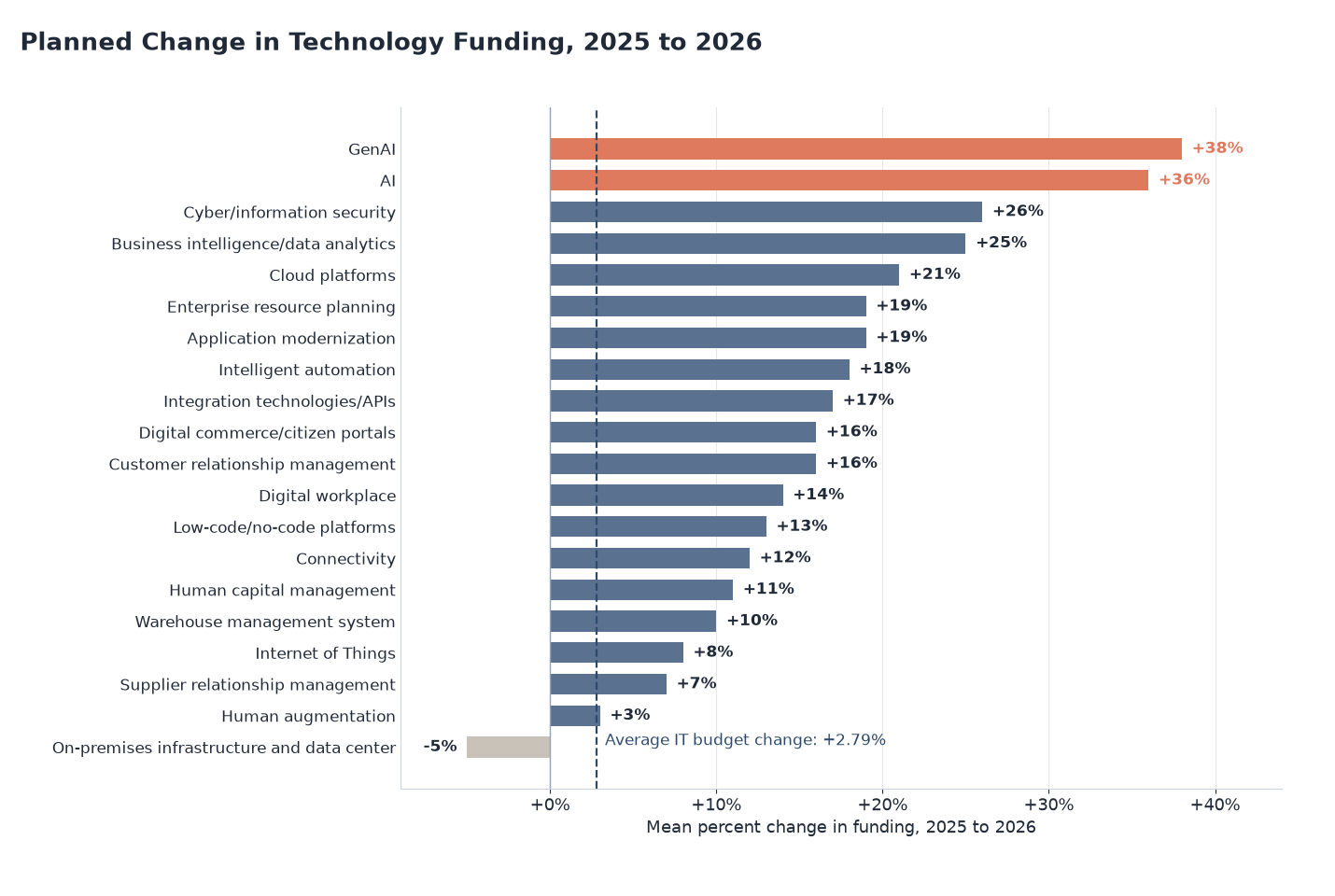
Source: AI Services Companies analysis of the 2026 Gartner CIO and Technology Executive Survey, conducted November 2026.
Key Findings
- Gartner's respondents expected their total IT budgets to grow by an average of 2.79% in 2026. 53% expected an increase, 27% expected no change, and 19% expected a cut.8
- AI funding grows even where budgets shrink. Executives planning IT budget cuts expected to raise AI funding by 40% and generative AI funding by 35%, slightly more than the 39% and 34% planned by executives whose budgets were growing.8
- On-premises infrastructure and data centers are the only area on Gartner's list where more respondents planned to cut funding (41%) than to raise it (32%), with a mean change of -5%. With total IT budgets growing less than 3%, large AI increases leave less room for other areas, and on-premises infrastructure is where respondents most often plan cuts.8
Nearly Three in Four Software Buyers Now Put More Than 10% of IT Budgets Into AI
Growth rates say how fast AI budgets are moving, but reporters also ask how big a slice of the technology budget AI has become and whether companies give it a budget of its own. Three surveys from late 2025 and 2026 answer those questions in different ways, so we set their figures side by side.2,9,10
| Measure | Earlier reading | Latest reading | Survey |
|---|---|---|---|
| Organizations with a dedicated AI budget | 36% (2023), 49% (2024) | 65% (2025) | Foundry CIO AI Priorities |
| Organizations that will increase AI spending in the coming year | 53% (2024) | 63% (2025) | Foundry CIO AI Priorities |
| Average AI share of the total IT budget | 6% (2025) | Foundry CIO AI Priorities | |
| Buyers allocating more than 10% of the IT budget to AI | 23% (2025) | 74% (2026) | West Monroe |
| Buyers that mainly buy AI solutions instead of building them | 42% (2026) | West Monroe | |
| Organizations including cost reviews in AI approval | 74% (Q3 2026) | KPMG US AI Pulse | |
| Organizations with usage or token budgets | 43% (Q3 2026) | KPMG US AI Pulse |
Source: AI Services Companies analysis of Foundry, CIO AI Priorities Survey, West Monroe, The New Rules of Enterprise Software and AI Spend, and KPMG AI Quarterly Pulse Survey Q3 2026, conducted November 2026. Data: ai-budget-share-and-formalization-2023-2026.csv
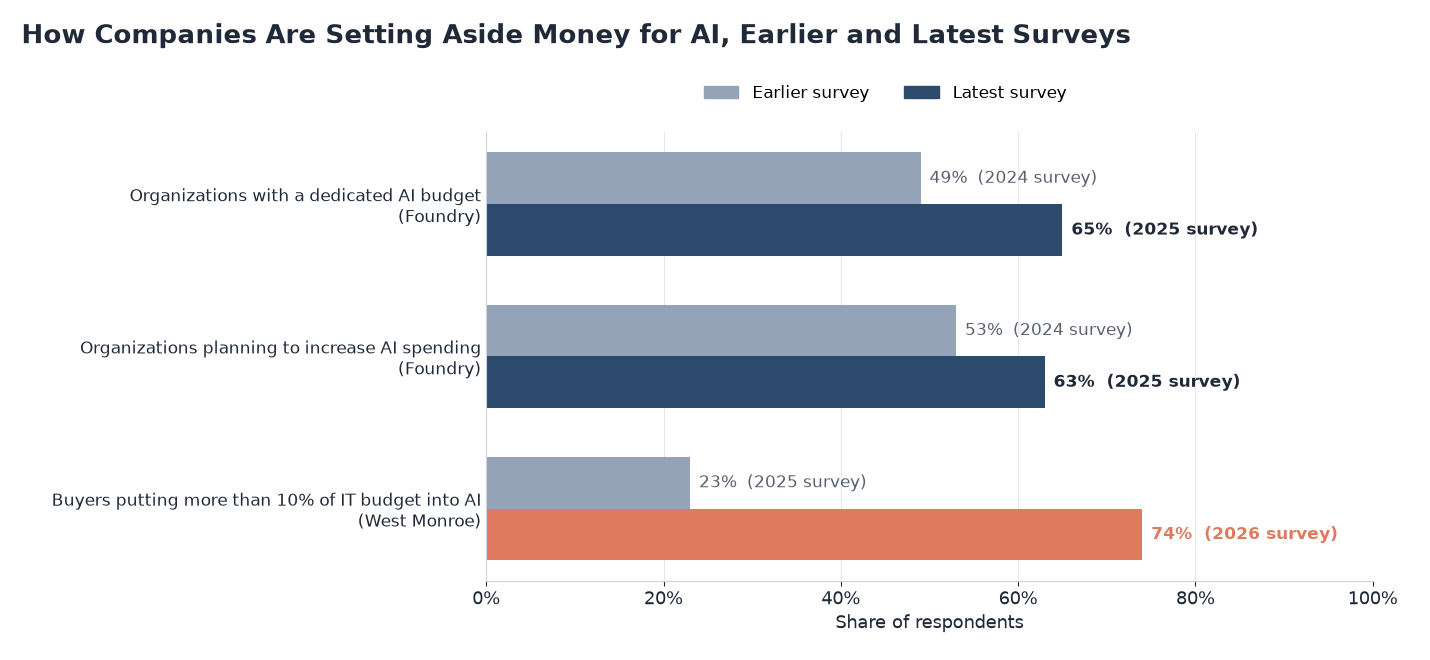
Source: AI Services Companies analysis of Foundry and West Monroe survey data, conducted November 2026.
Key Findings
- The share of organizations with a dedicated AI budget rose in each of Foundry's three annual surveys, from 36% to 49% to 65%. Foundry found that AI makes up 6% of the total IT budget on average, at both large and small organizations.9
- West Monroe's buyers report a much larger share. 74% put more than 10% of their IT budget into AI in 2026, up from 23% a year earlier. The two surveys differ in timing and sample: Foundry surveyed 538 IT decision-makers worldwide in December 2025, while West Monroe surveyed 300 US executives in Q3 2026.9,10
- A dedicated budget line turns AI from an experiment into a recurring cost that finance teams plan for each year. In 2024, 60% of enterprise generative AI spending still came from innovation budgets, so the move to dedicated budgets has happened within about two years.9,16
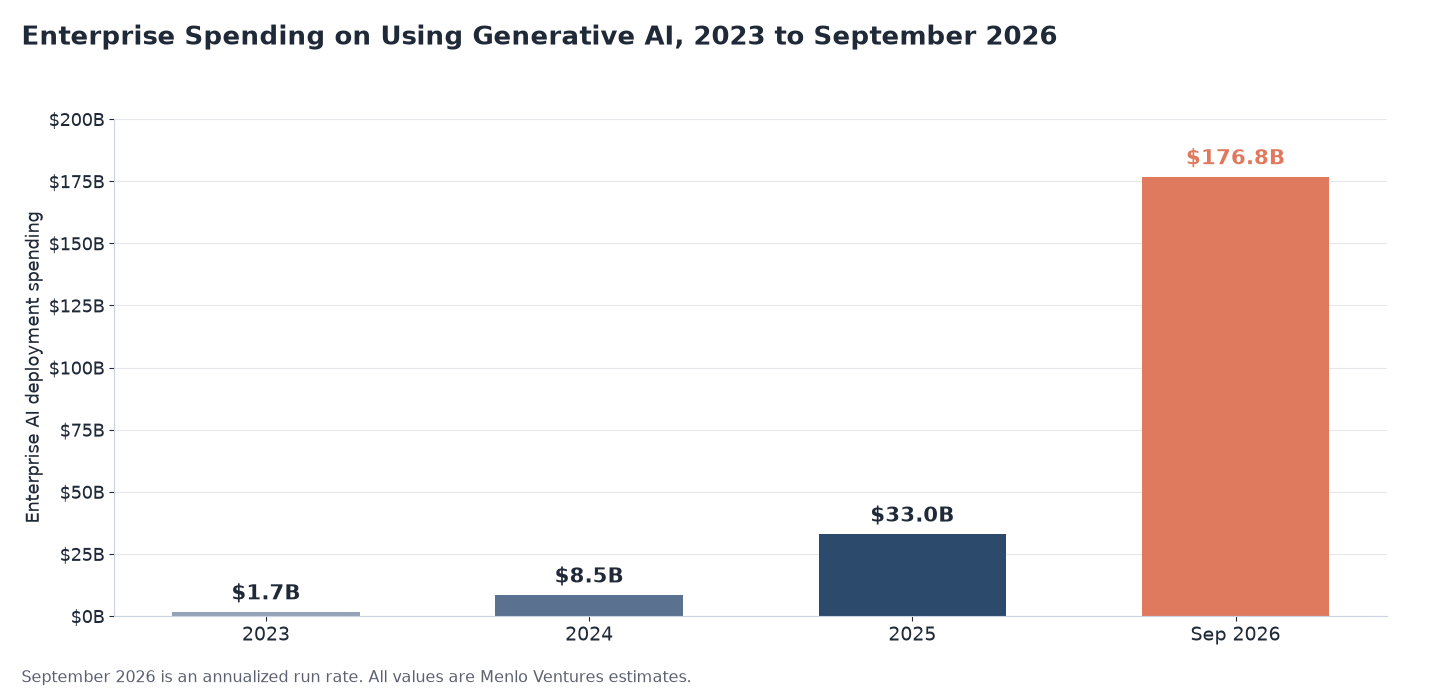
Enterprise Spending on Using AI Reached an Estimated $176.8 Billion by September 2026
Company surveys show what individual organizations plan, while market models add up what all enterprises spend. Menlo Ventures, a venture capital firm, has estimated enterprise spending on generative AI each year since 2023 and splits it into money spent on using AI, such as model access and applications, and money spent on building AI models. Its November 2026 report also asked companies how their actual spending compared with what they had planned.11
| Category | Period | Spending |
|---|---|---|
| Using AI (deployment), total | 2023 | $1.7 billion |
| Using AI (deployment), total | 2024 | $8.5 billion |
| Using AI (deployment), total | 2025 | $33.0 billion |
| Using AI (deployment), total | September 2026 run rate | $176.8 billion |
| Infrastructure for running models and agents | September 2026 run rate | $99.5 billion |
| Applications | September 2026 run rate | $77.3 billion |
| Applications: coding | September 2026 run rate | $34.0 billion |
| Applications: chatbots and workplace assistants | September 2026 run rate | $25.0 billion |
| Building AI (development), total | 2026 | $102.5 billion |
| Building AI: training compute | 2026 | $87.2 billion |
| Building AI: training data and services | 2026 | $15.3 billion |
Source: AI Services Companies analysis of Menlo Ventures, 2026: The State of Enterprise AI, conducted November 2026. All values are Menlo Ventures estimates. Data: enterprise-ai-spending-menlo-2023-2026.csv
Source: AI Services Companies analysis of Menlo Ventures estimates, conducted November 2026.
Key Findings
- Menlo Ventures estimates that enterprise spending on using AI grew 5.0 times in 2024, 3.9 times in 2025, and 5.4 times by September 2026, roughly 100 times in three years. Coding ($34.0 billion) and chatbots and workplace assistants ($25.0 billion) account for 76% of the $77.3 billion application market.11
- Actual spending ran far ahead of budgets. On average, enterprises spent 4.7 times their 2025 AI levels against a planned 1.9 times, and the median company spent 2.2 times last year's level against a planned 1.8 times. Menlo attributes the gap to AI agents, whose costs grow with the amount of work they do.11
- New budgets funded 55% of the added AI spending, compared with 22% from existing software budgets. Of the software money, 13% stayed with incumbent vendors converting licenses to AI products and 9%, or $12.6 billion, moved to AI-native vendors.11
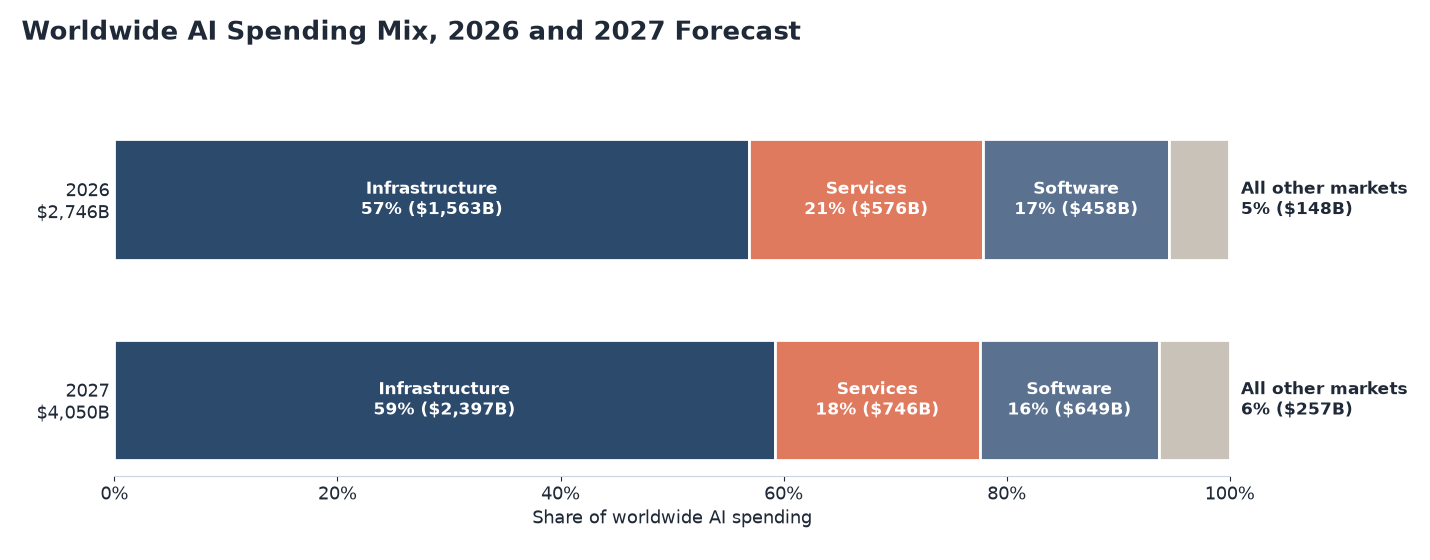
Gartner Expects AI Infrastructure to Take 59% of Worldwide AI Spending in 2027
The largest AI spending figures in circulation come from Gartner's worldwide forecast, which counts spending by every kind of buyer, including the cloud providers and other technology companies that build AI data centers. We looked at how that total breaks down by market, because the share that reaches enterprise software and services is far smaller than the headline.12,14
| Market | 2026 | 2027 | Growth | Share of 2026 total | Share of 2027 total |
|---|---|---|---|---|---|
| AI Services | $576B | $746B | +29.5% | 21.0% | 18.4% |
| AI Software | $458B | $649B | +41.7% | 16.7% | 16.0% |
| AI Cybersecurity | $51B | $86B | +68.6% | 1.9% | 2.1% |
| AI Agents and Assistants | $30B | $67B | +123.3% | 1.1% | 1.7% |
| Generative AI Models | $28B | $51B | +82.1% | 1.0% | 1.3% |
| AI Platforms for Data Science and Machine Learning | $26B | $35B | +34.6% | 0.9% | 0.9% |
| AI Application Development Platforms | $10B | $12B | +20.0% | 0.4% | 0.3% |
| AI Data | $3B | $6B | +100.0% | 0.1% | 0.1% |
| AI Infrastructure | $1,563B | $2,397B | +53.4% | 56.9% | 59.2% |
| Total AI Spending | $2,746B | $4,050B | +47.5% | 100% | 100% |
Source: AI Services Companies analysis of Gartner, worldwide AI spending forecast, November 12, 2026, conducted November 2026. Gartner publishes market values in billions of US dollars; growth rates and shares are calculated from those rounded values. Data: gartner-worldwide-ai-spending-by-market-2026-2027.csv
Source: AI Services Companies analysis of Gartner forecast data, conducted November 2026. Earlier 2026 forecasts: January 2026, May 2026, and September 2026. Data: gartner-2026-ai-spending-forecast-revisions.csv
Key Findings
- Gartner forecasts AI infrastructure spending of $2.40 trillion in 2027, up 53% from 2026. Spending on AI-optimized servers, the largest part of it, rises from $527.6 billion to $957.2 billion.12
- Gartner raised its 2026 total in each release this year, from $2.53 trillion in January to $2.60 trillion in May, $2.67 trillion in September, and $2.75 trillion in November. Most of the September increase came from infrastructure.12,13,14,15
- AI services, the market that includes consultants and implementation firms, grows 29.5% to $746 billion in 2027, while its share of the total falls from 21% to 18%. Gartner said in September that enterprises are turning to service providers less often to manage business transformation and more often for smaller projects built on AI features of their existing software.12,13
What Enterprise AI Budget Statistics Show Heading Into 2027
For a company planning next year's budget, the figures point in one direction. AI money is growing much faster than technology budgets as a whole, a growing share of companies give AI its own budget line, and in 2026 actual AI bills ran well ahead of plans, largely because of AI agents.8,9,11 Most large companies now review AI costs before approving projects, and 43% set usage or token budgets.2 Our AI ROI statistics and AI inference cost statistics cover what companies get back for that spending and what each model call costs.
The figures also measure very different things. A planned budget at a $1 billion company, a share of an IT budget, an estimate of enterprise spending on generative AI, and a worldwide forecast that is mostly data center construction can all appear in the same news story, and they differ by several orders of magnitude. Most of the trillions in Gartner's forecast are spent by technology providers building capacity, while the budgets that individual companies control are measured in the tens or hundreds of millions of dollars.2,12,14
So if you are citing an enterprise AI budget figure, say whether it is a planned or actual amount, whether it covers one company, a share of an IT budget, or a whole market, and which survey wave or forecast release it comes from.
Data Collection and Methodology
We collected KPMG's average planned AI investment over the next 12 months for every US AI Quarterly Pulse wave from Q4 2024 to Q3 2026. KPMG surveys C-suite and business leaders at US companies with annual revenue of $1 billion or more and reports a weighted average. The Q4 2024 value comes from KPMG's Q1 2025 release, which compared $114 million with $89 million in the previous quarter. The Q4 2024 and Q1 2025 waves asked about investment in generative AI, and later waves asked about AI. Sample sizes changed between waves (204 leaders in Q2 2026, fielded April 28 to May 25, 2026; 314 leaders in Q3 2026, fielded July 24 to August 25, 2026). Regional figures come from KPMG International's Global AI Pulse (Q1 2026 n=2,110; Q3 2026 n=2,131).
Gartner's IT budget figure comes from 2,321 CIOs and technology executives, excluding those who answered "don't know". Funding changes by technology come from 1,149 to 2,425 respondents whose enterprise has deployed each technology; Gartner's chart omits the share choosing no change in funding. Foundry surveyed 538 IT decision-makers in December 2025 (60% in North America). West Monroe surveyed 300 US executives online in Q3 2026; buyers represented organizations with at least $100 million in annual revenue.
Menlo Ventures' spending figures are estimates from a bottom-up model informed by a survey of nearly 400 US enterprise decision-makers fielded by Morning Consult from September 8 to 26, 2026, public filings, and third-party reports. The September 2026 values are annualized run rates, and Menlo reclassified prior years to its 2026 categories, so its 2024 and 2025 values differ from those in its earlier reports. Gartner's market values are forecasts in billions of US dollars; Gartner moved AI agents and assistants into a separate market in September 2026, so market rows are not comparable with its January and May 2026 releases, while totals are. We calculated products, differences, and ratios from the published values.
Sources (16)
- AI Services Companies analysis of KPMG AI Pulse survey waves Q4 2024 to Q3 2026, Gartner, Foundry, and West Monroe budget surveys, and Menlo Ventures and Gartner AI spending estimates, conducted November 2026
- KPMG, AI Quarterly Pulse Survey Q3 2026 (September 2026)
- KPMG, AI Investment and Agent Deployment Hold Steady Amid Growing Focus on Pragmatism, Q2 2026 AI Quarterly Pulse Survey (June 24, 2026)
- KPMG, AI Quarterly Pulse Survey Q1 2026 (March 2026)
- KPMG, AI Quarterly Pulse Survey Q4 2025 (January 2026)
- KPMG, AI Quarterly Pulse Survey, Q1 2025 release (April 16, 2025)
- KPMG International, Global AI Pulse Q3 2026 (September 2026)
- Gartner, 2026 CIO Agenda Preview, 2026 Gartner CIO and Technology Executive Survey
- Foundry, AI: It's ROI Time, CIO AI Priorities Survey (fielded December 2025)
- West Monroe, West Monroe Survey: AI Spending Surges as 74% of Enterprises Commit Over 10% of IT Budgets to AI (November 5, 2026)
- Menlo Ventures, 2026: The State of Enterprise AI (November 3, 2026)
- Gartner, Gartner Forecasts AI Infrastructure Spending to Represent 59% of Total Global AI Spending in 2027 (November 12, 2026)
- Gartner, Gartner Forecasts Worldwide AI Spending to Grow 49.5% in 2026 (September 16, 2026)
- Gartner, Gartner Forecasts Worldwide AI Spending to Grow 47% in 2026 (May 19, 2026)
- Gartner, Gartner Says Worldwide AI Spending Will Total $2.5 Trillion in 2026 (January 15, 2026)
- Menlo Ventures, 2024: The State of Generative AI in the Enterprise (November 20, 2024)