
AI Content Detection Statistics 2026
Published November 25, 2026
Our analysts gathered figures from two 2026 detector benchmarks, a 2026 test of three detectors on web articles, Turnitin's published counts, a Stanford study of non-native writers, an Ahrefs study of 900,000 new web pages, and a teacher survey. The goal was to show how often AI content detectors are wrong and how much online text they flag as AI as of Q4 2026.
Key Findings
- In Graphite's 2026 test, three detectors flagged 1.4% to 1.8% of articles written before ChatGPT as AI and missed 0.07% to 1.97% of AI-written articles on average.2,3
- In a June 2026 test on university papers, Turnitin, GPTZero, and Copyleaks scored none of the fully AI-written papers in the correct range, and Pangram placed 65% in the correct range (97.5% counting near misses).6
- Seven detectors flagged 61.22% of human-written essays by non-native English speakers as AI on average.9
- About half of new English web articles (49.9% in Q1 2026) are primarily AI-generated, and 74.2% of new pages Ahrefs checked contained some AI text.2,5
- 68% of US K-12 teachers regularly used an AI detection tool in the 2023-24 school year, and 64% said students had gotten in trouble over AI use or accusations.14
An AI content detector is software that estimates whether text was written by a person or by a language model such as ChatGPT. Most detectors return a percentage score or a label and are sold to schools, publishers, and marketing teams.
Detectors make two kinds of mistakes. A false positive flags human writing as AI, and a false negative misses AI writing.2,12
Our analysts read Graphite's May 2026 study, two 2026 academic benchmarks, Turnitin's press and help pages, the Stanford bias study, Ahrefs' 2025 study, and the Center for Democracy & Technology's 2024 survey. All sources were opened on November 25, 2026.
For related research, see our AI Misinformation Statistics 2026, AI Bias Statistics 2026, and Deepfake Fraud Statistics 2026.
In the following sections, we compare detector error rates on web articles and academic papers, benchmark results across studies, bias against non-native English writers, Turnitin's counts, how much of the web detectors flag, and how teachers use detection tools.
Three Detectors Flagged 1.4% to 1.8% of Human-Written Articles as AI in a 2026 Test
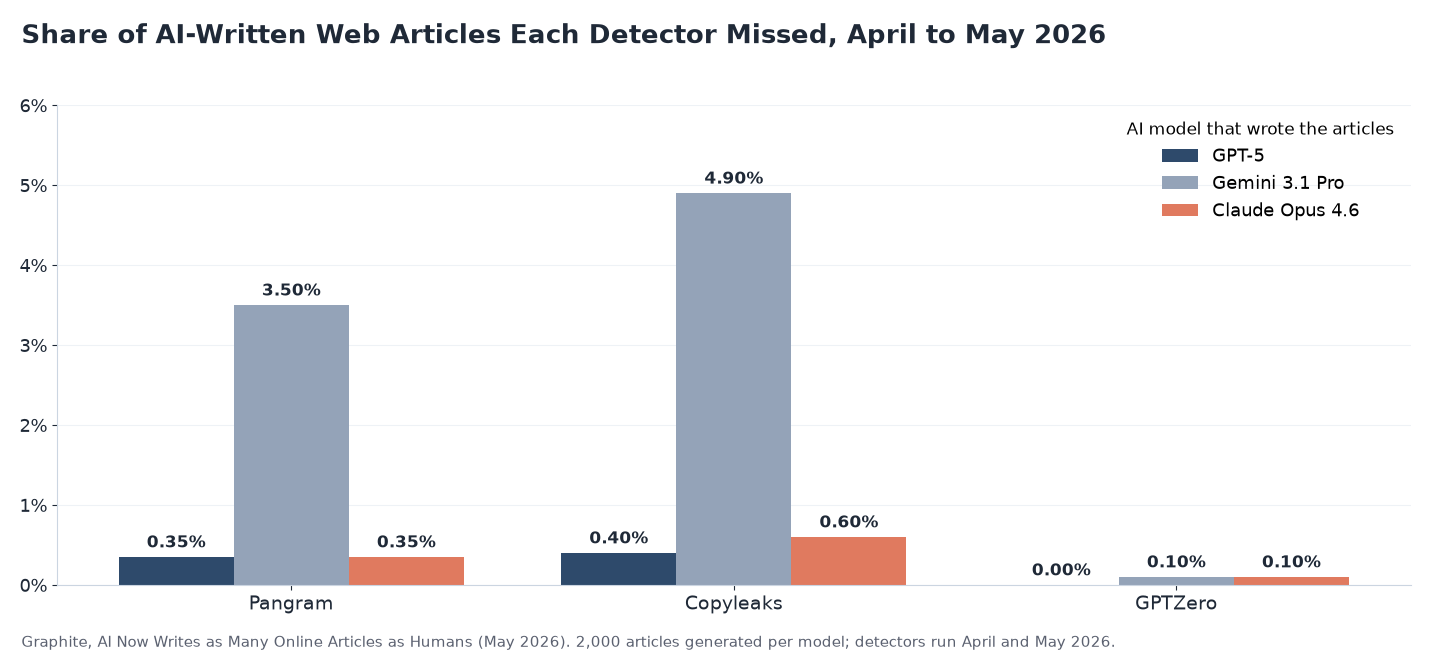
Graphite, a marketing agency, tested Pangram, Copyleaks, and GPTZero in April and May 2026. It ran them on about 15,700 web articles published before ChatGPT launched, which it treated as human-written, and on 2,000 articles written by each of three AI models.
| Detector | False positive rate (human articles flagged) | Missed GPT-5 articles | Missed Gemini 3.1 Pro articles | Missed Claude Opus 4.6 articles | Average miss rate | Source |
|---|---|---|---|---|---|---|
| Pangram | 1.844% | 0.35% | 3.50% | 0.35% | 1.40% | Graphite, May 2026 |
| Copyleaks | 1.836% | 0.40% | 4.90% | 0.60% | 1.97% | Graphite, May 2026 |
| GPTZero | 1.355% | 0.00% | 0.10% | 0.10% | 0.07% | Graphite, May 2026 |
Source: AI Services Companies analysis of Graphite and GPTZero-hosted Graphite data, conducted November 2026. Data: detector-miss-rate-by-ai-model-2026.csv
Source: AI Services Companies analysis of Graphite data, conducted November 2026.
Key Findings
- Every detector missed the most articles written by Gemini 3.1 Pro: 3.50% for Pangram, 4.90% for Copyleaks, and 0.10% for GPTZero.2,3
- Graphite generated each article from a 100-word summary of a pre-ChatGPT article, so the test covers unedited AI text and not text a person later rewrote.2
- Pangram, Copyleaks, and GPTZero gave Graphite access to their detectors for the study, and GPTZero published the results file.2,3
Pangram Identified 92.5% of Hybrid Papers in a 2026 Test and GPTZero Identified None
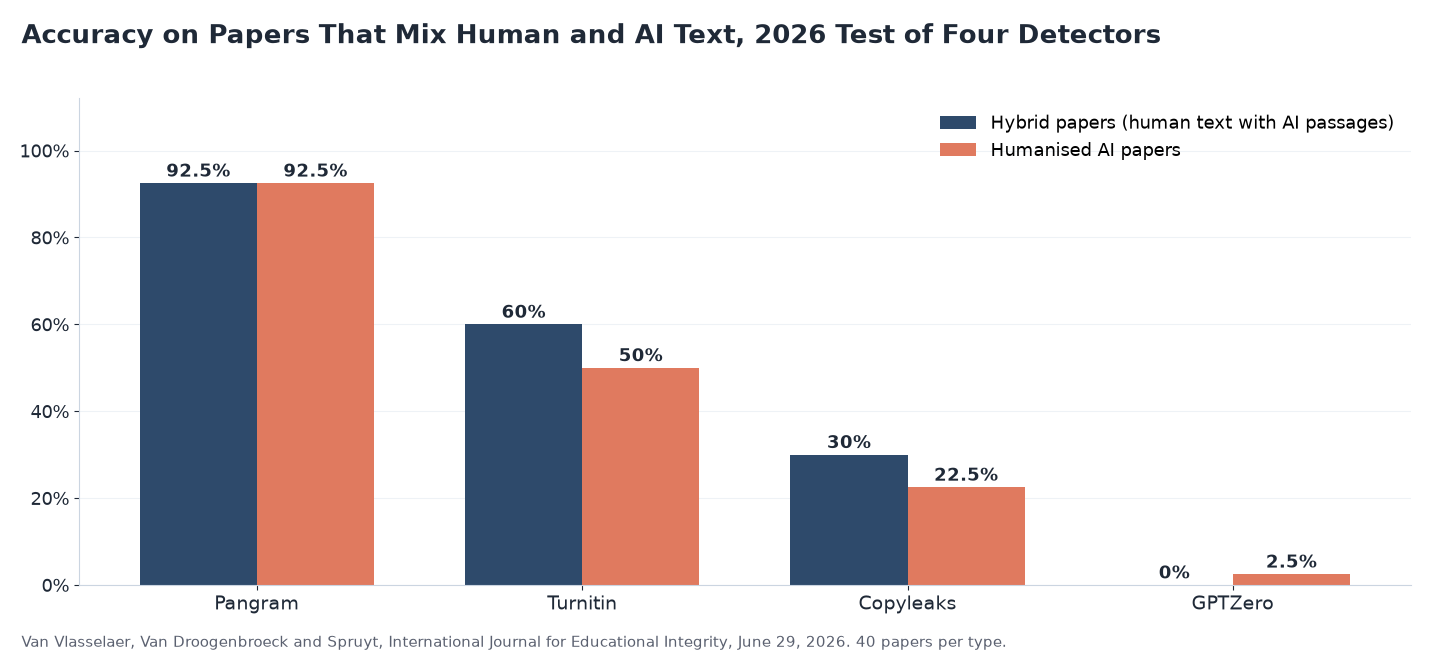
Van Vlasselaer, Van Droogenbroeck and Spruyt built 160 papers with known AI content: 40 fully human, 40 fully AI, 40 hybrid, and 40 humanised. They tested GPTZero, Pangram, Copyleaks, and Turnitin.
| Detector | Fully human papers correctly cleared | Fully AI papers identified (strict) | Hybrid papers identified | Humanised AI papers identified | Source |
|---|---|---|---|---|---|
| Pangram | 100% | 65.0% (97.5% inclusive) | 92.5% | 92.5% | Van Vlasselaer et al., June 2026 |
| Turnitin | 100% | 0% | 60.0% | 50.0% | Van Vlasselaer et al., June 2026 |
| Copyleaks | 100% | 0% | 30.0% | 22.5% | Van Vlasselaer et al., June 2026 |
| GPTZero | 100% | 0% | 0.0% | 2.5% | Van Vlasselaer et al., June 2026 |
Source: AI Services Companies analysis of Van Vlasselaer, Van Droogenbroeck and Spruyt data, conducted November 2026. Data: detector-accuracy-hybrid-humanised-papers-2026.csv
Source: AI Services Companies analysis of Van Vlasselaer, Van Droogenbroeck and Spruyt data, conducted November 2026.
Key Findings
- Strict accuracy counts a paper as correct only when the detector's score falls within the AI share the researchers built into the paper; the inclusive figure also counts near misses.6
- The fully AI papers came from ChatGPT's Deep Research mode in May 2025, and Turnitin classified all 40 of them as 0% to 20% AI.6
- Pangram flagged 529 of 1,163 master's theses (45.5%) from one faculty in 2024-25, with a mean estimated AI share of 34.0% among flagged theses.6
- Graphite's test found GPTZero missed 0.07% of AI articles on average, while this test found it missed most fully AI papers, so results depend on the kind of text tested.2,6
Academic Benchmarks Report Accuracy From 69.4% to 84.4% and False Positive Rates up to 30.6%
Detector studies use different texts, tools, and scoring, so their error rates do not line up. We listed the headline result from each test we opened.
| Study | Year | Test set | Headline result | Source |
|---|---|---|---|---|
| Alaqad et al., ICHORA 2026 | 2026 | 180 academic samples: human, AI, and hybrid; GPTZero, Turnitin, Copyleaks, ZeroGPT, Originality.ai | Accuracy from 69.4% (ZeroGPT) to 84.4% (Originality.ai); false positive rates 15.6% to 30.6%; hybrid accuracy 54.2% to 70.8% | Alaqad et al. |
| Van Vlasselaer et al., IJEI | 2026 | 160 papers; GPTZero, Pangram, Copyleaks, Turnitin | No false positives on fully human papers; Turnitin, GPTZero, and Copyleaks identified no fully AI papers | Van Vlasselaer et al., June 2026 |
| Graphite | 2026 | About 15,700 pre-ChatGPT articles and 6,000 AI articles; Pangram, Copyleaks, GPTZero | False positive rates 1.355% to 1.844%; average miss rates 0.07% to 1.97% | Graphite, May 2026 |
| Weber-Wulff et al., IJEI | 2023 | 54 documents, 756 tests; 14 tools including Turnitin | No tool exceeded 80% accuracy; Turnitin scored highest; tools leaned toward labeling text human-written | Weber-Wulff et al. |
| OpenAI AI classifier | 2023 | English "challenge set" | Identified 26% of AI text and flagged 9% of human text; withdrawn July 20, 2023 | OpenAI |
Source: AI Services Companies analysis of Alaqad et al., Van Vlasselaer et al., Graphite, Weber-Wulff et al., and OpenAI data, conducted November 2026.
Key Findings
- The 2026 academic benchmarks disagree on false positives: Alaqad et al. recorded 15.6% to 30.6% across five tools, while Van Vlasselaer et al. recorded none on 40 human papers.6,7
- OpenAI withdrew its own AI text classifier on July 20, 2023, citing a low rate of accuracy, and said it was unreliable on text under 1,000 characters.13
- Alaqad et al. found accuracy dropped on hybrid texts for all five tools, to between 54.2% and 70.8%.7
Detectors Flagged 61.22% of Non-Native English Essays as AI-Generated in a Stanford Study
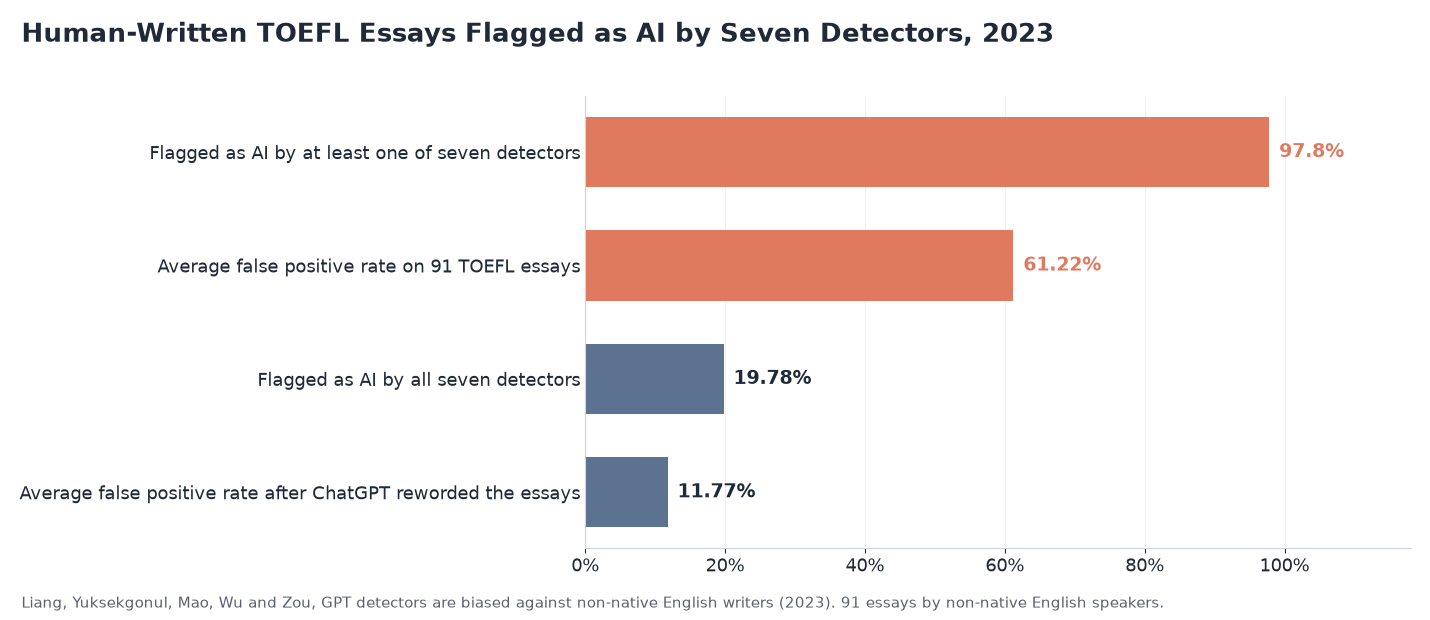
Stanford researchers tested seven detectors on 91 TOEFL essays written by non-native English speakers and 88 US eighth-grade essays. The detectors were close to accurate on the eighth-grade essays and flagged most TOEFL essays as AI.
| Measure | Result | Source |
|---|---|---|
| Average false positive rate on TOEFL essays | 61.22% | Liang et al. 2023 |
| TOEFL essays flagged as AI by all seven detectors | 18 of 91 (19.78%) | Liang et al. 2023 |
| TOEFL essays flagged as AI by at least one detector | 89 of 91 (97.80%) | Liang et al. 2023 |
| Average false positive rate after ChatGPT was asked to enhance word choices | 11.77% | Liang et al. 2023 |
| TOEFL essays flagged by all seven detectors after the rewrite | 1 of 91 (1.10%) | Liang et al. 2023 |
Source: AI Services Companies analysis of Liang et al. data, conducted November 2026. Data: toefl-essays-flagged-as-ai-2023.csv
Source: AI Services Companies analysis of Liang et al. data, conducted November 2026.
Key Findings
- The authors link the bias to perplexity, a measure of how predictable text is, because essays by non-native writers use simpler word choices that detectors read as machine-like.9
- The 61.22% figure describes the seven detectors tested in 2023, and newer versions may differ.9
- Asking ChatGPT to enhance the essays' word choices cut the average false positive rate by 49.45 points, from 61.22% to 11.77%.9
Turnitin Reported 11% of 200 Million Papers Had at Least 20% AI Writing
Turnitin, the plagiarism checker used by many schools, launched an AI writing detector in April 2023. It has published two counts of papers reviewed and flagged.
| Measure | July 2023 release | As of March 21, 2024 | Source |
|---|---|---|---|
| Papers reviewed since launch | 65 million+ | 200 million+ | Turnitin |
| Papers with at least 20% AI writing | Nearly 6.7 million (10.3%) | 22 million+ (about 11%) | Turnitin |
| Papers with at least 80% AI writing | 2.1 million+ (3.3%) | 6 million+ (about 3%) | Turnitin |
| Institutions with AI detection enabled in at least one account (as of June 30, 2023) | Nearly 98% | Not reported | Turnitin |
Source: AI Services Companies analysis of Turnitin (July 2023) and Turnitin (April 2024) data, conducted November 2026.
Key Findings
- Turnitin states a false positive target of under 1% for documents with at least 20% AI writing and tests each model update on more than 700,000 papers written before ChatGPT.12
- Turnitin's 2023 release said a high AI score does not by itself show misconduct, because some educators ask students to use AI tools.10
- The March 2024 count is the latest we found; Turnitin had not published a newer total on the pages we opened.11
49.9% of New English Web Articles Were Primarily AI-Generated in Q1 2026
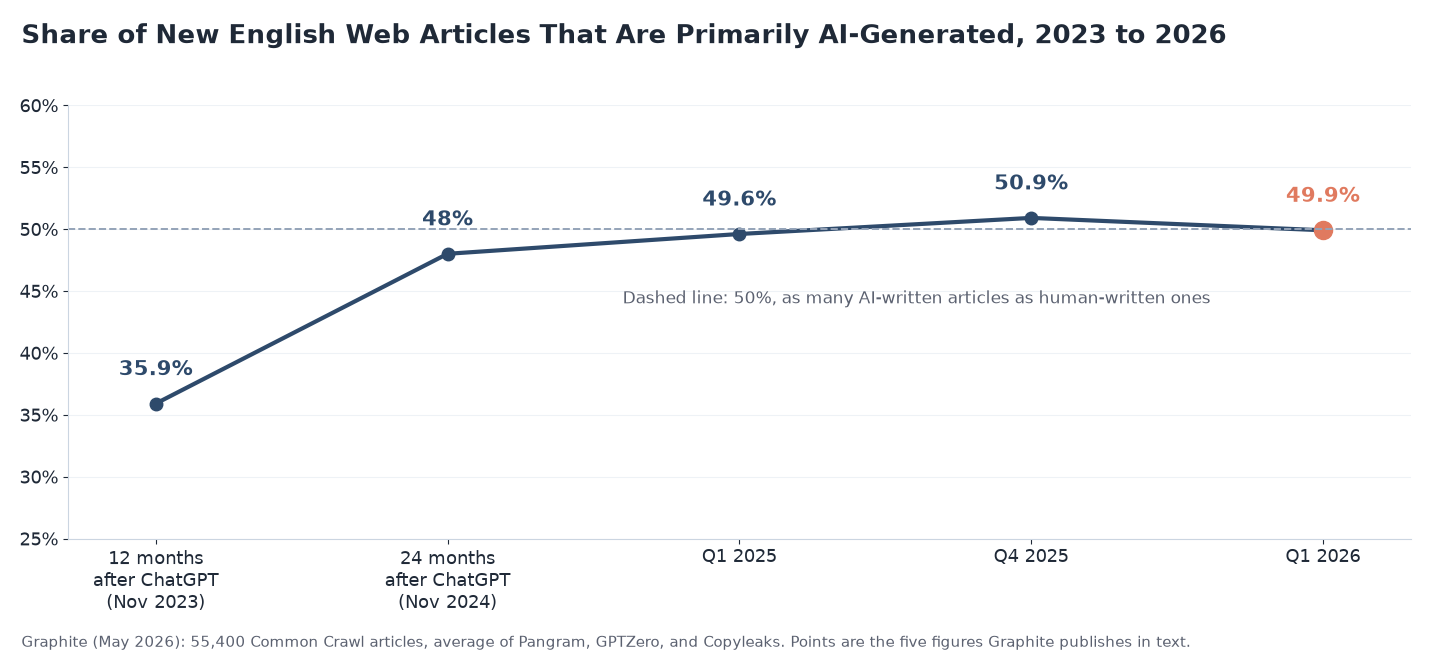
Detectors are also used to estimate how much of the web is AI-written. Graphite sampled 55,400 English articles from Common Crawl and averaged the three detectors above.
| Period | Share primarily AI-generated | Source |
|---|---|---|
| 12 months after ChatGPT (Nov 2023) | 35.9% | Graphite, May 2026 |
| 24 months after ChatGPT (Nov 2024) | 48% | Graphite, May 2026 |
| Q1 2025 | 49.6% | Graphite, May 2026 |
| Q4 2025 | 50.9% | Graphite, May 2026 |
| Q1 2026 | 49.9% | Graphite, May 2026 |
Source: AI Services Companies analysis of Graphite data, conducted November 2026. Data: primarily-ai-generated-web-articles-2023-2026.csv
Source: AI Services Companies analysis of Graphite data, conducted November 2026.
Key Findings
- The share has stayed near 50% for five quarters, and Graphite's earlier single-detector estimate ran 3.3 points higher on average.2,4
- Graphite counts an article as primarily AI-generated only when most of its text is detected as AI-written or AI-assisted, and it did not test articles that people edited after AI drafting.2,4
- Graphite sells SEO and content services, and the sample covers articles and listicles of at least 100 words with an article schema.2
Ahrefs Found AI Text in 74.2% of 900,000 New Web Pages, and 2.5% Were Entirely AI
Ahrefs ran its own detector on 900,000 English-language pages that its crawler first found in April 2025, one page per domain. The 74.2% figure counts any page with detected AI text, so most of those pages are mixed.
| Category | Share of pages | Source |
|---|---|---|
| Entirely human | 25.8% | Ahrefs, April 2025 |
| Mixed, 1% to 10% AI (calculated remainder) | 9.8% | Calculated |
| Moderate AI use (11% to 40% of the page) | 25.86% | Ahrefs, April 2025 |
| Substantial AI use (41% to 70%) | 20.5% | Ahrefs, April 2025 |
| Dominant AI use (71% to 99%) | 15.51% | Ahrefs, April 2025 |
| Entirely AI | 2.5% | Ahrefs, April 2025 |
Source: AI Services Companies analysis of Ahrefs data, conducted November 2026. Data: ahrefs-new-pages-ai-content-share-2025.csv
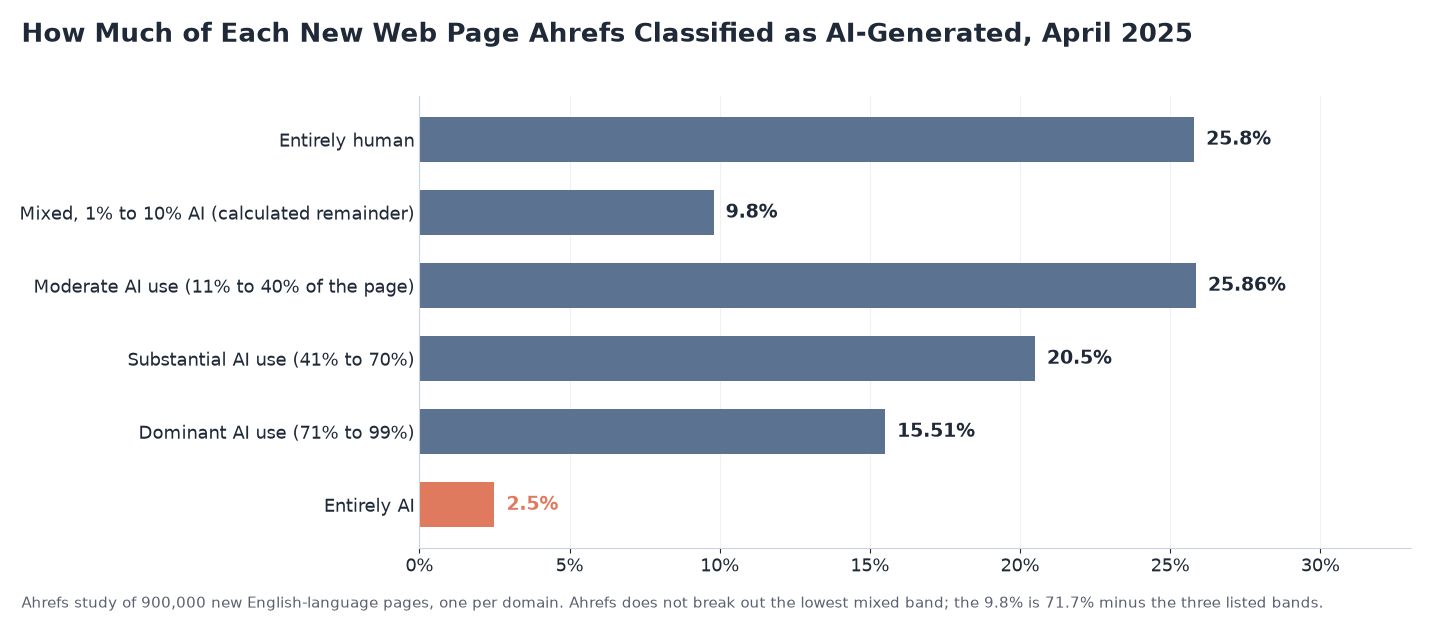
Source: AI Services Companies analysis of Ahrefs data, conducted November 2026.
Key Findings
- In a separate Ahrefs survey of 879 content marketers, 87% said they use AI to create or help create content.5
- Ahrefs sells an AI content detector and states that detectors are imperfect, especially on partial AI content.5
68% of US K-12 Teachers Regularly Used an AI Detection Tool in 2023-24
The Center for Democracy & Technology surveyed K-12 public school teachers about generative AI. It reported that detection tools were common and that few teachers had guidance on what to do after a suspected case.
| Measure | Share of teachers | Source |
|---|---|---|
| Teachers who regularly use an AI content detection tool | 68% | CDT, March 2024 |
| Teachers who say a student at their school got in trouble over AI use or accusations | 64% | CDT, March 2024 |
| Teachers certain a student used generative AI for school | 59% | CDT, March 2024 |
| Teachers more distrustful that students' work is their own | 52% | CDT, March 2024 |
| Teachers given guidance on responding to suspected AI use | 28% | CDT, March 2024 |
| Teachers who received formal training on generative AI policies and procedures | 80% | CDT, March 2024 |
Source: AI Services Companies analysis of Center for Democracy & Technology data, conducted November 2026. Data: teachers-and-ai-detection-tools-2023-24.csv
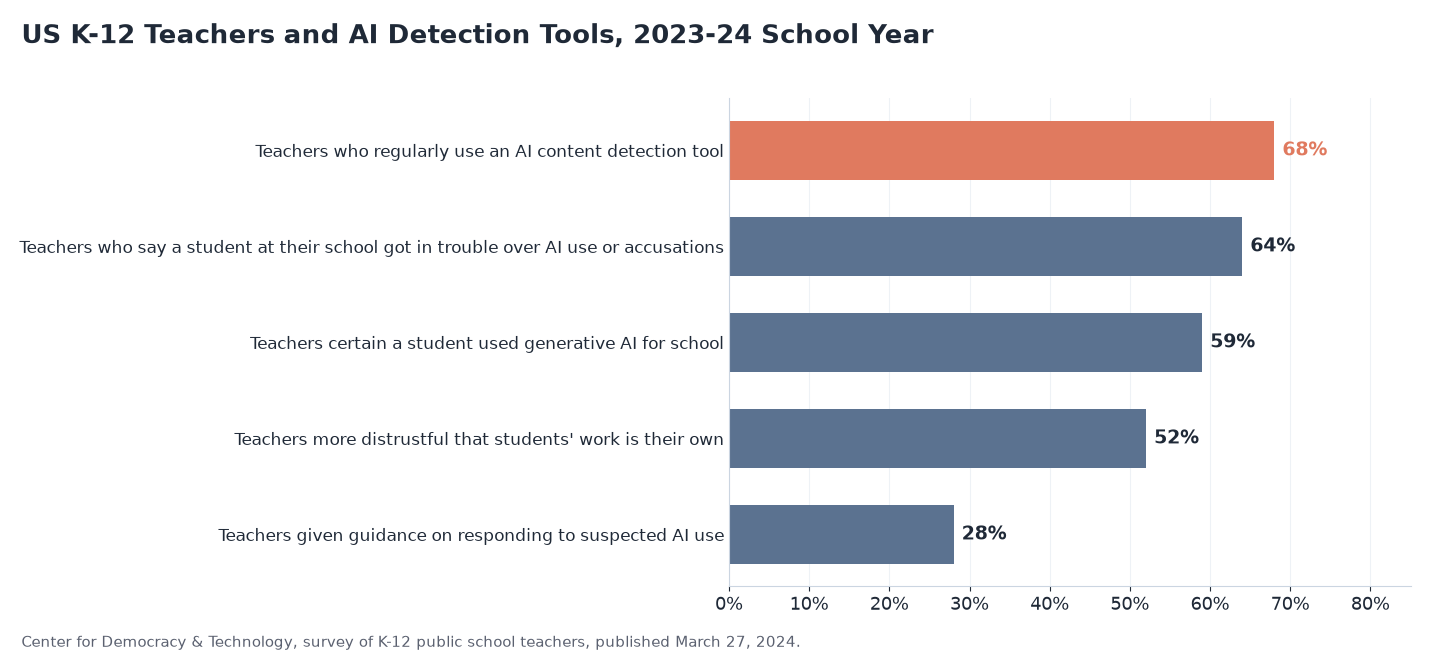
Source: AI Services Companies analysis of Center for Democracy & Technology data, conducted November 2026.
Key Findings
- The 64% who said students had gotten in trouble over AI use or accusations was 16 percentage points higher than the prior school year.14
- CDT is a civil liberties nonprofit, and it described detection tools as ineffective in its release; the 68% figure comes from its teacher survey.14
What AI Content Detection Statistics Show Going Into 2027
The 2026 tests do not agree on how accurate detectors are. Graphite measured false positives under 2% on web articles, Alaqad et al. measured 15.6% to 30.6% on academic samples, and Van Vlasselaer et al. measured none on 40 human papers.2,6,7
Detectors perform worst on mixed human and AI text, and the 2023 Stanford study showed they flagged most non-native English essays as AI. Teachers use them widely anyway, and 64% reported students in trouble over AI use or accusations.7,9,14
When you cite a detector statistic, state the tool, the year, the kind of text, and whether the figure is a false positive rate, a miss rate, or accuracy.
Data Collection and Methodology
We collected figures from published studies, company reports, and help pages, opened on November 25, 2026. Graphite's 2026 study sampled 55,400 English-language Common Crawl articles of at least 100 words, published from January 2020 to March 2026, and averaged Pangram, Copyleaks, and GPTZero. Its false positive rates come from about 15,700 articles published before November 2022, which Graphite treats as human-written.
Graphite's miss rates come from 2,000 articles written by each of GPT-5, Gemini 3.1 Pro, and Claude Opus 4.6. Graphite publishes five figures for the share of primarily AI-generated articles in text, and we plotted those five; the 24-month figure is placed at November 2024 and the others at the periods Graphite gives. Graphite's sheet has a quarterly series that we did not use.
Van Vlasselaer et al. built 160 synthetic papers with known AI content, and strict accuracy counts a score as correct only inside the known AI range. Alaqad et al. report ranges for false positives and hybrid accuracy, and we report them as ranges. Weber-Wulff et al. used strict binary accuracy, and we report the ranking and the 80% ceiling they state.
The Stanford figures are from the arXiv version of the study, which reports a 61.22% average false positive rate; the published Patterns version rounds it to 61.3%. The Ahrefs lowest mixed band is not published, so the 9.8% is calculated as 71.7% minus the three bands listed. Detector vendors and agencies in these sources sell detection, SEO, or content services, and their figures are self-reported. No figures in this article are estimates except the calculated 9.8%.
Sources (14)
- AI Services Companies analysis of AI content detection figures from Graphite, Ahrefs, Turnitin, OpenAI, Stanford researchers, the Center for Democracy & Technology, and academic benchmarks, conducted November 2026.
- Graphite, AI Now Writes as Many Online Articles as Humans (May 2026)
- GPTZero, graphite-online-articles.csv (Graphite study data, May 2026)
- Axios, How much of the web is written by AI? (May 15, 2026)
- Ahrefs, 74% of New Webpages Include AI Content (Study of 900k Pages)
- Van Vlasselaer, Van Droogenbroeck and Spruyt, Who wrote this? Evaluating the reliability of AI detection tools in higher education, International Journal for Educational Integrity (June 29, 2026)
- Alaqad et al., Benchmarking AI-Generated Text Detection Tools in Academic Writing: An Experimental Evaluation, ICHORA 2026
- Weber-Wulff et al., Testing of detection tools for AI-generated text, International Journal for Educational Integrity (December 25, 2023)
- Liang, Yuksekgonul, Mao, Wu and Zou, GPT detectors are biased against non-native English writers (2023)
- Turnitin, Turnitin AI detection feature reviews more than 65 million papers (July 2023)
- Turnitin, Turnitin celebrates one year for AI writing detection (April 9, 2024)
- Turnitin Guides, Turnitin's AI writing detection capabilities FAQs (updated November 3, 2026)
- OpenAI, New AI classifier for indicating AI-written text (January 31, 2023, updated July 2023)
- Center for Democracy & Technology, New Research: Educators Still Struggling with Generative AI Detection, Discipline, and Distrust (March 27, 2024)