
AI Personalization Statistics 2026
Published November 25, 2026
Our analysts gathered figures from Deloitte Digital's 2022, 2024, and 2026 personalization surveys, two Capgemini Research Institute reports, McKinsey's 2021 personalization research, Twilio Segment's 2024 report, and 2026 consumer surveys from Attentive and Amperity. The goal was to show what consumers expect from AI personalization, how brands rate their own work, and what mature programs earn as of Q4 2026.
Key Findings
- Brands estimate they personalize 62% of customer experiences, while consumers say 44% feel personalized, an 18-point gap that has not changed since 2022.2,3,4
- 52% of consumers are more likely to buy from brands that personalize, and they report spending 30% more with those brands.2
- 87% of brand leaders rate their personalization as good or excellent, compared with 29% of consumers.2
- 63% of consumers want generative AI to provide hyper-personalized content, up from 58% a year earlier, and 69% worry about the privacy of their data when it does.5
- Brands take an average of 4.7 business days to act on new customer data, and 97% of brand leaders say AI innovation is outpacing their ability to optimize it for personalization.2
AI personalization is the use of machine learning and generative AI to tailor content, product recommendations, offers, and messages to each customer from data such as browsing, purchases, and past conversations. It covers product recommendations in online stores, individualized emails and texts, and chatbots that remember a customer.
Consumers now also use AI tools to shop, so brands are personalizing both their own channels and what AI assistants say about them.2,7
Our analysts read the sources below in full or in their published summaries, and all were opened on November 25, 2026. Several are from vendors that sell personalization, data, or marketing products, so we note the seller beside each survey.
For related research, see our AI Trust Statistics 2026, AI Data Privacy Statistics 2026, and AI Customer Service Statistics 2026.
In the following sections, we compare how brands and consumers rate personalization, what consumers value, how mature programs differ, how consumers feel about hyper-personalization and data, what AI shoppers expect, and older McKinsey and Twilio benchmarks.
Brands Say They Personalize 62% of Experiences, Consumers Say 44%
Deloitte Digital has asked US brand leaders and consumers the same personalization questions every two years since 2022. The brand and consumer estimates have both risen, and the gap between them has stayed at 18 points.
| Survey year | Brands estimate they personalize | Consumers say feel personalized | Gap | Source |
|---|---|---|---|---|
| 2022 | 56% | 38% | 18 points | Deloitte Digital |
| 2024 | 61% | 43% | 18 points | Deloitte Digital |
| 2026 | 62% | 44% | 18 points | Deloitte Digital |
Source: AI Services Companies analysis of Deloitte Digital data from 2022, 2024, and 2026, conducted November 2026. Data: brand-vs-consumer-personalization-perception-2022-2026.csv
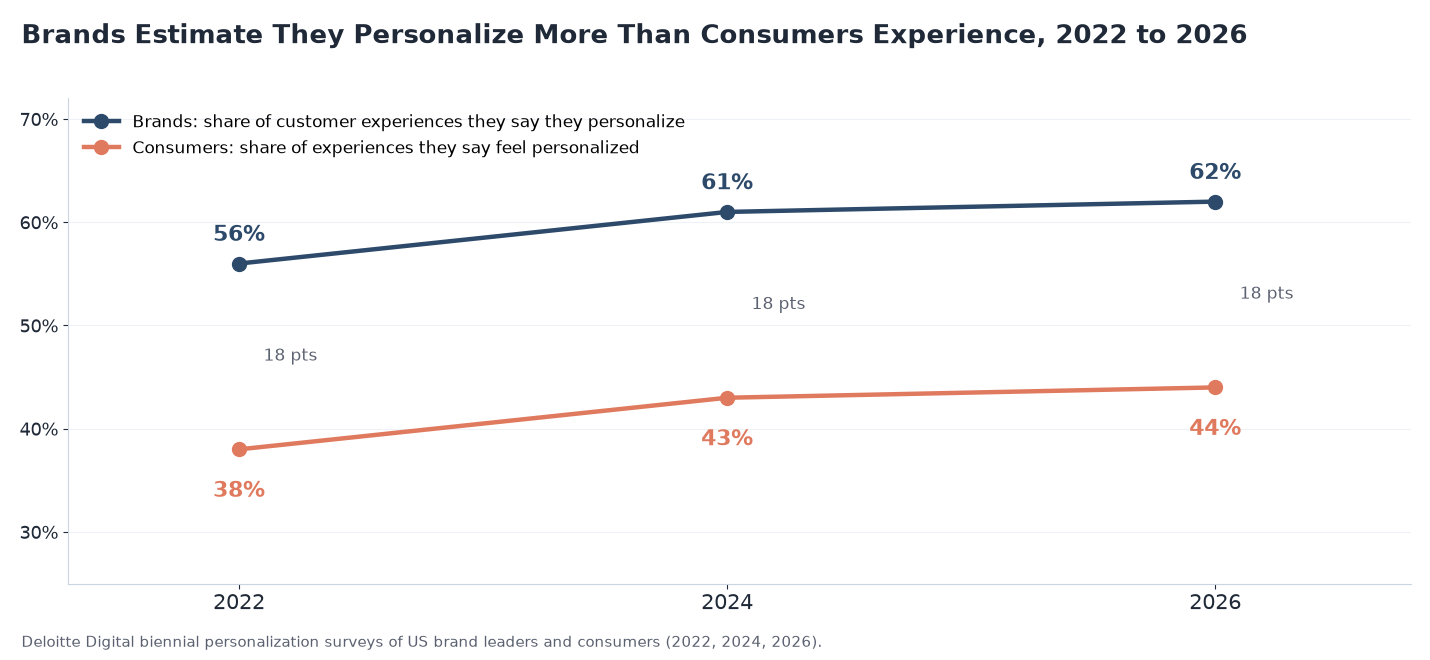
Source: AI Services Companies analysis of Deloitte Digital data, conducted November 2026.
Key Findings
- In 2026, 87% of brand leaders rated their personalization as good or excellent, and 29% of consumers rated the personalization they experience that way, a 58-point gap.2
- Deloitte Digital sells customer experience and personalization services, and it surveyed 480 US B2C brand leaders and 1,000 US consumers in April 2026.2
- Deloitte Digital says the gap suggests that what brands call personalization, more activity and targeting, is not what customers experience as valuable or authentic.2
52% of Consumers Are More Likely to Buy From Brands That Personalize, and Report Spending 30% More
Deloitte Digital asked consumers what makes personalization worth having. Resolving problems and saving money ranked highest.
| Measure | Share of consumers | Source |
|---|---|---|
| Value personalization that proactively resolves an issue | 67% | Deloitte Digital, 2026 |
| Value personalization that saves them money | 61% | Deloitte Digital, 2026 |
| Value personalization with loyalty benefits | 58% | Deloitte Digital, 2026 |
| Value clear and respectful use of their data | 58% | Deloitte Digital, 2026 |
| More likely to buy from brands that personalize | 52% | Deloitte Digital, 2026 |
| Want more direct control over how brands personalize | 38% | Deloitte Digital, 2026 |
| Average extra spending with brands that personalize | 30% | Deloitte Digital, 2026 |
Source: AI Services Companies analysis of Deloitte Digital data, conducted November 2026. Data: what-consumers-value-in-personalization-2026.csv
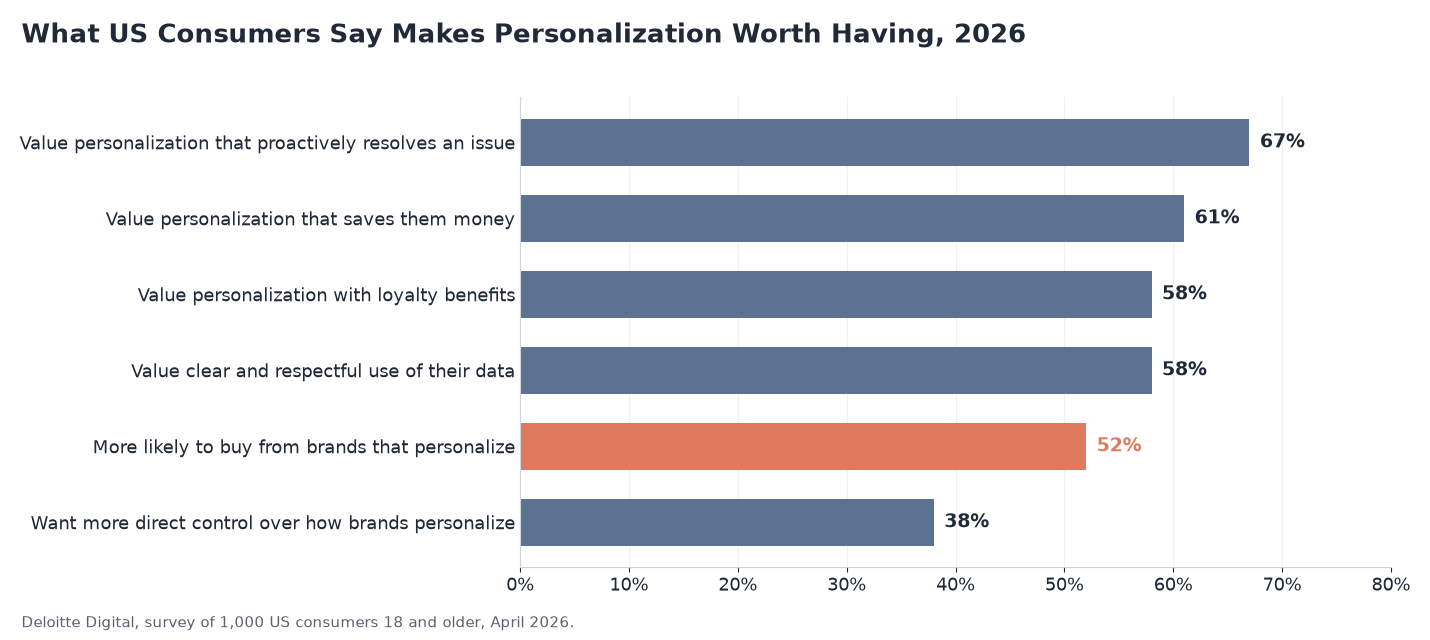
Source: AI Services Companies analysis of Deloitte Digital data, conducted November 2026.
Key Findings
- The 30% figure is the average extra amount consumers report spending, so it comes from their own estimates and not from purchase records.2
- 38% of consumers want more direct control over how companies personalize for them.2
38% of High-Maturity Brands Report Better Conversion From Personalization, Against 23% of Low-Maturity Brands
Deloitte Digital split the 480 brand leaders into three groups by self-reported personalization capabilities. We compared the top group with the bottom group.
| Measure | High-maturity brands | Low-maturity brands | Source |
|---|---|---|---|
| Strong data governance | 73% | 29% | Deloitte Digital, 2026 |
| Strong customer intelligence | 53% | 13% | Deloitte Digital, 2026 |
| Strong content supply | 52% | 13% | Deloitte Digital, 2026 |
| Say personalization improves purchasing | 54% | 43% | Deloitte Digital, 2026 |
| Say it improves operational efficiency | 49% | 34% | Deloitte Digital, 2026 |
| Say it improves retention | 44% | 32% | Deloitte Digital, 2026 |
| Say it improves conversion | 38% | 23% | Deloitte Digital, 2026 |
| Fund personalization as a multiyear strategic investment | 43% | 16% | Deloitte Digital, 2026 |
| Say AI significantly supports personalization | 57% | About 0% | Deloitte Digital, 2026 |
| Average lift reported by brands that improved conversion | 62% | 41% | Deloitte Digital, 2026 |
| Average lift reported by brands that improved retention | 60% | 45% | Deloitte Digital, 2026 |
| Average FY2025 financial goal exceeded by | 13.5% | 10.1% | Deloitte Digital, 2026 |
Source: AI Services Companies analysis of Deloitte Digital data, conducted November 2026. Data: high-vs-low-maturity-personalization-brands-2026.csv
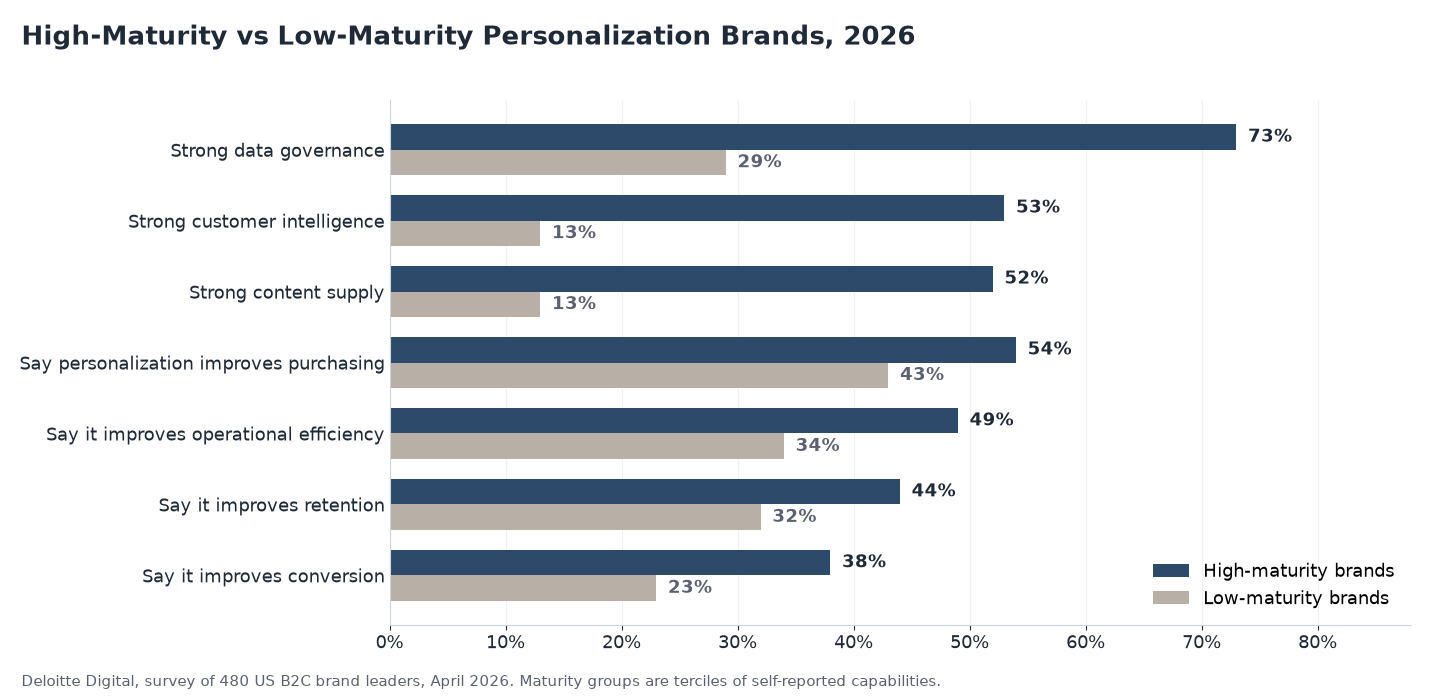
Source: AI Services Companies analysis of Deloitte Digital data, conducted November 2026.
Key Findings
- Brands take an average of 4.7 business days to activate personalization from new customer data, and 76% of brand leaders say their operating foundations do not significantly support AI value.2
- Integration is the top constraint on scaling personalization, cited by 44% of brands.2
- High-maturity brands are five times as likely to use advanced causal measurement, and 36% of them said personalization investment grew revenue 15% or more in FY2026, against 16% of low-maturity brands.2
- The maturity groups and results are self-reported by brand leaders, so they show association and do not show that maturity caused the results.2
63% of Consumers Want Generative AI to Hyper-Personalize, and 69% Worry About Data Privacy
Capgemini Research Institute surveyed 12,000 consumers in October 2025. Most want AI-driven personalization, and most also worry about how their data is used to create it.
| Measure | October 2024 | October 2025 | Source |
|---|---|---|---|
| Want Gen AI to provide hyper-personalized content and recommendations | 58% | 63% | Capgemini, October 2025 |
| Comfortable sharing shopping history and preferences with a digital assistant for recommendations | Not reported | 56% | Capgemini, October 2025 |
| Worried that hyper-personalized content risks privacy of their data | Not reported | 69% | Capgemini, October 2025 |
| Will switch retailers for better data-protection policies | Not reported | 52% | Capgemini, October 2025 |
| Consumers who expect personalization (December 2025 survey) | Not reported | 57% | Capgemini, December 2025 |
| Organizations that assign importance to personalization in CX (December 2025) | Not reported | 23% | Capgemini, December 2025 |
| Organizations using AI for personalization, which Capgemini calls underused (December 2025) | Not reported | 21% | Capgemini, December 2025 |
Source: AI Services Companies analysis of Capgemini Research Institute, What matters to today's consumer 2026 and Capgemini Research Institute, Reimagining customer experience data, conducted November 2026. Data: consumers-on-hyper-personalization-and-data-2025.csv
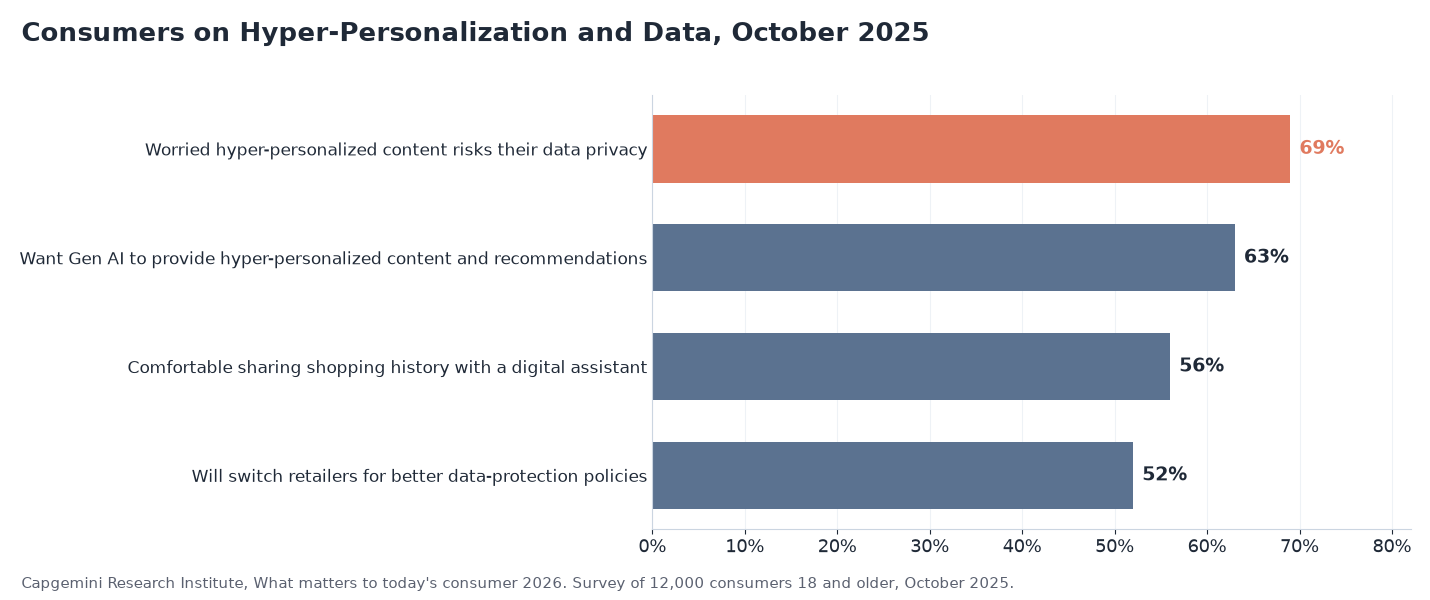
Source: AI Services Companies analysis of Capgemini Research Institute data, conducted November 2026.
Key Findings
- Capgemini found 57% of consumers expect personalization and 23% of organizations assign importance to it, which it calls a missed opportunity.6
- In the same report, 78% of front-line staff say they lack real-time access to customer data, and 82% say decentralized data is a major obstacle.6
- Capgemini describes AI as underused for personalization, at 21% of organizations, and for deeper customer understanding, at 19%.6
72% of AI-Assisted Shoppers Hold High Personalization Expectations, Against 41% of Other Shoppers
Shoppers who use AI chatbots expect more from the brands they buy from. Attentive surveyed 3,054 US adults in August 2026, and Amperity surveyed 1,000 US consumers in 2026.
| Measure | Result | Source |
|---|---|---|
| Shoppers who used a general AI chatbot for shopping in the past three months | 68% | Attentive, August 2026 |
| AI-assisted shoppers who agree with at least five of seven personalization statements | 72% | Attentive, August 2026 |
| Shoppers who did not use AI for shopping and agree with at least five of seven | 41% | Attentive, August 2026 |
| AI-assisted shoppers who say AI affected which products they considered or chose at least half the time | 71% | Attentive, August 2026 |
| Consumers who say personalized experiences matter when choosing a brand | 72% | Amperity, 2026 |
| Consumers who say recommendations they receive are often genuinely relevant | 15% | Amperity, 2026 |
| Consumers less likely to choose a brand after invasive personalization | 57.5% | Amperity, 2026 |
| Consumers more loyal to brands open about data use | 75% | Amperity, 2026 |
| Consumers more likely to engage with personalization if they trust data handling | 78% | Amperity, 2026 |
| Consumers who chose an AI-recommended brand they had not considered and were satisfied | 60% | Amperity, 2026 |
Source: AI Services Companies analysis of Attentive and Amperity data, conducted November 2026. Data: consumers-on-personalization-trust-relevance-2026.csv
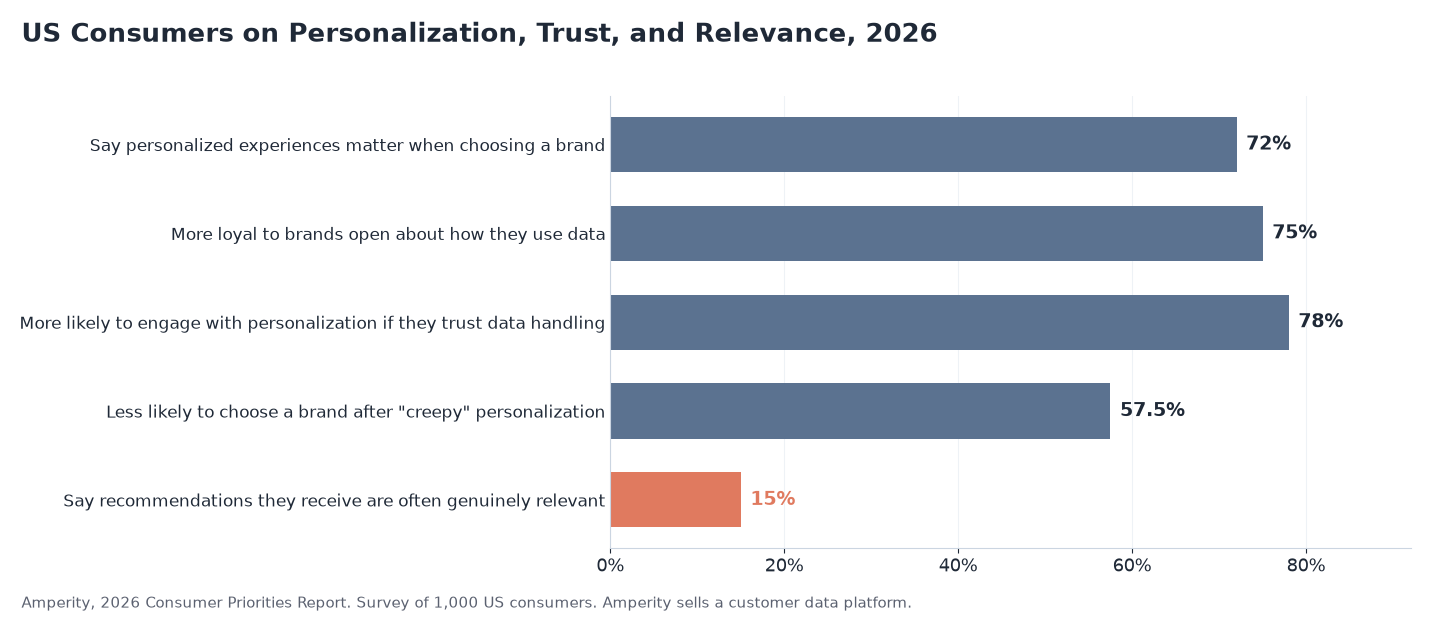
Source: AI Services Companies analysis of Amperity data, conducted November 2026.
Key Findings
- Attentive says the largest gap between AI-assisted and other shoppers is in expecting brands to remember what they have browsed, clicked, or bought when messaging them.7
- Attentive sells marketing messaging products and Amperity sells a customer data platform, so both surveys come from sellers of personalization tools.7,8
McKinsey Reported a 10% to 15% Revenue Lift From Personalization in 2021
The most cited revenue figures for personalization predate generative AI. We list McKinsey's 2021 results and Twilio Segment's 2024 survey of business leaders, and label their dates.
| Measure | Result | Source |
|---|---|---|
| Consumers who expect companies to deliver personalized interactions | 71% | McKinsey, 2021 |
| Consumers who get frustrated when it does not happen | 76% | McKinsey, 2021 |
| Consumers who say personalized communications prompted them to consider a brand | 76% | McKinsey, 2021 |
| Consumers who say personalized content made them more likely to repurchase | 78% | McKinsey, 2021 |
| Typical revenue lift from personalization (company range 5% to 25%) | 10% to 15% | McKinsey, 2021 |
| Business leaders who say personalization is crucial to success in the next three years | 89% | Twilio Segment, 2024 |
| Companies concerned that inaccurate data weakens AI personalization | 61% | Twilio Segment, 2024 |
| Brands that agree AI will fundamentally change personalization and marketing strategies | Over 70% | Twilio Segment, 2024 |
Source: AI Services Companies analysis of McKinsey and Twilio Segment data, conducted November 2026.
Key Findings
- McKinsey found companies that grow faster drive 40% more of their revenue from personalization than slower-growing companies.9
- McKinsey published these figures in November 2021, before generative AI tools were widely used, and we found no 2026 update with the same measures.9
- Twilio Segment sells customer data products, and its 2024 survey figures are from business leaders.10
What AI Personalization Statistics Show Going Into 2027
Consumers want personalization that is useful and respects their data, and brands consistently overestimate how well they deliver it. The 18-point gap between brand and consumer estimates has not moved from 2022 to 2026.2,3,4
Brands that report mature data, AI, and measurement foundations also report better results, and consumers who use AI to shop expect more. Trust is the limit: 69% of consumers worry about privacy when content is hyper-personalized.2,5,7
When you cite a personalization statistic, say whether it comes from brands or consumers, which year, and whether the source sells personalization products.
Data Collection and Methodology
We collected figures from published reports, press pages, and vendor survey pages, opened on November 25, 2026. Deloitte Digital's 2026 figures come from two blind surveys by Lawless Research in April 2026: 480 director-level or above employees at US B2C companies with 500 or more employees and $10 million or more in revenue, and 1,000 US consumers 18 and older.
Deloitte Digital's 2022 and 2024 brand and consumer percentages come from its earlier reports. Capgemini's consumer survey covered 12,000 consumers 18 and over in October 2025, and its customer experience report drew on 1,200 executives and 9,500 consumers in December 2025.
Capgemini's hyper-personalization chart shows 58% and 63% beside the November 2024 and October 2025 survey legend, and we read 58% as 2024 and 63% as 2025, which matches the report's text citing 63%. Attentive surveyed 3,054 US adults from August 12 to 14, 2026, weighted to US Census benchmarks, and defines AI-assisted shoppers as those who used a general AI chatbot for at least one of nine shopping activities. Amperity surveyed 1,000 US consumers in 2026.
McKinsey's figures are from its 2021 Next in Personalization report, and Twilio Segment's are from its 2024 report. Vendor surveys are self-reported, and the "30% more" spending figure is a consumer estimate. No figures in this article are estimates.
Sources (10)
- AI Services Companies analysis of AI personalization figures from Deloitte Digital, Capgemini, McKinsey, Twilio Segment, Attentive, and Amperity, conducted November 2026.
- Deloitte Digital, How AI is reshaping personalization and the customer journey (September 29, 2026)
- Deloitte Digital, Personalization: It's a value exchange between brands and customers (June 2024)
- Deloitte Digital, Embrace meaningful personalization to maximize growth (2022 survey, published January 2023)
- Capgemini Research Institute, What matters to today's consumer 2026 (January 2026)
- Capgemini Research Institute, Reimagining customer experience: Human-led, AI-powered (April 2026)
- Attentive, The 2026 State of AI in Retail
- Amperity, The 2026 Consumer Priorities Report: The New Rules of Loyalty in the Age of AI
- McKinsey, The value of getting personalization right, or wrong, is multiplying (November 12, 2021)
- Twilio Segment, The State of Personalization Report 2024