
AI Voice Assistant Statistics 2026
Published November 24, 2026
Our analysts gathered figures from five consumer surveys covering 19,277 US respondents, a survey of 400 North American business leaders, published Amazon, Apple, and OpenAI figures, and ElevenLabs funding announcements from 2017 to 2026. The goal was to show how many people use AI voice assistants and what voice AI costs as of Q4 2026.
Key Findings
- 39% of Americans 12 and older owned a smart speaker in January 2026, an estimated 112 million people, up from 7% in 2017.2
- 46% of US AI users speak to AI at least some of the time, and 19% say voice is their main way of using it.6
- Among US AI users, Alexa use fell from 32% in 2025 to 22% in 2026, and Siri use fell from 25% to 20%.6
- 97% of North American business leaders surveyed by Deepgram use voice technology, but only 21% are very satisfied with their current voice agents.11
- OpenAI's list price for a minute of AI speech in its Realtime API fell 68%, from $0.24 in October 2024 to about $0.077 in August 2025.12,14,16
- Voice AI company ElevenLabs was valued at $22 billion in September 2026, up from $3.3 billion in January 2025.17,20
An AI voice assistant is software that listens to spoken requests, works out what the person wants, and answers out loud or takes an action. Many people learned to use older assistants such as Alexa and Siri for short commands like setting timers and playing songs, while newer ones are built on large language models that can hold a conversation.
People reach these assistants through smart speakers, phones, cars, and the voice modes inside chatbot apps. Businesses use the same technology for voice agents that answer phone calls, take orders, and schedule appointments.2,6,11
Our analysts read Edison Research's Infinite Dial 2025 and 2026, Pew Research Center's June 2026 AI survey, the Epoch AI and Ipsos National AI Usage Survey, Menlo Ventures' 2026 consumer AI report, Deepgram's 2025 State of Voice AI report, and company pages from Amazon, Apple, OpenAI, and ElevenLabs. All sources were opened on November 24, 2026.
For AI in customer service centers, including chat, see our AI Customer Service Statistics 2026. For model prices beyond voice, see AI Inference Cost Statistics 2026, and for voice-clone scams, see Deepfake Fraud Statistics 2026.
In the following sections, we compare smart speaker ownership over time, how AI users talk to AI, what Amazon and Apple report about Alexa and Siri, how businesses use voice technology and voice agents, what voice AI costs per minute, and how fast one voice AI company has grown.
39% of Americans Own a Smart Speaker, Up From 7% in 2017
Smart speakers such as Amazon Echo and Apple HomePod were the first voice assistants many households bought. We tracked Edison Research's yearly ownership figures for Americans 12 and older and compared them with Pew Research Center's 2026 count for adults.
| Year | Share of Americans 12+ who own a smart speaker | Estimated people | Source |
|---|---|---|---|
| 2017 | 7% | Edison Research | |
| 2018 | 18% | Edison Research | |
| 2019 | 23% | Edison Research | |
| 2020 | 27% | Edison Research | |
| 2021 | 33% | Edison Research | |
| 2022 | 35% | Edison Research | |
| 2023 | 36% | Edison Research | |
| 2024 | 34% | Edison Research | |
| 2025 | 35% | 101 million | Edison Research |
| 2026 | 39% | 112 million | Edison Research |
| 2026 (adults 18+, Pew) | 35% | Pew Research Center |
Source: AI Services Companies analysis of Edison Research and Pew Research Center data, conducted November 2026. Data: smart-speaker-ownership-2017-2026.csv
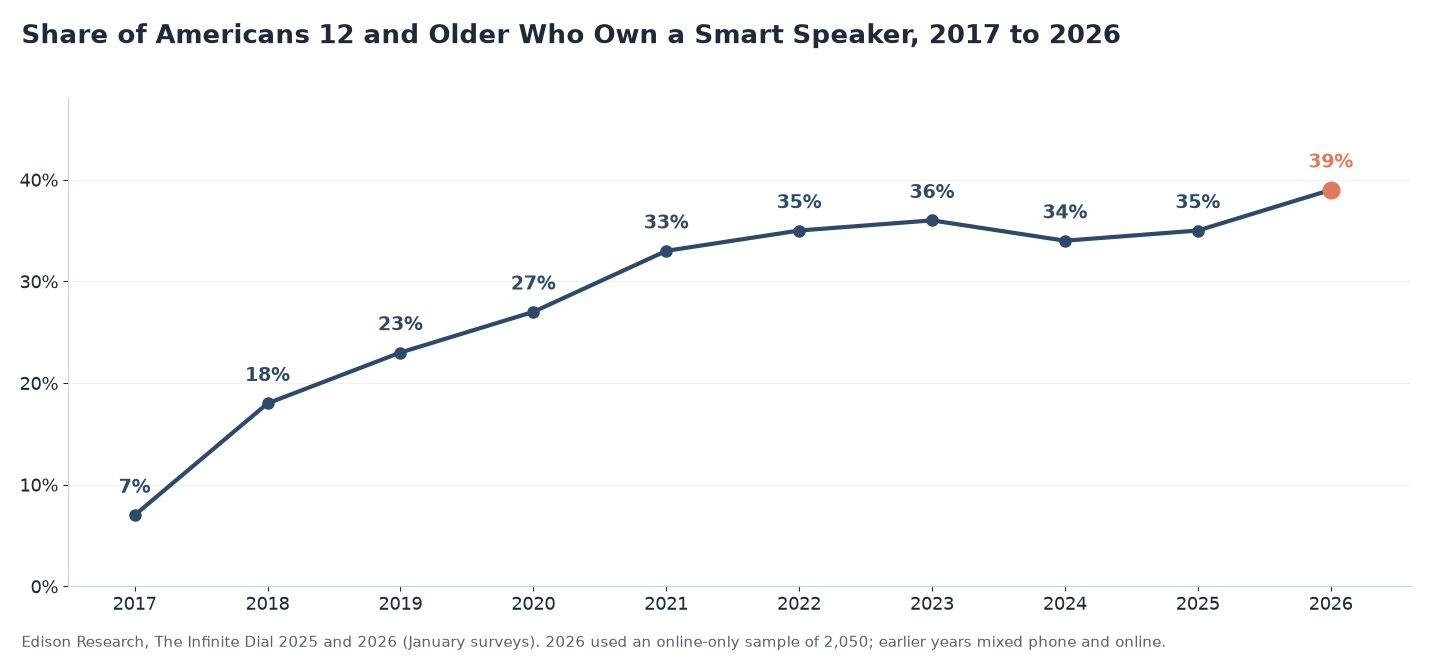
Source: AI Services Companies analysis of Edison Research data, conducted November 2026.
Key Findings
- Smart speaker ownership grew fast from 2017 to 2021, then stayed between 33% and 36% from 2021 to 2025 before reaching 39% in 2026.2,3
- Edison's 2026 survey used a new online-only sample of 2,050 people, so part of the 2026 rise may come from the change in method.2,3
- Owning a speaker is not the same as using it for audio: 22% of Americans 12 and older listened to audio through one in the past month in 2025, and 18% in the past week.3
- In Pew's February 2026 survey, 35% of US adults had a smart speaker, more than had a smart doorbell (18%), robot vacuum (13%), or smart thermostat (11%).4
15% of US AI Users Have Had a Voice Conversation With an AI Service
Chatbots such as ChatGPT and Gemini now include voice modes, so many people talk to AI without a smart speaker. We looked at how US adults who use AI services say they have interacted with them, using the Epoch AI and Ipsos survey from March 2026.
| Interaction | Share of AI users | Source |
|---|---|---|
| Typed a question or prompt | 75% | Epoch AI and Ipsos, March 2026 |
| Had the AI search the web for them | 48% | Epoch AI and Ipsos, March 2026 |
| Used the AI to generate an image | 42% | Epoch AI and Ipsos, March 2026 |
| Uploaded a file, image, or document for the AI to analyze | 41% | Epoch AI and Ipsos, March 2026 |
| Used the AI inside another app (for example Copilot in Word) | 27% | Epoch AI and Ipsos, March 2026 |
| Had a voice conversation | 15% | Epoch AI and Ipsos, March 2026 |
| Used an AI system that completed tasks on its own | 9% | Epoch AI and Ipsos, March 2026 |
Source: AI Services Companies analysis of Epoch AI and Ipsos data, conducted November 2026. Data: ai-interaction-modes-2026.csv
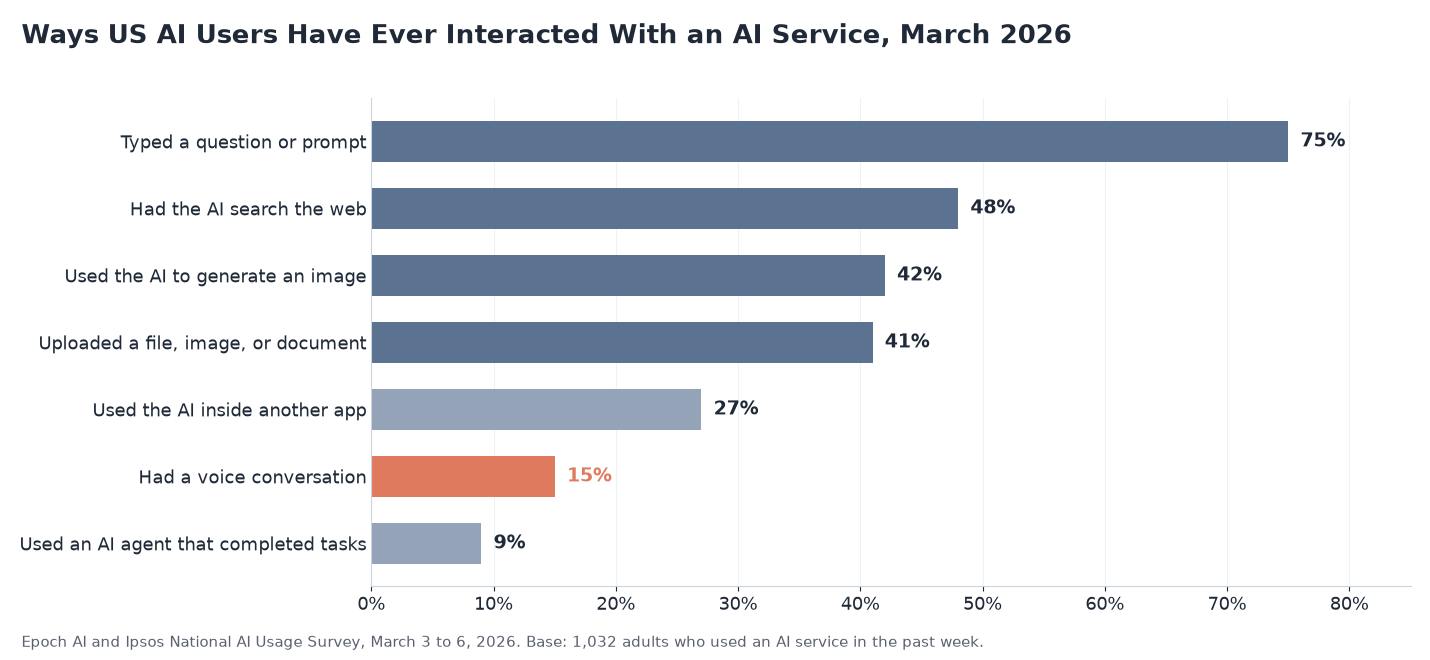
Source: AI Services Companies analysis of Epoch AI and Ipsos data, conducted November 2026.
Key Findings
- Typing is five times as common as a full voice conversation among AI users: 75% have typed a prompt, compared with 15% who have talked with an AI service.1,5
- The base is 1,032 adults who used an AI service in the past week, out of 2,021 surveyed from March 3 to 6, 2026.5
- In the same survey, 49% of US adults had not used any AI service in the past week, while 31% had used ChatGPT and 21% Google Gemini.5
Alexa and Siri Use Fell Among AI Users in 2026 as Voice Moved Into AI Apps
Menlo Ventures asked about 5,000 US adults in 2025 and again in 2026 how they use AI, including whether they speak to it and which assistants they use. We set those answers next to the usage figures Amazon and Apple have published for Alexa and Siri.
| Measure | 2025 | 2026 | Source |
|---|---|---|---|
| Say voice is their primary way of interacting with AI | 19% | Menlo Ventures, 2026 | |
| Move between voice and typing | 27% | Menlo Ventures, 2026 | |
| Speak to AI at least some of the time | 46% | Menlo Ventures, 2026 | |
| AI users 65 and older who count voice among the ways they use AI most | 25% | Menlo Ventures, 2026 | |
| Gen Z AI users who count voice among the ways they use AI most | 23% | Menlo Ventures, 2026 | |
| Use Alexa (share of AI users) | 32% | 22% | Menlo Ventures, 2026 |
| Use Siri (share of AI users) | 25% | 20% | Menlo Ventures, 2026 |
Source: AI Services Companies analysis of Menlo Ventures data, conducted November 2026. Data: voice-use-and-assistant-reach-2025-2026.csv
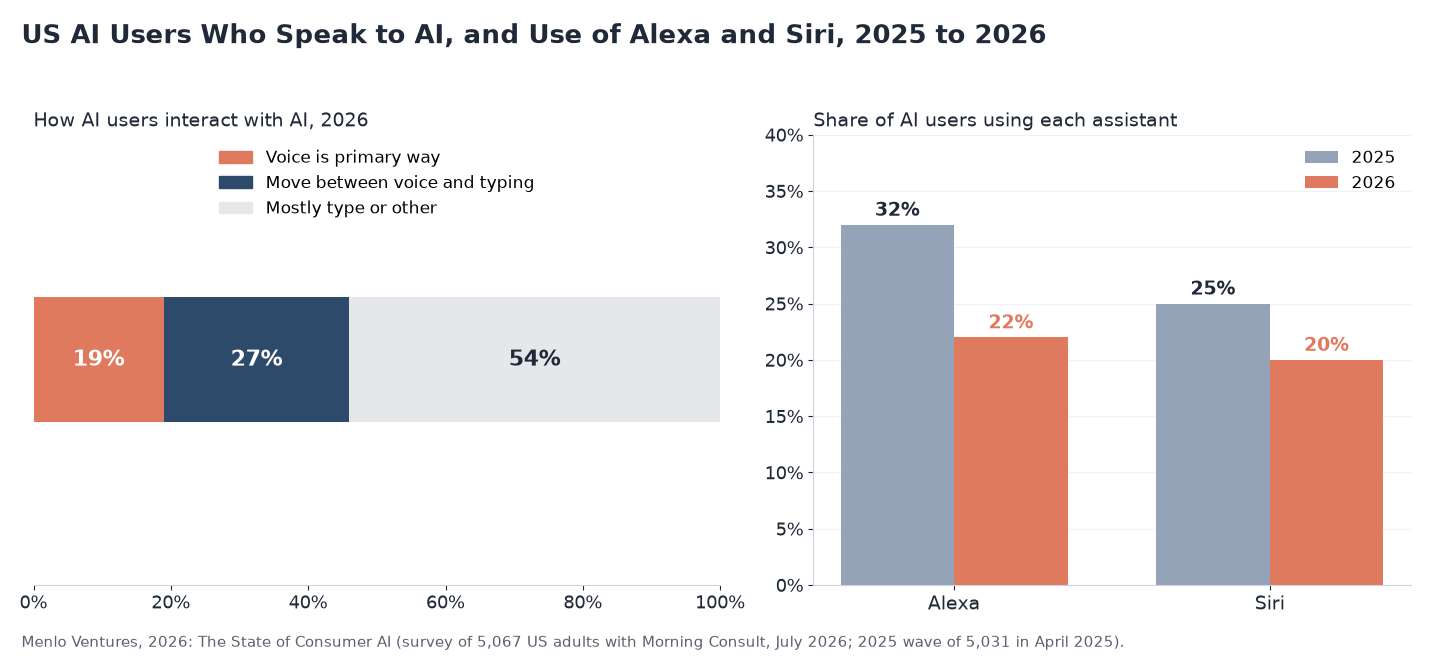
Source: AI Services Companies analysis of Menlo Ventures data, conducted November 2026.
| Measure | Value | Date | Source |
|---|---|---|---|
| Alexa devices in use | Over 600 million | February 2025 | Amazon |
| Price of Alexa+ | $19.99 a month, free with Prime | February 2025 | Amazon |
| People using Alexa+ | Tens of millions | February 2026 | CNBC, interview with Amazon |
| Change in conversations per Alexa+ user | Two to three times more | February 2026 | CNBC, interview with Amazon |
| Customers who used Alexa for Shopping in the past 12 months | 400 million+ | Q3 2026 | Amazon |
| Year-over-year change in Alexa for Shopping interactions | +570% | Q3 2026 | Amazon |
| Siri voice requests per day | 1.5 billion | June 2024 (WWDC) | Apple, via AppleInsider |
| Siri requests per day | More than 2.5 billion | November 2026 | Apple, via AppleInsider |
Source: AI Services Companies analysis of Amazon, CNBC, Amazon Q3 2026 results, and AppleInsider data, conducted November 2026.
Key Findings
- Menlo found that most speaking to AI now happens inside AI apps, through voice modes, dictation, and spoken prompts, and not on smart speakers.6
- Voice use holds up across ages: 25% of AI users 65 and older count it among the ways they use AI most, compared with 23% of Gen Z.6
- Amazon made Alexa+ available to everyone in the US on February 4, 2026, almost a year after its preview began.8
- Amazon counted over 600 million Alexa devices when it introduced Alexa+ in February 2025, and said in October 2026 that over 400 million customers used Alexa for Shopping in the past 12 months.7,9
- Apple has not said whether its 2024 and 2026 Siri request counts measure the same kinds of interactions, so the two are not a clean growth figure.10
97% of Surveyed Businesses Use Voice Technology, but 21% Are Very Satisfied With Voice Agents
Businesses use voice AI to transcribe calls, analyze what customers say, and answer phones with voice agents. We reviewed Deepgram's 2025 survey of 400 North American business leaders, 82% of them in the US and 83% at companies with more than $100 million in revenue.
| Measure | Share of respondents | Source |
|---|---|---|
| Use voice technology of some kind | 97% | Deepgram, 2025 |
| Capture and analyze their speech data | 92% | Deepgram, 2025 |
| Plan to increase voice technology budgets in the next 12 months | 84% | Deepgram, 2025 |
| Use some form of voice agent, from traditional phone menus to AI | 80% | Deepgram, 2025 |
| Say voice is foundational to their products and strategy | 67% | Deepgram, 2025 |
| Transcribe more than half of their conversations | 56% | Deepgram, 2025 |
| Very satisfied with their current voice agent technology | 21% | Deepgram, 2025 |
| Somewhat satisfied with their current voice agent technology | 61% | Deepgram, 2025 |
| Actively developing voice AI agents | 15% | Deepgram, 2025 |
Source: AI Services Companies analysis of Deepgram and Opus Research data, conducted November 2026. Data: business-voice-technology-adoption-2025.csv
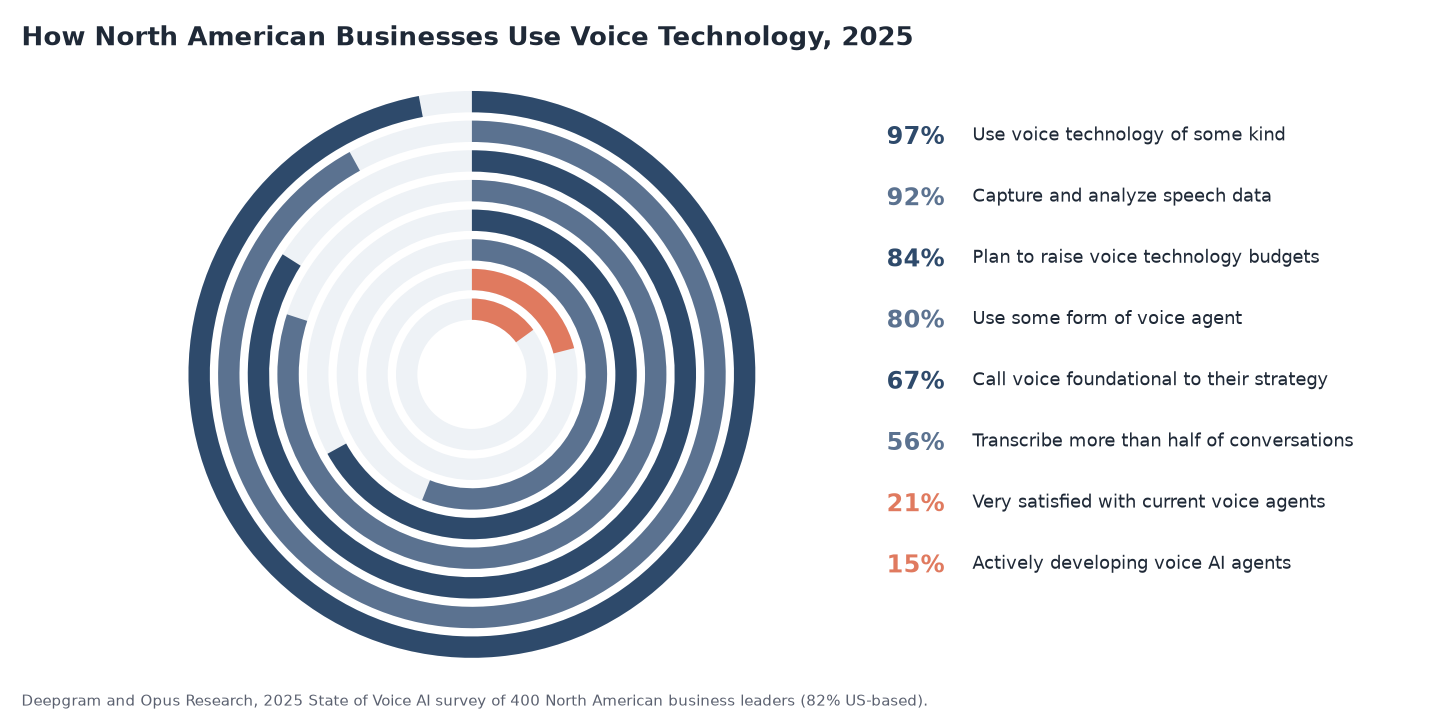
Source: AI Services Companies analysis of Deepgram and Opus Research data, conducted November 2026.
Key Findings
- Most businesses already use some voice technology, so the survey's main gap is quality: 61% of respondents are only somewhat satisfied with their voice agents.11
- Of the 15% of organizations building voice AI agents, 98% plan to have them in production within a year.11
- The respondents work mostly at large North American companies, 83% of them with more than $100 million in revenue, so the shares do not describe small businesses.11
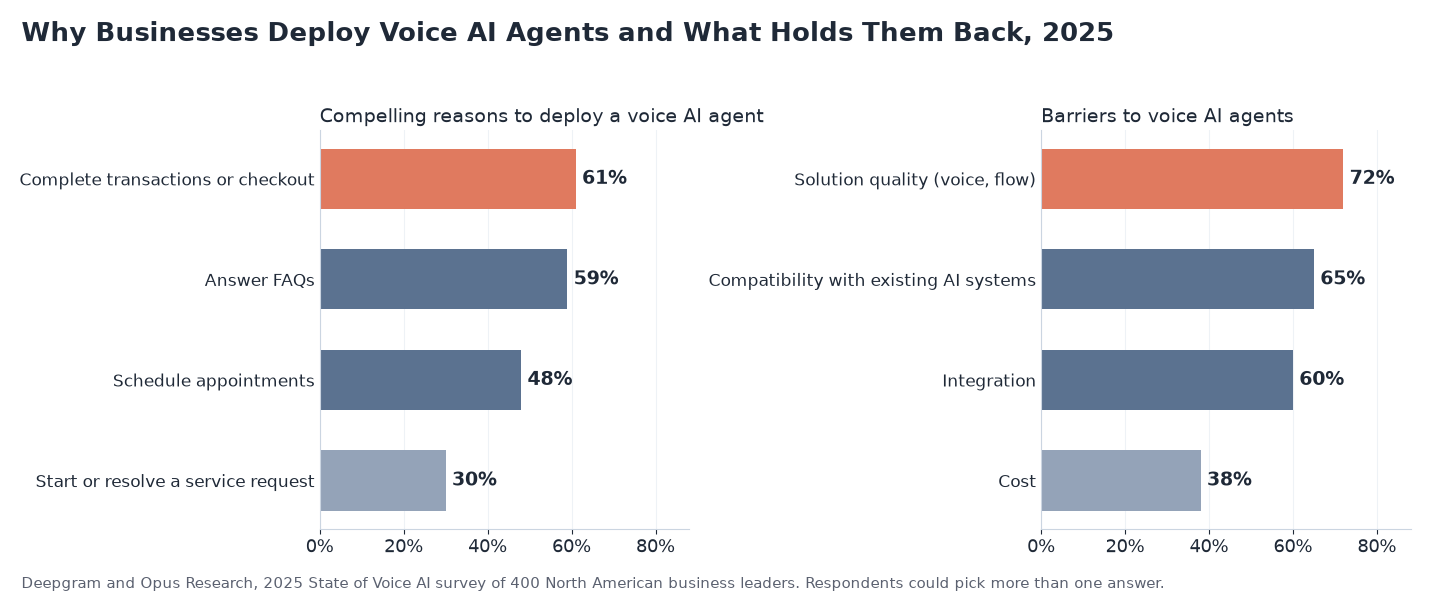
Businesses Want Voice Agents for Checkout and FAQs and Cite Voice Quality as the Main Barrier
A voice agent is an AI that answers a phone call or voice request and completes a task. We gathered the reasons Deepgram's respondents gave for deploying voice agents and the barriers they reported, since both shape what businesses will buy next.
| Answer | Type | Share of respondents | Source |
|---|---|---|---|
| Complete transactions or checkout | Reason to deploy | 61% | Deepgram, 2025 |
| Answer FAQs | Reason to deploy | 59% | Deepgram, 2025 |
| Schedule appointments | Reason to deploy | 48% | Deepgram, 2025 |
| Start or resolve a service request | Reason to deploy | 30% | Deepgram, 2025 |
| Solution quality (voice clarity, conversational flow, performance) | Barrier | 72% | Deepgram, 2025 |
| Compatibility with existing AI systems | Barrier | 65% | Deepgram, 2025 |
| Integration | Barrier | 60% | Deepgram, 2025 |
| Cost | Barrier | 38% | Deepgram, 2025 |
| Ability to fine-tune speech models would increase adoption | Adoption driver | 46% | Deepgram, 2025 |
| Expanded voice intelligence (for example sentiment analysis) would increase adoption | Adoption driver | 41% | Deepgram, 2025 |
Source: AI Services Companies analysis of Deepgram and Opus Research data, conducted November 2026. Data: voice-ai-agent-use-cases-and-barriers-2025.csv
Source: AI Services Companies analysis of Deepgram and Opus Research data, conducted November 2026.
Key Findings
- The most common reasons to deploy voice agents are tasks phone menus already handle, such as checkout, FAQs, and booking.11
- Voice quality and fit with existing systems worry more respondents than price: 38% call cost a barrier, compared with 72% for solution quality.11
- 52% of respondents see customer service or task automation as the most transformative use of voice AI.11
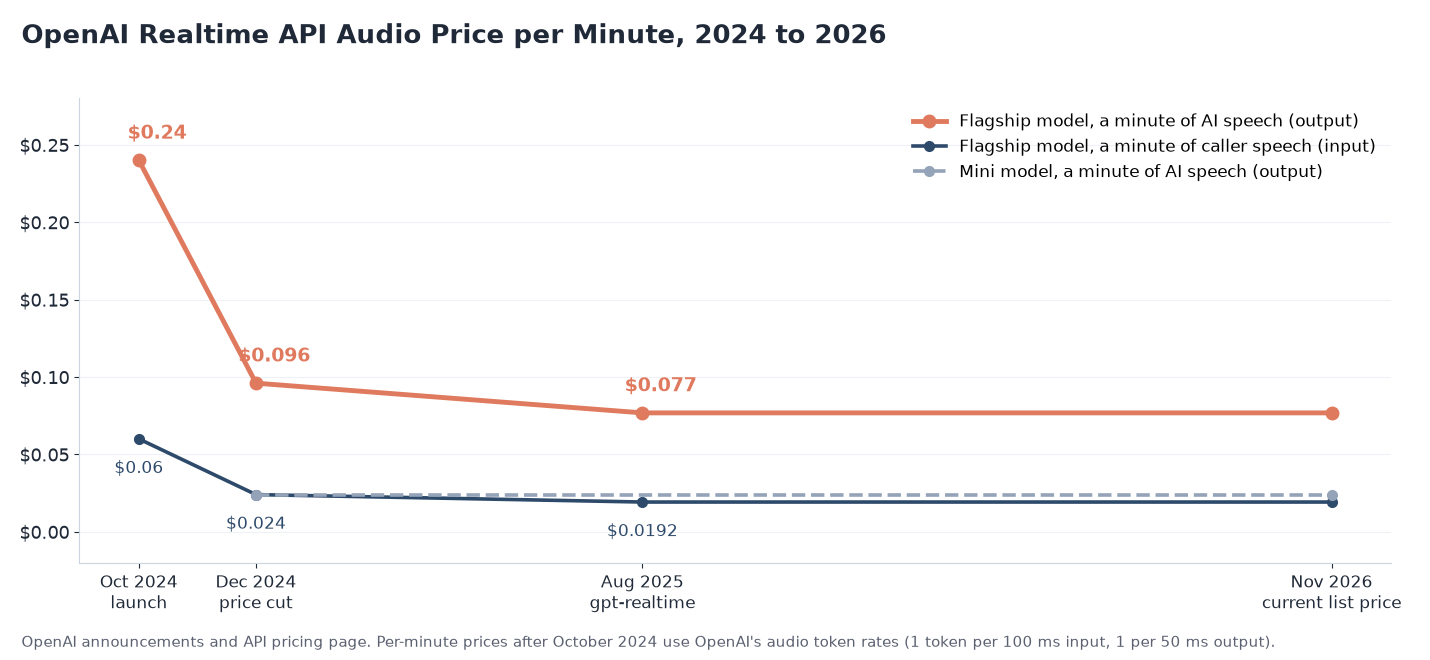
The List Price of a Minute of AI Speech Fell 68% Between October 2024 and August 2025
The price of voice AI matters to anyone building a voice agent, because calls are billed by the minute or by audio tokens. We tracked OpenAI's published Realtime API audio prices from launch to today and converted them to dollars per minute using OpenAI's own audio token rates.
| Date | Model | Audio input per 1M tokens | Audio output per 1M tokens | Input per minute | Output per minute | Source |
|---|---|---|---|---|---|---|
| October 1, 2024 | gpt-4o-realtime-preview | $100 | $200 | $0.06 | $0.24 | OpenAI |
| December 17, 2024 | gpt-4o-realtime-preview-2024-12-17 | $40 | $80 | $0.024 | $0.096 | OpenAI |
| December 17, 2024 | gpt-4o-mini-realtime-preview-2024-12-17 | $10 | $20 | $0.006 | $0.024 | OpenAI |
| August 28, 2025 | gpt-realtime | $32 | $64 | $0.0192 | $0.0768 | OpenAI |
| November 24, 2026 | gpt-realtime-2.1 | $32 | $64 | $0.0192 | $0.0768 | OpenAI |
| November 24, 2026 | gpt-realtime-2.1-mini | $10 | $20 | $0.006 | $0.024 | OpenAI |
| November 24, 2026 | gpt-live-1.1 (billed per active session minute) | $0.05 active, $0.02 standby | OpenAI |
Source: AI Services Companies analysis of OpenAI announcements and API pricing, conducted November 2026. Data: openai-realtime-audio-price-per-minute-2024-2026.csv
Source: AI Services Companies analysis of OpenAI data, conducted November 2026.
Key Findings
- The December 2024 update cut audio token prices by 60%, and the August 2025 gpt-realtime model cut them another 20%.13,14
- gpt-realtime-2.1, on OpenAI's pricing page in November 2026, carries the same $32 and $64 audio token prices as the August 2025 model.14,15
- OpenAI bills its GPT-Live voice sessions by the second, at $0.05 per active minute and $0.02 per standby minute.15
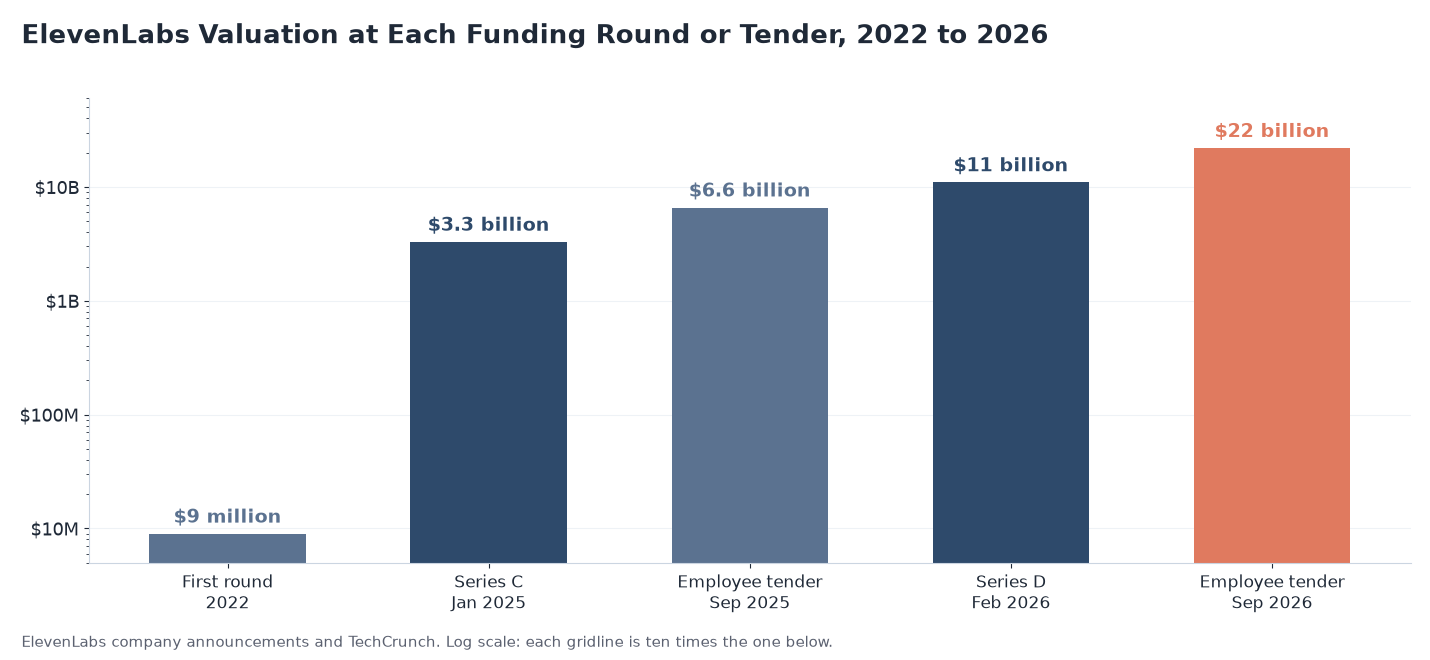
ElevenLabs' Valuation Rose From $3.3 Billion to $22 Billion in 20 Months
Investor money shows where the voice AI market expects growth. We tracked the published valuations and revenue milestones of ElevenLabs, a voice AI company whose models power products at Meta, Epic Games, and Salesforce, from its first round to September 2026.
| Date | Milestone | Value | Source |
|---|---|---|---|
| 2022 | Valuation at first funding round | $9 million | ElevenLabs |
| January 30, 2025 | Series C raise and valuation | $180 million at $3.3 billion | ElevenLabs |
| September 2025 | Employee tender offer valuation | $6.6 billion | TechCrunch |
| February 4, 2026 | Series D raise and valuation | $500 million at $11 billion | ElevenLabs |
| February 4, 2026 | Total funding across five rounds | $781 million | ElevenLabs |
| End of 2025 | Annual recurring revenue (ARR) | Over $330 million (Feb 2026 post); $350 million (May 2026 post) | ElevenLabs |
| April 2026 | ARR | Over $500 million | ElevenLabs |
| September 30, 2026 | Employee tender offer valuation | $22 billion ($300 million tender) | ElevenLabs |
| September 30, 2026 | Share of revenue from enterprise customers | 55% | ElevenLabs |
| September 30, 2026 | Conversations handled by its AI agents each week | More than 15 million | ElevenLabs |
Source: AI Services Companies analysis of ElevenLabs announcements and TechCrunch reporting, conducted November 2026. Data: elevenlabs-valuation-2022-2026.csv
Source: AI Services Companies analysis of ElevenLabs and TechCrunch data, conducted November 2026.
Key Findings
- ElevenLabs' valuation doubled between February and September 2026, from $11 billion to $22 billion.18,20,21
- ElevenLabs gave two different end-of-2025 ARR figures, over $330 million in February and $350 million in May; the May post reports ARR above $500 million within the first four months of 2026.18,19
- Its agents' weekly conversations tripled from February to September 2026, and ElevenLabs reports that voice agents resolved issues 31% faster than chat agents across its customers.20
What AI Voice Assistant Statistics Show Going Into 2027
Smart speakers reached about four in ten Americans, but people who use AI are moving their spoken requests into chatbot apps. Alexa and Siri lost reach among AI users from 2025 to 2026 even as Amazon and Apple added generative AI to both.2,6
On the business side, almost every large company surveyed uses voice technology, and voice agent prices dropped sharply in 2024 and 2025. Investor valuations of voice AI companies such as ElevenLabs rose quickly in 2026.11,14,20
So if you cite an AI voice assistant statistic, say whether it counts device owners, all adults, or only people who already use AI, because those bases give very different numbers.
Data Collection and Methodology
We collected figures from published surveys, company announcements, pricing pages, and news reports, opened on November 24, 2026. Smart speaker figures come from Edison Research's Infinite Dial, a January survey of Americans 12 and older weighted to the US population.
The 2025 Infinite Dial surveyed 5,020 people by phone and online. The 2026 edition surveyed 2,050 people online, half from the probability-based SSRS Opinion Panel and half from a non-probability sample, so the 2026 change may partly reflect the new method.
Pew Research Center surveyed 5,119 US adults from February 17 to 23, 2026. The Epoch AI and Ipsos survey reached 2,021 US adults from March 3 to 6, 2026, with a margin of error of plus or minus 2.2 points. Menlo Ventures surveyed 5,067 US adults with Morning Consult in July 2026 and 5,031 in April 2025.
Menlo published 2025 brand use as a share of all adults and converted it to a share of AI users for comparison with 2026. Deepgram's survey of 400 business leaders was run with Opus Research and published in 2025; Deepgram sells voice AI products.
Per-minute prices after October 2024 use OpenAI's published rates of 1 audio token per 100 milliseconds of user audio and 1 per 50 milliseconds of model audio. OpenAI itself gave the October 2024 per-minute prices. Company figures are self-reported and use different definitions.
The 19,277 consumer respondents total adds the five consumer surveys. We calculated products, differences, and ratios from the published values. No figures in this article are estimates.
Sources (21)
- AI Services Companies analysis of AI voice assistant figures from Edison Research, Pew Research Center, Epoch AI and Ipsos, Menlo Ventures, Deepgram, Amazon, Apple, OpenAI, and ElevenLabs, conducted November 2026.
- Edison Research, The Infinite Dial 2026
- Edison Research, The Infinite Dial 2025
- Pew Research Center, Americans and AI 2026: Chatbots, Smart Devices and Views on Impact (June 17, 2026)
- Epoch AI and Ipsos, National AI Usage Survey, topline and methodology (March 2026)
- Menlo Ventures, 2026: The State of Consumer AI
- Amazon, Introducing Alexa+ (February 2025)
- CNBC, Amazon makes Alexa+ AI assistant available to everyone in the U.S. nearly a year after launch (February 4, 2026)
- Amazon, Amazon.com Announces Third Quarter Results (October 29, 2026)
- AppleInsider, Over 2.5 billion daily Siri requests put Apple's AI overhaul in perspective (November 2, 2026)
- Deepgram and Opus Research, 2025 State of Voice AI Report
- OpenAI, Introducing the Realtime API (October 1, 2024)
- OpenAI, OpenAI o1 and new tools for developers (December 17, 2024)
- OpenAI, Introducing gpt-realtime and Realtime API updates for production voice agents (August 28, 2025)
- OpenAI, API pricing
- OpenAI, Realtime API cost optimization guide
- ElevenLabs, ElevenLabs raises $180M Series C (January 30, 2025)
- ElevenLabs, ElevenLabs raises $500M Series D at $11B valuation (February 4, 2026)
- ElevenLabs, ElevenLabs crosses $500M ARR and welcomes new investors (May 5, 2026)
- ElevenLabs, ElevenLabs reaches $22bn valuation after employee tender (September 30, 2026)
- TechCrunch, AI voice startup ElevenLabs doubles valuation to $22B (September 30, 2026)