
AI Ethics Statistics 2026
Published November 20, 2026
Our analysts reviewed seven studies, indexes, and surveys published from 2019 to 2025, covering two reviews of 84 and 200 AI ethics guidelines, Stanford's count of responsible AI research papers, three editions of the Foundation Model Transparency Index, a Stack Overflow survey of tens of thousands of developers, and a Guardian Freedom of Information survey of UK universities, to show how AI ethics is written down, studied, and practiced as of Q4 2026.
Key Findings
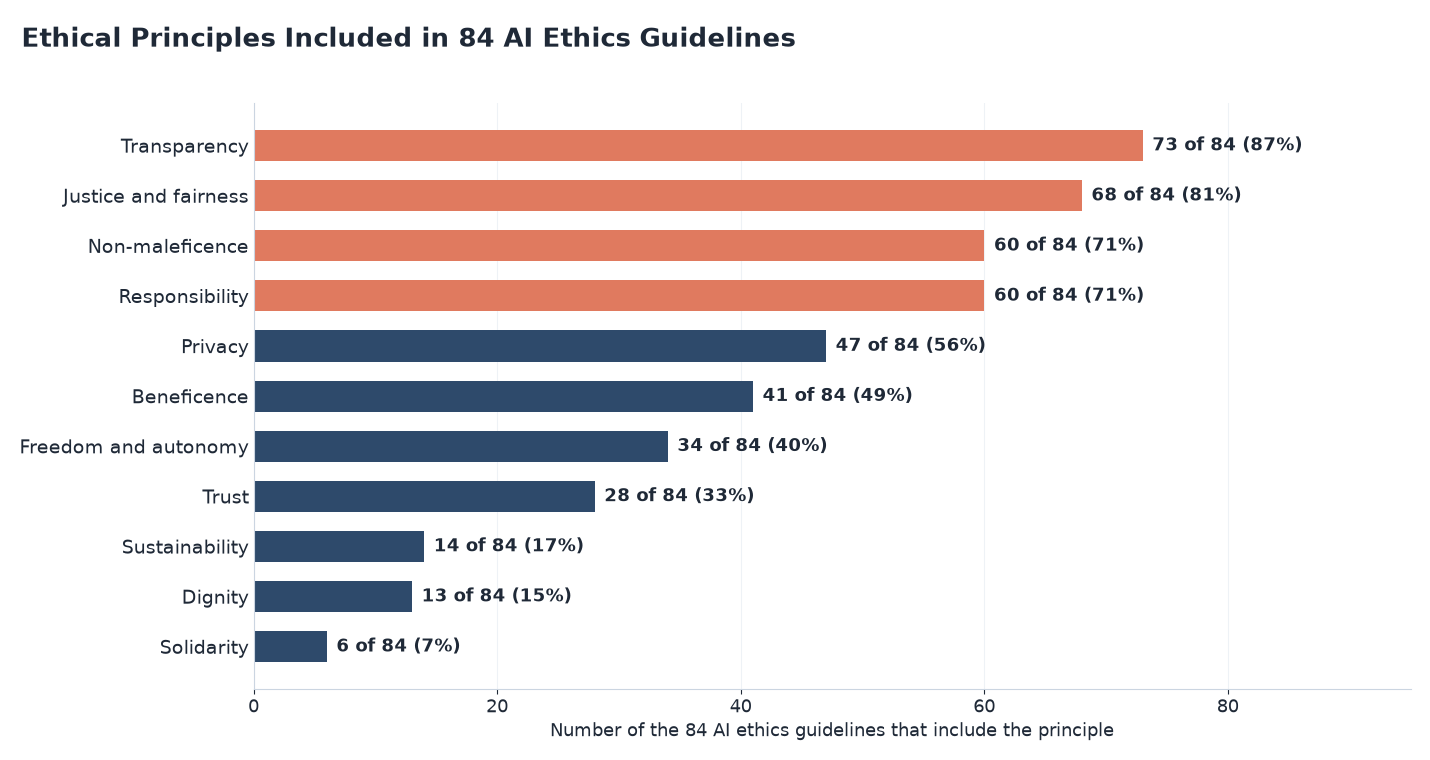
- Transparency was the most common principle in a review of 84 AI ethics guidelines, appearing in 73 of them (87%), while solidarity appeared in only 6.2
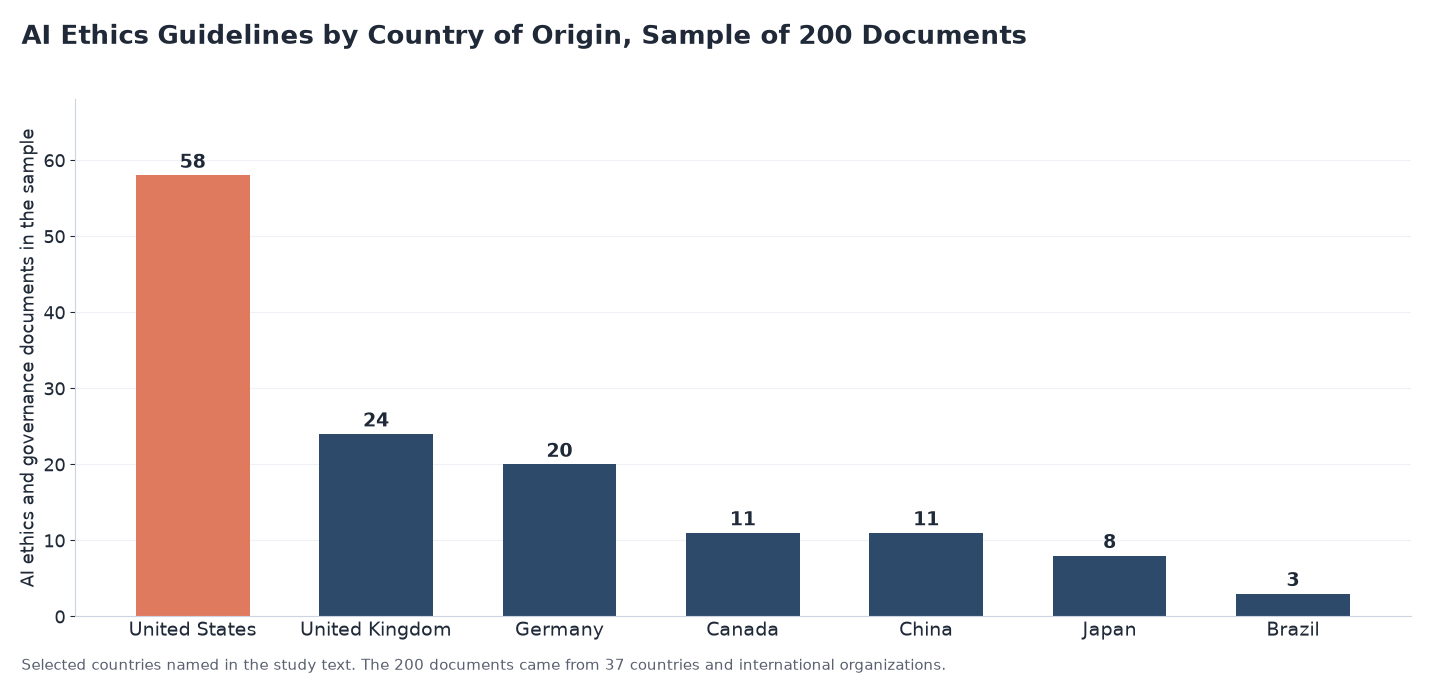
- 98% of the 200 AI ethics and governance documents in a review of global guidelines serve only as "soft law" with no legal obligation, and 58 of them (29%) came from the United States.3
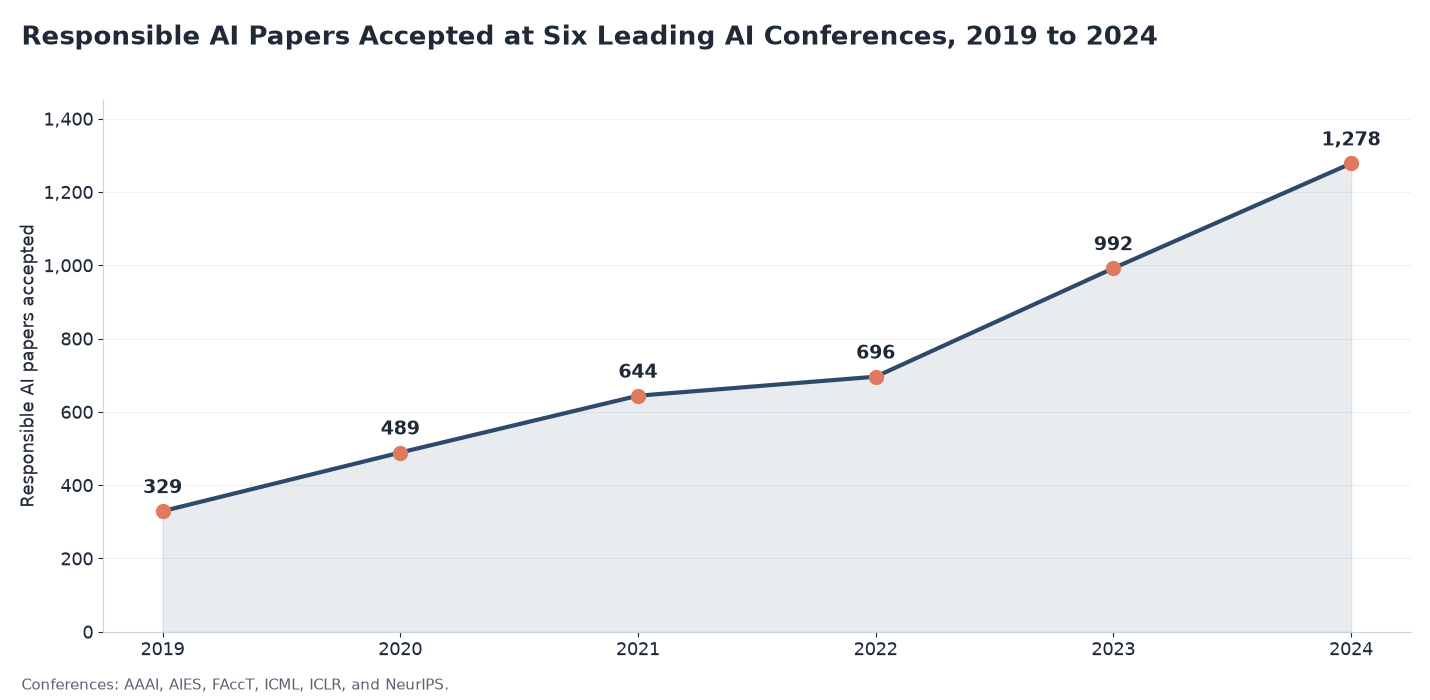
- Responsible AI papers accepted at six leading AI conferences nearly quadrupled from 329 in 2019 to 1,278 in 2024.5
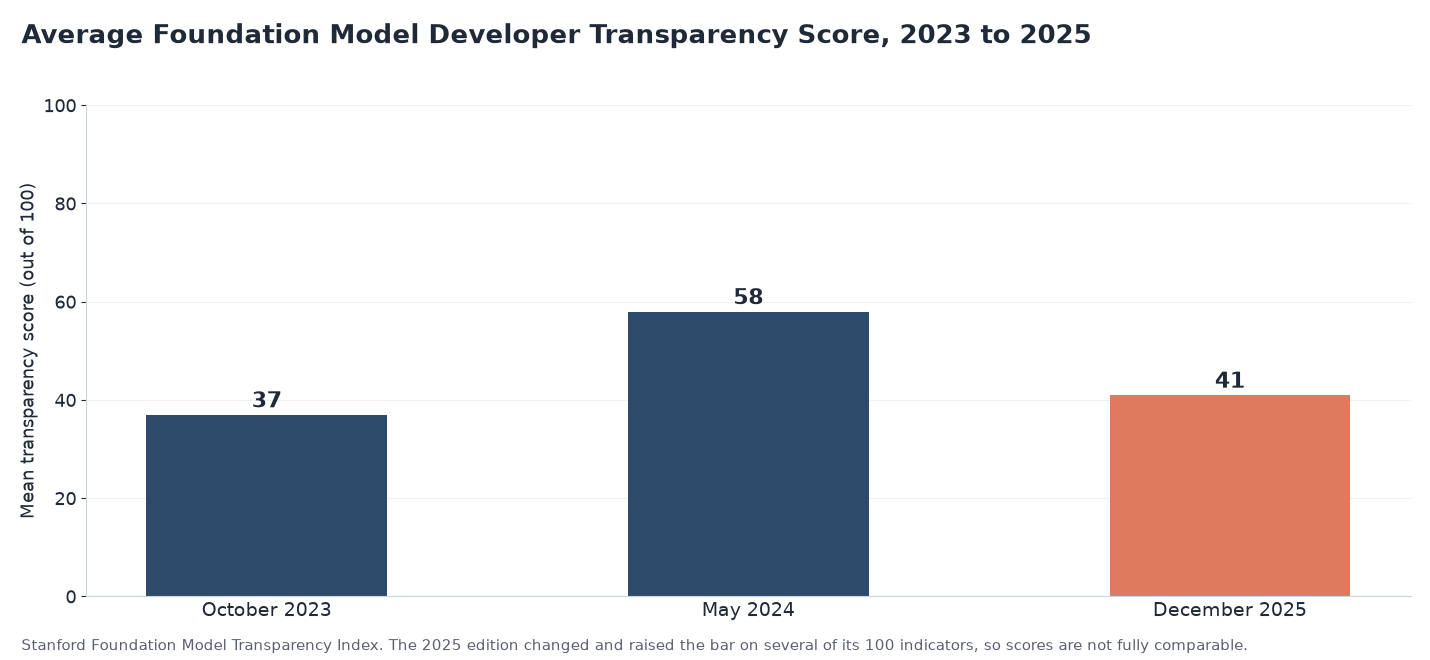
- The average transparency score of major foundation model developers rose from 37 to 58 out of 100 between 2023 and 2024, then fell to 41 in the December 2025 edition.5,6
- 79.9% of professional developers chose misinformation and disinformation as one of the most important AI ethical responsibilities in Stack Overflow's 2024 survey.7
AI ethics is the set of principles people use to judge whether an AI system is built and used in a fair, honest, and safe way, such as being open about how a model works, avoiding harm, and making someone accountable when things go wrong. Since 2021, UNESCO's Recommendation on the Ethics of Artificial Intelligence has applied to all 194 of its member states.4 Public bodies, companies, and researchers have also written hundreds of their own principles, and researchers now measure how well developers follow them.
Our analysts read two peer-reviewed meta-analyses of AI ethics guidelines, the responsible AI chapter of Stanford HAI's AI Index Report 2025, the December 2025 Foundation Model Transparency Index, Stack Overflow's 2024 Developer Survey, and a Guardian investigation of academic misconduct at UK universities. All sources were opened on November 20, 2026. This piece focuses on principles, transparency, and conduct; for related figures, see our AI Bias Statistics 2026, AI Trust Statistics 2026, AI Governance and Compliance Statistics 2026, and AI Data Privacy Statistics 2026.
In the following sections, we compare which principles AI ethics guidelines include, where those guidelines come from and how binding they are, how fast responsible AI research is growing, how transparent major model developers are, which ethical issues developers rank highest, and how often UK university students are caught misusing AI.
Transparency Appears in 87% of AI Ethics Guidelines
Researchers at ETH Zurich collected 84 documents that set out ethical principles or guidelines for AI, issued by companies, governments, research institutions, and other groups, and coded which principles each one included. Eleven principles came up across the set, though no single principle appeared in every document.2
| Principle | Guidelines including it | Share of 84 |
|---|---|---|
| Transparency | 73 | 87% |
| Justice and fairness | 68 | 81% |
| Non-maleficence (avoiding harm) | 60 | 71% |
| Responsibility | 60 | 71% |
| Privacy | 47 | 56% |
| Beneficence (doing good) | 41 | 49% |
| Freedom and autonomy | 34 | 40% |
| Trust | 28 | 33% |
| Sustainability | 14 | 17% |
| Dignity | 13 | 15% |
| Solidarity | 6 | 7% |
Source: Jobin, Ienca, and Vayena, Artificial Intelligence: the global landscape of ethics guidelines, 2019. Shares are our arithmetic. Data: ai-ethics-guideline-principles.csv
Source: AI Services Companies analysis of Jobin, Ienca, and Vayena data, conducted November 2026.
Key Findings
- Four principles appeared in more than 70% of the guidelines: transparency (87%), justice and fairness (81%), non-maleficence (71%), and responsibility (71%).2
- Sustainability appeared in only 14 of the 84 guidelines (17%) and solidarity in 6 (7%), so environmental impact and effects on the labor market rarely featured in the guidelines reviewed.2
- The authors found broad agreement on the names of principles but not on what they mean or how to apply them. Two guidelines can both list "transparency" and ask for very different things.2
98% of 200 AI Ethics Documents Are Voluntary
A larger review by Nicholas Kluge Corrêa and colleagues analyzed 200 AI ethics and governance documents from 37 countries, published by governments, companies, universities, nonprofits, and international organizations. The authors coded where each document came from, when it was published, and what kind of rule it proposed.3
| Measure | Value |
|---|---|
| Documents that serve only as "soft law" (no legal obligation) | 98% |
| Documents that are recommendations to AI stakeholders | 56% |
| Documents with self-regulatory or voluntary commitment guidelines | 24% |
| Documents proposing regulation administered by a state | 20% |
| Documents published in 2018 | 61 (30.5%) |
| Documents published from 2017 to 2019 | 129 (64.5%) |
| Documents from the United States | 58 (29%) |
| Documents from the United Kingdom | 24 (12%) |
| Documents from Germany | 20 (10%) |
| Documents from Canada and from China | 11 each (5.5%) |
| Documents from Japan | 8 (4%) |
| Documents that do not identify their authors | 132 (66%) |
Source: Corrêa and colleagues, Worldwide AI Ethics: A review of 200 guidelines and recommendations for AI governance, version of February 19, 2024. Data: ai-ethics-guidelines-by-country.csv
Source: AI Services Companies analysis of Corrêa and colleagues data, conducted November 2026.
Key Findings
- Nearly a third of the documents (61) were published in 2018, which the authors call the "AI ethics boom," and almost two-thirds came out between 2017 and 2019.3
- The United States, the United Kingdom, and Germany together produced 102 of the 200 documents (51%), while South America, Africa, and Oceania together made up less than 4.5% of the sample.3
- Even among documents written by governments, only 18.7% proposed legally binding rules. Reliability, safety, security, and trustworthiness appeared in 78% of the documents, joining the top five principles found in earlier reviews.3
Responsible AI Research Papers Nearly Quadrupled From 2019 to 2024
Stanford HAI's AI Index counts papers on responsible AI topics, such as fairness, transparency, privacy, and safety, accepted at six major AI conferences: AAAI, AIES, FAccT, ICML, ICLR, and NeurIPS. The count shows how much academic attention AI ethics questions receive each year.5
| Year | Papers accepted | Change from prior year |
|---|---|---|
| 2019 | 329 | |
| 2020 | 489 | +48.6% |
| 2021 | 644 | +31.7% |
| 2022 | 696 | +8.1% |
| 2023 | 992 | +42.5% |
| 2024 | 1,278 | +28.8% |
Source: Stanford HAI, AI Index Report 2025, Chapter 3: Responsible AI (Figure 3.4.1). Year-over-year changes are our arithmetic. Data: responsible-ai-papers-2019-2024.csv
Source: AI Services Companies analysis of Stanford AI Index data, conducted November 2026.
Key Findings
- The 2024 count of 1,278 papers is 3.9 times the 2019 count of 329, and the number rose in every year of the period.5
- Researchers in the United States had 669 responsible AI papers accepted in 2024, followed by China with 268 and Germany with 80.5
- Security and safety papers almost doubled in one year, from 276 to 521, in the 2024 count.5
Model Developer Transparency Scores Fell to 41 in 2025
The Foundation Model Transparency Index, run by Stanford researchers, scores major AI model developers on 100 indicators covering what they disclose about training data, labor, compute, model capabilities, risks, and downstream use. The score measures public disclosure only and does not rate how safe a model is.5,6
| Measure | Value |
|---|---|
| Average score, October 2023 edition | 37 out of 100 |
| Average score, May 2024 edition | 58 out of 100 |
| Average score, December 2025 edition | 41 out of 100 |
| Developers scored in the 2025 edition | 13 |
| Highest score in 2025 (IBM) | 95 |
| Lowest scores in 2025 (xAI and Midjourney) | 14 each |
| DeepSeek and Alibaba scores, 2025 | 32 and 26 |
| Contacted companies that submitted transparency reports, 2024 | 74% |
| Contacted companies that submitted transparency reports, 2025 | 30% |
| Score change from 2024 to 2025: Mistral, Meta, OpenAI | -37, -29, and -14 points |
Source: Stanford CRFM, Foundation Model Transparency Index, December 2025 and Stanford HAI, AI Index Report 2025, Chapter 3. Data: foundation-model-transparency-scores-2023-2025.csv
Source: AI Services Companies analysis of Foundation Model Transparency Index data, conducted November 2026.
Key Findings
- The 2025 average of 41 was 17 points below 2024 but 4 points above 2023. The index changed and tightened several indicators in 2025, so part of the drop reflects a higher bar.6
- Rankings reversed among the six companies scored in all three editions: Meta and OpenAI fell from first and second in 2023 to fifth and sixth in 2025, while AI21 and Anthropic rose from fourth and fifth to first and second.6
- Training data stayed opaque in all three editions, and the index found that Amazon, Google, Midjourney, Mistral, OpenAI, and xAI scored no indicators in its basic model information subdomain in 2025.5,6
Developers Rank Misinformation as the Top AI Ethics Issue
Stack Overflow's 2024 Developer Survey asked respondents which AI ethical responsibilities are most important to them, with all answers that apply allowed. 33,701 respondents answered, including 26,172 professional developers and 3,704 people learning to code.7
| Issue | All respondents | Professional developers | Learning to code |
|---|---|---|---|
| Circulating misinformation or disinformation | 79.4% | 79.9% | 77% |
| Missing or incorrect attribution for sources | 64.7% | 64.6% | 65.4% |
| Biased results that do not represent diverse viewpoints | 49.6% | 49.2% | 51.9% |
| Imitating a person's likeness | 37.2% | 37.6% | 33.8% |
| Energy demand | 36.3% | 36.9% | 31.5% |
| Replacing jobs without employment options | 34.1% | 33.5% | 40.6% |
Source: Stack Overflow, 2024 Developer Survey: AI. Answer wording is shortened on the survey page. Data: developer-ai-ethics-concerns-2024.csv
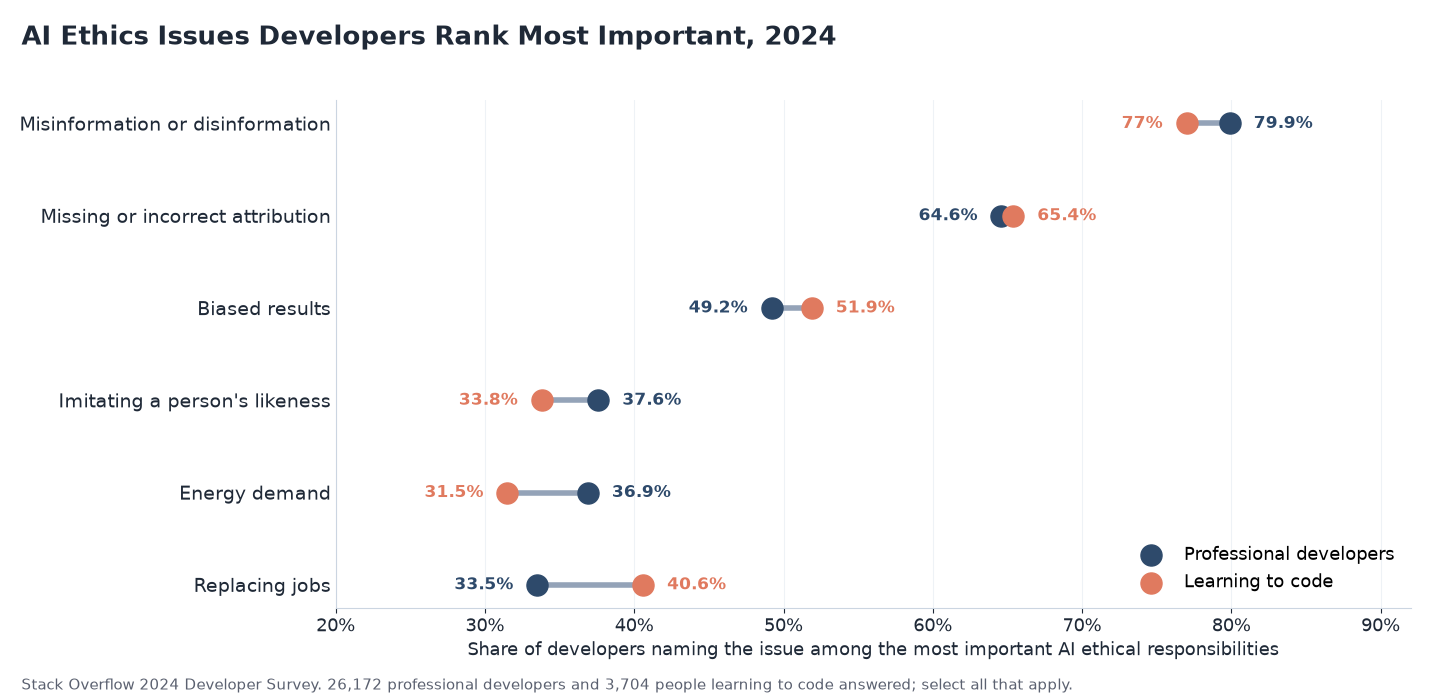
Source: AI Services Companies analysis of Stack Overflow data, conducted November 2026.
Key Findings
- Misinformation led every respondent group, and source attribution was second at about 65%. Stack Overflow said it is working to protect source attribution for its community members.7
- People learning to code were 7.1 points more likely than professional developers to choose job replacement, 40.6% compared with 33.5%, the widest gap between the two groups.7
- Professionals put more weight on energy demand (36.9% vs 31.5%) and on imitating a person's likeness (37.6% vs 33.8%) than learners did.7
Proven AI Cheating Cases at UK Universities Tripled in One Year
The Guardian sent Freedom of Information requests to 155 UK universities asking for proven cases of academic misconduct, plagiarism, and AI misuse over five years, and 131 provided some data. The figures show one of the most common everyday AI ethics problems: passing off AI-generated work as one's own.8
| Academic year | AI misuse | Traditional plagiarism |
|---|---|---|
| 2022-23 | 1.6 | 19 |
| 2023-24 | 5.1 | 15.2 |
| 2024-25 (projected from data up to May) | About 7.5 | About 8.5 |
Source: The Guardian, Revealed: Thousands of UK university students caught cheating using AI, June 15, 2025. Data: uk-university-ai-misconduct-2022-2025.csv
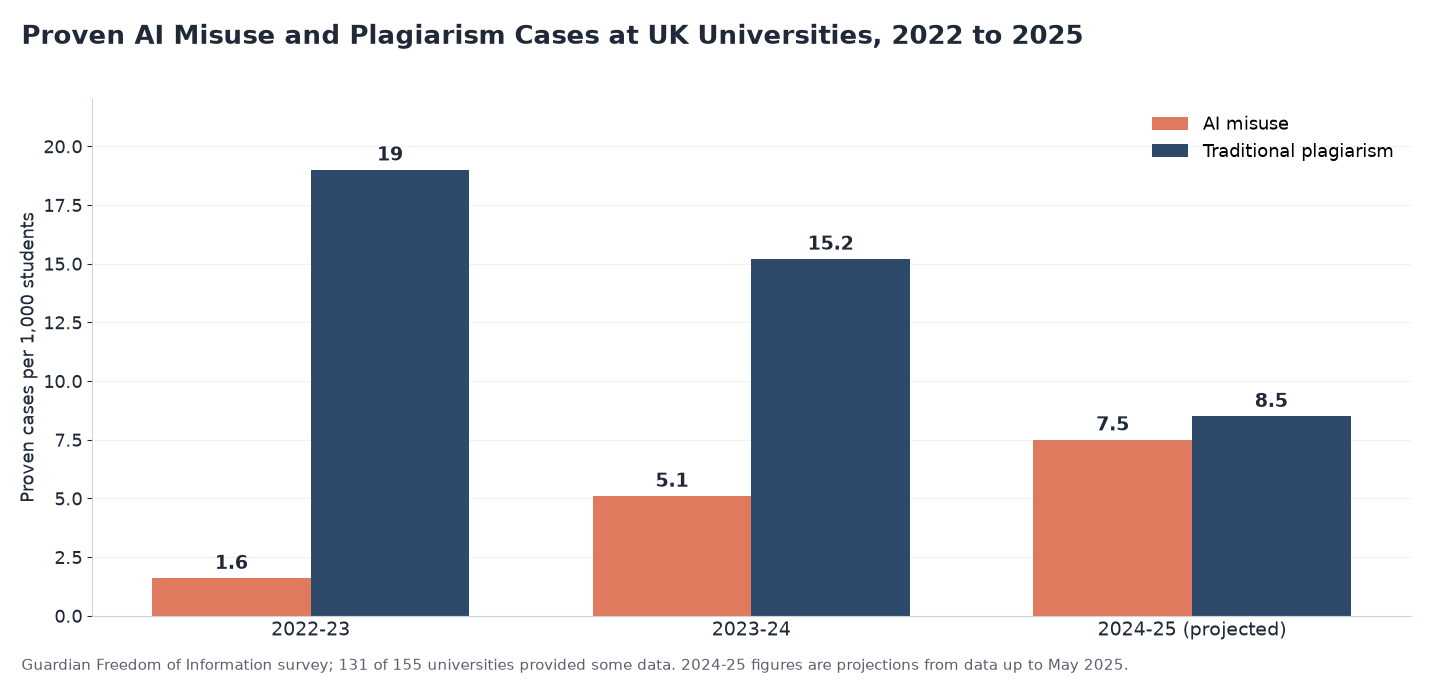
Source: AI Services Companies analysis of Guardian data, conducted November 2026.
Key Findings
- Almost 7,000 proven cases of cheating with AI tools were recorded in 2023-24, equal to 5.1 per 1,000 students, more than three times the 2022-23 rate of 1.6.8
- Traditional plagiarism moved the other way, from 19 cases per 1,000 students to 15.2 in 2023-24 and a projected 8.5 in 2024-25, nearly level with AI misuse.8
- More than 27% of responding universities did not yet record AI misuse as its own category in 2023-24, and researchers quoted by the Guardian said proven cases are likely the tip of the iceberg.8
What AI Ethics Figures Show Going Into 2027
The figures show a gap between writing AI ethics principles and following them. Hundreds of guidelines list transparency as a core principle, yet almost all of them are voluntary, and the average transparency score of major model developers fell from 58 to 41 between 2024 and 2025, while the share of contacted companies that submitted transparency reports fell from 74% to 30%.2,3,6
Interest in the topic keeps growing. Responsible AI papers at top conferences rose every year from 2019 to 2024, developers report clear ethical priorities led by misinformation and attribution, and universities are recording more cases of AI misuse as students adopt the tools.5,7,8
So if you cite an AI ethics statistic, give the study, the year, and what was counted, such as guidelines, papers, disclosure indicators, survey answers, or proven cases, since each measures a different part of the problem.
Data Collection and Methodology
All sources were opened on November 20, 2026. Guideline figures come from the 2019 review of 84 documents by Anna Jobin, Marcello Ienca, and Effy Vayena of ETH Zurich (read from the authors' preprint) and the review of 200 documents by Nicholas Kluge Corrêa and colleagues (version of February 19, 2024). Country counts are those stated in the study text; Brazil (3 documents) is shown because the authors identify it as the leading contributor from South America, Africa, and Oceania. Shares of 84 are our arithmetic.2,3
Research paper counts and 2023 and 2024 transparency scores come from the responsible AI chapter of Stanford HAI's AI Index Report 2025. The 2025 transparency average, company scores, and report submission rates come from the December 2025 Foundation Model Transparency Index page. The index changed its indicators in 2025, so changes from 2024 to 2025 partly reflect new and stricter indicators.5,6
Developer figures come from Stack Overflow's 2024 Developer Survey, a select-all-that-apply question answered by 33,701 respondents. UK university figures come from a Guardian Freedom of Information survey published June 15, 2025; 2024-25 rates are the Guardian's projections from data up to May 2025. UNESCO's member count is from its Recommendation page. Ratios such as "3.9 times" and "7.1 points" are our own arithmetic.4,7,8
Sources (8)
- AI Services Companies analysis of AI ethics figures from guideline reviews, Stanford HAI, the Foundation Model Transparency Index, Stack Overflow, and The Guardian, November 2026
- Anna Jobin, Marcello Ienca, and Effy Vayena, Artificial Intelligence: the global landscape of ethics guidelines (2019, preprint)
- Nicholas Kluge Corrêa and colleagues, Worldwide AI Ethics: A review of 200 guidelines and recommendations for AI governance (February 19, 2024 version)
- UNESCO, Recommendation on the Ethics of Artificial Intelligence (last updated September 26, 2024)
- Stanford Institute for Human-Centered AI, AI Index Report 2025, Chapter 3: Responsible AI
- Stanford Center for Research on Foundation Models, The Foundation Model Transparency Index (December 2025)
- Stack Overflow, 2024 Developer Survey: AI
- The Guardian, Revealed: Thousands of UK university students caught cheating using AI (June 15, 2025)