
AI Implementation Timeline Statistics 2026
How long does it take to put AI into production? We collected the phase plans and project timelines published by 42 reviewed AI firms and set them beside survey data from Gartner, Google Cloud and MIT.
Published October 23, 2026
AI firms usually sell the work in steps: a short assessment, then a pilot or proof of value, then a full build. Buyers often can't tell how long each step should take before they sign, and surveys report only broad averages. But most firms never say how long their own work runs.
Our analysts went through our reviews of the 42 AI firms we cover, which draw on each firm's website, case studies and client reviews. In October 2026, we recorded every phase length and project timeline in those reviews and converted months and days to weeks. Ten of the 42 publish how long their work takes. Their assessment phases run two to four weeks, their pilots four to 13 weeks, and the six completed client projects they describe took a median of 29 weeks from start to launch.
Gartner, the technology research firm, puts the average generative AI project at 29.3 weeks from idea to production, close to that median. MIT's NANDA initiative found a wider gap by company size: top-performing mid-market companies took about 90 days to go from pilot to full implementation, and large enterprises took nine months or longer.
In the following sections, we compare phase lengths across firms, the timelines of completed client projects, and survey figures from Gartner, Google Cloud and MIT.
How Long Each Phase Takes at Reviewed AI Firms
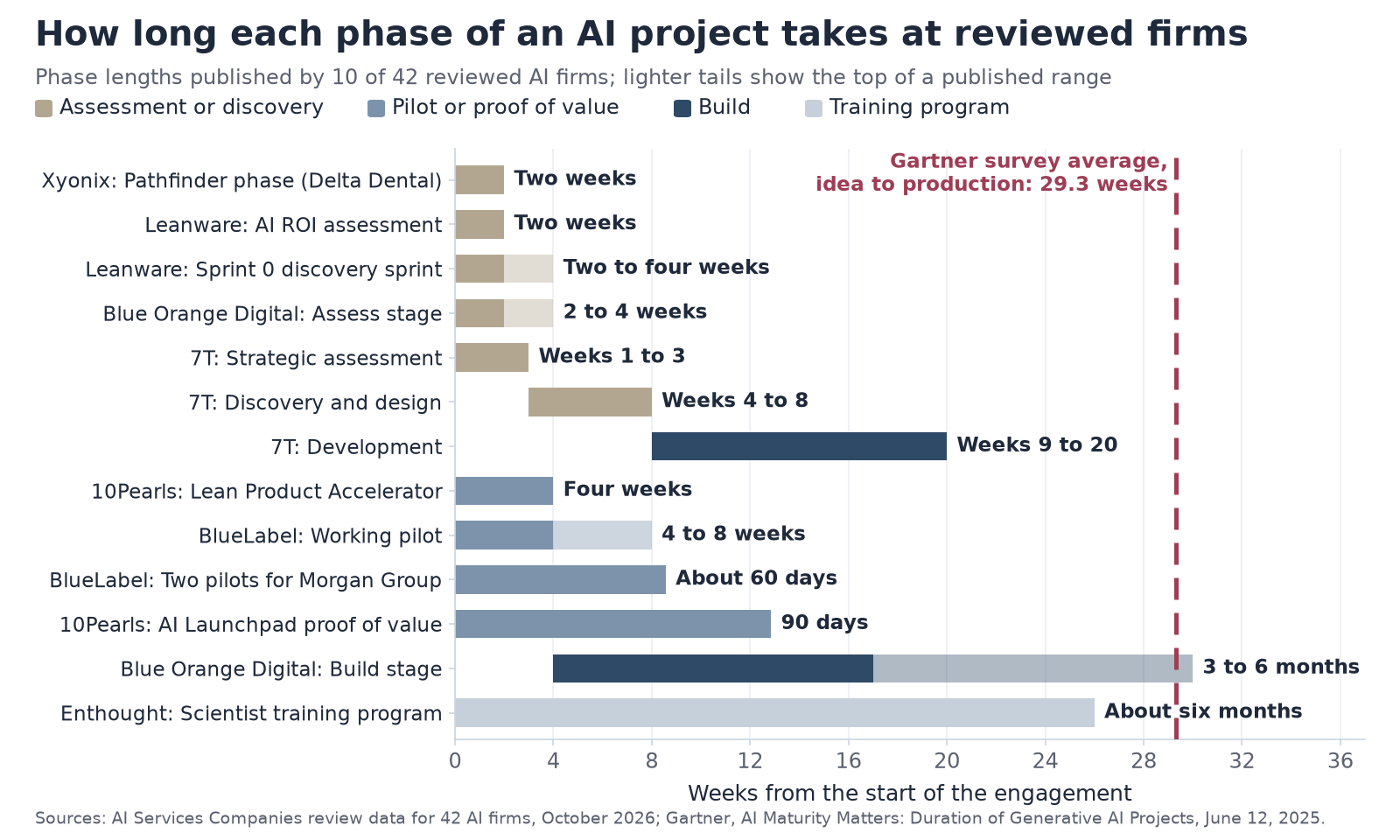
Firms that publish a timeline usually describe it in phases: a short assessment or discovery step, then a pilot or a build. The chart places each published phase on one scale of weeks from the start of an engagement.
| Firm | Headquarters | Phase | Type of phase | Length as published | Weeks |
|---|---|---|---|---|---|
| Xyonix | Seattle, Washington | Pathfinder phase (Delta Dental) | Assessment | Two weeks | 2 |
| Leanware | Bogotá, Colombia | AI ROI assessment | Assessment | Two weeks | 2 |
| Leanware | Bogotá, Colombia | Sprint 0 discovery sprint | Assessment | Two to four weeks | 2 to 4 |
| Blue Orange Digital | New York, New York | Assess stage | Assessment | 2 to 4 weeks | 2 to 4 |
| 7T | Dallas, Texas | Strategic assessment | Assessment | Weeks 1 to 3 | 3 |
| 7T | Dallas, Texas | Discovery and design | Discovery and design | Weeks 4 to 8 | 5 |
| 7T | Dallas, Texas | Development | Build | Weeks 9 to 20 | 12 |
| 10Pearls | Vienna, Virginia | Lean Product Accelerator | Pilot | Four weeks | 4 |
| BlueLabel | New York, New York | Working pilot | Pilot | 4 to 8 weeks | 4 to 8 |
| BlueLabel | New York, New York | Two pilots for Morgan Group | Pilot | About 60 days | about 9 |
| 10Pearls | Vienna, Virginia | AI Launchpad proof of value | Pilot | 90 days | about 13 |
| Blue Orange Digital | New York, New York | Build stage | Build | 3 to 6 months | 13 to 26 |
| Enthought | Austin, Texas | Scientist training program | Training program | About six months | 26 |
- Every published assessment or discovery sprint lasts two to four weeks, from Xyonix's two-week Pathfinder phase to Blue Orange Digital's Assess stage of 2 to 4 weeks.
- 7T, a Dallas firm, publishes the longest lead-in. Its plan runs a three-week assessment and then discovery and design, and development does not start until week 9. Development then runs to week 20.
- Only one published plan reaches Gartner's 29.3-week average for idea to production: Blue Orange Digital's Assess and Build stages, which end at about 30 weeks at the top of their ranges. The firm also says the first workflow goes live by day 100. A buyer can ask each firm to commit to its published phase lengths in the contract.
Assessment, Pilot and Build Lengths Compared
Grouping the 13 published phases by type shows how much of a timeline each step takes. Some groups rest on one or two firms, so the ranges matter more than any single figure.
| Type of phase | Phases published | Firms | Shortest | Longest |
|---|---|---|---|---|
| Assessment or discovery sprint | 5 | Xyonix, Leanware, Blue Orange Digital, 7T | 2 weeks | 4 weeks |
| Discovery and design after an assessment | 1 | 7T | 5 weeks | 5 weeks |
| Pilot or proof of value | 4 | 10Pearls, BlueLabel | 4 weeks | About 13 weeks (90 days) |
| Build | 2 | 7T, Blue Orange Digital | 12 weeks | About 26 weeks (6 months) |
| Training program | 1 | Enthought | About 26 weeks | About 26 weeks |
- Pilots are the most varied step. BlueLabel aims for a working pilot in 4 to 8 weeks, and its client Morgan Group said two Copilot Studio pilots arrived in about 60 days. 10Pearls targets a proof of value in 90 days.
- Only two firms publish the length of a full build phase: 12 weeks of development at 7T and 3 to 6 months at Blue Orange Digital.
- Enthought's six-month program is a different kind of timeline. Client scientists build machine learning tools for their own lab problems with Enthought mentors, so the time also trains the client's staff. A buyer comparing quotes should check whether a firm's timeline includes that kind of handoff or ends at launch.
How Long Client AI Projects Took
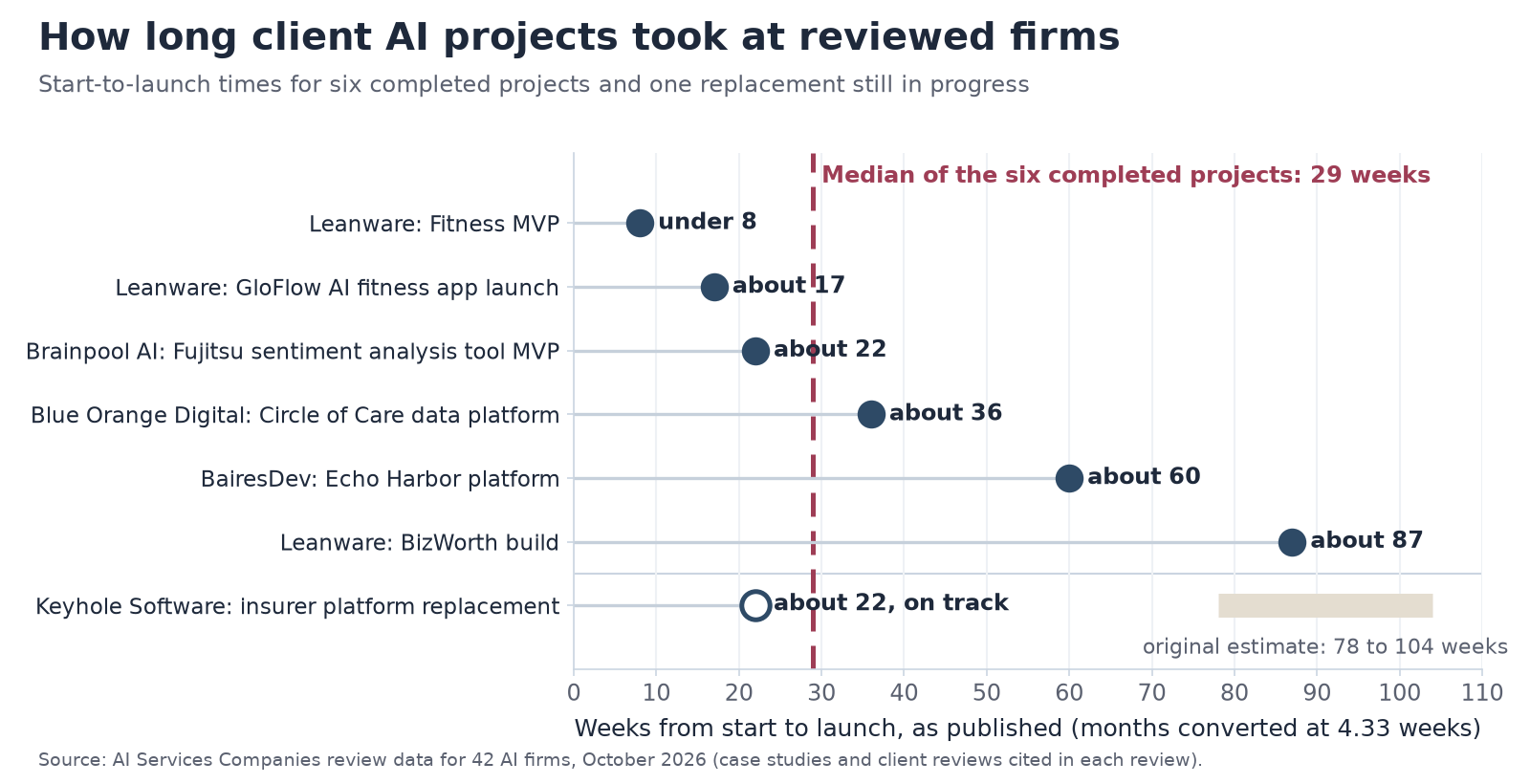
Case studies and client reviews give the length of real projects, not only planned phases. Six completed projects at four reviewed firms come with a start-to-launch time.
| Firm | Client project | Time as published | Weeks |
|---|---|---|---|
| Leanware | Fitness MVP, per a client review | Under eight weeks | Under 8 |
| Leanware | GloFlow AI fitness app, concept to iOS and Android launch | About four months | About 17 |
| Brainpool AI | Fujitsu sentiment analysis tool, scoping to MVP | Five months | About 22 |
| Blue Orange Digital | Circle of Care data platform on Google Cloud | About 36 weeks | About 36 |
| BairesDev | Echo Harbor platform on Anthropic's Claude models | About 30 two-week sprints | About 60 |
| Leanware | BizWorth build | 20 months | About 87 |
| Keyhole Software | Kansas City insurer platform replacement (in progress) | On track for about five months, against an 18 to 24 month estimate | About 22, against 78 to 104 |
- The six projects ran from under 8 weeks for a fitness MVP built by Leanware to about 87 weeks, or 20 months, for its BizWorth build.
- The two longest projects were full platforms. BairesDev built the Echo Harbor platform over about 30 two-week sprints, with a team that grew to 10 to 19 engineers, and Blue Orange Digital's Circle of Care data platform took about 36 weeks.
- Keyhole Software says its replacement of a Kansas City insurer's platform is on track for about five months, against an earlier estimate of 18 to 24 months, using two of its consultants, nine client engineers and AI coding agents. It is not finished, so it is not in the median. If it lands on schedule, it will show how much AI coding tools can shorten a large rebuild.
What Surveys Say About AI Implementation Timelines
Surveys of companies that build or buy AI measure the whole path to production, including time spent inside the company before and after any outside firm is hired.
| Source | Who was surveyed | Finding |
|---|---|---|
| Gartner, AI Maturity Matters: Duration of Generative AI Projects, June 12, 2025 | Respondents to the 2024 Gartner AI Mandates for the Enterprise Survey | Organizations spend 29.3 weeks on average going from idea to production in generative AI projects, including 7.2 weeks of idea vetting |
| Gartner press release, May 7, 2024 | 644 respondents at organizations in the US, Germany and the UK, surveyed in the fourth quarter of 2023 | It takes 8 months on average to go from AI prototype to production, and 48% of AI projects make it into production |
| Google Cloud, ROI of AI study, September 4, 2025 | 3,466 senior leaders of global enterprises in 24 countries | 51% of organizations take an AI application from idea to production within 3 to 6 months, up from 47% in 2024 |
| Google Cloud, ROI of AI study, September 4, 2025 | Same survey | 74% of executives report a return on investment within the first year |
| MIT NANDA, The GenAI Divide: State of AI in Business 2025, July 2025 | Interviews, surveys and analysis of public AI deployments | Top-performing mid-market companies averaged 90 days from pilot to full implementation; enterprises with more than $100 million in revenue took nine months or longer |
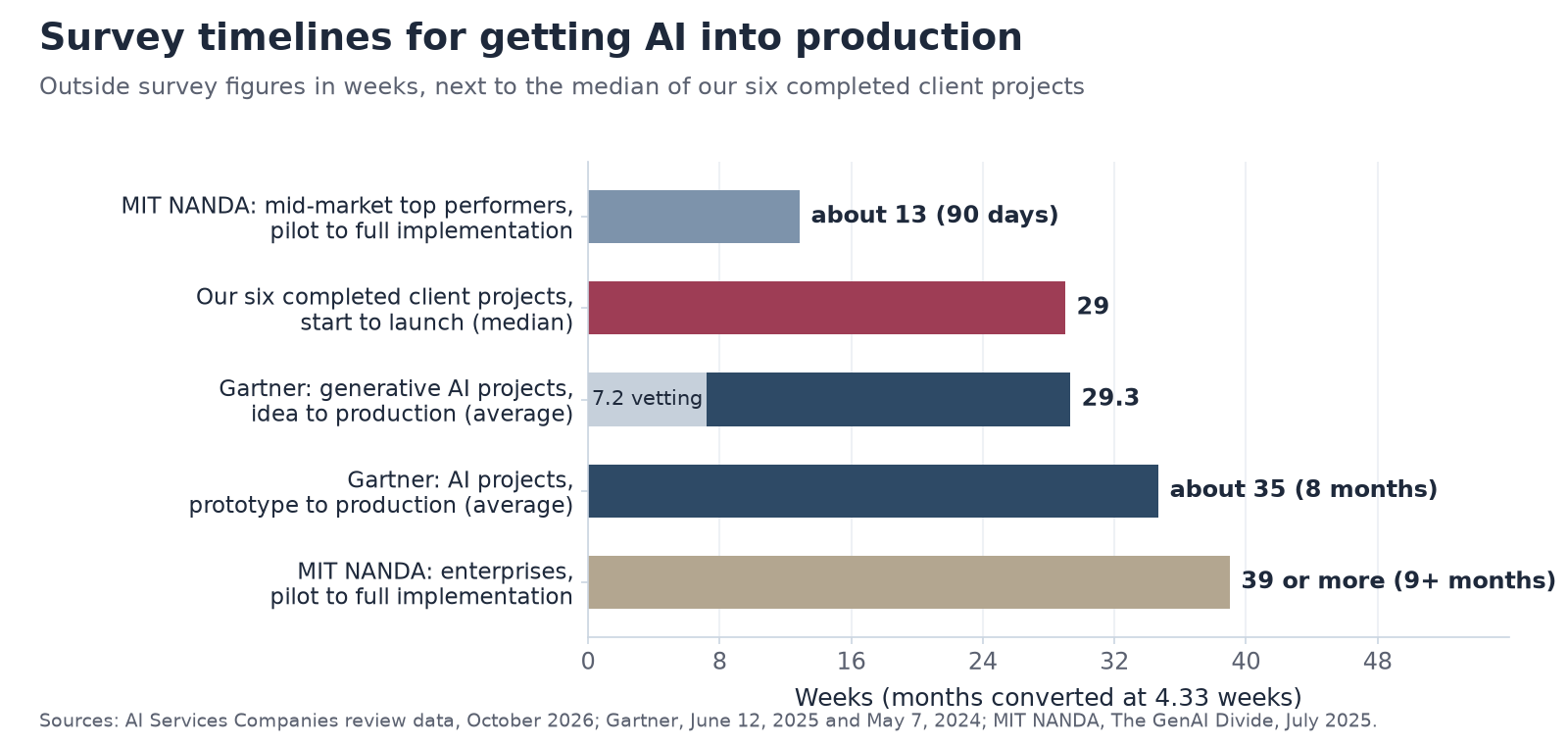
- Gartner found that 7.2 of its 29.3 weeks go to idea vetting, deciding whether an idea is worth building. That is longer than any assessment phase our reviewed firms publish.
- Google Cloud reports that 51% of organizations took an AI application from idea to production within 3 to 6 months in 2025, up from 47% in 2024. Two of our six completed projects, at about 17 and 22 weeks, fall inside that range.
- Speed does not guarantee a project reaches production. Gartner's 2024 survey found that 48% of AI projects make it, and MIT NANDA reports that external partnerships were about twice as likely as internal builds to reach deployment. Firms that publish a short, priced first phase give buyers an early point to stop a project that is not working.
What AI Implementation Timelines Mean for 2027 and Beyond
For a company hiring an outside firm, the first visible result usually comes within a quarter. Assessments take a few weeks and pilots one to three months, while the completed projects we found took a median of about seven months to launch.
The share of companies reaching production within six months rose between Google Cloud's 2024 and 2025 studies, and Keyhole's in-progress rebuild points to AI coding tools shortening some large projects. Most reviewed firms still do not publish a timeline, so a buyer usually has to ask for one.
So if you are planning a first AI project with an outside firm, budget about two to four weeks for an assessment and about 29 weeks to reach production, and ask each firm for a phase plan in writing.
Data Collection and Methodology
The figures depend on what each firm chooses to publish about its process and its past projects.
The study covers the 42 firms reviewed on AI Services Companies as of October 23, 2026. We recorded every phase length and project duration printed in those reviews, which come from the firms' own websites, their published case studies and client reviews. Ten firms publish at least one. Leanware's Sprint 0 length was re-checked on its website on October 23, 2026.
Months are converted to weeks at 52 weeks per 12 months (about 4.33) and days at 7 per week, then rounded to whole weeks. 7T publishes its assessment as weeks 1 to 3 and development as weeks 9 to 20; its discovery and design step is placed in the weeks between them. Blue Orange Digital's Build stage is drawn after the 4-week top of its Assess stage. The fitness MVP took under eight weeks and is counted as 8. The median covers the six completed projects; Keyhole Software's replacement is in progress and is shown separately. With six projects, the median is the average of the two middle values, 22 and 36 weeks.
Outside figures are as published. Gartner's 29.3-week figure comes from the summary of a client-only report; its respondents and the Google Cloud and MIT samples are mostly companies doing the work themselves or with many kinds of vendors, not only the firms we review. Gartner's 8-month and Google Cloud's figures are self-reported by survey respondents.
Sources (6)
- AI Services Companies, AI Implementation Timeline Study: published phase lengths and client project timelines for the 42 AI development, implementation and consulting firms reviewed on aiservicescompanies.com, compiled October 2026.
- Gartner, AI Maturity Matters: Duration of Generative AI Projects, June 12, 2025
- Gartner, Gartner Survey Finds Generative AI Is Now the Most Frequently Deployed AI Solution in Organizations, May 7, 2024
- Google Cloud, ROI of AI study press release, September 4, 2025
- MIT NANDA, The GenAI Divide: State of AI in Business 2025, July 2025
- Leanware, Sprint 0 product discovery service