
AI Vendor Selection Criteria 2026
Published October 29, 2026
Our analysts compared the scores of all 66 AI development and consulting firms we review on the eight criteria we use to judge an AI vendor, from production track record to commercial clarity, to show where firms are strong, where they fall short, and which criteria most separate the higher-rated firms from the rest. Every score comes from a firm review published on this site and checked against the firm’s own materials and outside sources in October 2026.
Key Findings
- Commercial clarity has the lowest average of the eight criteria, at 6.32 out of 10, and 24 of the 66 firms (36%) score below 6.0 on it.
- Technical depth has the highest average, at 7.32, and no firm scores below 6.0 on it or on delivery model and handoff.
- Stability and scale shows the widest gap between firms rated 7.0 or higher and firms rated below 7.0, at 1.54 points, followed by independent evidence at 1.16.
- Commercial clarity is the lowest score, or tied for lowest, for 35 of the 66 firms, more than twice as many as any other criterion.
- Cloud and data platform AI firms have the highest average in six of the eight criteria and the highest average overall score, at 7.3.
Choosing an AI vendor is harder than choosing most software. There is no product to try first, and one firm’s sales materials look much like the next firm’s. Gartner predicts that over 40% of agentic AI projects will be canceled by the end of 2027 because of rising costs, unclear business value, or weak risk controls, and estimates that only about 130 of the thousands of agentic AI vendors are real (Gartner).
We score every firm on the same eight weighted criteria: production track record (20%), technical depth (15%), delivery model and handoff (15%), and industry depth, commercial clarity, platform independence, stability and scale, and independent evidence (10% each). The full rules are on our methodology page. Because every firm is scored the same way, the scores show which criteria the market as a whole meets well and which ones a buyer will most often need to check alone.
In the following sections, we compare average scores by criterion, the criteria that separate higher-rated firms, the criteria that are most often a firm’s strongest and weakest, and how the four categories of firms differ.
Commercial Clarity Is the Weakest Criterion Among 66 Reviewed AI Firms
The simplest view of the market is the average score on each criterion. We also counted the firms that score 7.5 or higher, the level of a clear strength, and the firms that score below 6.0, the level of a clear weakness.
| Criterion | Weight | Average score | Median score | Firms at 7.5 or higher | Firms below 6.0 |
|---|---|---|---|---|---|
| Technical depth | 15% | 7.32 | 7.3 | 29 | 0 |
| Delivery model and handoff | 15% | 7.25 | 7.2 | 26 | 0 |
| Production track record | 20% | 7.20 | 7.2 | 27 | 2 |
| Platform independence | 10% | 7.06 | 7.0 | 20 | 4 |
| Industry depth | 10% | 6.99 | 7.0 | 16 | 2 |
| Stability and scale | 10% | 6.88 | 7.0 | 20 | 10 |
| Independent evidence | 10% | 6.77 | 6.9 | 18 | 12 |
| Commercial clarity | 10% | 6.32 | 6.4 | 8 | 24 |
Source: AI Services Companies analysis of eight-criterion scores for 66 reviewed AI firms, October 2026. Data: average-score-by-criterion.csv
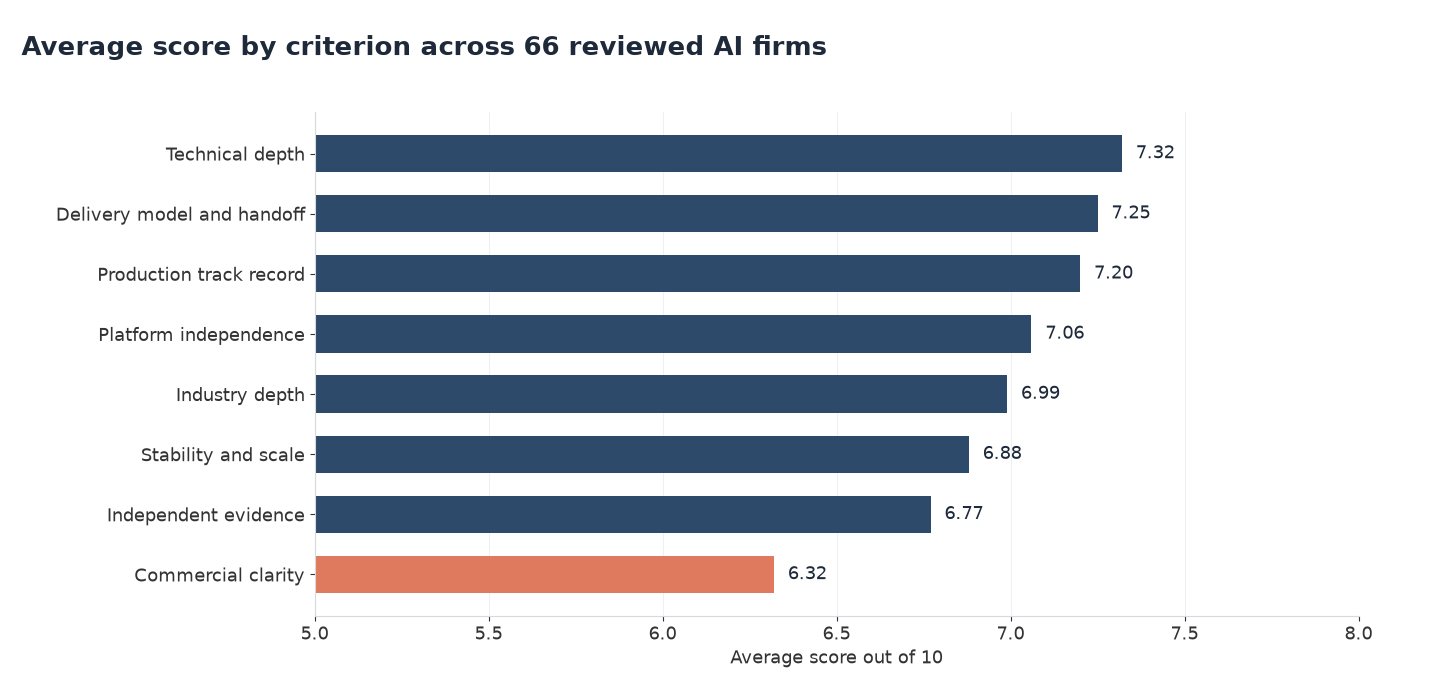
Source: AI Services Companies analysis of eight-criterion scores for 66 reviewed AI firms, October 2026.
Key Findings
- Technical depth is where AI firms are strongest. Its average is 7.32, 29 firms score 7.5 or higher, and none score below 6.0. Most firms can show capable engineers, so technical skill alone does little to tell them apart.
- Commercial clarity trails every other criterion by more than 0.4 points. Only 8 firms score 7.5 or higher, led by 7T at 8.8, Blue Orange Digital at 8.5, and Leanware at 8.4, which publish prices, minimums, or fixed-scope offers.
- Stability and scale and independent evidence have the most firms below 6.0 after commercial clarity, at 10 and 12. These are often young or small firms with few public client reviews, a risk a buyer can reduce with references and a small first project.
Stability and Independent Evidence Separate Higher-Rated AI Firms From the Rest
A buyer comparing two firms wants to know which criteria make the difference. We split the 66 firms into the 43 with an overall score of 7.0 or higher, the level at which we recommend a firm at least for the right fit, and the 23 below 7.0, then compared their average score on each criterion.
| Criterion | Firms rated 7.0 or higher (43) | Firms rated below 7.0 (23) | Gap |
|---|---|---|---|
| Stability and scale | 7.42 | 5.88 | +1.54 |
| Independent evidence | 7.17 | 6.01 | +1.16 |
| Production track record | 7.51 | 6.60 | +0.91 |
| Commercial clarity | 6.60 | 5.80 | +0.80 |
| Industry depth | 7.17 | 6.65 | +0.52 |
| Technical depth | 7.49 | 7.01 | +0.48 |
| Delivery model and handoff | 7.39 | 7.00 | +0.39 |
| Platform independence | 7.17 | 6.85 | +0.32 |
Source: AI Services Companies analysis of eight-criterion scores for 66 reviewed AI firms, October 2026. Data: scores-recommended-vs-conditional.csv
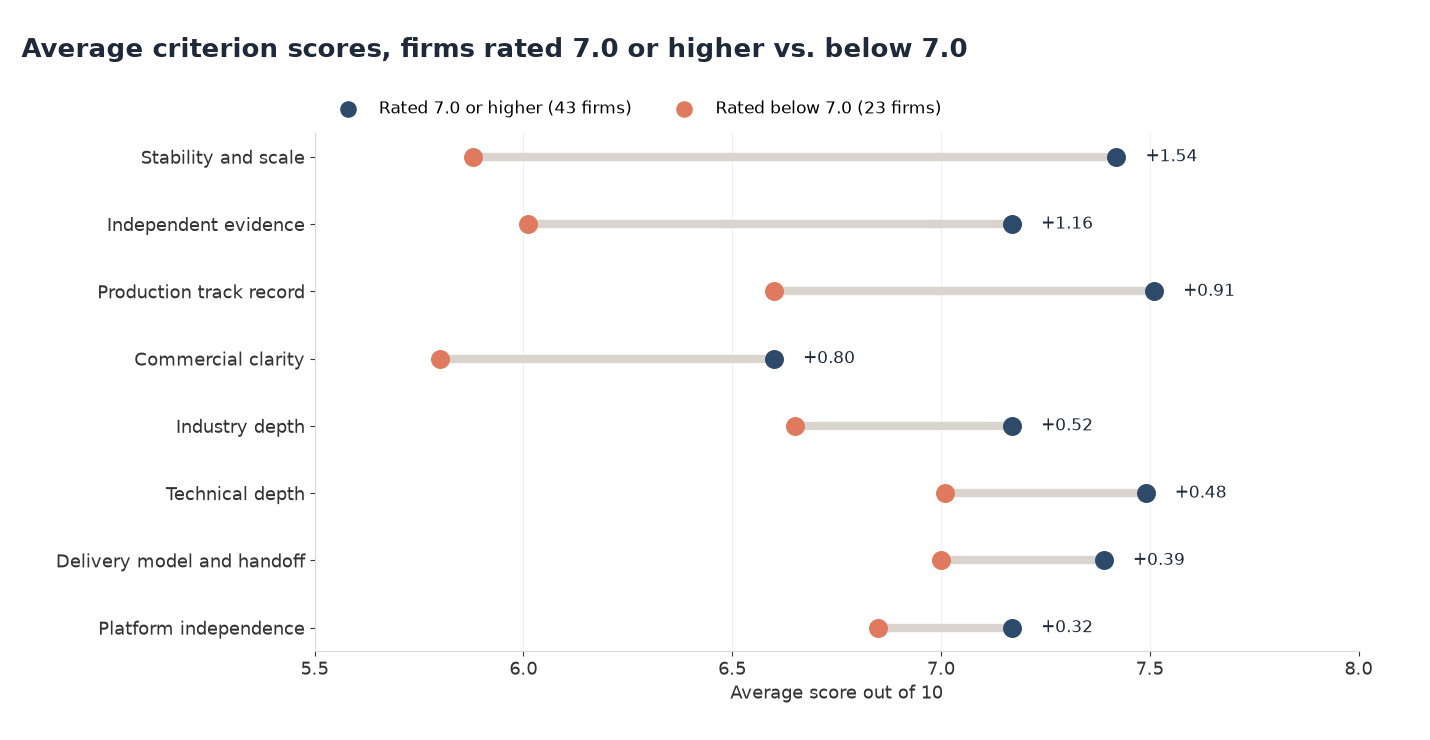
Source: AI Services Companies analysis of eight-criterion scores for 66 reviewed AI firms, October 2026.
Key Findings
- Stability and scale shows the widest gap, at 1.54 points. Firms rated below 7.0 average 5.88 on it, and only one firm below 6.0 on stability, Hang Ten Systems, reaches 7.0 overall.
- Independent evidence and production track record follow, at 1.16 and 0.91 points. Higher-rated firms can point to client references, awards, or outside reviews, and to more systems running in production.
- Technical depth, delivery model, and platform independence differ by half a point or less between the two groups. Firms rated below 7.0 still average 7.0 or higher on technical depth and delivery, so a strong technical pitch says little about overall quality.
Commercial Clarity Is the Lowest Score for 35 of 66 AI Firms
Averages can hide how often a single criterion holds a firm back. For each firm we found the criterion with its highest score and the one with its lowest, counting ties for each criterion they apply to.
| Criterion | Firms where it is the lowest score | Firms where it is the highest score |
|---|---|---|
| Commercial clarity | 35 | 7 |
| Stability and scale | 14 | 12 |
| Independent evidence | 10 | 10 |
| Platform independence | 9 | 16 |
| Industry depth | 9 | 9 |
| Technical depth | 3 | 21 |
| Delivery model and handoff | 1 | 15 |
| Production track record | 0 | 11 |
Source: AI Services Companies analysis of eight-criterion scores for 66 reviewed AI firms, October 2026. Data: strongest-and-weakest-criterion.csv
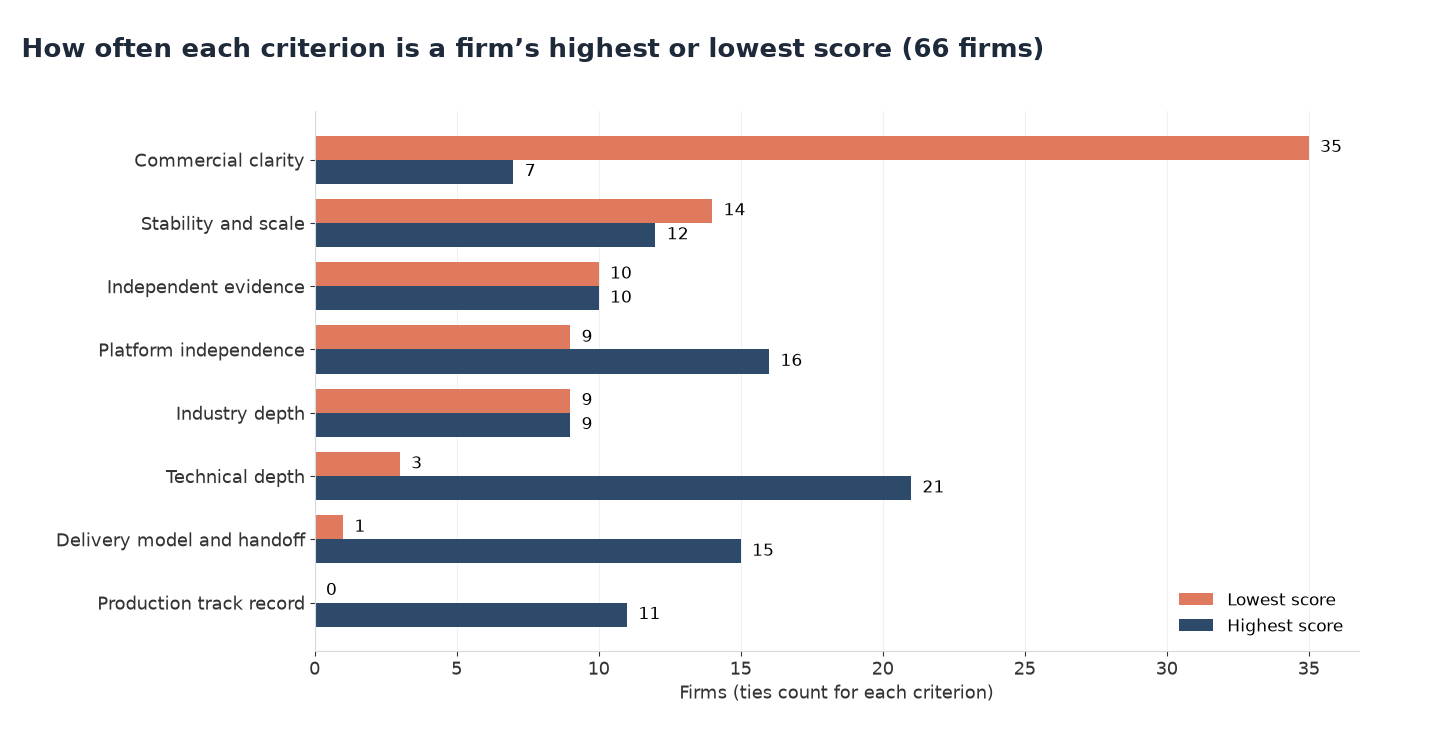
Source: AI Services Companies analysis of eight-criterion scores for 66 reviewed AI firms, October 2026.
Key Findings
- Commercial clarity is the lowest score, or tied for lowest, at 35 of the 66 firms. It is the lowest score even for deepsense.ai and Aimpoint Digital, two of the highest-rated firms, which publish no prices, as our AI consulting pricing models study found.
- Technical depth is the highest score at 21 firms, and platform independence at 16. Platform independence is also the lowest score for 9 firms, often specialists such as Caylent on AWS or SapienAI on Claude, where the focus is the point of hiring them.
- Production track record is never a firm’s lowest score. Each of the 66 firms has at least some production work to show, so the question for a buyer is how much and how similar to the project at hand.
Cloud and Data Platform AI Firms Score Highest on Six of Eight Criteria
Buyers usually compare firms within one kind of work. We averaged each criterion for the four categories we use on this site.
| Category | Firms | Track record | Technical depth | Industry depth | Delivery and handoff | Commercial clarity | Platform independence | Stability and scale | Independent evidence | Overall |
|---|---|---|---|---|---|---|---|---|---|---|
| Cloud and data platform AI | 16 | 7.6 | 7.8 | 7.3 | 7.4 | 6.5 | 6.9 | 7.4 | 7.0 | 7.3 |
| AI application development | 27 | 7.2 | 7.3 | 6.8 | 7.2 | 6.3 | 7.2 | 6.9 | 6.8 | 7.0 |
| Enterprise systems and modernization | 7 | 6.9 | 7.0 | 7.3 | 7.3 | 6.3 | 7.3 | 7.2 | 6.6 | 7.0 |
| Agentic workflow automation | 16 | 6.9 | 7.1 | 6.9 | 7.2 | 6.2 | 6.8 | 6.3 | 6.5 | 6.8 |
Source: AI Services Companies analysis of eight-criterion scores for 66 reviewed AI firms, October 2026. Data: average-score-by-category.csv
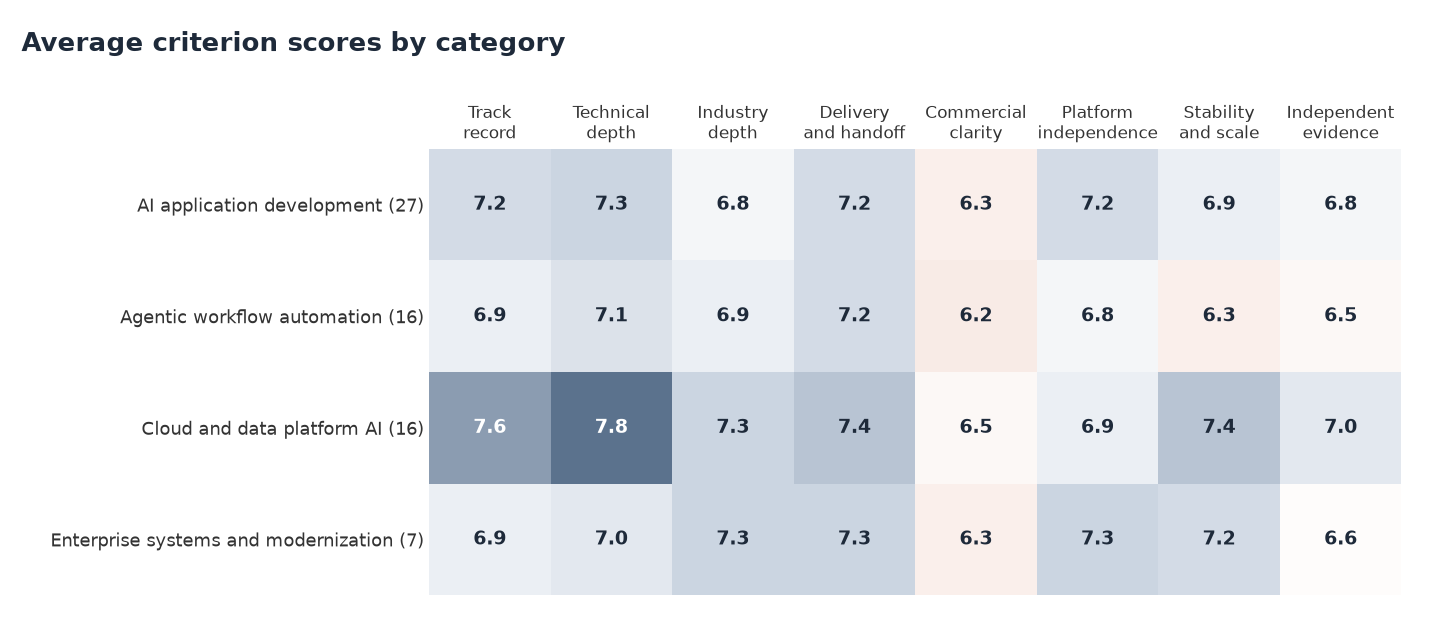
Source: AI Services Companies analysis of eight-criterion scores for 66 reviewed AI firms, October 2026.
Key Findings
- Cloud and data platform AI firms lead on production track record, technical depth, delivery model, commercial clarity, stability and scale, and independent evidence, and have the highest overall average, at 7.3. Many are older consultancies with partner awards, such as Provectus and phData.
- Agentic workflow automation firms have the lowest averages on stability and scale (6.3) and commercial clarity (6.2). The category holds many firms founded since 2023, such as AuxoAI, Parallel Loop, and UNKAPPED.
- Enterprise systems and modernization firms have the highest average on platform independence, at 7.3, and tie with cloud and data platform firms on industry depth. Cloud and data platform firms score 6.9 on platform independence, their second-lowest criterion, because many build on one cloud or data platform.
What AI Vendor Selection Criteria Mean for Buyers
Most AI firms we review can show strong engineers and a sensible way of working, so technical depth and delivery model are rarely what sets one apart. The criteria that separate firms are the ones that take time to build: years in business, a team large enough to absorb turnover, and outside proof such as client references and reviews.
Price is the gap a buyer will meet most often. Commercial clarity is the weakest criterion across the market and the lowest score for more than half of the firms, so a buyer should expect to ask for a rate range, a minimum project size, or a fixed-scope first step before a first call.
So if you are choosing an AI vendor, check stability and independent evidence first, ask early for pricing in writing, and treat a strong technical demo as the starting point of the comparison.
Data Collection and Methodology
The study covers the 66 firms reviewed on AI Services Companies as of October 29, 2026. For each firm we took the eight criterion scores and the overall score shown in its review. Reviews draw on the firm’s own website, its case studies and announcements, outside listings, and press coverage, and are scored under the rules on our methodology page.
Averages are means of the criterion scores, rounded to two decimals in the first two sections and one decimal in the category table. The split at 7.0 follows our verdict labels: firms at 7.0 or higher are recommended at least for the right fit, and firms below 7.0 are conditional. In the third section, a firm whose highest or lowest score is shared by several criteria is counted under each of them.
Scores are our editorial judgments and change as firms change. Where a firm publishes little, such as new firms without client reviews, the score reflects what a buyer can find in public.
Sources (5)
- AI Services Companies analysis of eight-criterion scores for 66 reviewed AI firms, conducted October 2026.
- AI Services Companies, directory of 66 reviewed AI firms and their review pages
- AI Services Companies, scoring methodology
- AI Services Companies, AI Consulting Pricing Models 2026
- Gartner, Gartner Predicts Over 40% of Agentic AI Projects Will Be Canceled by End of 2027 (June 25, 2025)